
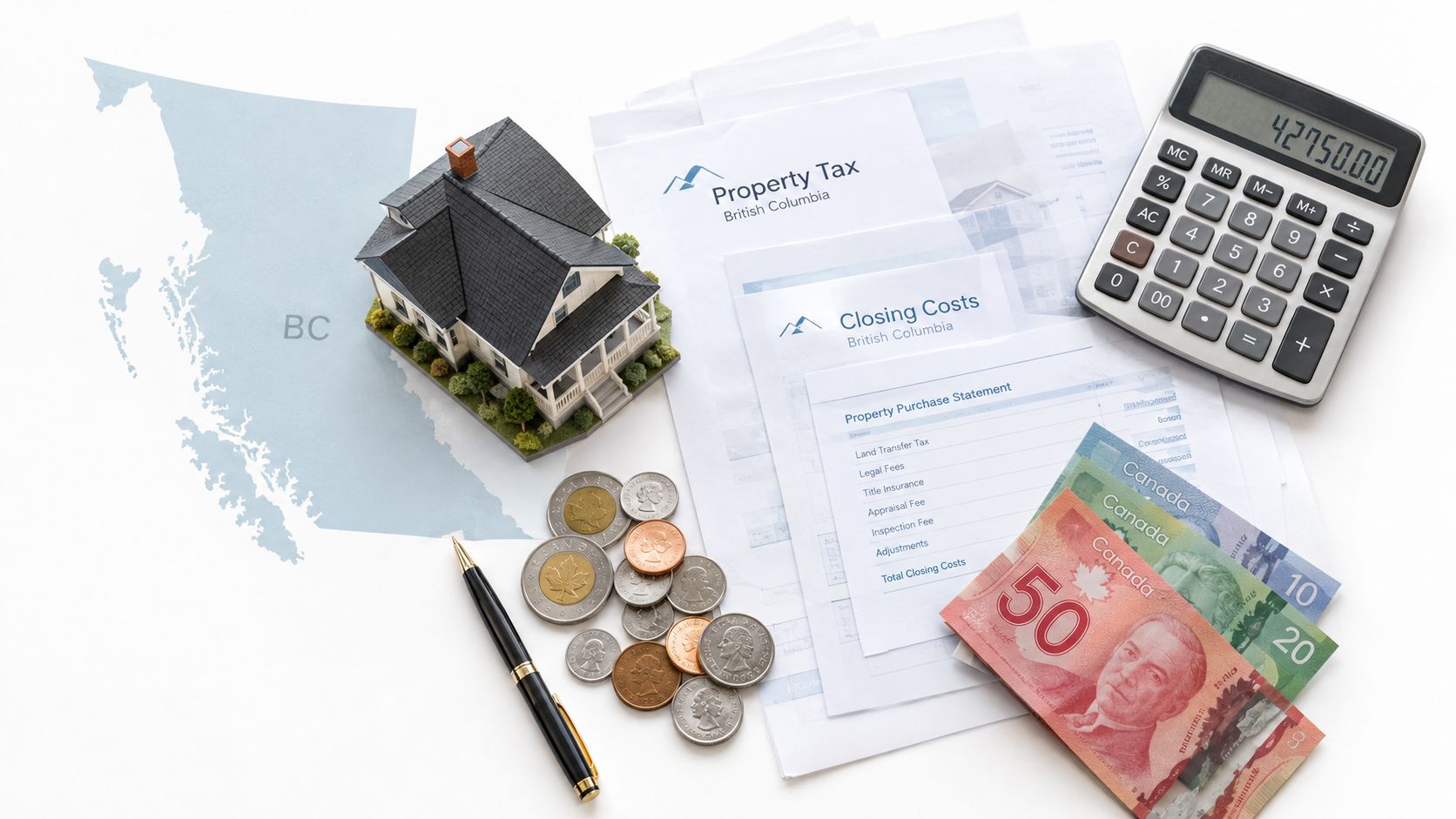
A $600,000 BC purchase triggers about $10,000 in Property Transfer Tax before any exemption. Buyers should plan for roughly 1.5% to 4% of the purchase price in combined closing costs and taxes beyond the down payment.
That is the part many buyers miss when they focus only on the mortgage and the deposit. In Maple Ridge and Pitt Meadows, the completion cheque can look bigger than expected because the lawyer's statement of adjustments pulls together provincial tax, possible GST, title and legal charges, and prorated property costs that the seller has already paid.
Table of Contents
- What a BC Buyer Actually Pays at Completion
- How Property Transfer Tax Is Calculated in BC
- The First-Time Home Buyer Exemption and Its Limits
- New Construction PTT Exemptions and GST on New Homes
- Additional Property Transfer Tax and the Speculation and Vacancy Tax
- Closing Costs Beyond the Taxes
- Building a Realistic Cash-to-Close Budget
What a BC Buyer Actually Pays at Completion
A Maple Ridge buyer sitting down at the completion table for a $750,000 home does not just write one cheque for the balance of the price. The lawyer's statement of adjustments usually groups the money into separate buckets, and that is where the surprises show up. The buyer pays the purchase price balance, then adds tax, legal, and adjustment items that are outside the deposit and mortgage advance.
At a practical level, the completion statement can include Property Transfer Tax, any GST on a new build, possible additional property transfer tax in limited cases, plus prorated municipal or school property taxes, strata fees, utility adjustments, and the legal office's disbursements. A straightforward overview of the closing sequence is useful, and a closing timeline for sales teams can help buyers understand how those closing-day tasks tend to line up, even though the buyer's own legal team handles the actual filing and funds transfer.
Practical rule: the purchase price is never the full cash requirement. The completion cheque is built from price, tax, fees, and adjustments.
A buyer in Pitt Meadows who budgets only for the down payment will feel squeezed if the property is a strata home, because the statement of adjustments can include prepaid monthly charges the seller already covered. A resale home and a new build also behave differently, because a new build can bring GST into the picture while a resale usually does not. That is why the phrase closing costs and taxes when buying a house in BC needs to be taken exactly as written, not as a rough estimate.
For a local buyer, the right mental model is simple. The mortgage covers part of the price, the deposit covers part of the price, and the lawyer's statement decides the rest. This real estate closing process guide is a useful companion if the buyer wants the legal steps laid out in plain language.
How Property Transfer Tax Is Calculated in BC
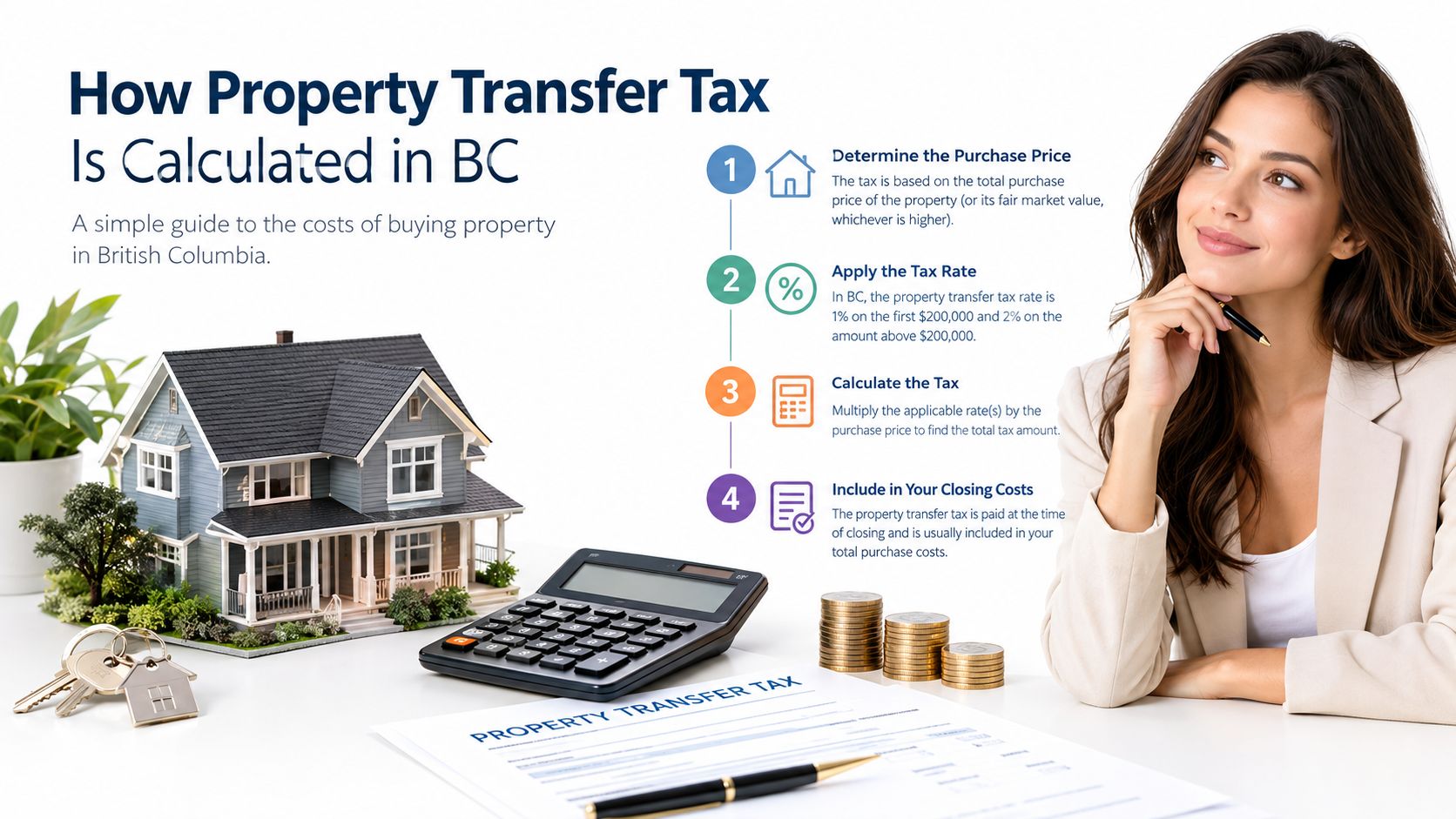
BC's Property Transfer Tax, or PTT, is charged when an interest in land is registered at the Land Title Office. The tax is based on the property's fair market value on the registration date, generally the land plus improvements, so the registered value matters more than a buyer's down payment or the amount of cash in hand. The standard marginal rates are 1% on the first $200,000, 2% on the portion from $200,000 to $2 million, and 3% on the portion above $2 million. Residential property value above $3 million is subject to an additional 2% tax on the residential value above that level. BC property transfer tax calculation examples
Two worked examples buyers can actually use
A $600,000 Maple Ridge or Pitt Meadows purchase produces $10,000 in PTT before exemptions, made up of $2,000 on the first $200,000 and $8,000 on the remaining $400,000. A $1,000,000 purchase produces $18,000, which is $2,000 plus $16,000 on the balance. Those examples are useful because they show how quickly the tax rises once the price moves beyond the first bracket.
A buyer should not treat PTT as a surprise fee. The math is public, the brackets are fixed, and the lawyer normally collects and remits it at closing.
The buyer or the buyer's legal professional must file the PTT return and pay the tax unless an exemption applies. That is why this tax belongs in the completion budget, not in the vague category of “miscellaneous fees.” A buyer who wants a clearer breakdown of the filing side can use this land transfer tax explainer alongside the government calculation page.
What matters most is discipline. If the price is known, the PTT can be estimated before an offer is written. If the property is near an exemption threshold, the estimate should be checked again before subjects are removed.
The First-Time Home Buyer Exemption and Its Limits
The biggest mistake buyers make is assuming first-time buyer status automatically wipes out the tax. It doesn't. BC's First Time Home Buyers' Program is value-sensitive, and the benefit changes sharply as the price moves up. For a qualifying buyer receiving 100% of the transfer, the full exemption applies only when the home's fair market value is $500,000 or less. Between $500,000 and $835,000, the exemption is capped at $8,000. Between $835,000 and $860,000, it phases out proportionally, and homes at or above the upper threshold do not receive the standard exemption. BC first-time home buyers' program
The threshold matters more than the label
That is why a buyer hearing “first-time buyers are exempt” can make a bad budgeting decision. The program is not a universal waiver, and the difference between $600,000, $835,000, and $850,000 can materially change the cheque at closing. A $550,000 property has calculated PTT of $9,000, with an $8,000 exemption and $1,000 payable. A $600,000 property has $10,000 in PTT, again with $8,000 exempt and $2,000 payable. A $700,000 property has $12,000 in PTT, with $8,000 exempt and $4,000 payable. BC first-time home buyers' program
Eligibility also matters. Buyers must meet program requirements tied to principal-residence use, citizenship or residency, and ownership history. Co-purchasers can complicate the file further, because not every buyer on title may qualify for the same level of relief. A written eligibility check before an offer is the sensible move, not a guess made after acceptance. The detailed provincial explanation of these rules is in the first-time home buyer exemption page.
A buyer who is unsure about eligibility should not budget as if the exemption is guaranteed. The conservative number is the safer one.
Brookside's local first-time home buyer programs in BC guide is useful for buyers comparing homes across Maple Ridge and Pitt Meadows, especially when the price sits close to a threshold and the exemption stops being simple.
New Construction PTT Exemptions and GST on New Homes
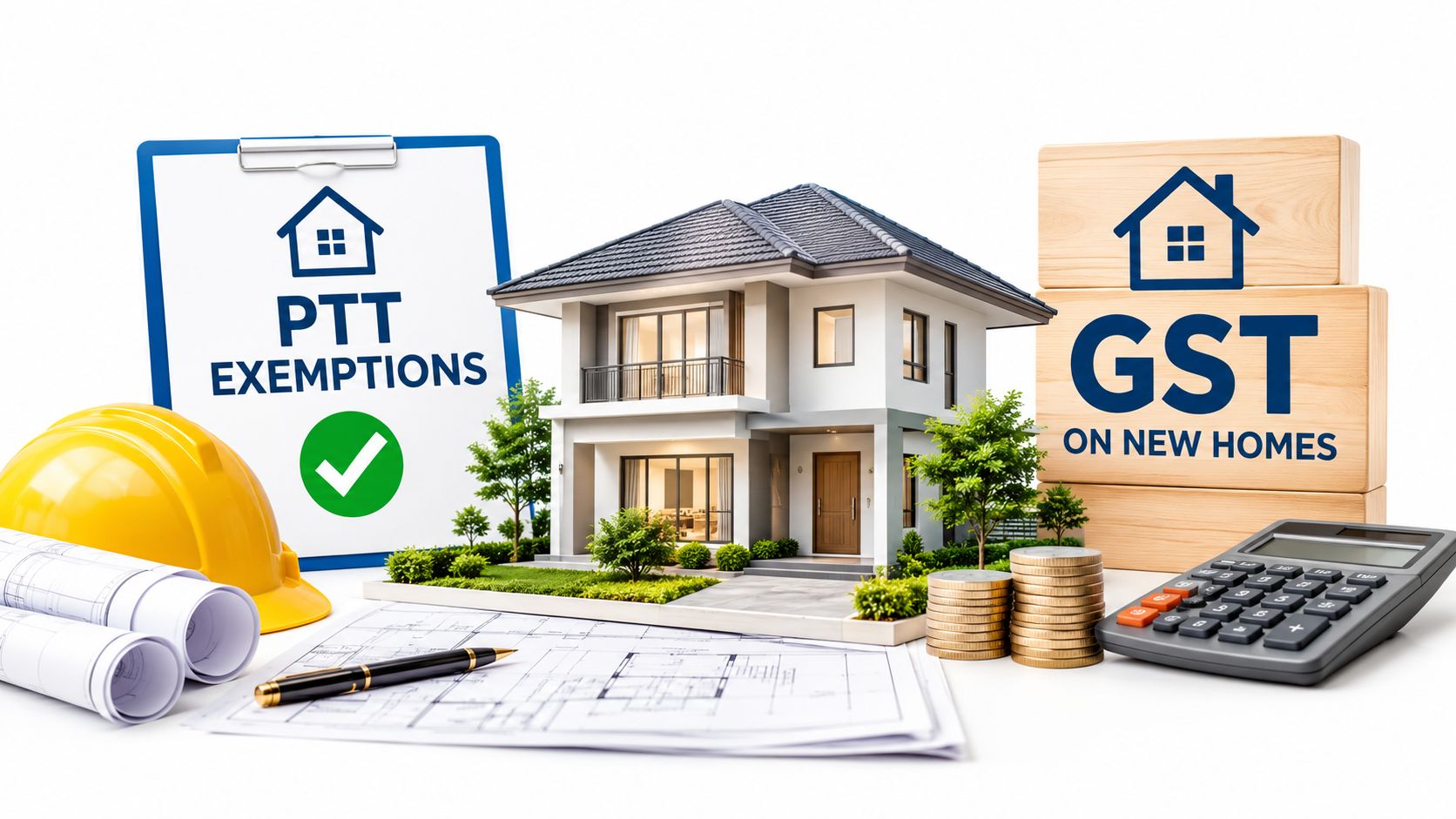
A new home purchase in BC can trigger two different tax systems, and buyers need to keep them separate. PTT is provincial and applies to land transfers. GST is federal and can apply to taxable new homes or builder sales. A buyer may qualify for relief on one tax and still owe the other. In Pitt Meadows and Maple Ridge, where new builds and substantially new homes often price differently from resale homes, that split changes the completion cheque.
On the provincial side, a qualifying newly built principal residence may receive the newly built home PTT exemption. For registrations on or after April 1, 2024, the full exemption applies where fair market value is $1.1 million or less, with a partial exemption available above that threshold under the program rules. The property must generally be in B.C., be the buyer's principal residence, be the first registration with a completed improvement, and be no larger than 0.5 hectares. BC newly built home exemption
GST is separate, and buyers should budget for that difference
The federal new-housing rebate is a different test. The general new-housing rebate is 36% of GST, capped at $6,300, and it phases out between $350,000 and $450,000, with no general rebate at or above $450,000. The federal first-time home-buyers' GST/HST rebate can provide 100% of GST or the federal HST component on qualifying new homes valued up to $1 million, subject to timing, occupancy, and first-time-buyer conditions. CRA new housing rebate
A builder purchase in Pitt Meadows has to be read differently from a resale in Maple Ridge. A buyer can qualify for provincial PTT relief on a new home and still face GST rules that need separate review. Get the completion statement checked before you waive or sign. That is where avoidable surprises show up.
Additional Property Transfer Tax and the Speculation and Vacancy Tax
Some buyers in Maple Ridge and Pitt Meadows face taxes that have nothing to do with being a typical local purchaser. The most important one is BC's additional property transfer tax, which applies at 20% of the fair market value of the buyer's proportionate interest in qualifying residential property in the Fraser Valley Regional District. Because both Maple Ridge and Pitt Meadows sit in that district, ownership structure matters. The buyer's proportionate interest is the percentage registered on title, so the way title is held directly affects the calculation. Limited exemptions exist in some situations, including certain confirmed BC Provincial Nominees and transactions already exempt from regular PTT. BC additional property transfer tax
Annual compliance is not the same as closing tax
The other item buyers often confuse with closing costs is the speculation and vacancy tax declaration. Both Maple Ridge and Pitt Meadows are designated taxable areas, so owners in both municipalities must complete the annual declaration. That is a recurring ownership obligation, not a one-time closing charge, and it belongs in a long-term budget rather than only in the purchase-day file. The provincial overview is laid out on the foreign buyers tax page, which is useful for understanding how the regional rules fit together.
School and municipal property tax adjustments also show up at completion. Those are not new taxes, they are prorated amounts that reconcile what the seller already paid for the year. If the seller prepaid municipal or school property taxes, the buyer may reimburse the unused portion on the statement of adjustments.
Local rule: if the property is in the Fraser Valley Regional District, the title structure and residency status deserve a hard look before subjects come off.
That combination of regional tax and annual declaration is exactly why buyers should not assume every charge belongs in the same bucket. Some items are completion-day taxes, some are annual compliance, and some are just prorated reimbursements between buyer and seller.
Closing Costs Beyond the Taxes
Taxes are the headline item, but non-tax closing costs still add up quickly. Legal fees, disbursements, title insurance, home inspection, appraisal, mortgage setup, and adjustment charges all sit on the buyer's side of the ledger. A careful budget treats these as separate line items, not as a catch-all estimate.
Typical non-tax closing costs a BC buyer should budget for
| Line item | Type | How it's usually calculated |
|---|---|---|
| Legal fees and disbursements | Mandatory | Quoted by the legal office, often a fixed fee plus file expenses |
| Title insurance | Often required | Flat premium tied to the transaction and lender conditions |
| Home inspection | Optional but strongly advised | Inspector fee based on property size and complexity |
| Appraisal | Sometimes required | Charged when the lender requests an independent value check |
| Survey or title search charges | Situational | Depends on title issues, lender requests, or property type |
| Mortgage setup or assignment fees | Lender-dependent | Set by the lender or broker arrangement |
| Strata, tax, and utility adjustments | Mandatory when applicable | Prorated through the completion statement |
A condo and a townhouse at the same price can produce different completion costs because the adjustment line changes with the building's prepaid strata items. That is why the same purchase price does not guarantee the same cash-to-close figure. A buyer should ask for the statement format early, then read it line by line before removing subjects.
For a more practical walk-through of those line items, the closing cost guide for future MLOs is useful background, even though every transaction still needs its own legal review. The key point is simple, mandatory costs are not optional, but some items can be planned around if they are known in advance.
Building a Realistic Cash-to-Close Budget
A buyer in Maple Ridge or Pitt Meadows should budget with a formula, not a guess. The cleanest version is down payment plus PTT, net of any confirmed exemption, plus GST and any rebates, plus legal fees and disbursements, plus inspection, appraisal and title insurance, plus adjustments for prepaid taxes or strata fees, plus a contingency line for insurance changes or lender conditions. That gives a far better picture than staring at the purchase price alone.
What should be confirmed before the offer goes firm
- Exemption status: get a written eligibility assessment for the first-time buyer program before relying on it.
- New-build taxes: separate PTT treatment from GST, because they are not the same charge.
- Title structure: check whether any additional property transfer tax could apply in the Fraser Valley Regional District.
- Completion adjustments: ask how strata fees, municipal taxes, and school tax proration will be handled.
- Annual filing: remember the speculation and vacancy tax declaration if the property is in Maple Ridge or Pitt Meadows.
Budgeting rule: if a cost is time-sensitive, price it from the current transaction paperwork, not from memory or last year's numbers.
A useful companion for buyers trying to organise savings is budgeting tips for first-time buyers, but the purchase file still needs local review. Brookside's own closing costs calculator for BC is another sensible starting point for a rough estimate before a lawyer or lender confirms the final figures.
For buyers comparing homes in Maple Ridge and Pitt Meadows, the discipline is straightforward. Confirm the tax treatment early, budget for the adjustments late, and never assume the down payment is the whole cash requirement. Royal LePage Brookside Realty can help buyers interpret the local purchase context and line up the right next step for the property they're considering.
Royal LePage Brookside Realty works with Maple Ridge and Pitt Meadows buyers who need a local read on taxes, closing adjustments, and the cash needed to complete. For a grounded conversation about your purchase and the numbers that will appear on your completion statement, visit Royal LePage Brookside Realty.