
A lot of buyers in Maple Ridge think the hard part ends when subjects come off. It doesn't. Estate closing process is where the deal either stays organised or starts to wobble.
A familiar local example looks like this: a buyer removes subjects on a Thursday for a Silver Valley townhouse, books movers for the following week, and assumes key pickup happens automatically on closing day. In BC, that's usually not how it works. Completion and possession are two different moving parts, and the buyer also needs closing cash that is separate from the down payment cash.
That distinction matters in Maple Ridge and Pitt Meadows, where many transactions move on tight timelines and buyers, sellers, lenders, notaries, and lawyers all have to hit the same dates. BC closings typically unfold over about two to four weeks from subject removal to key handover, with completion and possession usually separated by one day or two days, according to Alpine Lawyers on the BC real estate closing process.
Table of Contents
How the Real Estate Closing Process Works in BC
On paper, a Maple Ridge deal can look finished once subjects are removed. In practice, the closing period is where timing, money, and paperwork all have to line up properly. I often see buyers focus on the down payment and forget they also need separate closing cash for legal fees, adjustments, and tax. That gap causes more stress than people expect.
In BC, closing works as a sequence, not a single appointment. After subject removal, the file moves through legal preparation, mortgage funding, money transfers, title registration, and then possession. The title has to register through the Land Title Office before the transfer is complete, which is why key handover is often scheduled for a later date instead of the same moment papers are signed.

If you are still placing closing inside the full purchase timeline, this guide to the home buying process in Canada gives the broader context.
The two dates that matter most
Completion date is the legal date. The buyer's lawyer or notary receives lender funds and buyer funds, pays the required amounts, and submits the transfer and mortgage documents for registration.
Possession date is the moving date. That is when the seller gives up access and the buyer gets keys, fobs, remotes, alarm codes, and occupancy.
Those dates are connected, but they do different jobs. In Maple Ridge and Pitt Meadows, plenty of closings run smoothly because everyone respects that difference. Trouble usually starts when movers are booked around completion and nobody has confirmed when possession begins.
A simple rule helps. Plan your life around possession. Treat completion as the legal checkpoint that has to clear first.
How the timeline usually unfolds
Once subjects are removed, the transaction enters a short coordination window. Deposits are delivered, the lender sends instructions, the lawyer or notary prepares documents, and both sides sign. The work happens in parallel, which is why a small delay in one office can affect the whole file.
A typical path looks like this:
- Subjects are removed and the deposit is delivered under the contract terms.
- The buyer's lender sends instructions to the lawyer or notary.
- Buyer and seller sign documents for the transfer, mortgage, and any payout statements.
- Completion takes place when funds are exchanged and registration is submitted and confirmed.
- Possession follows when access items are released and the property is delivered as agreed.
That sequence sounds tidy, but there are real trade-offs. A tighter gap between completion and possession can help a buyer move sooner, but it leaves less room if funding or registration runs late. A bit more time between the two dates can reduce stress, especially for sellers coordinating a move out of a condo or townhouse in Pitt Meadows or a detached home in Silver Valley.
The practical point is simple. Closing cash, legal timing, and key timing are related, but they are not the same thing. Buyers and sellers who treat completion and possession as separate moving parts usually have a much calmer week.
What Buyers and Sellers Do Before Closing Day
A common Maple Ridge closing week looks calm from the outside. Boxes are stacked in Albion, the buyer has booked the movers, and everyone assumes the hard part is done. Then the lender asks for one more document, the lawyer's office is still waiting for insurance confirmation, or the seller realizes the mortgage payout statement is out of date. That is usually where stress starts.
The work before closing day is mostly coordination. Buyers are lining up mortgage funds, legal signing, insurance, and move-in timing. Sellers are clearing mortgage payouts, finishing disclosure items, and making sure the home will be vacant and in the agreed condition on possession. In Maple Ridge and Pitt Meadows, I always separate two things for clients early: closing cash and down payment cash. They overlap, but they are not identical in practice. Buyers often have the down payment plan sorted out and still get caught off guard by the extra cash needed for legal fees, adjustments, and transfer tax.
Buyer tasks that can't wait
Financing comes first because pre-approval does not guarantee final approval, which depends on updated lender verification, the property details, and the lender's final conditions. Brookside's guide to what mortgage pre-approval means helps if you want a plain-English refresher.
From there, buyers should handle the file in this order:
- Send documents to the lawyer or notary early: ID, the accepted contract, lender contact details, and any amendments need to be in the file before signing appointments get tight.
- Arrange insurance effective for possession: Lenders usually want proof of insurance before they release mortgage funds.
- Review property-specific records carefully: For a condo, townhouse, or bare-land strata, that means reading the available strata records with enough time to ask questions. For a detached home, it means confirming title matters and any disclosed issues are understood.
- Move the closing funds before the deadline: Closing funds often include more than the balance of the down payment. Buyers should ask their legal representative for the amount due and send it early enough to clear the trust account.
- Book utilities and service transfers to match possession: Internet, hydro, gas, movers, and elevator bookings for an apartment should line up with the day access is granted.
That last point matters more than buyers expect. Completion is the legal transfer. Possession is the handover. If those dates are separated, the move-in plan should follow possession, not the day the money changes hands.
Seller tasks that often get overlooked
Sellers usually concentrate on packing and cleaning first. The legal and administrative pieces still need attention.
A seller should confirm mortgage payout instructions, sign transfer documents promptly, and make sure any promised records or keys are ready. If there is a known property issue, such as an open permit question, a utility account complication, or missing strata paperwork, it is much easier to address it before the final week than during it. In Pitt Meadows and Maple Ridge, that can be the difference between a routine file and a long afternoon of calls between the legal offices.
Marketing records can matter too. If listing photos used digital editing before the sale, it helps to understand virtual staging compliance for MLS, especially if questions come up later about how the property was presented.
| Task | Buyer | Seller |
|---|---|---|
| Financing | Satisfy final lender conditions and send requested documents quickly | N/A |
| Legal file | Provide ID, signed documents, insurance, and closing funds | Provide signed transfer documents and mortgage payout details |
| Insurance | Put policy in place for possession | Keep coverage active until completion and handover |
| Property records | Review title, disclosures, and strata documents if applicable | Provide complete disclosure material and requested records |
| Utilities and moving | Set up services and movers for the possession date | Cancel or transfer services and be fully moved out on time |
| Closing cash | Budget separately from the down payment and deliver funds early | Confirm net sale proceeds after mortgage payout, legal fees, and adjustments |
| Condition of property | Complete final walk-through if arranged | Leave the property in the condition required by the contract |
The files that close most smoothly are usually the ones where both sides deal with small items early, while there is still time to fix them.
Key Documents That Drive the Closing
Completion in Maple Ridge or Pitt Meadows usually goes off track for one reason. Someone signs papers without fully understanding which document controls the money, which one controls title, and which one controls the handoff of the property.
At the kitchen-table stage, I often tell clients that closing is really two moving parts. One set of documents gets the sale completed and registered. Another set supports possession, adjustments, and the practical handover. If those papers are clear early, the last few days are usually much calmer.
A plain-English review of the real estate contract helps before anyone gets to the final signing stage.
The contract and the adjustments statement
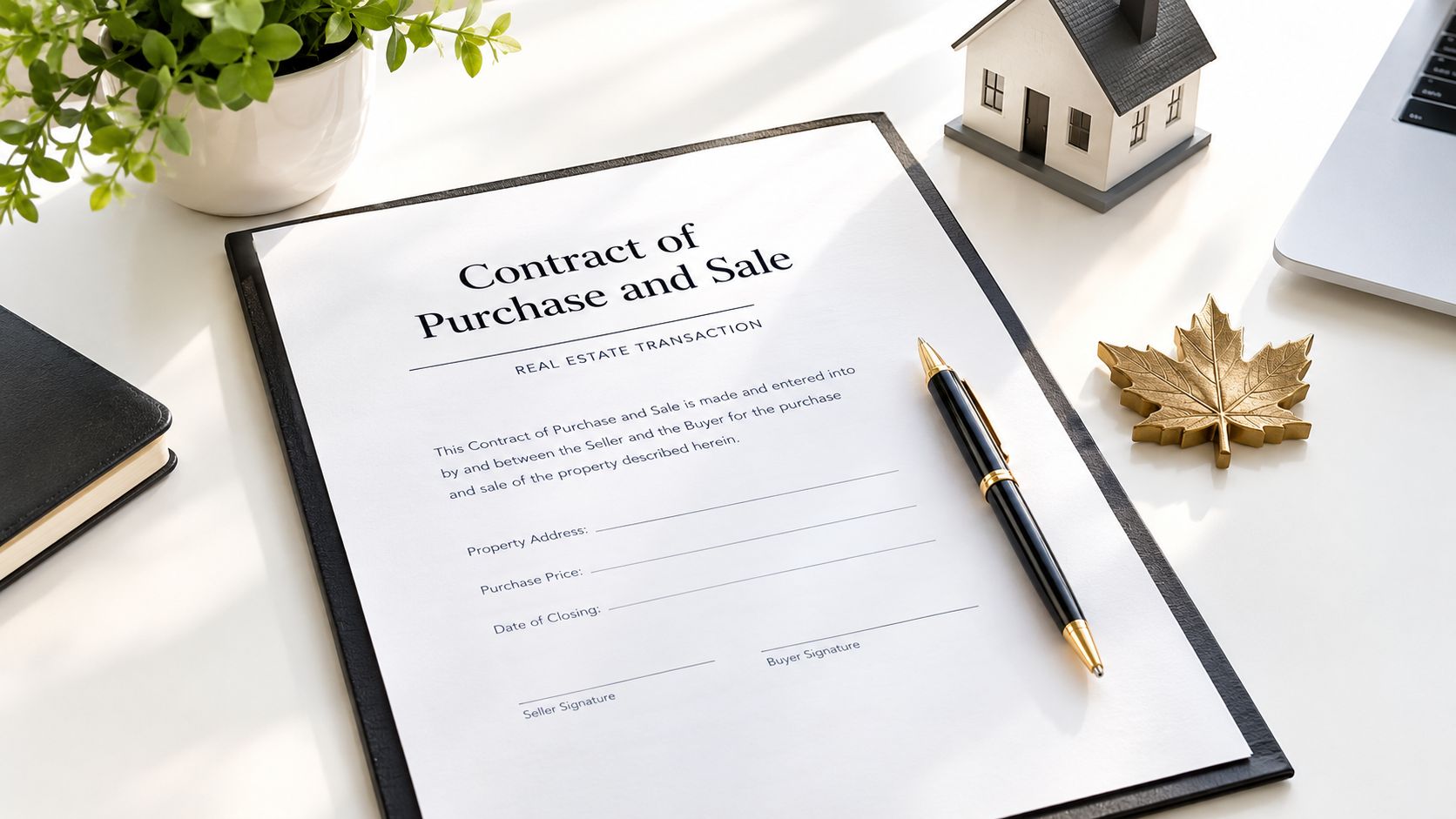
The Contract of Purchase and Sale is the file's instruction sheet. It sets the completion date, possession date, included items, adjustment terms, and any promises that still need to be carried through after subjects are removed.
That timing matters more than many buyers expect. In Maple Ridge and Pitt Meadows, completion and possession are often different dates. The legal transfer can happen first, while keys change hands later. The contract is the first place to confirm that everyone is working toward the same calendar.
The Statement of Adjustments is the money document. Buyers and sellers see the credits and debits worked out in real numbers, including the deposit, mortgage proceeds, property taxes, strata fees, utilities if applicable, and any prepaid or unpaid items that must be adjusted between the parties.
It also helps separate two cash buckets that people regularly blend together. Down payment funds are one part of the buyer's money. Closing funds are another. The adjustments statement is usually where that difference becomes very clear.
Title, strata, and transfer papers
A current title search shows the registered interests attached to the property. That can include mortgages, easements, statutory rights of way, covenants, and other charges that affect use or registration. Some items are routine. Some need follow-up before the legal office is comfortable closing the file.
For strata properties, the supporting records deserve careful reading because they affect both approval and day-to-day ownership. The main documents usually include:
- Form A for ownership and strata fee information
- Form B Information Certificate for current financial and legal details
- Depreciation report for longer-term building planning
- Strata bylaws covering pets, rentals, parking, storage, and alterations
The final legal package usually includes transfer documents for the sale and, for financed buyers, mortgage documents from the lender. Buyers sign to complete the purchase and register financing. Sellers sign to transfer title and allow existing financing to be paid out from sale proceeds.
Another paper worth reading closely is the Statement of Disbursements. It shows where the closing money is going, including registration charges, tax remittances, and legal or notarial fees.
If a document feels vague before signing, that is usually the one to slow down and review line by line.
Closing Costs and Property Transfer Tax in BC
A buyer can feel financially ready because the down payment is sitting in the account, then get a hard surprise a few days before completion when the legal statement arrives. I see that one often in Maple Ridge and Pitt Meadows. Down payment money and closing money need to be budgeted as two separate buckets.
Property Transfer Tax is usually the largest closing cost on the buyer side. In BC, it is paid at the time the transfer is registered, and your lawyer or notary normally collects and remits it with the rest of the closing funds. That timing matters. If every available dollar has gone toward the down payment, there may not be enough cash left to finish the purchase.
How BC Property Transfer Tax is usually calculated
For most residential purchases, the tax is calculated on a tiered basis:
- 1% on the first $200,000
- 2% on the portion from $200,001 to $2,000,000
- 3% on the portion from $2,000,001 to $3,000,000
- 5% on the residential portion above $3,000,000
On a $900,000 purchase, that works out to:
- 1% on the first $200,000 = $2,000
- 2% on the remaining $700,000 = $14,000
Total Property Transfer Tax: $16,000
That number catches buyers off guard because it is due with closing funds, not weeks later.
Some buyers may qualify for relief, including first-time buyer exemptions or partial exemptions, depending on the price and the buyer's eligibility at the time of purchase. There are also separate rules the province has scheduled for certain qualifying purpose-built rental properties in future periods, but those do not apply to a typical Maple Ridge resale home purchase. Your lawyer or notary should confirm what applies to your file before you rely on an exemption.
Property Transfer Tax is only one line item. Buyers should also expect legal or notarial fees, title insurance, adjustment amounts for property taxes or strata fees, and practical moving-related costs that hit around the same time.
| Cost Item | Approximate Amount | Who Pays |
|---|---|---|
| Property Transfer Tax on $900,000 | About $16,000 | Buyer |
| Legal or notary fees | Varies | Buyer |
| Title insurance or survey-related cost | Varies | Buyer |
| Property tax, strata fee, and utility adjustments | Varies | Buyer or seller depending on adjustment |
| Moving, connection, and address-change costs | Varies | Buyer |
| Commission and agreed sale-side transaction costs | Varies | Seller |
For a more local budgeting breakdown, Brookside's guide to closing costs when buying a home in BC is a useful reference.
The practical trade-off is straightforward. A larger down payment can improve financing terms, but draining the account to reach that number can create last-minute pressure when closing cash has to be delivered on time. In this part of BC, I would rather see a buyer plan those funds clearly from the start than scramble during the final week.
Completion Day and Possession Day in Maple Ridge
A Tuesday closing in Maple Ridge often starts. The buyer has already signed. The seller has already signed. Movers are booked. Utility accounts are lined up. Then everyone waits for one thing. Registration.
That's completion day. The buyer's funds and mortgage proceeds have to arrive in the trust account, the seller's mortgage payout has to be accounted for, and the title transfer has to be registered before the deal is legally complete. In BC, the legal completion framework is tied to registration, not key exchange, which is why possession often follows the next day or shortly after.

If the difference between those dates still causes confusion, Brookside's explanation of closing date vs possession date clears it up well.
What happens on completion day
In many local transactions, buyer and seller sign at separate offices. One might sign in Maple Ridge, the other in Port Coquitlam or elsewhere in the Lower Mainland.
The legal representative for the buyer won't register the transfer until final funds are delivered. If money lands late, the schedule shifts. Even a short delay at the Land Title Office can ripple through movers, elevator bookings, child care, and key pickup plans.
What happens in the gap before possession
Practical closing advice matters more than generic checklists.
Buyers usually do a final walk-through shortly before possession to confirm the property matches the contract, agreed fixtures remain in place, and no new damage has appeared. Sellers use the gap to finish move-out, leave remotes and alarm details, and make sure the property is empty unless the contract says otherwise.
On possession day, the handover is physical rather than legal. Keys, fobs, garage remotes, strata move-in information, and service details are released. In Maple Ridge, timing can tighten quickly when movers are trying to cross Lougheed Highway or Dewdney Trunk Road during busy daytime windows, so a slim buffer helps.
The smoothest handovers happen when both sides treat possession as an operations day, not as a paperwork day.
Common Closing Pitfalls and How to Avoid Them
A closing usually goes sideways for ordinary reasons. The buyer thought the down payment was the full cash requirement. The seller assumed mortgage payout numbers from two weeks ago were still fine. Someone waited too long on insurance, strata records, or lender conditions. In Maple Ridge and Pitt Meadows, those are the files that turn a calm week into a rush.
The money mistake is the one I see most often at the kitchen table. Buyers prepare the down payment, then get surprised by the rest of the closing funds. Those are two separate buckets. Deposit and down payment money are only part of the picture. The statement of adjustments, legal fees, lender fees, insurance, and tax items can change what needs to be in the lawyer or notary's trust account before completion.

Problems that show up late
These are the issues that tend to appear near the end, when there is the least room to fix them:
- Mortgage conditions still outstanding: Income documents, appraisal issues, or lender instructions can hold up funding.
- Cash to close calculated too tightly: Buyers may cover the down payment but come up short on adjustments, taxes, or closing fees.
- Old payout figures on the sale side: Sellers sometimes budget from an earlier mortgage statement and forget that interest, penalties, or discharge costs may have changed.
- Missing strata paperwork: In a condo or townhouse sale, delayed documents can slow review, sign-off, or lender approval.
- Insurance placed too late: Properties near river areas, homes with older systems, or unusual construction can take longer to insure.
- Unfinished repair commitments: If the contract says a repair will be done, vague wording or missing receipts can create a dispute right before possession.
Timing pressure makes all of this worse. Completion is a legal and banking event. Possession is the handover day. Those are separate moving parts, and a problem in the first one can upset the second one very quickly.
Fixes that prevent delays
The best prevention steps are plain, but they work.
- Budget closing cash separately from down payment cash: Buyers should ask their lawyer or notary for an updated amount owing as soon as adjustments are available, then keep a buffer.
- Clear lender conditions early: Do not wait for the final week to send documents, confirm employment items, or deal with appraisal questions.
- Order payout statements close to completion: Sellers should confirm fresh mortgage payout figures and ask about any penalty or discharge costs.
- Review strata records before the file gets rushed: Sellers can avoid last-minute document chasing by pulling key records early.
- Arrange insurance well before completion: If underwriting takes longer than expected, there is still time to solve it.
- Write repair terms clearly and keep proof: Receipts, photos, and clear wording prevent arguments during the final walkthrough.
A local, well-managed file helps because someone is watching the handoff points between lender, lawyer or notary, and the other side. Royal LePage Brookside Realty handles that coordination in Maple Ridge and Pitt Meadows transactions, which often matters more than people expect once dates are tight.
Your Closing Day Checklist and Next Steps
The easiest way to manage estate closing process is to stop thinking of it as one big event. It's a string of confirmations. When each small item is checked off on time, completion and possession feel much less dramatic.
For buyers and sellers in Maple Ridge and Pitt Meadows, a simple checklist is often more useful than a long theory lesson.
Possession day checklist
- Completion confirmed: Make sure legal completion has been confirmed before expecting key release.
- Final walk-through done: Buyers should verify condition, included items, and vacancy if required by contract.
- Keys and access collected: Include fobs, mail keys, garage remotes, storage keys, and alarm codes.
- Meters and utility details noted: Keep final readings and account transfer dates organised.
- Mail forwarding arranged: That helps both buyer and seller avoid small but annoying post-move issues.
- Strata notified if applicable: Elevator bookings, move-in rules, and contact updates should be handled promptly.
- Essential services active: Heat, power, water, and internet should align with actual occupancy.
A compact timeline that works
This simple sequence keeps most local files on track:
- Offer accepted
- Subject removal and deposit delivery
- Financing, insurance, and legal instructions
- Document signing with lawyer or notary
- Completion day
- Possession day
- Move-in and post-possession follow-up
For many BC transactions, the time from subject removal to key handover is about two to four weeks, as noted earlier in the article. That's enough time when everyone acts early. It's not much time when someone waits for the last few days.
A steady closing comes from clear dates, enough cash on hand, complete documents, and realistic expectations about the difference between legal completion and actual possession.
Royal LePage Brookside Realty helps buyers and sellers in Maple Ridge and Pitt Meadows stay organised through contract dates, adjustments, document coordination, and possession planning. Anyone who wants practical local guidance from accepted offer through key handover can visit Royal LePage Brookside Realty.