

A landlord in Silver Valley has finally accepted an offer on a duplex. The sale agreement is signed at the kitchen table, the proceeds look reassuring on paper, and the first instinct is to calculate the difference between the purchase price and the sale price. The tax file, however, is only beginning.
For landlords in Maple Ridge and Pitt Meadows, capital gains when selling a rental property in Canada usually involve more than one calculation. The sale may create a capital gain, while previously claimed capital cost allowance can create recapture reported as rental income. A former home, basement suite or owner-occupied unit can add a separate allocation problem. The practical record often matters as much as the eventual sale price. A useful overview of the broader home-sale questions appears in this guide to selling a home and capital gains.
Table of Contents
- When a Maple Ridge Sale Becomes a Tax Story
- What a Capital Gain Actually Is on a Rental Property
- How the Inclusion Rate Shapes What You Owe
- Where CCA Recapture Sneaks Into the Picture
- Principal Residence, Change of Use and Partial Rentals
- Reporting the Sale to CRA Without Surprises
- Smart Timing and Planning Moves Before You List
- Next Steps for Landlords Getting Ready to Sell
When a Maple Ridge Sale Becomes a Tax Story
The money from a completed sale reaches the seller through the closing process, but the tax work continues after the keys change hands. The lawyer or notary provides closing documents, the accountant reviews the property history, and the owner has to support the calculations with records that may stretch back to the original purchase.
A rental property can have several overlapping histories. A Maple Ridge duplex might have started as a family home, gained a basement suite, operated as a full rental during a relocation, and later returned to personal use. Each period can affect how the sale is analysed. A Pitt Meadows owner who remembers only the listing price may overlook the value at the change of use, improvements completed during ownership, or the portion of the building that was rented.
The sale price is only the starting point
The tax result generally separates into two layers:
- Capital gain: The proceeds, adjusted for eligible selling expenses, are compared with the adjusted cost base.
- CCA recapture: If the depreciable building's undepreciated capital cost becomes negative after disposition, the negative amount is treated as recaptured CCA and included as rental income.
- Principal-residence overlap: A property used as a home for part of the ownership period may require a separate calculation for the personal and rental portions.
The Canada Revenue Agency requires a rental-property disposition to be reported on Schedule 3, while recapture is reported through Form T776, Statement of Real Estate Rentals. Those forms don't turn the sale into a single line item. They reflect different parts of the same property history.
Practical rule: A sale file should be assembled before listing, not after closing. The earlier the records are found, the easier it is to identify missing invoices, valuation evidence and CCA schedules.
This isn't a substitute for advice from the accountant down the street. It is a working framework for the questions that should be answered before a landlord commits to a sale price, timing decision or change in use.
What a Capital Gain Actually Is on a Rental Property
A capital gain is generally the proceeds of disposition minus the adjusted cost base and eligible selling expenses. The adjusted cost base isn't limited to the original purchase price. It is built from the property's documented history, including qualifying acquisition costs and capital improvements.
Land and the building should generally be analysed separately. Land isn't depreciable, while the building may belong to a depreciable class for CCA purposes. A landlord who keeps one undifferentiated property number may make the accountant's work harder and weaken the evidence supporting the final allocation.
Building the adjusted cost base
The following table shows the structure of the calculation without inserting an unsupported sale amount or invented property history.
| Line Item | Amount | Running ACB |
|---|---|---|
| Original purchase price | Recorded purchase amount | Purchase amount |
| Eligible acquisition costs | Documented eligible costs | Purchase amount plus eligible costs |
| Capital improvements | Documented qualifying improvements | Prior running ACB plus improvements |
| Adjustments supported by records | Confirmed property-specific adjustments | Final supported ACB |
A new roof, addition or other lasting improvement may need to be distinguished from ordinary repairs and maintenance. The distinction should be reviewed with the accountant, particularly where invoices combine labour, materials and work on both the rental and personal-use portions.
Selling expenses affect the proceeds used in the capital-gain calculation. Legal fees and real-estate commissions connected with the sale are examples of costs that may reduce the proceeds, provided they are eligible and properly documented. The calculation is created from the records, not from a T-slip that tells the owner the final gain.
Why the paperwork carries the calculation
A complete file should contain the purchase agreement, statement of adjustments, invoices for qualifying improvements and the final sale statement. If part of the property was rented, the file should also show the allocation used for that portion. A landlord reviewing general property-tax material from another country can use CGT strategies from EndureGo Tax for terminology and planning prompts, but Canadian tax treatment must be confirmed through Canadian records and professional advice.
The practical Canadian focus is record quality. A folder labelled “renovations” isn't enough if it contains only credit-card statements with no description of the work. An organised file identifies the date, nature of the work, property portion affected and whether the cost was treated as a current expense or capital item.
For a related discussion of the ownership-period deductions that can affect later sale analysis, landlords can review Brookside's guide to rental property tax deductions in Canada. The gain calculation itself still belongs in the accountant's year-end review.
How the Inclusion Rate Shapes What You Owe
The inclusion rate determines how much of a capital gain is added to taxable income. The remaining portion isn't added as a taxable capital gain, but the result still isn't a standalone “capital gains tax” bill. The taxable portion is combined with the owner's other income and assessed under the applicable tax rules.
The verified Canadian rules for a particular filing year should be confirmed before a landlord relies on a rate or threshold. Legislative proposals and administrative guidance can change, and a sale that closes in one year may not be treated in the same way as a transaction in another year.
Read the table as a calculation framework
The requested comparison is best used as a planning template rather than a made-up tax illustration. No unsupported gain, inclusion rate or federal tax amount should be inserted into a Maple Ridge seller's file.
| Scenario | Capital Gain | Taxable Portion | Approx. Federal Tax |
|---|---|---|---|
| Modest gain | Confirmed from proceeds, ACB and selling expenses | Apply the rate in force for the filing year | Accountant calculates using the owner's taxable income |
| Larger gain | Confirmed from proceeds, ACB and selling expenses | Apply the rate in force for the filing year and relevant thresholds | Accountant calculates using the owner's taxable income |
This approach may appear less tidy than a headline example, but it reflects the information that controls the return. The same capital gain can produce a different overall tax result depending on other income, deductions, available losses and the rules in force for the year of disposition.
Don't confuse tax layers
A landlord may also have dealt with other costs during ownership or at closing. Those costs aren't interchangeable with the income-tax calculation on the capital gain. Property transfer tax paid when acquiring a property, for example, isn't the same issue as the income-tax treatment of a later disposition.
A sale can therefore require several conversations:
- The accountant reviews the gain, inclusion rate, CCA history and any change-of-use allocation.
- The closing professional prepares the statement of adjustments and handles the legal transfer.
- The property professional helps establish market positioning, preparation and negotiation.
- The landlord supplies the evidence tying the property history together.
General material such as these Florida real estate tax tips may prompt questions about improvements, but it isn't a Canadian authority and shouldn't replace advice based on the property's Canadian records.
Where CCA Recapture Sneaks Into the Picture
CCA can reduce taxable rental income during ownership, but it doesn't disappear when the building is sold. If the building's disposition proceeds exceed its undepreciated capital cost, the resulting recapture is included as ordinary rental income rather than being treated as a capital gain. That means it isn't reduced by the capital-gains inclusion rate.
The distinction is important at the kitchen table. A landlord may see one overall increase in property value, while the tax return separates the capital gain from the building and land analysis from the recapture created by prior CCA claims.
Two strategies, different tax character
A comparison can be made without inventing a dollar outcome. The critical question is not just how much CCA was claimed, but how that history affects the UCC and the amount included in rental income at disposition.
| Line Item | Aggressive CCA Strategy | Minimal CCA Strategy |
|---|---|---|
| Rental income during ownership | More CCA claimed, subject to eligibility and professional advice | Less CCA claimed |
| UCC at disposition | Lower UCC may increase potential recapture | Higher UCC may reduce potential recapture |
| Sale-year income character | Potentially more income treated as recapture | Potentially less income treated as recapture |
| Capital-gain calculation | Analysed separately | Analysed separately |
| Records required | CCA schedules and supporting rental records | CCA schedules and supporting rental records |
The trade-off is immediate tax relief during the rental years versus a possible ordinary-income inclusion in the sale year. Skipping or limiting CCA isn't automatically the right answer, because the decision depends on the owner's complete tax position and long-term plans. Claiming CCA aggressively without modelling the eventual sale can create a surprise.
Recapture needs its own review
Legal and accounting fees connected with the sale may affect the capital-gain calculation where eligible, but they don't erase CCA recapture. The two components must be kept separate in the working papers.
A Maple Ridge landlord should ask the accountant to review the CCA schedules before the property is listed. Brookside's material on rental property accounting can help an owner organise questions about capital records and CCA history, but the accountant must determine the treatment for the specific property.
CCA is a tax-planning decision during ownership, not just a bookkeeping entry. The sale year is where the long-term trade-off becomes visible.
Principal Residence, Change of Use and Partial Rentals
A former home, basement suite or owner-occupied side of a duplex rarely produces a clean, single-purpose rental calculation. When a property changes from personal use to rental use, or from rental use back to personal use, the owner may need to establish the property's fair market value at the change and separate the gain attributable to each use.
The practical allocation problem is easy to underestimate. A Maple Ridge homeowner may have lived upstairs, rented the basement suite, moved out during a relocation and later sold the entire property. A Pitt Meadows duplex may have one unit occupied by the owner and another rented to a tenant. The tax result depends on the use over time, the portion rented and the evidence supporting each allocation.
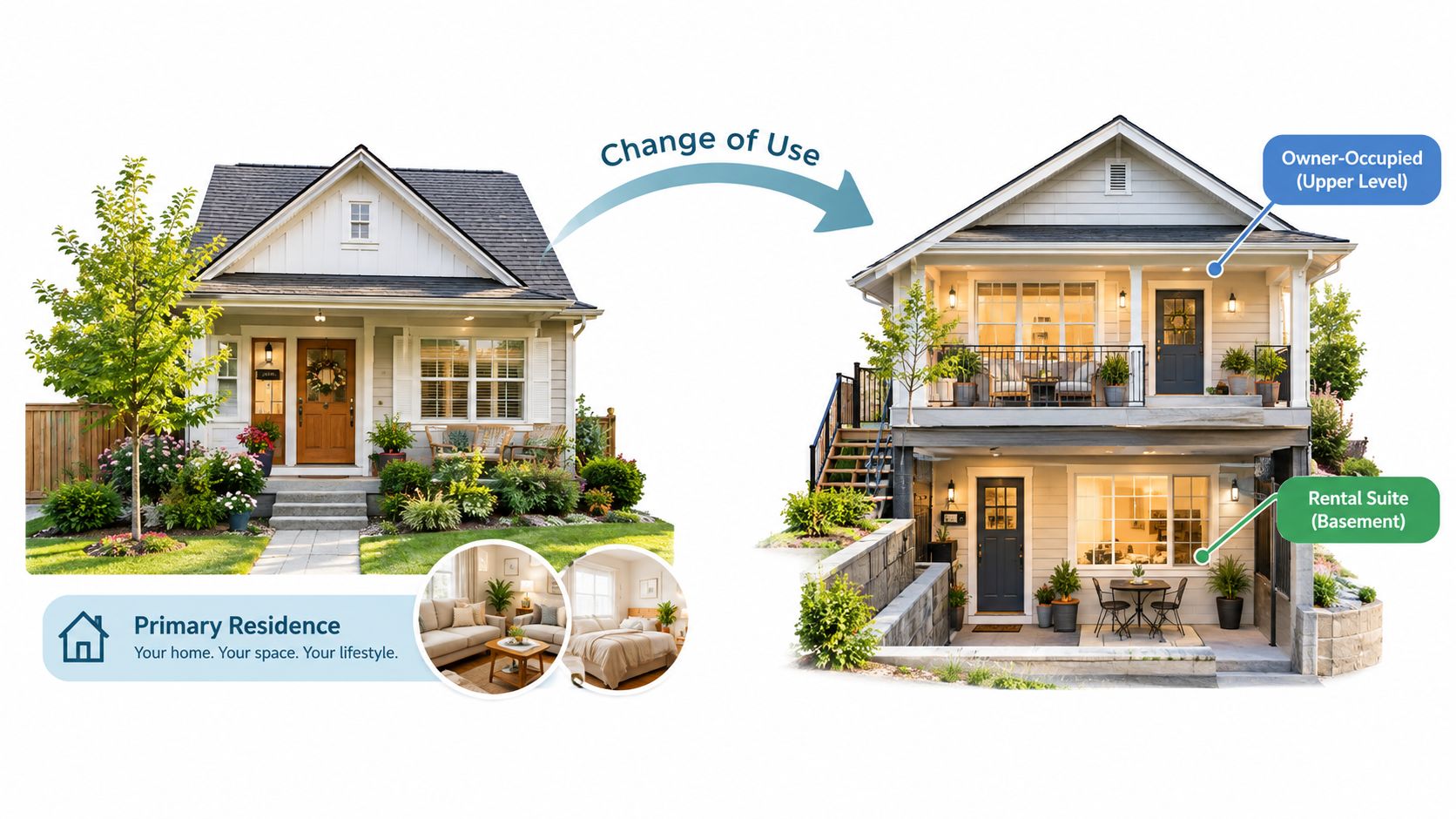
Change-of-use records matter
CRA guidance addresses situations in which a property changes use and confirms that a gain may need to be calculated separately for a rented portion. It also states that a rental property can qualify for principal-residence treatment only under specific conditions. Living in a property for part of the ownership period doesn't automatically shelter the entire gain.
A landlord should preserve evidence created close to the date of the change:
- Valuation evidence: A contemporaneous indication of fair market value when personal use became rental use, or the reverse.
- Occupancy evidence: Photos, insurance records and other documents that show which portion was used personally.
- Address history: Records such as a driver's licence history that help establish where the owner lived.
- Rental evidence: Lease documents and rent rolls that align with the claimed rental dates.
- Improvement records: Invoices that show which portion benefited from each improvement.
The principal-residence designation formula can involve the years designated plus an additional year, divided by the total ownership period, but the correct application depends on the facts and the applicable CRA rules. A property used for both personal and rental purposes needs a professional allocation rather than a casual percentage selected after the sale.
Short ownership periods require care
CRA also states that a qualifying Canadian housing unit held for less than 365 consecutive days is generally treated as producing business income rather than a capital gain, subject to listed life-event exceptions. That rule can matter when a property is sold soon after acquisition, and it shouldn't be assumed that a property labelled “rental” receives capital-gain treatment.
A landlord considering a change-of-use election, a return to personal occupancy or more than one change in designation should consult the accountant before acting. The principal residence exemption guide provides a useful starting point for the questions, but the final result depends on the property's documented history.
Reporting the Sale to CRA Without Surprises
The year-end file should connect the closing documents to the rental records. The lawyer or notary's statement of adjustments establishes the transaction details, while the accountant uses the sale information, ACB records and CCA schedules to prepare the relevant tax forms.
CRA requires the capital gain from a rental-property disposition to be reported on Schedule 3. Any recaptured CCA is reported through Form T776, Statement of Real Estate Rentals, as part of the rental-income calculation. The capital gain and recapture aren't two descriptions of the same amount. They are separate tax components arising from the property sale.
Build the file around the completion
The listing date and the date an offer is accepted don't answer every tax question. The accountant needs the completion details, the final sale statement and the records showing how the property was used. The date and terms recorded in the closing documents should be reconciled with the tax year in which the disposition is reported.
A practical document request includes:
- Purchase records: The agreement, statement of adjustments and eligible acquisition costs.
- Improvement invoices: Receipts that distinguish capital work from routine repairs.
- Rental statements: Income and expense records for the relevant ownership periods.
- CCA schedules: Prior-year calculations, UCC information and any changes in the rental class.
- Change-of-use evidence: Valuations and occupancy records prepared close to the transition.
- Sale costs: Commission, legal fees and other eligible disposition expenses.
- Residence records: Prior designations and documents supporting personal occupancy.
An accountant should also review whether an owner needs to plan for instalments after the sale. The specific timing and amount depend on the owner's broader tax position, so a landlord shouldn't rely on a generic calendar or estimate.
For a general discussion of the tax work that can accompany a disposition, landlords may consult this overview of selling a rental property taxes. Canadian owners still need Canadian advice, particularly where a mixed-use property or CCA recapture is involved.
Smart Timing and Planning Moves Before You List
Tax planning starts before the sign goes up, but the tax decision isn't the same as the marketing decision. A landlord may delay a sale to pursue a higher future price, yet the property continues to carry financing, maintenance, vacancy, insurance and management responsibilities. Waiting can also expose the owner to a different market outcome, so appreciation shouldn't be treated as guaranteed.
Selling sooner may create a cleaner exit and release capital for another purpose. It may also bring the tax event into a year when the owner's other income makes the result less comfortable. The accountant can model those consequences. The real estate professional can assess preparation, pricing and buyer response in the local Maple Ridge or Pitt Meadows market.
Consider the available planning levers
Several topics deserve an early conversation:
- Sale timing: Compare the likely cost of holding with the owner's investment objectives and readiness to sell.
- Capital-gains reserve: Where the transaction qualifies and proceeds are received over time, the reserve rules may allow a gain to be recognised over several years, subject to the applicable requirements. The accountant must confirm whether the structure qualifies and how the reserve works.
- Spousal transfers: A transfer between spouses can create attribution, disposition and other tax issues. It shouldn't be treated as a simple way to move a future gain.
- Trust structures: A trust may have administrative, legal and tax consequences that require specialist advice before any transfer occurs.
- CCA review: The existing CCA position should be modelled alongside the expected sale, not considered in isolation.
A family discussion at the kitchen table often starts with “Should the property be sold this year?” The better question is broader: what are the financial, tax and practical consequences of selling now, holding longer or changing the property's use?

Keep professional roles clear
The accountant handles tax calculations, elections, attribution questions, reserves and trust structures. The Realtor handles market preparation, pricing strategy, buyer positioning and negotiation. A landlord needs both perspectives, but one professional shouldn't be asked to replace the other.
Brookside's discussion of the best time to sell a home in Maple Ridge can help frame the market conversation. It can't predict the owner's tax outcome, and an accountant can't determine the strongest presentation plan without understanding the property and its likely buyers.
Next Steps for Landlords Getting Ready to Sell
A Maple Ridge landlord preparing for a sale should begin with the file, not the sign. Pull the rental statements, CCA schedules, purchase documents and improvement invoices. If the property was ever a home, locate the change-of-use valuation and records that establish when each portion was occupied or rented.
The next step is to book two conversations in parallel. The accountant should review the likely capital gain, CCA recapture, principal-residence overlap and any planning options. A local Realtor should review the property's condition, market positioning, preparation priorities and a realistic pricing strategy for Maple Ridge or Pitt Meadows.
The owner doesn't need a perfect tax calculation before asking for a market opinion. The owner does need enough documentation to avoid making a timing decision based only on the gross sale price. The accountant signs off on the numbers, while the real estate professional helps manage the sale itself.
Royal LePage Brookside Realty provides local listing guidance, valuation, investment discussions and property-management services for landlords in Maple Ridge and Pitt Meadows. Landlords planning a sale can visit Royal LePage Brookside Realty to start the market conversation while their accountant reviews the tax file.