
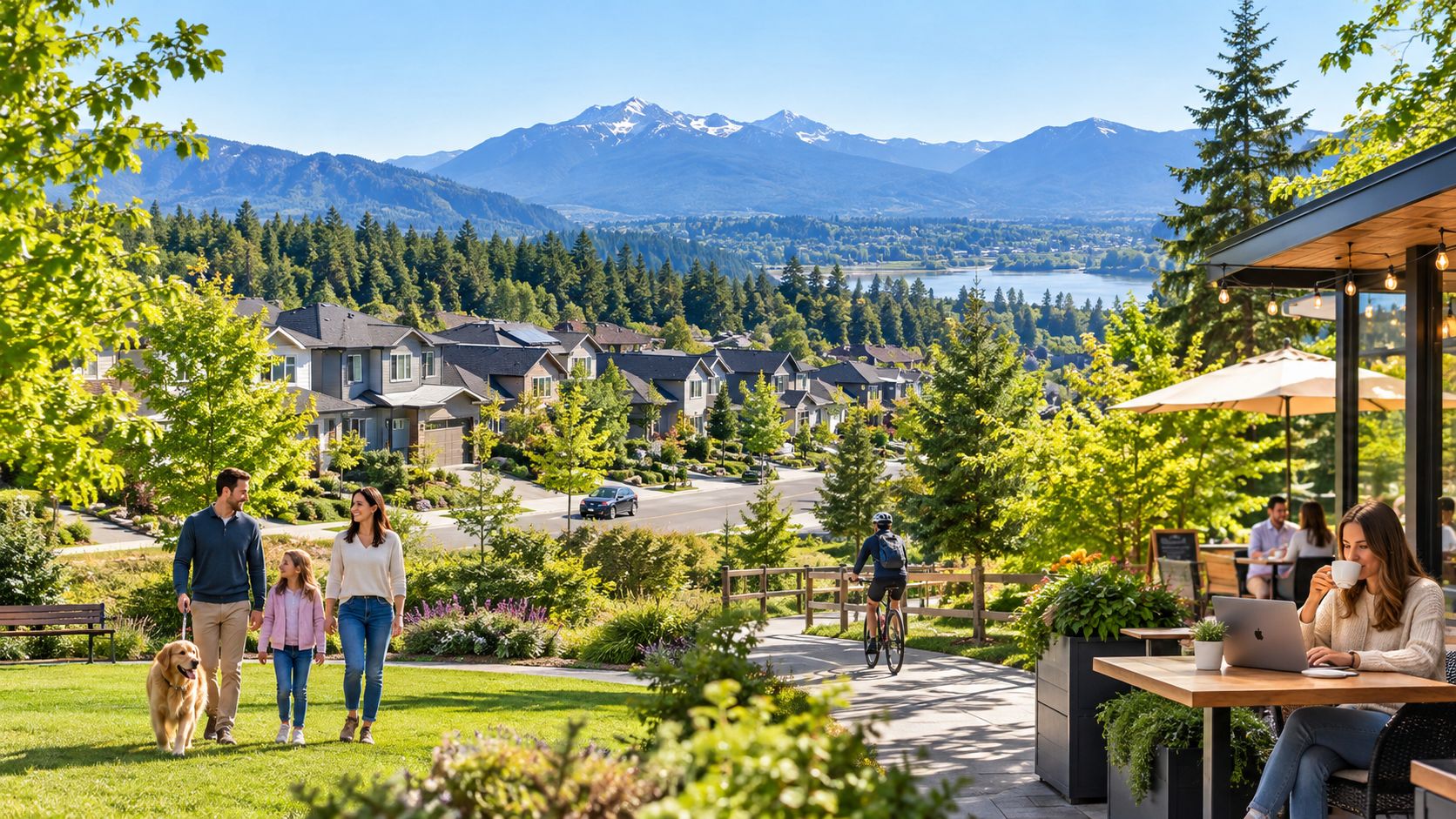
Maple Ridge trades more space and relatively accessible prices for car dependence, a thinner transit network and fewer specialised amenities than inner Metro Vancouver. Whether it suits a household depends on its commute, budget and lifestyle priorities.
Is more room worth a longer drive, fewer rail options and a service pattern that changes sharply from one neighbourhood to the next? That is the central question behind living in Maple Ridge, pros and cons. The city can suit buyers who want suburban space, outdoor access and a high ownership environment. It can frustrate households that need frequent transit, dense amenity access or a short trip to central employment areas.
Each factor below has a clear upside and a clear cost. A larger home may improve daily comfort, but it can add maintenance and commuting expense. A new subdivision may offer modern construction, but roads, schools and shops may still be catching up. A river-adjacent setting may provide scenery and recreation, but it also demands closer review of drainage, insurance and emergency access.
The practical test is simple. Buyers should score each trade-off against their own week, then visit shortlisted streets by car and on foot at different times. Listing photographs and broad city averages can't replace a morning commute, an evening school run or a review of the actual tax bill.
Table of Contents
- 1. Housing Market and Property Availability
- 2. Cost of Living and Property Values
- 3. Commute and Transit Options
- 4. Community Amenities and Services
- 5. Schools and Educational Quality
- 6. Outdoor Recreation and Natural Spaces
- 7. Safety and Crime Rates
- 8. Growth, Development, and Future Change
- Maple Ridge Living: 8-Point Pros & Cons
- Turn the Trade-Offs Into a Decision You Can Test
1. Housing Market and Property Availability
Maple Ridge gives buyers more housing variety than a single suburban product would suggest. Detached houses, townhomes and condominiums appear across established neighbourhoods and newer growth areas. The city recorded 90,990 residents in the 2021 Census, up 10.6% from 2016, and had approximately 33,110 households. Its 79.1% homeownership rate points to a market with a strong owner-occupier base, although that figure doesn't mean every buyer faces easy affordability. Statistics Canada figures and local housing context are summarised here.
The upside is choice. A downsizer can compare a condominium with a townhouse, while a growing family can consider a detached property or a newer home with different maintenance demands. The downside is that supply and condition vary by area. A lower asking price may reflect an older roof, drainage work, a long drive to services or renovation needs that aren't visible during a short showing.
What buyers should test before offering
Buyers should view several properties in the same category before deciding whether a home is fairly positioned. A professional inspection can identify building-envelope concerns, plumbing or electrical issues, moisture, deferred maintenance and likely replacement costs. It also helps separate cosmetic work from a project that could affect financing or possession planning.
Practical rule: Treat the neighbourhood, lot and condition as one purchase decision. A house that looks affordable on paper may not remain so after maintenance, insurance and commuting costs are added.
The city's growth means buyers should also distinguish mature streets from active construction zones. Newer areas may provide modern layouts and future amenities, while established neighbourhoods may offer more settled services and landscaping. The Maple Ridge neighbourhood guide can help buyers frame those comparisons, but the final check should happen at the specific address. Drive the route to work, walk to the nearest useful service and ask what work remains around the property before writing an offer.
2. Cost of Living and Property Values
How much home does Maple Ridge really buy once you add the monthly carrying costs?
Start with the full ownership budget, not the asking price. In Maple Ridge, the annual bill can include municipal taxes, charges collected for other authorities, utilities, insurance, maintenance, commuting and, for some properties, strata fees. That matters because the tax line is not just a city charge. More than 30% of property-tax collections are remitted to other taxing authorities, so buyers should review the actual notice for the address instead of relying on a rough tax estimate. The City explains the components of Maple Ridge property taxes.
The upside is straightforward. Many buyers get more interior space, more lot area or room for a home office than they would closer to Vancouver. The trade-off is that extra space usually brings more ongoing cost. A bigger roof costs more to replace. More yard means more upkeep. A longer drive adds fuel, wear and time.
For 2025, the City reported a 23.5% sewer-rate increase, about $136 more per year for the average residential dwelling unit, plus a 4.5% water-rate increase, roughly $35 more per household. On a working budget, that sewer change alone is about $11 more per month before you add the water increase. Buyers should verify the current utility schedule and the seller's recent bills before they decide a payment is comfortable.
A useful check is to price the property three ways. First, use the mortgage payment. Second, add the annual costs tied to the address. Third, test your lifestyle costs after move-in.
- Property tax: ask for the current notice and confirm which charges apply.
- Utilities: check water, sewer, heating and any recent changes.
- Maintenance: budget for roof, windows, drainage, appliances and landscaping based on age and condition.
- Insurance: confirm both availability and premium before subjects come off.
- Travel: add fuel, vehicle costs and the time your household will spend on the road.
If your goal is a smaller footprint or flexible backyard use, you can find affordable tiny home kits before pricing a full detached purchase.
Renters face a different squeeze. Median monthly rents increased 89% between 2010 and 2023, while vacancy conditions shifted sharply over the same period, according to the Union of BC Municipalities housing profile. That is why a city with many owners can still feel expensive to new renters and first-time buyers.
For a side-by-side household budget view, review the cost of living in Maple Ridge versus Vancouver. The practical test is simple. Run the numbers with every recurring charge included, then drive the routes you will use daily.
3. Commute and Transit Options
Maple Ridge works best for households that can accept a driving-oriented routine or arrange work around regional transit. The Golden Ears Bridge provides an important connection south of the Fraser, but traffic demand is substantial. The bridge carries roughly 67,000 vehicle movements per day, and peak traffic volumes increased by approximately 20% to 35% after tolls were removed in 2017. Lougheed Highway recorded average annual daily traffic of about 71,500 vehicles in the cited municipal profile. The City's opportunity profile provides the bridge and corridor figures.
The advantage is regional reach. A household with a car can connect to employment, shopping and services across the Fraser more directly than a purely local network might allow. The con is variability. A route that feels manageable during an off-peak test can become tiring when repeated for work, school, appointments and errands.
Transit can work, but the exact address matters. The Maple Ridge and Pitt Meadows network is primarily bus-based, with five local routes and one regional connection identified in TransLink's area plan. Haney Place functions as the central exchange, with additional exchanges at Meadow Ridge Plaza, Pitt Meadows and Maple Meadows stations. West Coast Express and TrainBus add commuter options. TransLink's area plan describes the local network and regional connections.
A realistic commute test
A buyer should run the intended journey at the time it will normally happen. Check the walk from the front door to the stop, the transfer points, the return trip and the backup plan when weather or delays intervene. In Pitt Meadows, the Lougheed Highway R3 RapidBus connects with Coquitlam Central SkyTrain station, with service described as every 10 minutes during peak periods and every 15 minutes outside peak periods. The trip from Pitt Meadows to Coquitlam Central is approximately 20 minutes, according to TransLink's plan.
A car-dependent household should price fuel, maintenance and wear. A transit-dependent household should test whether the schedule supports the actual job, not an idealised timetable. The pro is connectivity. The con is that neither is equally convenient from every Maple Ridge street.
4. Community Amenities and Services
Maple Ridge provides the daily services most households use, including shopping, recreation, libraries, parks, healthcare access and restaurants. The practical advantage is a suburban rhythm with room for local errands and family activities. The limitation is distribution. Amenity access can change significantly between a central location and a newer or more peripheral subdivision.
A buyer considering a home near central Maple Ridge may value shorter trips to shops, recreation facilities and civic services. A buyer choosing a growth area may receive a newer home, a larger layout or a quieter edge-of-town setting, but rely more heavily on a vehicle. Those differences affect ordinary tasks, such as groceries after work, children's programmes and appointments for older family members.
Test the week, not the brochure
A useful visit includes more than an open house. Buyers should drive to the nearest grocery store, library, community centre and medical service. They should also visit at the time a household would normally travel. A short Sunday drive can conceal weekday congestion, school traffic or a difficult left turn.
The Maple Ridge neighbourhood guide provides a starting point for comparing areas such as Albion, Silver Valley, Cottonwood, Kanaka Creek and West Maple Ridge. The final decision still belongs at street level.
A neighbourhood can feel close to services on a map and inconvenient in a real school-week routine.
The pro is that Maple Ridge supports a broad range of suburban lifestyles, from central convenience to quieter, more spacious surroundings. The con is that buyers may need to trade one type of convenience for another. More privacy can mean fewer walkable errands. A newer community can mean more construction and fewer finished amenities. Households should list their five most frequent weekly trips, then test each one before making an offer.
5. Schools and Educational Quality
School decisions require address-level precision. Maple Ridge and Pitt Meadows are served by School District 42, which operates elementary, middle and secondary schools across the area. School assignment, programming and travel distance can influence both family routine and future resale appeal. A broad city reputation isn't enough to determine whether a particular home fits a child's needs.
The upside is a local public-school system with multiple neighbourhood contexts and programme choices. The downside is that catchment boundaries can separate nearby streets, and a new development may face changing enrolment pressure as more families arrive. Parents should verify the designated school directly with the district instead of relying on a listing description or informal assumption.
Checks for family buyers
- Confirm the catchment: Review School District 42's current boundary information for the exact address.
- Compare programmes: Check whether the child needs a particular academic, arts, sports or support programme.
- Measure the route: Walk or drive the journey at school-start and school-finish times.
- Visit in person: Assess the building, grounds, communication style and community fit.
- Plan for change: Ask how nearby development could affect enrolment or transportation.
A family choosing between Maple Ridge and Pitt Meadows may find that daily travel, housing type and school logistics point in different directions. The Maple Ridge versus Pitt Meadows comparison for families can help organise the discussion, but it shouldn't replace district confirmation.
The pro is the ability to choose among different neighbourhood settings and housing formats while remaining within the same school district. The con is that the apparently perfect home may not deliver the expected school assignment. Buyers should make the school check a condition of their search, not an afterthought once they have fallen in love with the property.
6. Outdoor Recreation and Natural Spaces
Maple Ridge's natural setting is a genuine lifestyle advantage for households that use it. Parks, trails, rivers and rural-style surroundings create options for walking, cycling, fishing and other outdoor activities. Golden Ears Provincial Park adds a major regional recreation destination, while local trail access can shape whether outdoor time becomes a routine or remains an occasional plan.
The trade-off is that nature access isn't automatically the same as convenience. A home near open space may be farther from shops, schools or transit. Trail-adjacent streets can experience seasonal traffic, parking pressure or construction linked to growth. Buyers who value quiet should visit on a weekend when the recreational area is busy, not only on a calm weekday.
Match the setting to the household
An outdoor-oriented buyer should test the actual route to the trailhead, park or water access. That means checking parking, walking conditions, lighting, winter use and the time required to return home for forgotten equipment. A family with young children may value a nearby play area more than a longer drive to a regional park. A cyclist may care more about route continuity and road conditions than a scenic view from the property.
Climate exposure also changes the practical cost of a natural setting. The City identifies heavier rain and alpine snowmelt as factors affecting river flood pressure, while hotter temperatures and drier summers raise questions about cooling, landscaping water demand, wildfire smoke and emergency preparation. The City's climate-action information outlines these local risks and responses.
Scenic proximity is a benefit only after floodplain mapping, drainage, insurance and evacuation access have been checked.
The pro is daily access to outdoor space and a stronger connection to the natural surroundings. The con is that river-adjacent or rural-feeling locations may require more due diligence and higher running costs. Buyers should ask how the home's basement, drainage, insurance and access would perform over the life of the property, not just how attractive the view looks during a showing.
7. Safety and Crime Rates
Safety is a street-level decision, not a label that can be applied evenly across the city. Property crime, violent crime, traffic conditions, lighting, parking patterns and neighbouring land uses can all affect how a household experiences an area. Buyers should review current police information and then visit the exact street at different times.
The benefit of a direct local check is better context. A busy corridor may create more traffic and noise but provide lighting and regular activity. A quiet edge location may feel private while offering fewer nearby people, services or alternative routes. Neither setting should be treated as automatically safe or unsafe without examining the specific conditions.
Build a grounded visit routine
A practical buyer can:
- Review current police information: Check RCMP reports and available crime data for the area under consideration.
- Visit after dark: Look at lighting, sightlines, parking and pedestrian activity.
- Check traffic behaviour: Observe crossings, turning movements, speeding concerns and school-zone activity.
- Walk the block: Note vacant properties, poorly maintained areas, active construction and access to nearby services.
- Ask focused questions: Speak with residents and community contacts about recurring issues, without treating personal impressions as conclusive evidence.
A home near a major road may have easier access but more traffic incidents and noise. A property on a low-traffic residential street may feel calmer but require more driving for basic errands. The buyer's task is to identify which condition affects the household most.
The con is that broad crime-rate comparisons can create false confidence when neighbourhood patterns differ. The pro is that a careful visit, combined with current official information, can expose practical issues before an offer. Buyers should avoid relying on a single conversation, a daytime viewing or an old online comment.
8. Growth, Development, and Future Change
Growth is one of Maple Ridge's biggest opportunities and one of its clearest sources of uncertainty. The City reported 105,918 residents in 2025, a 14% increase from 2020, and acknowledged pressure on aging infrastructure, roads, schools, policing and essential services. At the same time, Maple Ridge delivered 751 net new homes between July 2024 and June 2025, exceeding its provincial target of 612 by 23%, and advanced 57 infrastructure projects covering water, sewer, drainage, transportation and parks. The City's 2025 annual report provides these current growth and infrastructure figures.
The pro is visible investment. New roads, utilities, parks and housing can improve access and support future services. The con is timing. A new home may sit beside construction, incomplete amenities or a traffic bottleneck for years before the broader plan feels finished.
Choose the type of change deliberately
Established areas usually offer more mature services and a clearer sense of daily conditions. Growth areas such as Silver Valley and Albion may provide newer housing and longer-term transformation, but buyers should inspect construction routes, school capacity, drainage work and planned commercial services. Abernethy Way improvements between 224 and 230 Street are complete, while further expansion toward 240 Street and other transportation projects remain part of longer-term planning, according to the City's report.
Buyers should review the Official Community Plan, zoning maps, development permits and infrastructure plans for the exact address. They should also ask whether a neighbouring parcel could change from open land to housing, a road connection or a commercial use.
Growth test: Don't pay for a future amenity until the plan, funding, timing and access are clear enough to verify.
The trade-off is straightforward. Mature neighbourhoods reduce uncertainty but may have older homes and less room for change. Developing neighbourhoods can offer modern housing and future upside, but they demand patience and careful document review.
Maple Ridge Living: 8-Point Pros & Cons
| Topic | Implementation complexity | Resource requirements | Expected outcomes | Ideal for | Key advantages |
|---|---|---|---|---|---|
| Housing Market and Property Availability | Moderate, requires market research and realtor help | Down payment, inspection costs, time for viewings | Variety of housing; potential appreciation; possible renovation needs | Families, buyers seeking suburban space, investors | Wide property mix; more space per dollar; established neighbourhoods |
| Cost of Living and Property Values | Low, mainly financial planning and comparison | Ongoing mortgage, property taxes, utilities, maintenance | Moderate affordability vs Vancouver; variable long-term appreciation | Cost-conscious families, first-time buyers | More affordable than inner suburbs; larger properties at accessible prices |
| Commute and Transit Options | Moderate, dependent on commute planning and schedule | Vehicle ownership/fuel or limited transit time; parking costs | Longer commutes to Vancouver at peak times; regional transit access | Drivers, hybrid workers, commuters with flexible hours | Direct highway access; regional bus service and West Coast Express option |
| Community Amenities and Services | Low, amenities present; choice of neighbourhood affects access | Local travel (walking or short drives); membership or program fees | Good daily convenience; local recreation and services available | Families, retirees, residents wanting local services | Full-service local amenities; parks, recreation and community programs |
| Schools and Educational Quality | Moderate, requires catchment and program research | Time to visit schools; possible extracurricular or private costs | Good public options with program variety; quality varies by school | Families with school-age children | French immersion and specialized programs; neighborhood school access |
| Outdoor Recreation and Natural Spaces | Low, access depends on neighbourhood and transport | Travel to parks, gear for activities, seasonal planning | High access to trails, rivers, parks; seasonal limitations and occasional crowds | Outdoor enthusiasts, active families | Golden Ears and river access; extensive trail networks and year-round activities |
| Safety and Crime Rates | Low, research RCMP stats and visit neighbourhoods | Time to review reports; optional home security costs | Generally suburban safety with neighborhood variation | Safety-conscious buyers evaluating specific areas | Lower violent crime than urban cores; community policing and neighborhood networks |
| Growth, Development, and Future Change | High, requires tracking OCPs, permits and zoning changes | Time to monitor municipal plans; tolerance for construction impacts | Infrastructure upgrades, new amenities, potential value change and disruption | Investors, buyers open to change, those seeking new amenities | New infrastructure and services; potential for property value appreciation |
Turn the Trade-Offs Into a Decision You Can Test
Maple Ridge suits households that can use its advantages without letting the drawbacks dominate the week. More space matters if the household needs bedrooms, a yard, storage or a quieter setting. It matters less if every adult commutes long distances, depends on frequent rail service or expects a dense selection of specialised amenities outside the home.
The eight factors should be scored against actual priorities:
- Commute: Test the route at the time work and school begin, then price fuel, maintenance and parking.
- Budget: Add tax, utilities, insurance, maintenance and strata costs to the purchase payment.
- Housing: Compare several properties of the same type and inspect condition before judging value.
- Schools: Verify the catchment and programme directly with School District 42.
- Services: Drive the household's regular errands from the proposed address.
- Outdoor life: Visit the parks and trails during the season when the household expects to use them.
- Safety: Walk the street by day and after dark, then review current official information.
- Future change: Check zoning, permits, infrastructure plans and nearby development applications.
A buyer shouldn't treat the city as one uniform market. Central Maple Ridge, established family areas, Silver Valley, Albion, Pitt Meadows and other local settings can produce different outcomes for the same household. A newer property may reduce immediate repair work but increase exposure to construction. A mature property may provide settled services but require a larger maintenance reserve.
The same discipline applies to sellers. A property's value depends on more than broad city conditions. Buyers compare street noise, school access, transit, lot function, building condition, tax costs and future changes. A careful valuation should account for those details rather than relying on a generic comparison.
Landlords also need a property-specific review. Tight rental availability can support demand, but unit type, age, transit access and current vacancy conditions still affect achievable rent. Since the primary-rental vacancy rate was 1.3% in 2023, equivalent to an estimated 21 vacant purpose-built rental units, owners should still assess compliance, operating costs and tenant suitability rather than assume every unit will perform the same way. The Union of BC Municipalities profile provides this rental-market context.
Royal LePage Brookside Realty in downtown Maple Ridge can provide neighbourhood-level guidance for buyers before an offer. Sellers and landlords can also discuss valuation, marketing, residential property management and the practical costs that affect a property's performance. A decision model can be useful when several homes meet the basic criteria, but it should support site visits and document review rather than replace them. A structured decision model for property choices can help organise competing priorities.
The right conclusion isn't that Maple Ridge is universally good or bad. It is that the city rewards households that match location, housing type and routine carefully. A buyer who values space and outdoor access may accept a longer drive. Another household may decide that transit depth and amenity density matter more. The answer becomes clearer after a real commute, a real walk and a complete budget.
Royal LePage Brookside Realty provides local guidance for buying, selling, home valuations and licensed residential property management in Maple Ridge and Pitt Meadows. Visit Royal LePage Brookside Realty to discuss neighbourhood trade-offs, property costs and the next practical step for your household.