

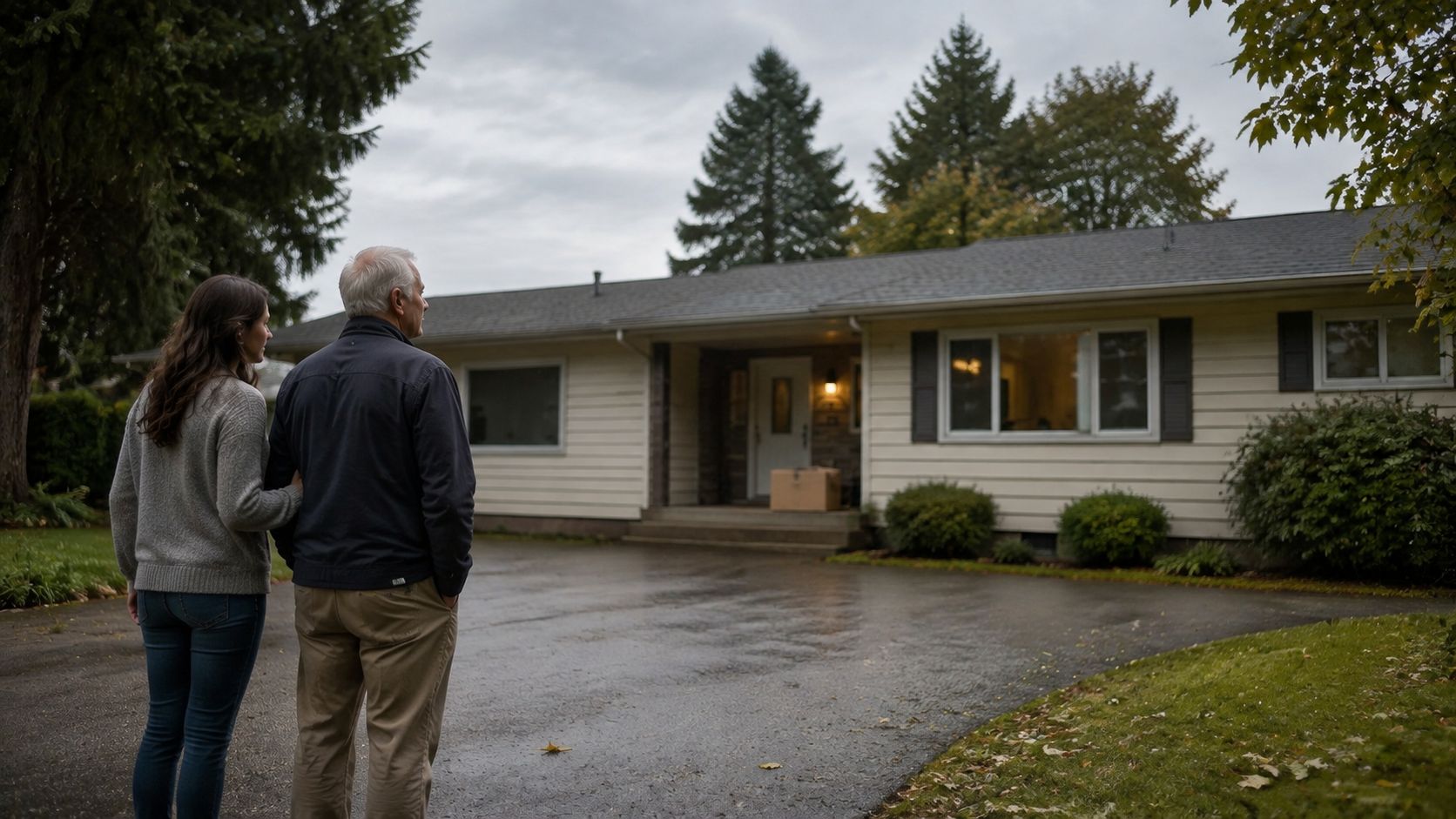
An adult child in Maple Ridge often enters the senior housing conversation after a small warning becomes impossible to ignore. A parent in a long-held Albion or Hammond home may still manage daily life, but the stairs, yard work, winter maintenance, and distance from services are becoming harder. The family then has to make a decision that looks like a care decision, but is also a major residential real estate transaction involving equity, affordability, timing, and the next suitable address.
The Reality of Downsizing in the Fraser Valley
A long-time homeowner may have substantial equity, yet still struggle to find a practical replacement. A ground-level condo, an age-friendly townhouse, a retirement residence suite, or an assisted living unit each carries different costs, rules, and lifestyle trade-offs. Families often assume that selling the detached home will solve the problem, then discover that suitable inventory is limited or that monthly housing and service charges don't fit the parent's income.
That pressure is especially important in British Columbia. The Office of the Seniors Advocate reported that 80% of B.C. seniors owned their homes in the 2016 Census, while 20% were renters. The same report placed median senior income at about $24,000, and found that 35% of senior renters lived on household incomes of $20,000 or less. Those figures show why a move can't be assessed from sale proceeds alone. Affordability after the sale matters just as much as the listing price. The Office of the Seniors Advocate's seniors housing summary provides the broader context.
Staying local or moving closer to care
The strongest argument for staying in Maple Ridge or Pitt Meadows is continuity. Parents may want to remain near friends, familiar shops, churches, parks, doctors, and family members. A smaller home near the Pitt Meadows town core or a low-maintenance condo near services can preserve independence without forcing a move outside the Fraser Valley.
Relocation may make more sense when the current property has stairs, a large yard, or limited access to transit and healthcare. Ridge Meadows Hospital, the Lougheed Highway corridor, Meadowtown Centre, and local community services all influence how workable a property will be after mobility changes. The right choice is rarely the newest building by default. It's the property that supports the parent's daily routine while protecting financial flexibility.
Practical rule: A senior housing purchase should be evaluated like any other real estate transaction, with a careful review of price, location, condition, title, strata documents, monthly obligations, and resale prospects.
Families should also settle estate matters before accepting an offer. If a parent has died and the property is being sold through an estate, the BC probate process guide can help clarify why timing and authority to sell must be addressed early.
The local market contains a broad range of senior housing properties, not one single category. The best plan compares the existing home's equity with the cost and suitability of the next home, then works backwards from health, mobility, income, and family support.
Comparing Independent Living and Assisted Care Options
Senior housing properties in Maple Ridge and Pitt Meadows sit across a continuum. Independent living may offer meals, housekeeping, activities, and maintenance without providing medical care. Assisted living adds support with daily activities, while complex care addresses substantially greater medical and mobility needs.
A parent who is active and socially engaged may prefer an independent apartment or a condo with elevators, accessible entrances, and nearby services. Another parent may need staff support, medication assistance, or a setting designed for complex care. Treating both options as interchangeable creates poor financial and lifestyle decisions.
| Housing Type | Care Level | Typical Monthly Cost (Fraser Valley) | Ownership Model | Best Suited For |
|---|---|---|---|---|
| Age-friendly condo or townhouse | No regular care included | Varies by property and services | Usually ownership, sometimes rental | Independent seniors who want lower maintenance |
| Independent living community | Hospitality and lifestyle services, limited personal support | Varies by residence and service package | Usually rental, with some specialized arrangements | Active seniors seeking meals, activities, and simplified living |
| Retirement residence | Hospitality with optional support | Varies by accommodation and services | Usually rental | Seniors who want a social setting and a gradual support pathway |
| Assisted living | Housing, hospitality, and assisted living services | Varies by provider and care needs | Usually rental or service agreement | Residents requiring help with daily activities |
| Memory care or complex care | Substantial supervision or medical support | Varies by care level and funding arrangement | Generally service-based rather than conventional ownership | Residents whose needs exceed independent living |
The table intentionally avoids invented price ranges. Operators set charges according to suite size, meals, services, care requirements, and funding arrangements. A family should request a full fee schedule, including additional charges, rather than relying on a headline monthly rate.
Maple Ridge offers a useful local example. Fraser Health lists Maple Ridge Seniors Village at 22141 119 Avenue as providing Independent Living, Assisted Living, and Complex Care, demonstrating that the local choice isn't limited to either a private condo or institutional care. Fraser Health's Maple Ridge Seniors Village listing is a practical starting point for understanding the local continuum.
Ownership changes the financial strategy
An owned condo allows sale proceeds to be used toward the next purchase, subject to financing and tax advice. A rental or assisted living arrangement may preserve capital but create an ongoing monthly obligation. Families should compare the parent's net sale proceeds, income, care costs, strata fees, property taxes, and moving expenses before deciding that ownership is automatically better.
Independent living also isn't a substitute for healthcare. Families should ask exactly what staff provide, what happens after a health change, and whether a resident must move if care needs increase. For home modifications in a private residence, practical guidance on senior renovations and aging in place can help families assess whether adapting the current home is more sensible than moving immediately.
Understanding the Provincial Supply Gap
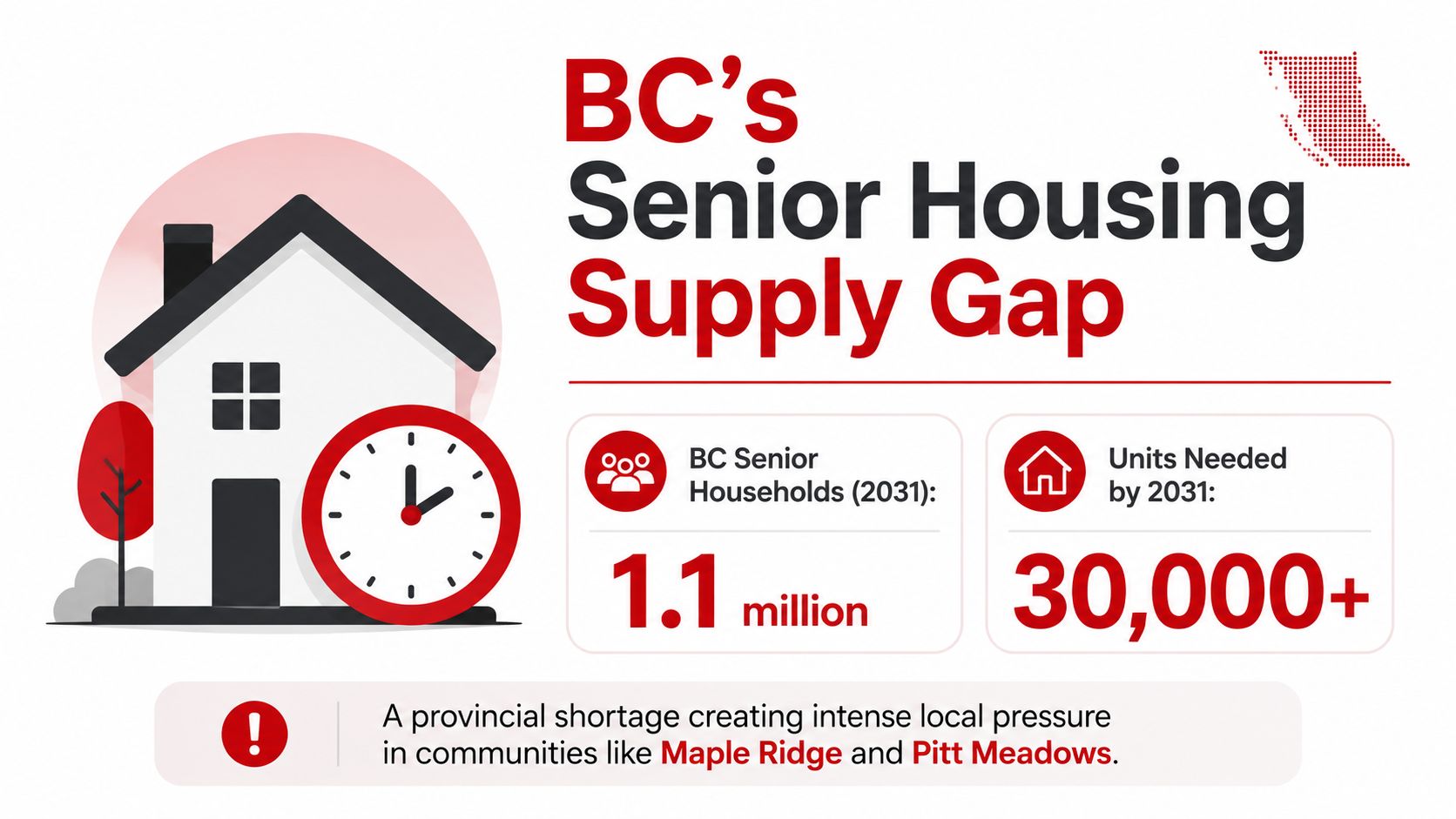
British Columbia's senior housing challenge is a supply problem, not a lifestyle issue. The BC Seniors Advocate reported that the rate of publicly subsidized long-term care beds per 1,000 seniors aged 75 and older fell 16% over six years, while the waitlist reached 7,029 people in 2025. The same report said the waitlist was 9% higher than the prior year and nearly 200% higher than in 2019/20. The 2025 monitoring report makes the capacity issue difficult to dismiss.
The report also found that subsidized seniors housing units per 1,000 people aged 55 and older declined 5% over six years, and that only 7% of approved applicants received a unit in 2024/25. The practical consequence is clear. Families shouldn't wait until a parent has an urgent care need before investigating housing options.
What the shortage means locally
Maple Ridge and Pitt Meadows aren't isolated from the provincial supply problem. A limited choice of accessible condos, purpose-built residences, and subsidized units can force families to consider properties before they feel fully ready. It can also make the location of existing senior housing properties more valuable, particularly where residents can remain near family, healthcare, transit, and daily services.
The province has a substantial non-market sector. A BC housing summary reported 407 housing societies operating 682 buildings and providing 31,112 seniors' housing units, with 71% concentrated in the Vancouver and Victoria census metropolitan areas. It also reported 16,609 independent living suites and 7,194 heavy care spaces as of February 2014. These figures are historical, but they show the scale and complexity of the system, as well as the concentration of supply outside smaller communities. The BC seniors housing report explains that mixed structure.
For downsizers, fewer suitable listings can mean compromising on neighbourhood, layout, or timing. Adult children may need to join waitlists while the parent remains in an unsuitable home. Investors should see demand fundamentals, but they shouldn't assume every senior-oriented property will perform the same way. Product type, affordability, accessibility, care level, and operating model all affect absorption.
Early planning gives families choices. A crisis removes them.
Maple Ridge has a concrete response underway. The Province announced 98 affordable rental homes for seniors at 22534, 22548, and 22556 Royal Crescent, with one- and two-bedroom homes for low- to moderate-income seniors who can live independently. The project is being delivered with New Vista Society, supported by $16.1 million from BC Housing through the Community Housing Fund and $34.9 million in construction financing, and is expected to be ready in 2027. The provincial Royal Crescent announcement is directly relevant to local planning.
Families tracking timing, inventory, and neighbourhood activity can also use Maple Ridge real estate market reports alongside provider waitlists and application requirements.
Navigating BC Tenancy and Care Regulations
A senior housing property may look like a conventional apartment, but the legal framework can be completely different. Standard residential tenancies generally fall under the Residential Tenancy Act, while assisted living residences are governed by the Community Care and Assisted Living Act and the Assisted Living Regulation.
BC policy states that assisted living applies to premises providing housing, hospitality services, and assisted living services to three or more unrelated adults. Residents in an assisted living residence aren't covered by the Residential Tenancy Act. BC's policy guidance on assisted living should be reviewed before a buyer treats an arrangement as an ordinary tenancy.
| Feature | Standard Residential Tenancy | Assisted Living Arrangement |
|---|---|---|
| Governing framework | Residential Tenancy Act | Community Care and Assisted Living Act and Assisted Living Regulation |
| Primary arrangement | Housing rental | Housing combined with hospitality and assisted living services |
| Residents covered | Ordinary residential tenants | Residents in an assisted living residence |
| Dispute process | Residential tenancy processes | Agreement and regulatory framework applicable to assisted living |
| Care services | Not automatically included | Services form part of the assisted living arrangement |
| Transaction concern | Rent, deposits, repairs, and tenancy terms | Service package, care obligations, registration, and operating compliance |
Verify the building before signing
A buyer considering a strata unit should confirm whether the building operates as independent housing, an assisted living residence, or another regulated model. That distinction affects how the unit can be occupied, leased, financed, and resold. A conventional condo buyer may expect broad rental flexibility, while a care-oriented building may operate under agreements and restrictions that narrow the purchaser's options.
The same caution applies to investors. Renting to seniors is lawful in an ordinary residential property, but providing care services can trigger a different regulatory framework. Misclassifying a service arrangement as a standard tenancy creates legal and financial exposure, especially if the owner markets meals, personal assistance, medication support, or other services as part of the housing offer.
Municipal zoning adds another layer. Maple Ridge and Pitt Meadows properties must comply with applicable zoning, building, fire, and occupancy requirements. A purchaser should obtain professional advice on the specific property, review strata bylaws and disclosure documents, and confirm permitted use before removing conditions.
Families dealing with a conventional tenancy should also understand notice rules. The BC tenancy notice guide can provide general context, but it doesn't replace legal advice for a care residence or a complex occupancy arrangement.
Accessibility Standards That Protect Property Value
Accessibility is not a decorative upgrade. It determines whether a home remains usable as a resident's mobility changes and whether a future buyer can move in without immediate construction.
BC's accessibility guidance requires senior-oriented apartment and condominium buildings to include specialized life-safety features, including special strobe-light outlet boxes and cover plates in each dwelling unit. The purpose is practical. Emergency notification shouldn't depend only on audible alarms when hearing impairment is more common among older residents.
BC Housing guidance says projects intended for seniors should prioritize adaptable one-bedroom layouts and universal-access common areas. For new construction, at least 5% of units should be wheelchair accessible, and where buildings serve seniors or people with impaired mobility, the preferred passenger elevator standard is 1,600 kg, with internal dimensions of at least 2,032 mm by 1,650 mm. The BC Building Accessibility Handbook sets out these specifications.
Design choices affect resale
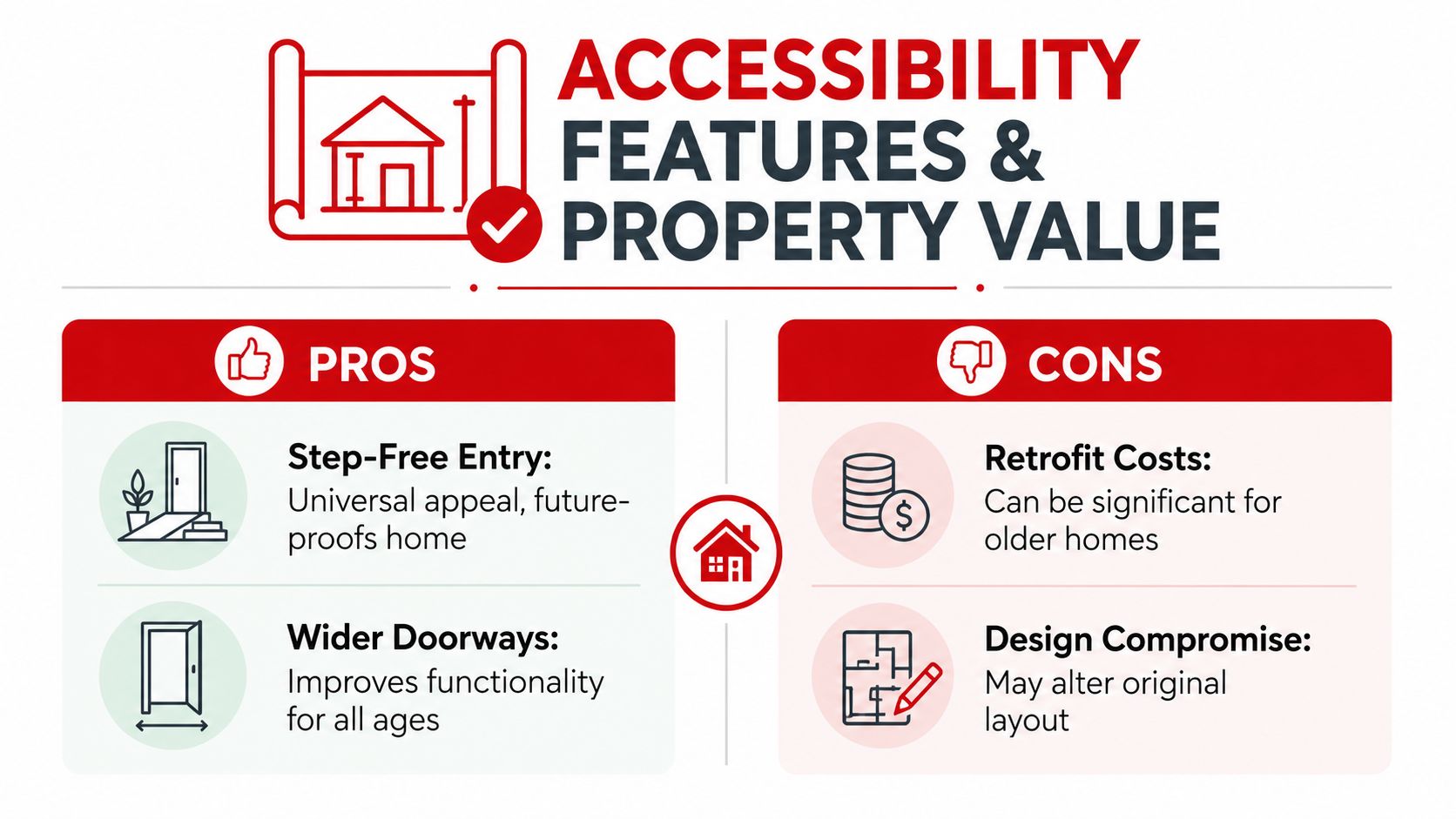
A step-free entrance, practical bathroom, wider circulation paths, bedroom access on the main floor, and secure exterior lighting can broaden the buyer pool. These features also help a parent remain at home longer, reducing the risk that a family must sell under pressure after a fall or sudden mobility change.
Retrofitting an older Maple Ridge home can be worthwhile, but the work must be selected carefully. A threshold removal may be simple, while a bathroom reconfiguration or stair solution can involve structural, plumbing, electrical, and permit considerations. No reliable cost range applies to every property, so sellers should obtain project quotes before assuming that a renovation will recover its full cost.
For an investor, the key question is not whether a building looks modern. It's whether the building has compliance gaps, inaccessible common areas, weak emergency systems, or strata restrictions that could make future remediation expensive. Specialist material on handicapped access doors offers useful technical context for evaluating entry systems and accessibility design.
Value test: Prioritize improvements that remove daily barriers for residents and remain useful to buyers of different ages.
A seller should avoid over-renovating for a narrow imagined purchaser. Before listing, the owner can use Maple Ridge home pricing guidance alongside an accessibility review to determine which improvements support marketability and which only add cost without solving a buyer concern.
Local Market Trends and Neighbourhood Fit
Senior housing properties don't succeed on accessibility alone. A technically suitable home can still be wrong if it leaves a resident isolated from familiar people, medical services, shopping, or recreation.
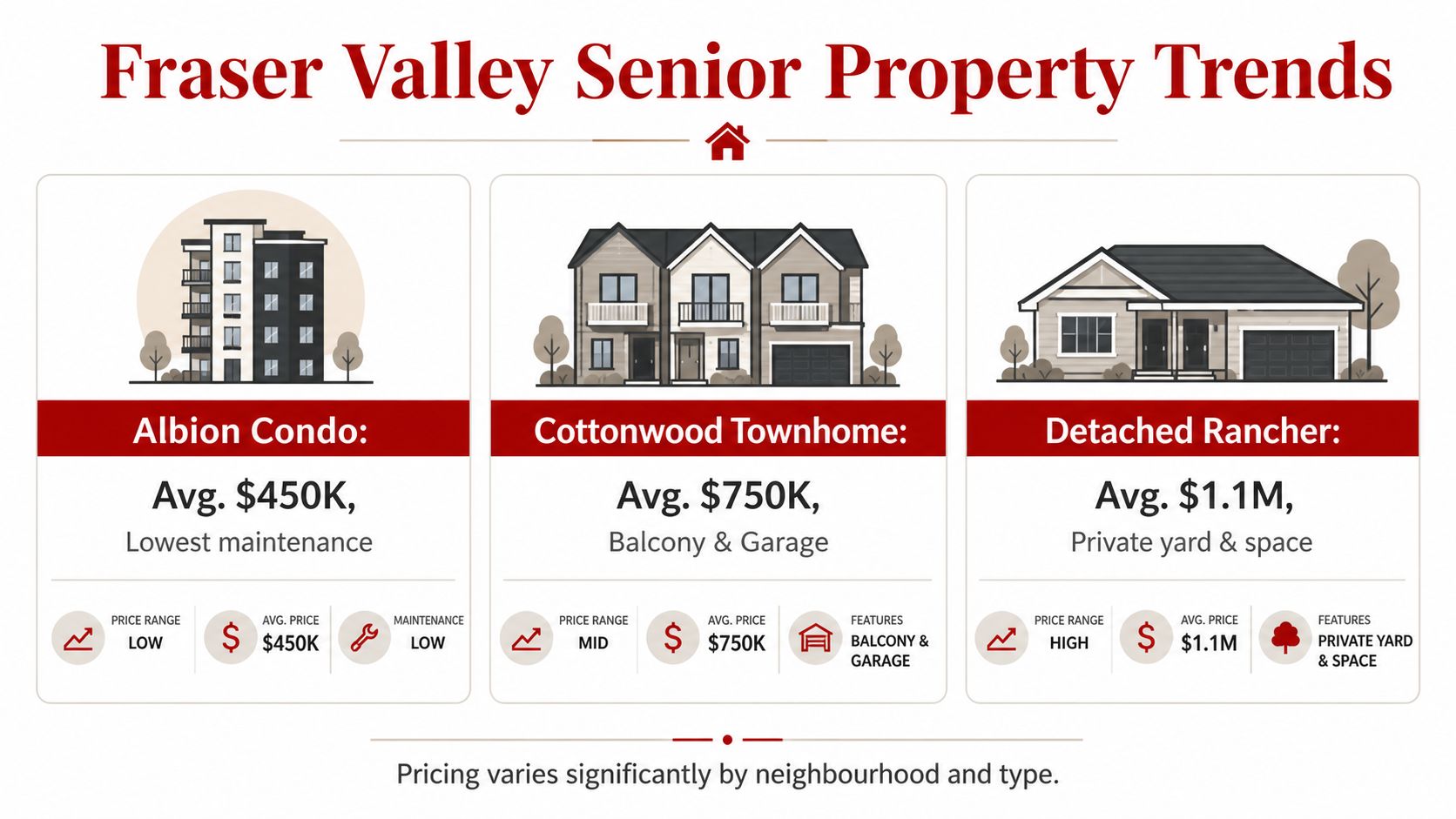
For many downsizers, the most practical choices are low-maintenance condos and townhomes in established areas. Albion offers newer housing and modern layouts, but some residents may find that daily errands require more planning. Cottonwood can appeal to buyers seeking townhome space, garages, and a residential setting. The Pitt Meadows town core deserves close attention for buyers who value a more compact routine and access to local services.
Detached ranchers remain attractive for parents who want a private yard, extra storage, and no internal stairs. They also bring greater responsibility for roofs, landscaping, heating systems, and exterior maintenance. A smaller condo may cost more in monthly strata fees, but the trade can be worthwhile when it removes the physical and administrative burden of a detached property.
Location must match the daily routine
Proximity to Ridge Meadows Hospital matters for families planning around appointments and changing health needs. Access to transit along the Lougheed Highway corridor can help residents who no longer drive. Walkable access to Meadowtown Centre may support everyday independence, especially when groceries, services, and social outings are easier to reach without relying on a family member.
The right neighbourhood depends on the resident's priorities:
- For social engagement: Independent living or a condo near shops, community facilities, and transit may be preferable.
- For quiet surroundings: A rancher in a mature part of Maple Ridge or a lower-density Pitt Meadows setting may offer more privacy.
- For low maintenance: An elevator condo or well-managed townhome can reduce yard and exterior responsibilities.
- For future flexibility: A home with a main-floor bedroom, accessible bathroom, and straightforward entry is more adaptable than a property built around stairs.
The Royal Crescent project adds another local option, but it won't solve every family's problem. Its announced homes are affordable rentals for independent seniors, not a universal replacement for assisted living or complex care. Buyers and sellers should treat new supply as one part of the market, while continuing to assess established buildings, resale inventory, and service availability.
Local pricing should be analysed by property type and neighbourhood, not by a generic “senior housing” average. Current listings, recent comparable sales, strata fees, age restrictions, building condition, and accessibility features all matter. A family comparing options can review Maple Ridge homes for sale, then narrow the search based on the parent's actual routine rather than choosing a property from photographs alone.
Practical Next Steps for Buyers and Sellers
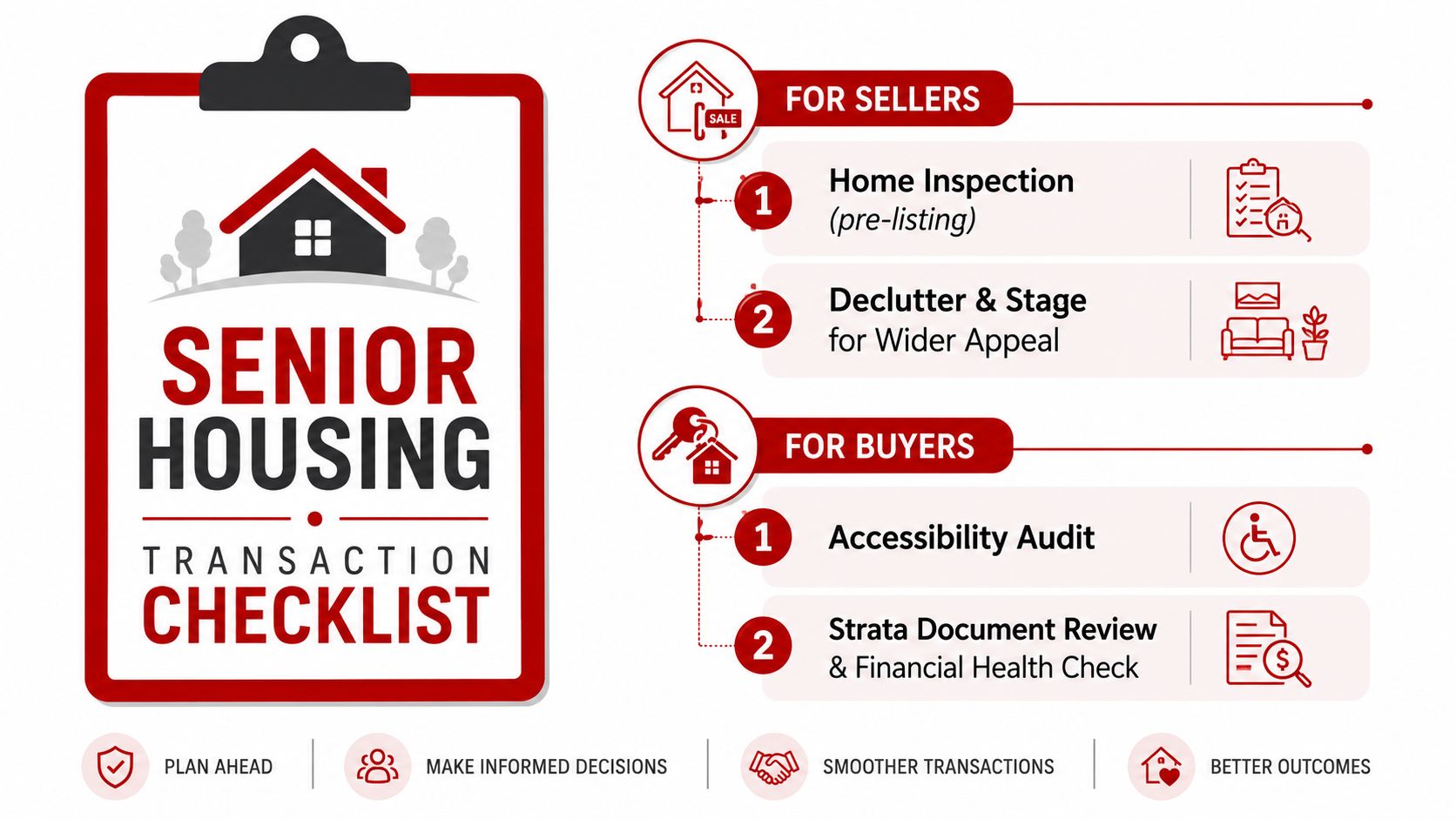
A successful move usually starts before the parent reaches a crisis point. Sellers need a plan for the existing home, while buyers need a disciplined process for evaluating the replacement.
For sellers
- Audit accessibility first: Review entrances, stairs, bathrooms, lighting, flooring, and bedroom placement. A professional assessment can identify safety issues that a cosmetic staging consultation won't catch.
- Separate useful work from expensive work: Prioritize changes that improve daily function and broad resale appeal. Obtain quotes before approving stairlifts, bathroom changes, or major layout alterations.
- Prepare the property for a wider audience: Declutter, improve lighting, clear pathways, and make the home easy to inspect. A clean, accessible presentation helps buyers understand the property's potential.
- Coordinate timing with care availability: If the parent is applying for subsidized housing or waiting for an assisted living placement, the sale timeline should account for that uncertainty. Selling too early can create housing stress, while selling too late can force rushed decisions.
- Protect decision-making capacity: Confirm who has authority to sign, manage proceeds, and communicate with professionals. Legal and financial advice should be obtained where capacity, estate planning, or representation is in question.
For buyers
- Review the building documents: Check age restrictions, rental rules, renovation permissions, depreciation reports, contingency funds, insurance, and pending assessments.
- Confirm the operating model: Determine whether the property is independent housing, assisted living, or another regulated arrangement. Don't assume that a building marketed to seniors provides care.
- Compare total monthly obligations: Include strata fees, property taxes, utilities, meals, transportation, service packages, and potential care charges. Compare the total with the parent's income and available equity.
- Test the location: Drive or walk the route to Ridge Meadows Hospital, transit, shopping, parks, and family support. A convenient address today may become a barrier if mobility changes.
- Get financing advice early: Pre-approval should account for strata requirements, leasehold or life-lease structures where applicable, and the possibility that the parent's income differs from a conventional borrower's profile.
- Use professional disclosure guidance: A local real estate professional should identify material facts, clarify property use, and coordinate with legal and financial advisers when tenancy or care regulations are involved.
The best senior housing decision in Maple Ridge or Pitt Meadows protects three things at once: the parent's daily independence, the family's financial position, and the property's future flexibility. A personalized consultation can map the downsizing timeline, compare local housing choices, and identify whether selling, adapting, renting, or purchasing makes the most sense.
Royal LePage Brookside Realty Property Management offers local guidance for families managing senior housing transitions, including property valuations, downsizing strategies, purchases, sales, and rental planning in Maple Ridge and Pitt Meadows. Visit Royal LePage Brookside Realty Property Management to arrange a consultation and build a practical property strategy around the family's timeline.