

A Maple Ridge homeowner preparing to list often starts with a familiar question: should the asking price leave room to negotiate, or should it match what a neighbour received in a stronger market? The answer shouldn't come from emotion, an online estimate, or the highest sale remembered from years ago. It should come from the right property segment, current comparable sales, condition, and the specific Maple Ridge neighbourhood where the home sits.
Pricing a detached home in Silver Valley isn't the same exercise as pricing an apartment in West Maple Ridge. A townhome in Albion competes with a different buyer pool than a single-family property in Kanaka Creek. Sellers who understand those distinctions give themselves a much stronger chance of attracting serious buyers while protecting their negotiating position.
Why Pricing Right From Day One Matters
A seller in Cottonwood may spend weeks preparing a home, arranging repairs, clearing storage, and planning the move. Once the listing goes live, the natural temptation is to start high and “test” the market. That approach sounds safe, but it can waste the listing's most valuable period, when buyers and their agents are paying close attention to new inventory.
A price that sits above the current buyer conversation can cause qualified purchasers to skip the home entirely. They don't necessarily submit a low offer to start a negotiation. They compare the listing with other Maple Ridge homes, decide the value isn't there, and book a showing elsewhere. By the time a price reduction appears, the original launch momentum may already be gone.

Overpricing also weakens negotiating power. A stale listing invites questions. Buyers may wonder whether the home has a hidden defect, whether the seller is under pressure, or whether there's room to negotiate. A seller who intended to protect the price can end up negotiating from a weaker position after the market has seen the property sit unsold.
The opposite mistake is pricing below a defensible market range without a clear plan. A deliberately competitive price can create attention when the home has broad appeal and the local buyer pool is active, but an unnecessarily low price can leave money behind if demand doesn't produce competing offers. The strategy has to match the property and current conditions.
Practical rule: The first list price should be a deliberate market position, not an opening guess.
A seller who wants a broader explanation of valuation can review how much a Maple Ridge home may be worth, but the final recommendation still needs property-specific analysis. The CREA/MLS® Home Price Index benchmark is a better foundation than a simple citywide average because it compares a mix-adjusted benchmark home over time and reduces distortions caused by changing sales mix.
Maple Ridge's May 2026 market conditions show why this matters. The benchmark price for all home types was $907,600, while detached homes were $1,205,200, townhomes were $727,300, and apartments were $504,000 (local Maple Ridge market update). The same report described May 2026 as historically quiet, with detached and townhome sales volumes at their lowest recorded levels for that month. In a slow market, an inflated launch price can delay the sale and reduce the seller's negotiating power.
Building a Comparative Market Analysis That Actually Works
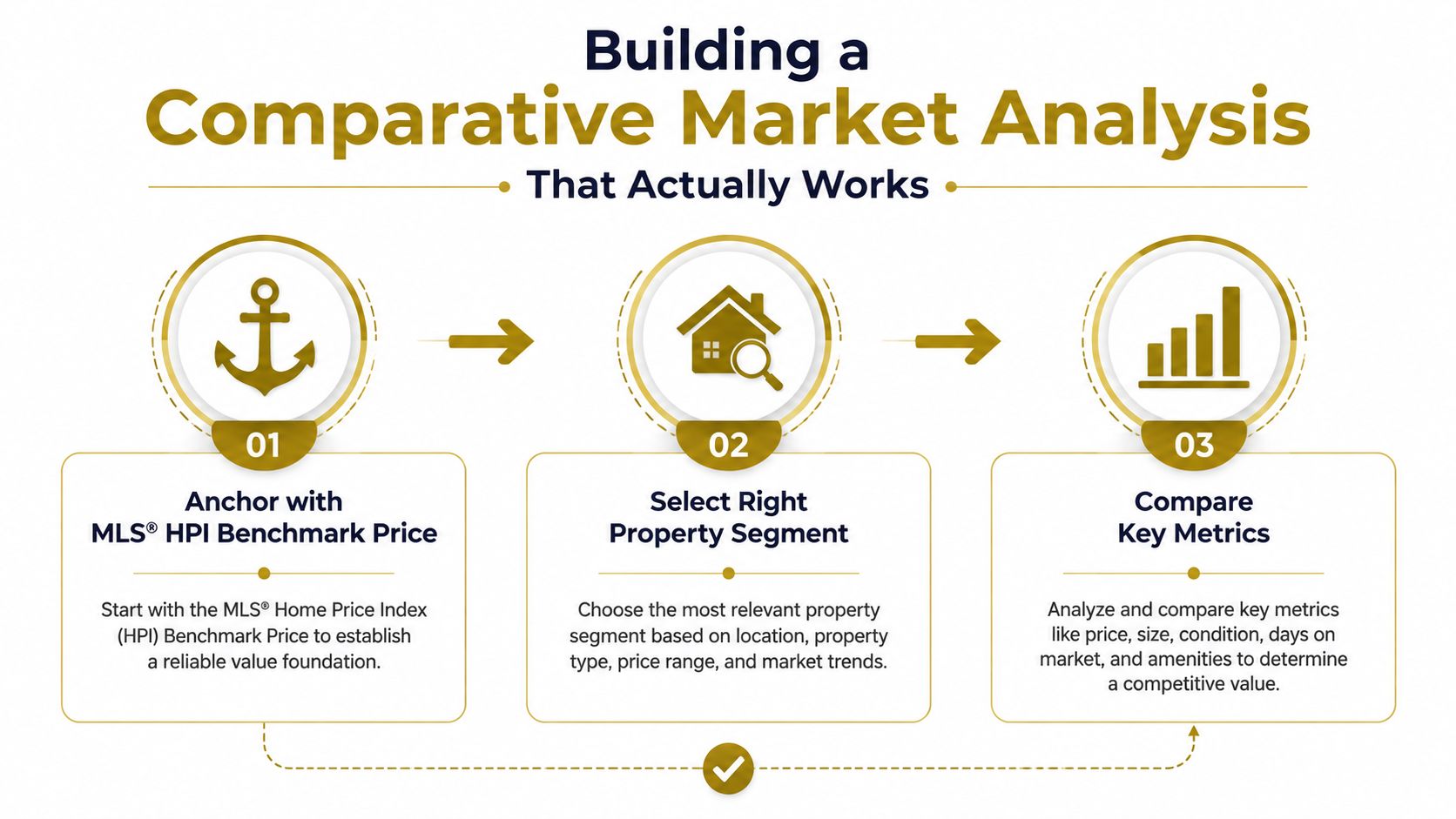
A useful comparative market analysis, or CMA, doesn't begin with the question, “What did homes sell for across Maple Ridge?” It begins with, “Which homes would a buyer compare with this property today?” That means identifying the correct segment before looking at a price range.
The HPI benchmark should serve as the anchor. In July 2026, Maple Ridge's benchmark was about C$897,000 for all home types, with detached homes at C$1,184,800, townhomes at C$718,100, and apartments at C$501,700 (Maple Ridge housing market data). Those figures aren't automatic list prices. They establish a starting point that must be adjusted for the actual home.
Start with the correct segment
A detached property should be compared primarily with other detached properties. A townhome needs attached-home comparisons, while an apartment should be measured against similar apartments. Using a citywide average can produce a misleading result when one month includes more detached sales or more condominium transactions than usual.
A practical CMA process includes:
- Anchor the analysis with the HPI benchmark. The benchmark provides a mix-adjusted reference point rather than an unfiltered average.
- Select comparable properties carefully. Look for similar property type, location, layout, lot characteristics, condition, and buyer appeal.
- Review recent closed sales. Recent sales show what buyers paid, rather than what sellers hoped to receive.
- Study active competition. Current listings reveal what buyers can choose instead of the subject property.
- Compare listing performance. Showing activity, offer patterns, and time on market help determine whether the price is attracting attention or creating resistance.
The same discipline applies when comparing Maple Ridge with Pitt Meadows. A July 2026 regional update placed the benchmark single-family price in Maple Ridge and Pitt Meadows at about $1.19 million, compared with $1.64 million for the Lower Mainland overall (July 2026 Maple Ridge real estate report). That comparison is useful for context, but it shouldn't replace neighbourhood-level and segment-level evidence.
Adjust the baseline instead of averaging blindly
Once the right comparable sales are assembled, the analysis should account for lot size, floor plan, renovation quality, parking, outdoor space, and micro-location. A recently updated townhome beside a well-used amenity may compete differently from a similar-sized unit with deferred maintenance, even when both sit in the same broad segment.
Sellers should also separate improvements that support buyer confidence from improvements that merely reflect personal taste. If repainting is under consideration, a practical resource on how much repainting costs can help frame the project before the expense is added to the pricing discussion. The cost of work still isn't the same as the value buyers will assign to it.
A detailed explanation of the index itself is available in the guide to the MLS® Home Price Index. The important takeaway is straightforward: the HPI establishes the baseline, and the CMA makes it specific to the home.
Adjusting for Condition, Upgrades, and Neighbourhood Appeal
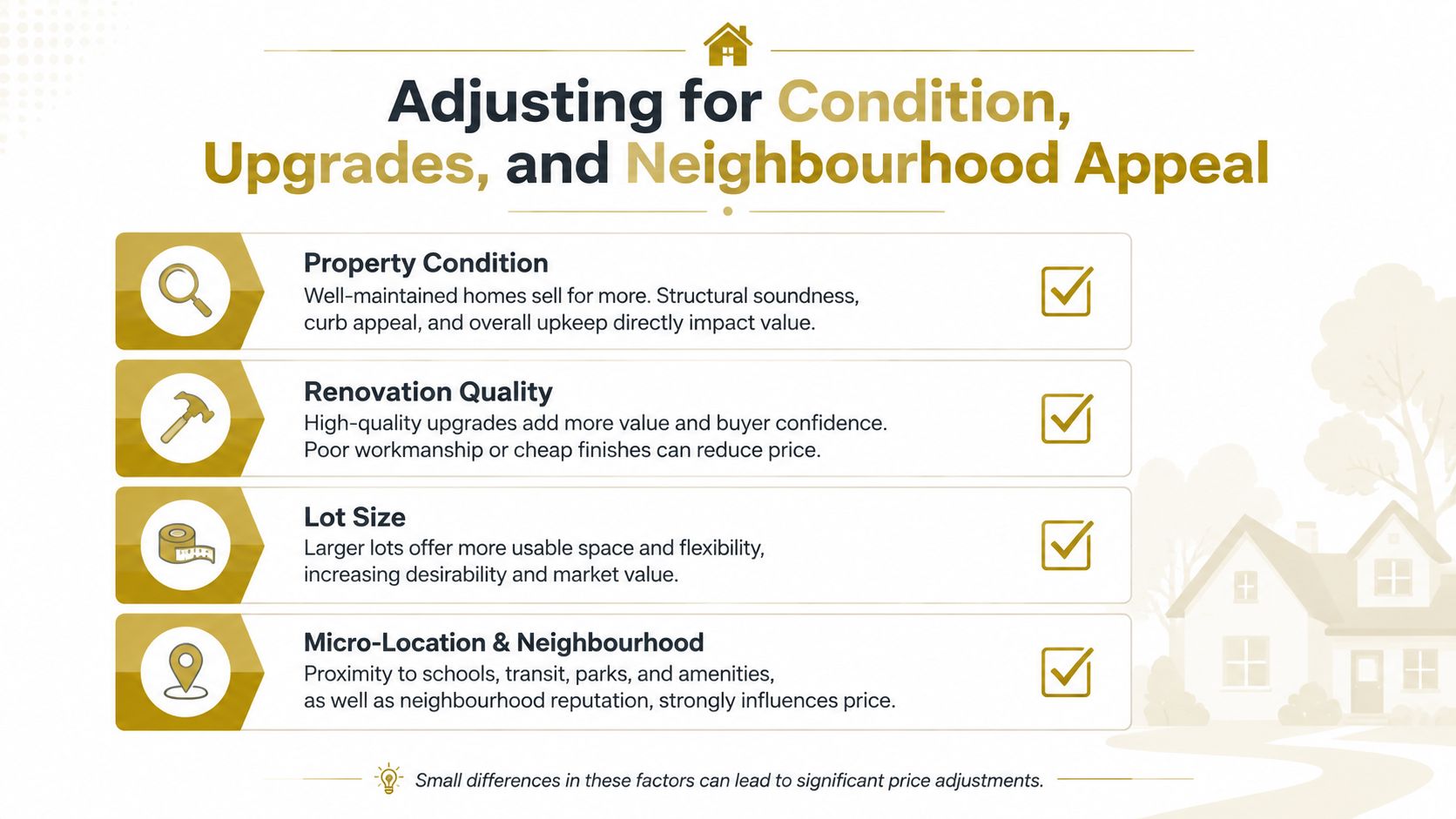
A benchmark can't see the inside of a house. It doesn't know whether the kitchen is dated, whether the roof has been maintained, or whether the backyard gives a family room to play. Those details determine how far a seller should move from the baseline.
The adjustment should be evidence-based, not a dollar-for-dollar record of renovation spending. Buyers pay for the overall value of the property compared with alternatives. They don't automatically reimburse every amount a seller spent on cabinets, flooring, landscaping, or appliances.
Evaluate condition before adding upgrades
A clean, well-maintained home generally gives buyers fewer reasons to discount their offer. Obvious repairs, strong odours, worn flooring, damaged walls, or neglected exterior areas can make purchasers budget for risk, even when the underlying property has good potential.
The most useful pre-listing work usually improves presentation and reduces objections. A seller considering renovation priorities can consult this overview of top home improvements for resale, then ask a local professional to rank projects according to the actual competing listings.
A sensible review separates improvements into three groups:
- Necessary maintenance: Fix defects that could distract buyers or create inspection concerns.
- Broad-appeal presentation: Fresh paint, thorough cleaning, tidy landscaping, and functional lighting can make the home easier to evaluate.
- Personal upgrades: Highly customised finishes may appeal to one buyer but fail to justify a higher list price across the wider market.
The best question isn't “How much did the work cost?” It's “How does this home compare with the alternatives buyers will see at the same price?”
Treat location as a pricing adjustment
Maple Ridge's neighbourhoods carry different lifestyle signals. Albion, Silver Valley, Cottonwood, West Maple Ridge, and Kanaka Creek each attract buyers who may weigh school access, parks, commuting patterns, trails, shopping, and family routines differently. Local neighbourhood appeal doesn't create a universal premium, but it can influence which properties feel like the better choice within a buyer's search.
That makes micro-location essential. A home close to a preferred park or convenient school route may show better than a similar home farther away, while traffic exposure, difficult access, or a less appealing outlook can work against the price. The adjustment should reflect the buyer's lived experience, not just the neighbourhood name printed in a listing.
Lot size deserves its own review. A larger, usable yard can matter to families and pet owners, but an awkward slope or difficult maintenance burden may reduce its practical benefit. The same principle applies to parking, storage, basement finish, suite potential, and outdoor privacy.
For a more detailed local renovation framework, sellers can review pre-listing renovations that add value in Maple Ridge. The final price should reflect the finished home's position against current competition, not the seller's attachment to the property or renovation invoice.
Choosing the Right Pricing Strategy for Your Home
Maple Ridge pricing decisions should start with the property's segment, not a citywide average. A detached home in Silver Valley, a townhome in Albion, and an apartment near West Maple Ridge compete for different buyers. Choose among aggressive, market, and premium pricing only after comparing the home with direct competitors, current inventory, presentation, and your selling timeline.
An aggressive strategy places the home at the sharper end of its defensible range. It suits a broadly appealing property when the seller wants immediate attention and can handle competing interest. The price still needs support from the CMA and the home's condition. An artificially low number creates confusion, not a reliable sale.
Market pricing keeps the listing close to its evidence-based current value. Use it when you want steady exposure without depending on multiple offers. Buyers can compare the property clearly, while negotiations stay tied to its actual strengths, limitations, and micro-market position.
Reserve premium pricing for a home with features buyers can readily recognise, such as an unusually strong location, an exceptional lot, a rare layout, or superior renovation quality. Sentimental value and a neighbour's result from a different market do not justify a premium.
| Strategy | Best For | Risk Level | Typical Outcome |
|---|---|---|---|
| Aggressive | Sellers prioritising attention and a faster market response | Higher execution risk | Strong early activity, with the final result dependent on buyer competition |
| Market | Sellers seeking a balanced launch and evidence-based negotiations | Moderate | Consistent showings and a sale shaped by comparable value |
| Premium | Distinctive properties with features buyers can clearly recognise | High | Longer exposure is possible, with success dependent on a buyer accepting the added value |
Your timeline sets the acceptable risk. A seller coordinating a purchase, relocation, or estate settlement usually needs a direct market position. A seller with flexibility can test premium pricing, provided they accept that fewer buyers may engage and the listing may take longer to convert.
First-time buyers also respond to tax thresholds. British Columbia's first-time home buyers' program provides a full property transfer tax exemption for qualifying principal residences valued at $835,000 or less, subject to eligibility requirements, including a property size of 0.5 hectares or smaller (Government of British Columbia announcement). The exemption covers tax on the first $500,000 of value. Qualifying purchases above $835,000 but below $860,000 may receive a partial benefit that declines as the price approaches $860,000 (first-time home buyers' exemption details).
For suitable entry-level homes, crossing a threshold can change a buyer's total cost calculation. Do not force a property into an artificial bracket, but include that buyer math when setting the launch price.
Before listing, sellers can also review a guide to selling your Maple Ridge home faster. The strategy should reflect the home's actual appeal, its segment benchmark, and the seller's priorities, not a generic promise of multiple offers.
Common Pricing Mistakes That Cost Sellers Thousands
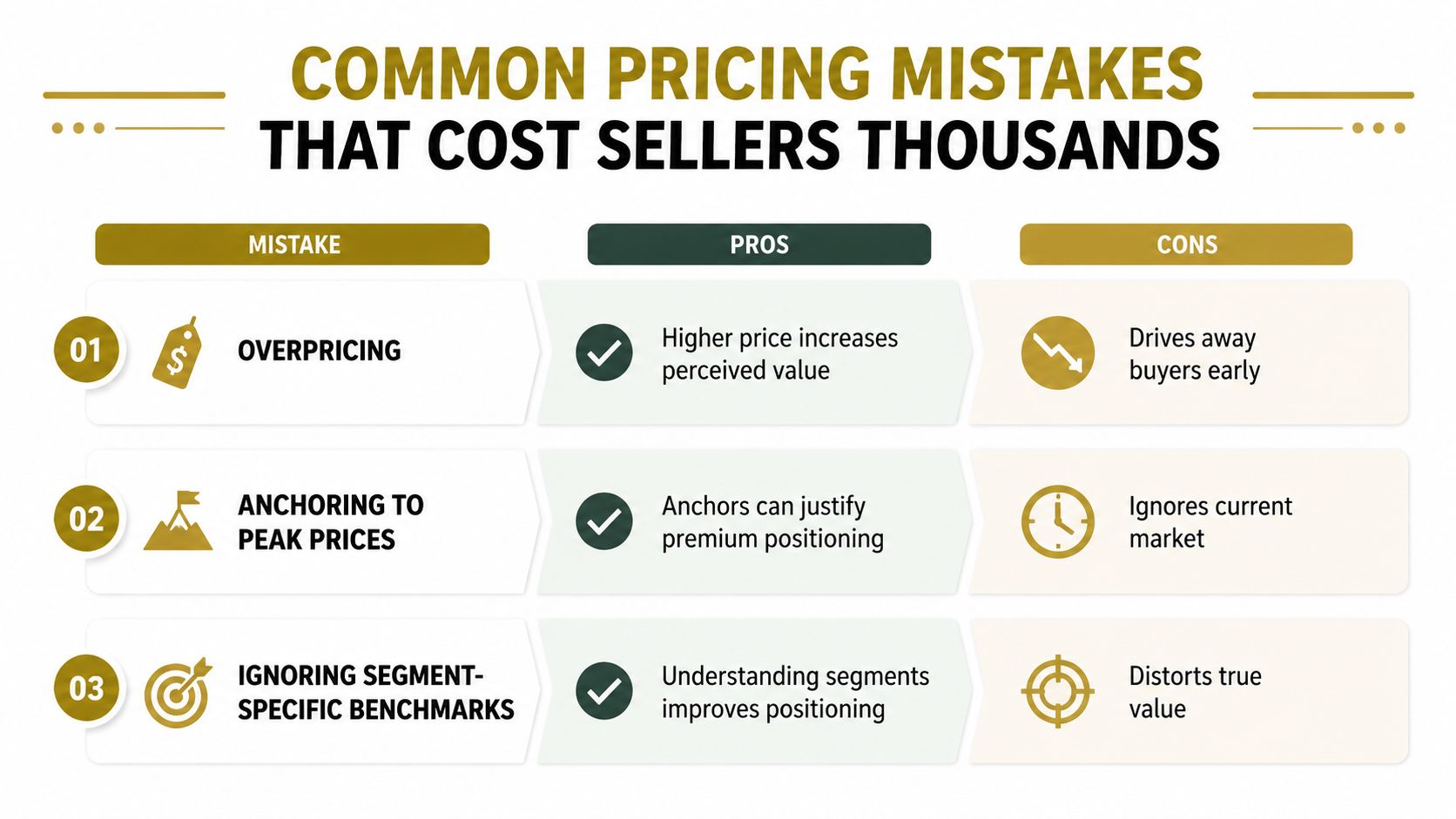
A Maple Ridge seller can lose momentum before the first showing by pricing from an old peak instead of the home's current segment. July 2026 benchmark data put detached homes near $1,184,800, townhomes near $718,100, and apartments near $501,700 (Maple Ridge benchmark data). Those figures are not interchangeable. A detached home in Silver Valley competes within a different buyer pool than an apartment near central Maple Ridge, and the launch price must reflect that reality.
Anchoring to a previous high-water mark creates the same problem. Sellers remember what comparable homes commanded at the peak, while buyers judge today's alternatives, condition, location, and monthly cost. Price from the relevant neighbourhood and property segment, not from a number that once felt achievable.
Three habits that create trouble
- Pricing around the seller's finances: Mortgage debt, renovation bills, and the budget for a next home do not establish market value. They determine whether the seller should list now, wait, or adjust expectations.
- Adding upgrades dollar for dollar: Buyers reward useful improvements, but they compare the finished home with competing listings. Receipts do not guarantee an equal increase in the sale price.
- Ignoring buyer thresholds: Entry-level sellers should account for the British Columbia first-time buyer tax bands discussed earlier. A price just above a threshold can change the buyer's total cost and shrink the audience, even when the home itself is a strong fit.
Slow conditions also punish ambitious pricing. The May 2026 Maple Ridge market update described quiet activity for detached and townhome properties during that month. In that setting, a listing without clear value can sit while sharper competitors attract the serious buyers.
List prices show current competition. Closed sales show what buyers accepted. Review both, then account for property type, micro-location, condition, and buyer segment. Do not confuse an active listing's wish price with evidence of market value.
Emotional attachment belongs in the decision to sell, not in the pricing formula. A family may cherish a backyard, while buyers focus on drainage, maintenance, parking, or school access. Price the features buyers can compare, and be honest about the ones they may not pay extra to keep.
When to Call a Local Agent for Pricing Guidance
DIY research gives you a starting point. Call a local agent before listing when your Maple Ridge home does not fit a standard comparison. Unique lots, secondary suites, major renovations, unusual layouts, rural-adjacent settings, and nearby competing developments require local interpretation, not an online estimate.
Sound pricing combines current benchmark data, closed comparable sales, active competition, neighbourhood context, and negotiation strategy. A local agent can separate features buyers will pay for from features they only notice. That distinction matters across Albion, Silver Valley, Cottonwood, West Maple Ridge, Kanaka Creek, and nearby Pitt Meadows, where property type, buyer demand, and segment-specific HPI benchmarks can differ.
Get advice before listing if:
- The home serves more than one buyer segment, such as a property with suite potential or an unusual layout.
- You have a firm deadline, since an ambitious launch can leave the home sitting while sharper listings attract serious buyers.
- The property needs work, and you must choose between improving it and pricing for its condition.
- You are relying on broader Lower Mainland benchmarks, which may overstate what your specific Maple Ridge micro-market supports.
- The likely buyers include first-time purchasers, because the provincial tax thresholds discussed in section 4 can affect the audience for a home near those bands.
Ask whether a no-obligation evaluation is enough or whether the property needs a full pre-listing plan. The value of working with a local Maple Ridge realtor is turning scattered information into a clear decision on list price, preparation, launch timing, and offer management.
Royal LePage Brookside Realty Property Management offers home evaluations, listing guidance, marketing, negotiations, and property management services for owners in Maple Ridge and Pitt Meadows. Visit Royal LePage Brookside Realty Property Management to request local pricing guidance and discuss a practical plan.