
A parent dies, and suddenly a Maple Ridge home in Albion or Cottonwood becomes the centre of a legal, financial, and practical problem. The executor may know the beneficiaries, understand the family wishes, and even have a buyer in mind, but none of that automatically gives authority to transfer or sell the property.
The probate process in BC matters especially when the estate's main asset is a house. A mortgage balance may reduce what beneficiaries receive, but BC probate fees are generally calculated using the gross value of assets subject to probate. That difference can affect the court fee, the timing of a listing, and how long utilities, insurance, taxes, and property maintenance continue.
When Probate Is Required in BC
An executor in Maple Ridge often asks the question while standing inside a family home, perhaps near the kitchen table in Albion, with the will, a mortgage statement, and a real estate assessment spread out in front of them. The immediate concern is usually practical: can the house be listed, or does the family have to wait for court approval?
Probate is generally needed when the deceased owned assets in their sole name and the institution holding those assets requires a court grant. A house registered only to the deceased is the clearest example. The Land Title Office typically needs the grant before the executor can transfer title or complete a sale, even if the property has a mortgage and the estate has little net equity.
Financial institutions can also insist on probate before releasing sole-name accounts. The estate's specific assets determine the answer, not the family's understanding of the will.
Common situations that may avoid probate
Several ownership and beneficiary arrangements can keep an asset outside the usual court route:
- Joint ownership: Property held jointly with a right of survivorship may pass to the surviving owner through registration rather than through the estate.
- Designated beneficiaries: RRSPs, TFSAs, and life insurance policies may pass directly to named beneficiaries.
- Small estates: Certain assets below the applicable small-estate threshold may use a simplified process, including Form P10 where it applies.
The original will still matters. BC court rules require the original will to be deposited with the registrar when probate is sought, together with the required application documents and executor affidavit. The BC probate court rules set out that requirement.
Practical rule: A Maple Ridge house held only in the deceased's name almost always deserves an early probate review. Don't assume the mortgage balance changes the title requirement.
Before discussing a sale agreement, the executor should understand how contract terms interact with authority, conditions, and closing obligations. A careful real estate contract review can help identify problems before an estate signs anything. The key question isn't merely whether probate exists. It's whether the estate's particular assets require a grant before anyone can deal with them.
Executor Duties Before You File Anything
Probate paperwork shouldn't be the first task. An executor's first responsibility is to protect the estate, preserve the property, and establish what exists.
Find the original will
The search should begin with the deceased's home, safety deposit box, and the lawyer who prepared the document. A photocopy can help identify the intended will, but the court rules focus on the original. Executors should also confirm whether there are later codicils or another testamentary document.
Certified death certificates should be ordered early. The executor should also confirm whether a separate representation agreement exists, because that document may contain information relevant to incapacity before death, although it doesn't replace the will or probate process.
Secure the Maple Ridge or Pitt Meadows property
Vacant homes deteriorate quickly and attract unwanted attention. The executor should:
- Change the locks: This protects the home from unauthorised access and clarifies who controls entry.
- Redirect mail: Uncollected mail can expose financial information and signal that the property is empty.
- Maintain insurance: The insurer should be told about the vacancy or change in occupancy.
- Protect the contents: Family members and tenants shouldn't remove belongings until the executor has completed an inventory and confirmed the will's instructions.
- Keep essential services active: Heat, water, electricity, and basic maintenance protect the structure while decisions are pending.
A home in Silver Valley may need different maintenance from one near central Maple Ridge, but the executor's duty is the same. The property must remain safe, insured, and reasonably preserved.
Build an asset and liability file
The executor should request recent bank statements, identify investment and registered accounts, and locate mortgage details from the lender serving the Maple Ridge or Pitt Meadows property. Property tax notices from the applicable municipality should be collected, along with strata records where relevant.
Personal property of significant value should be photographed and inventoried. No beneficiary should receive a distribution just because the family expects the will to be straightforward. The executor must understand debts, taxes, and possible claims before distributing anything.
The standard application is evidence-based. It includes an affidavit of assets and liabilities, notice-delivery affidavits, and an estate grant submission, as described in Clicklaw's probate application guidance. An executor who keeps a clean file from the beginning will have an easier time working with counsel and a listing professional. Information about the difference between listing roles is available in this listing agent and selling agent guide.
How BC Probate Fees Are Calculated
The gross-value rule is where many families misjudge the cost. Under the BC Probate Fee Act, estates valued at $25,000 or less pay no probate fee. Estates from $25,001 to $50,000 are charged $6 per $1,000, and the portion above $50,000 is charged $14 per $1,000. The fee applies to the gross value of estate assets subject to probate, as set out in the BC Probate Fee Act.
That means the value of a home can dominate the calculation. A mortgage may affect the estate's eventual distribution, but executors shouldn't assume it reduces the value used for the probate fee. The fee is payable before the grant is issued, which can create a cash-flow problem where the estate consists mainly of a house.
The table below applies the statutory rates to three local examples. It shows the probate fee and the filing fee identified in the available BC guidance. A Wills Notice search may also be part of the preliminary work, but the amount requested for that search isn't included in the verified fee data and shouldn't be guessed.
Local examples
| Estate Gross Value | Probate Fee Calculation | Total Court Fees |
|---|---|---|
| Pitt Meadows townhouse, $850,000 | $6 on the first applicable band, then $14 per $1,000 above $50,000. The gross-value calculation produces a probate fee of $11,600. | $11,800, including the $200 filing fee |
| Maple Ridge detached home, $1.2 million | $6 on the first applicable band, then $14 per $1,000 above $50,000. The gross-value calculation produces a probate fee of $16,500. | $16,700, including the $200 filing fee |
| Albion estate, $2 million | $6 on the first applicable band, then $14 per $1,000 above $50,000. The gross-value calculation produces a probate fee of $27,700. | $27,900, including the $200 filing fee |
The legal threshold and rates come from the consolidated Probate Fee Act. The table illustrates why an estate with one Maple Ridge home may need to arrange liquid funds before filing.
Probate should be treated as a real estate transaction cost, not a minor administrative charge. It sits beside legal work, staging, repairs, mortgage interest, insurance, utilities, and the eventual real estate commission. Executors can begin with a professional Maple Ridge home valuation, then have the lawyer confirm which assets require probate and how the value should be reported.
Filing the Application at the Supreme Court of BC
A BC probate application is a document package, not a single form dropped at a counter. The court needs evidence that the will is authentic, the applicant has authority, required people received notice, and the estate's assets and liabilities have been identified.
Assemble the core package
The commonly used forms and supporting documents include the following:
| Form or Document | Purpose |
|---|---|
| Form P1, Application for Grant of Probate | Asks the Supreme Court of BC to issue the grant |
| Form P2, Affidavit of Executor | Confirms the executor's identity, authority, and evidence supporting the application |
| Form P3, Renunciation | Records that a co-executor is stepping aside where renunciation is appropriate |
| Original will and copies | Gives the registrar the testamentary document to review and retain |
| Death certificate | Confirms the death that triggered the application |
| Vital Statistics clearance certificate | Helps establish that the deposited will is the latest will recorded through the applicable search |
| Signed beneficiary consents | Records notice and consent where the application uses those documents |
| Affidavit of assets and liabilities | Shows the estate property and debts used in the application |
The original will must be deposited with the registrar under the BC court rules. The application also needs affidavits proving that notice was delivered to the required people. The registrar can request further affidavits if the file needs clarification.
Choose the filing route carefully
Maple Ridge and Pitt Meadows files are commonly connected with the New Westminster registry. An executor may submit a desk application or use Court Services Online where the filing method and document type permit it. The lawyer handling the application should confirm current registry procedures before the package is sent.
The registrar checks more than whether every page is present. Informal will execution, missing witness addresses, inconsistent names, unsigned codicils, and unexplained changes can trigger a requisition. A correction may require a replacement affidavit, a new document, or additional evidence. The response should be organised and prompt because the file cannot move forward until the registrar is satisfied.
Executors managing several administrative streams can also benefit from practical workflow ideas, such as those described in this law firm admin automation guide. Automation won't replace legal judgment, but a disciplined document system can reduce missed requests and duplicate follow-up.
Once the registrar accepts the application and the required fee is paid, the Grant of Probate is issued. Certified copies should then be obtained for lenders, financial institutions, and the Land Title Office, because each recipient may need evidence of the executor's authority before releasing or transferring an asset.
The Real Timeline for Maple Ridge Estates
Families often plan around the wrong calendar. Probate isn't measured only from the date of death to the filing date, and a house usually can't be treated like an ordinary listing while authority remains unresolved.
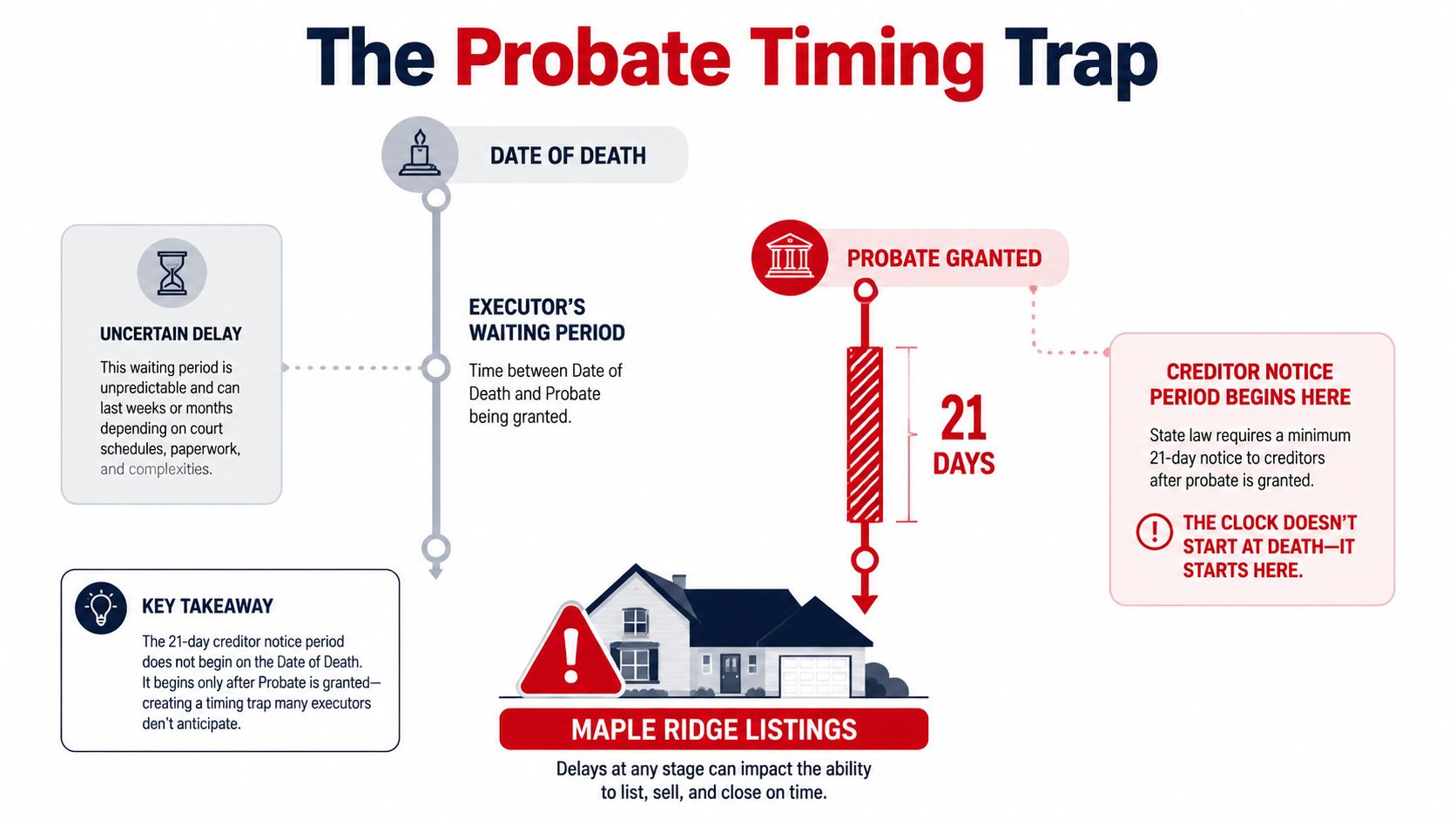
BC-focused guidance indicates that even straightforward grants often take 3 to 6 months, while the full executor timeline can extend to 12 to 18 months when notice, tax, and clearance steps are included. The BC government's wills and estates guidance confirms that probate is court supervised.
The creditor notice period begins after probate is granted, not when the person dies. The verified planning material identifies a 21-day notice period, so an executor who waits to think about the house until the grant arrives may lose valuable preparation time.
A workable preparation sequence
| Stage | Practical action |
|---|---|
| Immediately after death | Secure the home, notify the insurer, preserve contents, and locate the original will |
| Early administration | Call the estate lawyer, gather financial records, and arrange a property appraisal |
| Before the grant | Complete repairs that don't require a transfer of title, organise belongings, and plan photography |
| After the grant | Transmit the grant as required, confirm title authority, and monitor the creditor notice process |
| Once authority and timing are clear | Finalise pricing, marketing, disclosures, and the listing schedule |
A typical Albion or Cottonwood home may therefore face a much longer gap between death and a marketable listing than beneficiaries expect. Holding costs continue while the executor waits, and vacant properties carry risks involving maintenance, security, weather, and insurance compliance.
A sale also has its own calendar. Executors should distinguish the listing date, accepted offer, completion date, and possession date, as explained in this guide to closing dates and possession dates. The listing plan should be built backward from the legal milestones, not from a beneficiary's preferred payout date.
Alternatives That Skip Probate Entirely
Probate isn't inevitable for every Maple Ridge estate. The ownership structure, beneficiary designations, asset type, and title record can change the route completely.
A surviving spouse may have rights under the Wills, Estates and Succession Act that allow a family home to be transferred or sold without a grant in the right circumstances, particularly where the required beneficiary consents are signed. That route still needs legal review. A spouse shouldn't assume that living in the home automatically removes the Land Title Office's requirements.
Compare the available paths
| Route | When It Works |
|---|---|
| Spousal transfer or sale route | May work where a surviving spouse qualifies and the required beneficiary consent forms are properly completed |
| Small-estate affidavit process | May apply to personal property under the relevant $50,000 threshold, where BC's simplified requirements are met |
| Joint tenancy with survivorship | May allow the surviving owner to register the transfer without probate |
| Designated beneficiary asset | May pass directly to the named beneficiary, subject to the account or policy terms |
| Ordinary probate application | Applies when sole-name real property or other assets require a court grant |
The threshold for the small-estate route mustn't be confused with the probate fee bands. The available BC fee legislation sets out $25,000 and $50,000 fee thresholds, while the simplified transfer route discussed here concerns $50,000 in personal property. Those are different questions.
A Land Title Office review may still demand a grant if the deceased was the sole registered owner, if survivorship wasn't recorded, or if the proposed transfer doesn't fit the applicable exception. A mortgage also doesn't prove that probate can be avoided.
The executor's decision checklist
Before filing, the family should ask:
- Is the home registered solely to the deceased?
- Is there a surviving joint tenant?
- Is there a valid designated beneficiary?
- Are the assets personal property within the applicable small-estate limit?
- Has the lawyer confirmed that the proposed transfer or sale can proceed without a grant?
- Will the financial institution and Land Title Office accept the alternative documents?
If any answer remains uncertain, the executor should obtain legal advice before signing a listing agreement or distributing property.
Selling an Estate Property in Maple Ridge and Pitt Meadows
The legal and real estate tracks should run together, but they shouldn't be confused. An executor may be able to prepare the home before the grant, yet the authority to complete a sale and transfer title still needs to be confirmed with the estate lawyer and the Land Title Office.
The New Westminster Land Title Office process matters to Maple Ridge and Pitt Meadows sellers because title transmission, mortgage discharge, and completion documents all depend on accurate authority. The listing professional should receive the lawyer's instructions, the registered ownership information, and a clear explanation of any surviving joint tenant or spousal claim.
Prepare the property without losing control
A practical estate-sale plan usually includes:
- Secure the property: Change locks, maintain insurance, arrange snow and yard care, and check for leaks or damage.
- Clear the contents: Photograph valuable items, follow the will, and document removals approved by the executor.
- Review strata requirements: A townhouse or condominium may require current records, a depreciation report, meeting minutes, and confirmation of fees or special levies.
- Check municipal obligations: Property taxes, zoning matters, permits, and vacancy-related concerns should be reviewed for the specific Maple Ridge or Pitt Meadows address.
- Plan repairs selectively: Fix safety and presentation problems that support the sale, but don't spend estate funds on renovations without a clear benefit.
Pricing should reflect the immediate competition and property condition in the relevant neighbourhood. Albion, Cottonwood, and Silver Valley attract different buyers, and a detached family home near schools and parks shouldn't be priced from a generic Fraser Valley comparison. The estate's timing also matters. If the legal calendar points toward a slower market period, the executor may choose a sharper launch price, postpone marketing, or complete preparation while waiting for authority.
Executors can review practical guidance on handling probate property listings, then have the lawyer and listing professional adapt it to the property's title and estate documents. Buyer disclosures should state the material facts accurately, including that the seller is acting as executor, whether probate has been granted, and whether court or title steps remain outstanding.
Holding costs often decide the strategy. Mortgage payments, utilities, property tax, insurance, lawn care, snow removal, and vacancy security continue while the house sits. A careful home pricing strategy should account for those carrying costs, the condition of the home, comparable sales, and the actual date on which the executor can deliver clear title.
Royal LePage Brookside Realty Property Management offers estate-sale coordination with the executor and the estate's lawyer or notary, including property preparation, local valuation, marketing, and transaction management. Families handling a Maple Ridge or Pitt Meadows estate can visit Royal LePage Brookside Realty Property Management to discuss the property, the probate timeline, and a practical plan for moving from secured home to completed sale.