
A homeowner in Albion is sitting at the kitchen table with a listing agreement in front of them and one practical question: if the agent who listed the home finds the buyer, is that helpful, or does it leave someone without a proper advocate?
That question comes up often in Maple Ridge, particularly when a seller is comparing a slower Cottonwood condo market with stronger demand for certain detached homes in West Maple Ridge. The labels listing agent and selling agent sound straightforward, but the important issue is the relationship behind them. Who represents whom, who receives compensation, what information must remain confidential, and what happens when the same professional is asked to assist both sides?
The answer has become more important as buyer representation and compensation discussions have become more explicit in British Columbia. Sellers need to understand how the listing agreement affects exposure, negotiations, and net proceeds. Buyers need to know whether the person opening the door to a Silver Valley townhome is working for them, the seller, or neither side exclusively.
The practical distinction matters whether someone is preparing to sell near Albion's schools and parks, buying in Pitt Meadows, or comparing neighbourhoods through a guide to the best time to sell a home in Maple Ridge.
Why Maple Ridge Homeowners Ask This Question Right Now
A seller in Albion may hear that a buyer has contacted the listing agent directly and wonder whether keeping both sides of the conversation with one person will make the transaction simpler. The instinct is understandable. Fewer people appear to mean fewer messages, quicker decisions, and perhaps a smoother path from showing to completion.
The difficulty is that convenience doesn't automatically equal representation. The listing agent has accepted duties to the seller. If a prospective buyer walks through the home and shares a maximum budget, urgency, or preferred possession date, those details can affect the seller's negotiating position. The buyer may be speaking with a helpful professional, but helpfulness alone doesn't establish buyer representation.
Maple Ridge isn't one negotiation
Neighbourhood performance can vary sharply. Recent Maple Ridge reporting identified declines in detached and condominium prices in areas including Cottonwood, Southwest Maple Ridge, and East Central Maple Ridge, while a 2025 market report noted that fewer than 12% of listings sold within 30 days. Those conditions make pricing discipline, presentation, follow-up, and offer management particularly important for sellers in slower segments. Maple Ridge News reporting provides local context for that uneven performance.
A well-priced West Maple Ridge detached home can create a different problem. Buyers may need an agent who can assess conditions, protect financing and inspection interests, and present a credible offer without giving away unnecessary negotiating power. The same professional can't approach both sides with identical loyalty.
Practical rule: The person holding the open house isn't automatically the buyer's representative.
The money conversation has changed
British Columbia's 2025 brokerage data call found that 98% of buyers were represented by a real estate licensee, according to the BCFSA brokerage data call summary. The practical question is therefore less about whether buyers typically have representation and more about what that representation includes, how it's documented, and how compensation is negotiated.
For Maple Ridge homeowners, the old assumption that one agent can handle both sides no longer provides enough clarity. Before signing this spring, a seller should understand the listing agent's duties, the buyer's representation options, the compensation flow, and BC's limits on dual agency.
What Each Role Means in BC
In British Columbia, the legal starting point is the brokerage relationship. A listing brokerage provides trading services to or for a seller under the province's real estate legislation and rules. An agent is a person who, for a fee or other reward, acquires or disposes of real estate, or solicits listings for sale or lease. The statutory framework is set out in the BC Laws Real Estate Services Act.
A listing agent works for the seller under a listing agreement. The work includes establishing an asking price, recommending preparation, arranging photography and marketing, managing showings, communicating feedback, presenting offers, and negotiating price and terms. Those responsibilities matter more in Maple Ridge because Silver Valley, Cottonwood, West Maple Ridge, and other neighbourhoods can attract different buyer responses. Pricing and launch decisions cannot be copied from one area to another.
The listing agent's job
For a Silver Valley townhome, the listing agent reviews relevant market evidence, discusses presentation, confirms the seller's timing, and prepares the property for launch. After showings begin, the agent manages access and feedback while keeping the owner's interests at the centre of the relationship.
At a Cottonwood open house, visitors may ask whether the seller is flexible, why the property is being sold, or whether another offer exists. The listing agent can answer courteously without revealing private seller information or advising an unrepresented visitor as though that person were a client.
The listing relationship also limits how the property can be advertised. BC rules require the owner's consent, or consent from the owner's authorised agent, before a licensee advertises specific real estate for sale. An exclusive listing must also satisfy the statutory requirements in the provincial real estate regulations.
The buyer's or cooperating agent's job
Selling agent is an imprecise term. Technically, it may describe the agent whose brokerage listed and sold the property. In everyday BC usage, people often mean the buyer's agent, also called the cooperating agent because that brokerage works with the listing brokerage on the transaction.
A buyer's agent represents the buyer under a buyer representation agreement. The agent helps assess a home, compare alternatives, identify risks, structure conditions, and negotiate price and terms. A buyer considering a property near 224th Street may need advice about layout, resale considerations, inspection findings, financing conditions, and whether an offer is competitive without exposing the buyer unnecessarily. See this explanation of what a buyer's agent does.
The practical dividing line is loyalty, confidentiality, advice, and authority. The listing agent protects the seller's negotiating position. The buyer's agent protects the buyer's position. The person hosting an open house is not automatically the buyer's representative.
Listing Agent vs Selling Agent Side by Side
The comparison below separates the roles in the way a Maple Ridge buyer or seller encounters them during an actual transaction.
| Dimension | Listing Agent | Selling / Buyer's Agent |
|---|---|---|
| Primary client | Seller | Buyer |
| Fiduciary duty | Owes duties and loyalty to the seller under the listing relationship | Owes duties and loyalty to the buyer under the buyer representation relationship |
| Contract type | Listing Agreement | Buyer Representation Agreement |
| Key duties | Pricing, marketing, showings, offer presentation, negotiation, and transaction coordination for the seller | Property search, evaluation, offer strategy, condition advice, negotiation, and transaction guidance for the buyer |
| Who pays the commission | Seller generally pays the commission from sale proceeds, with the listing brokerage allocating a cooperating portion | Buyer-side compensation generally flows through the transaction structure and is negotiated, rather than normally paid directly by the buyer |
| Negotiation focus | Achieving the seller's preferred price, terms, timing, and level of certainty | Protecting the buyer from overpaying and securing suitable price, conditions, and risk allocation |
| Disclosure obligations | Must manage seller information and explain relevant transaction matters within the rules | Must protect buyer information and disclose relevant matters according to the representation relationship |
The table in practice
For a Silver Valley townhome, the listing agent may recommend a particular preparation plan, arrange photography, coordinate showings, and decide how to respond when early interest is strong but the offers don't meet the seller's expectations. That agent isn't deciding what the buyer should pay. The agent is advising the seller about the seller's choices.
For a buyer considering a detached home in West Maple Ridge, the buyer's agent examines the offer terms from the buyer's perspective. The advice may involve financing, inspection, timing, or the risk of removing conditions. The agent may help the buyer compete, but shouldn't encourage a buyer to accept exposure the buyer doesn't understand.
Why the contract matters
A listing agreement authorises the brokerage to market and represent the seller. A buyer representation agreement sets out the services and compensation arrangement between the buyer and the buyer's representative. Those agreements make the relationship more than an informal arrangement built around property tours.
BC's legal framework also makes the seller-side relationship a regulated activity. As the provincial legal framework establishes, soliciting real estate for sale forms part of the licensed agent definition. The title on a business card matters less than the written relationship and the duties that follow it.
How Commissions Really Flow in a BC Deal
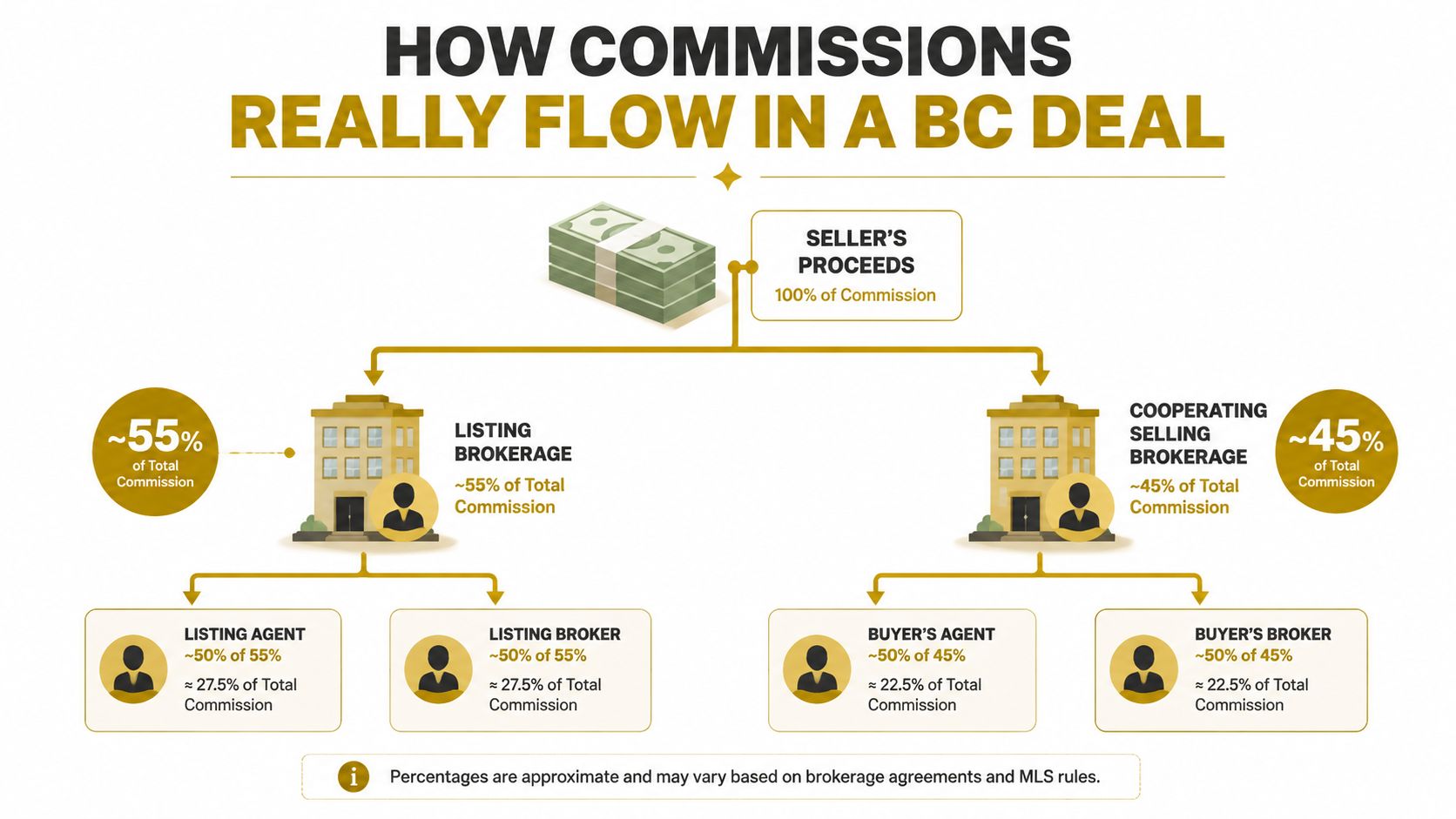
In a Maple Ridge sale, the seller typically pays the commission from the sale proceeds. The listing brokerage receives the agreed amount, then allocates a cooperating portion to the buyer's brokerage. Each brokerage handles its own internal agent compensation. Buyers often do not pay a separate commission at closing, but the arrangement still affects the terms they sign and the homes they can realistically pursue.
Some brokerages reference a general 45/55 split between buying and selling agents, although actual rates and allocations vary by agreement. The BC commission calculator illustrates the commonly discussed structure. It should not be treated as a fixed BC benchmark.
A Maple Ridge example
Consider a hypothetical $1.1 million Albion detached sale, using the commission assumptions in the scenario. A 5% listing-side amount would apply to one portion of the transaction, while a 2.5% buyer-side amount would apply to the other portion. The exact agreement, applicable taxes, negotiated rates, and brokerage arrangements must be confirmed in writing. Commission is not a universal fixed charge.
The seller normally does not hand a separate cheque to the buyer's agent at the kitchen table. The agreed amounts move through the sale proceeds and are distributed between the brokerages, which then compensate their agents according to their own arrangements. A seller comparing listing proposals should ask for the total cost, the listing-side amount, the cooperating amount, applicable taxes, and any additional charges.
What buyer representation changed
The 2025 buyer-representation environment makes compensation a more explicit part of the buyer representation agreement. Buyer-agent compensation is negotiated separately rather than set by the listing agent. That discussion now belongs early in the buyer's relationship with an agent, before an offer creates pressure.
For sellers, this changes how the listing-side offer is discussed with agents and how represented buyers may assess a property. For buyers, the agreement should be read before viewing homes. Ask what the agent will be paid, what happens if the seller's offered amount does not cover that compensation, and what obligations continue if the buyer finds a property independently.
A practical explanation of what real estate commission means for buyers and sellers can help clarify the terminology. The point is not to chase the lowest percentage. It is to understand who gets paid, from which portion of the transaction, and what service each side is expected to provide.
Dual Agency and Who Represents the Buyer
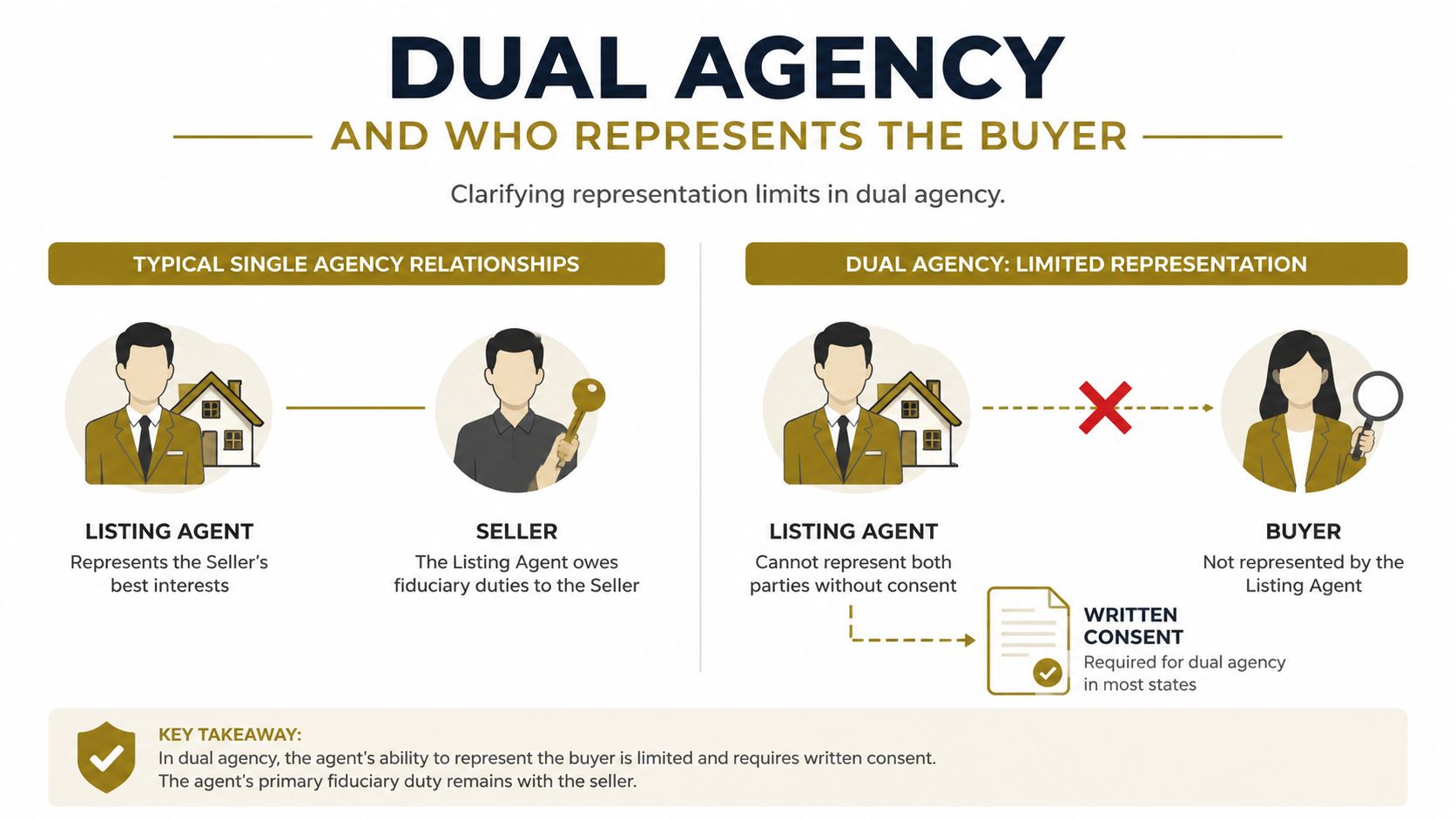
A listing agent standing beside a sign outside a Silver Valley townhome doesn't automatically represent the person walking through the front door. The agent may be hosting the showing for the seller, communicating information, or explaining the offer process. None of those actions alone creates buyer loyalty.
In British Columbia, an agent generally can't represent both sides of the same transaction in the normal course of business. Dual agency is limited to a narrow remote-location exception where separate representation is impracticable, and disclosure must be made to both parties. The Clicklaw guide to selling a home outlines the restriction and its exception.
Convenience can carry a cost
Dual agency may appear convenient in a soft Cottonwood segment. A seller wants a quick, clean transaction, and a nearby family wants to buy without bringing another professional into the discussion. But the agent's ability to advocate becomes restricted because the agent can't freely use confidential information from one side to advance the other side's position.
The agent can't properly advocate for the seller's maximum price while also advising the buyer on the lowest workable price. The agent also can't give both parties the same candid advice about motivation, urgency, or negotiating limits. Representation clarity is therefore a strategic issue, not just an administrative form.
If the person across the table knows both sides' private information, neither party should assume they still have the same negotiating advantage.
BC's rules make the listing-agent versus buyer-agent distinction legally meaningful because the sides have different duties, loyalties, and disclosure obligations. Anyone considering an unusual arrangement should review the terms carefully and ask what advice the professional can and can't provide. A broader discussion about professional boundaries appears in when to draw the line with real estate clients.
The representation question should be settled before an offer is written. The following video provides additional context on how boundaries can affect a real estate relationship.
Choosing the Right Representation for Your Situation
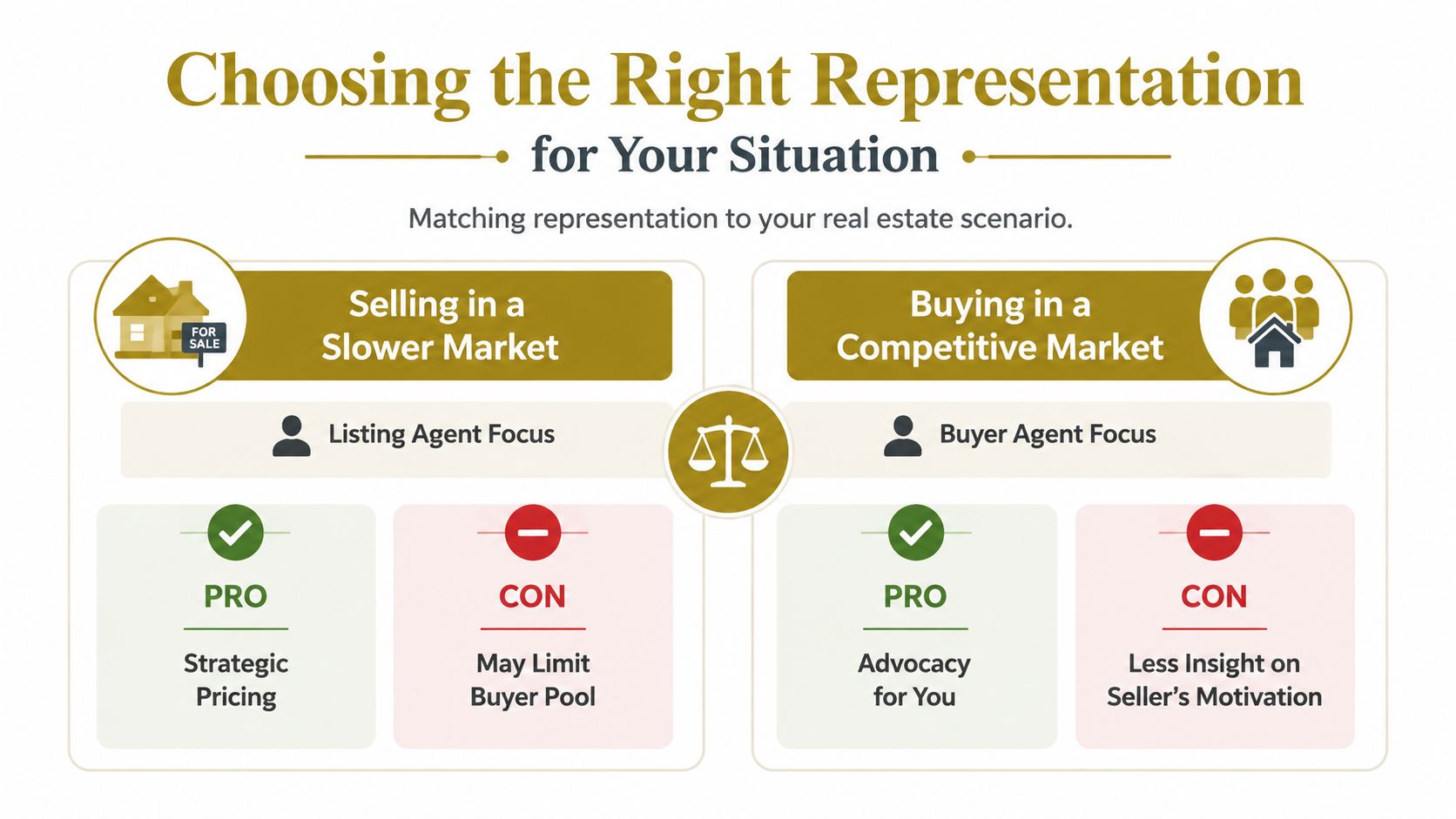
There isn't one correct answer for every Maple Ridge move. The right emphasis depends on the property, the neighbourhood, the market response, and the risks the client needs help managing.
Selling where price and exposure do the heavy lifting
Owners of Cottonwood condos and townhomes should scrutinise listing-side capability. In a slower segment, an ambitious asking price can reduce early interest, while weak presentation can make reasonable pricing look excessive. The listing agent needs a clear launch plan, accurate local comparisons, disciplined feedback analysis, and a strategy for responding to limited offers.
School access and outdoor space also affect how buyers evaluate family-oriented areas. Maple Ridge is served by School District 42, which operates 22 elementary schools, 6 secondary schools, and 2 alternate schools for about 16,000 students, according to local school information from Maple Ridge school guidance. Silver Valley planning also defines neighbourhoods around a 200-metre, 2-minute walking radius from a central community or park space and a transit stop, with school parks intended to be within a 5 to 10 minute walk of most dwellings, as set out in the Silver Valley Area Plan. Those details can shape positioning, not just lifestyle descriptions.
Buying where the offer needs protection
A buyer competing for detached inventory in West Maple Ridge should normally seek dedicated buyer representation and a signed buyer representation agreement. The buyer's agent can focus on conditions, financing risk, inspection findings, timing, and whether the offer is stronger because of its structure rather than merely its price.
The buyer also needs local due diligence. An out-of-area agent may not know how flood-plain overlays, well-water systems on rural properties, or school catchment boundaries affect a particular home and its resale appeal. Local knowledge doesn't replace inspections or legal advice, but it helps identify the questions that need to be asked.
A brokerage or agent may also use realtor social media content to keep listing promotion organised across channels. That can support exposure, but social posting won't compensate for weak pricing, poor disclosure, or an agent who can't explain the neighbourhood's actual buyer profile.
For a broader selection framework, buyers and sellers can review how to choose a realtor. The strongest choice is the professional whose process matches the transaction's real risk.
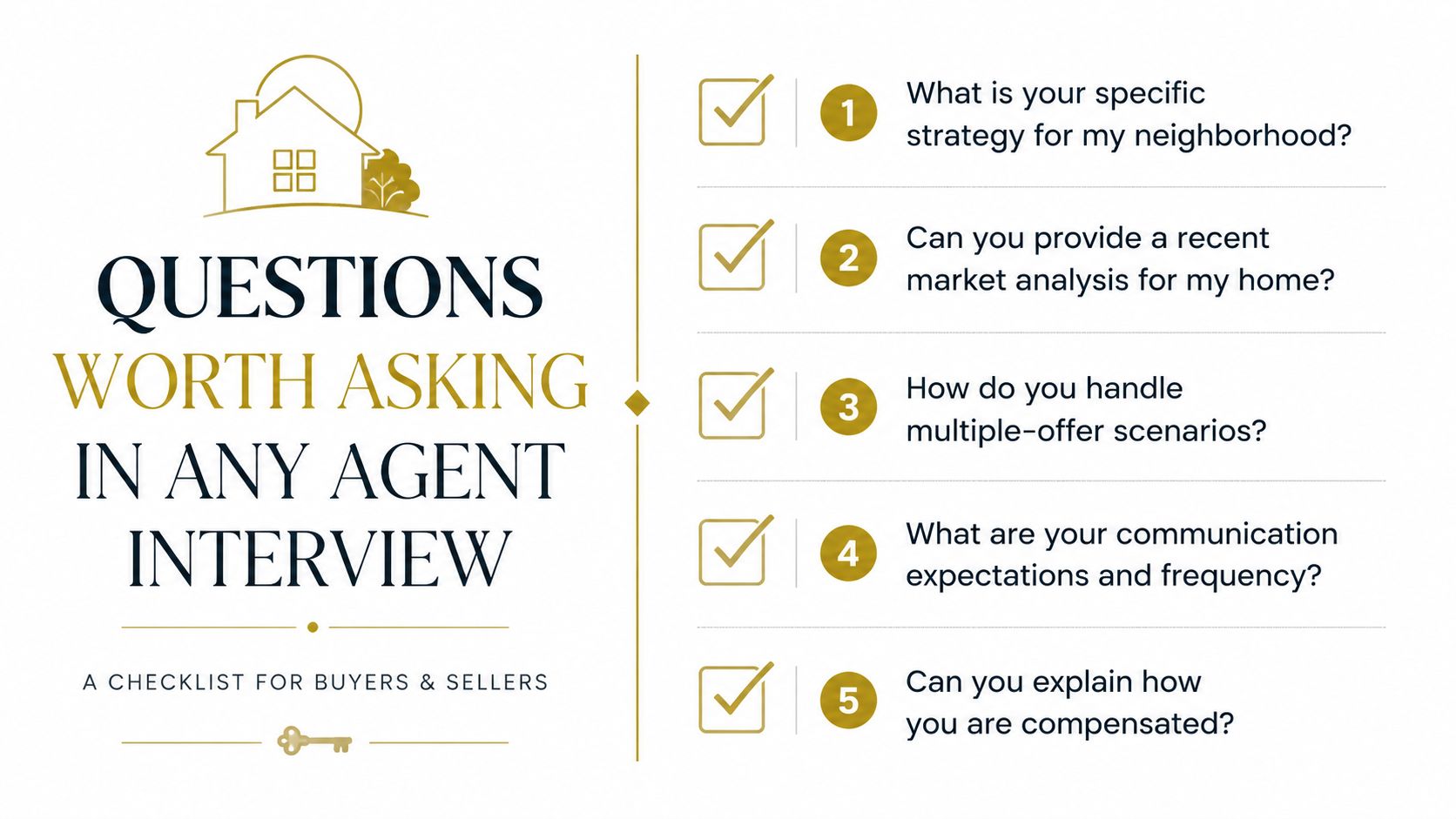
Questions Worth Asking in Any Agent Interview
Most agent interviews drift into broad promises about marketing, networks, and service. Those words don't tell a Cottonwood condo seller how the agent will respond to weak showing feedback, or tell a West Maple Ridge buyer how an offer will be protected when another buyer appears.
A useful interview asks every candidate the same questions. That makes vague answers visible and allows a seller or buyer to compare process rather than personality.
Experience and neighbourhood knowledge
Ask for recent activity in the specific pocket, not a general claim about Maple Ridge. A candidate should be able to discuss relevant property types, buyer objections, competing listings, and the difference between a Silver Valley townhome, an Albion family home, and a Cottonwood condo.
Useful questions include:
- Local evidence: What recent transactions or market observations support the proposed price?
- Property fit: How would the strategy change for a rural Pitt Meadows property with well water or a home affected by an overlay?
- Buyer profile: Which features are likely to matter most to the buyers who will view this property?
Representation and disclosure
Ask directly whether the candidate represents the seller, buyer, or both under the proposed arrangement. Buyers should ask whether the professional will enter a designated buyer representation agreement and explain the compensation terms before showings or offer preparation.
Sellers should ask how the candidate handles direct inquiries from unrepresented buyers. A clear answer should explain what information can be shared, what advice cannot be given, and how the buyer can obtain independent representation.
Commission transparency
The commission discussion should be specific. Ask the listing agent to separate the listing-side amount from the cooperating amount and explain how each affects the seller's proceeds. On a hypothetical $1.1 million sale, the candidate should be able to walk through the agreed assumptions without presenting the example as a universal rate.
Ask the buyer's agent what the representation agreement says if the seller's offered compensation differs from the amount negotiated with the buyer. If the answer is unclear, the agreement needs closer review before the relationship begins.
Communication and transaction management
Finally, ask who attends inspections, who communicates during subjects, how often updates arrive, and who handles urgent issues when the primary agent is unavailable. A polished presentation matters, but a deal also requires organised follow-through after acceptance.
A vague answer is still an answer. If a candidate can't explain the representation and compensation structure plainly, the paperwork probably won't become clearer later.
Your Next Step in Maple Ridge or Pitt Meadows
The listing-agent versus selling-agent decision should be made before the first offer, not after a buyer appears. A seller should decide whether the property needs stronger listing-side pricing and exposure work, while a buyer should decide whether dedicated advocacy is necessary for conditions, valuation, and negotiation.
A practical process has three parts:
- Match the representation to the pocket. A Cottonwood condo may require careful positioning and feedback management. A West Maple Ridge detached home may require a buyer's agent who can protect the buyer in a competitive offer. A Pitt Meadows property may bring its own questions about land, services, access, and local resale considerations.
- Interview comparable candidates. Speak with at least two candidates from each relevant side, then ask the same checklist questions. Compare their neighbourhood reasoning, communication standards, marketing plan, offer strategy, and explanation of compensation.
- Confirm the relationship in writing. Before the first showing or listing launch, identify who represents the client, what the agreement covers, how compensation is negotiated, and what happens if the other side is unrepresented.
BC's rules apply in Pitt Meadows as they do in Maple Ridge. The geography changes, but the need for clear loyalty, disclosure, and compensation terms doesn't. The cost of choosing poorly can be measured in tens of thousands of dollars through pricing mistakes, weak negotiation, avoidable exposure, or an agreement the client didn't understand.
A short discovery call can help a homeowner or buyer map the representation options before taking the next step. The conversation should focus on the property, neighbourhood, timing, and the side of the transaction that needs the strongest protection.
Royal LePage Brookside Realty Property Management offers buying and selling guidance, pricing and market valuations, property marketing, negotiation, and property management services in Maple Ridge and Pitt Meadows. Visit Royal LePage Brookside Realty Property Management to discuss which representation structure fits the transaction before signing an agreement.