
A non-owner-occupied investment property in British Columbia generally requires at least 20% down. That means a $600,000 rental typically needs $120,000, while an $800,000 rental typically needs $160,000 before closing costs and reserves.
A common Maple Ridge scenario starts with a buyer finding a townhouse that appears manageable because the buyer previously purchased a home with a much smaller down payment. The financing conversation changes as soon as that townhouse becomes a pure rental. The buyer isn't planning to live there, insured high-ratio financing generally isn't available, and the cash requirement rises sharply.
The useful question isn't only, “How much is the investment property down payment?” It's, “How much cash can this investor commit without making the property fragile?” The distinction matters in Maple Ridge, Pitt Meadows and the Fraser Valley, where a purchase that works on a simple mortgage calculator can become difficult after closing costs, vacancy and repairs are included.
Table of Contents
- What an Investment Property Down Payment Actually Looks Like in Maple Ridge
- How Occupancy and Property Type Change the Minimum
- Calculating the Real Cash You Need to Close
- Ways to Source the Down Payment and Other Cash
- Why More Than the Minimum Often Makes the Deal Work
- How Lenders Underwrite an Investment File in BC
- Next Steps for a Maple Ridge Investor
What an Investment Property Down Payment Actually Looks Like in Maple Ridge
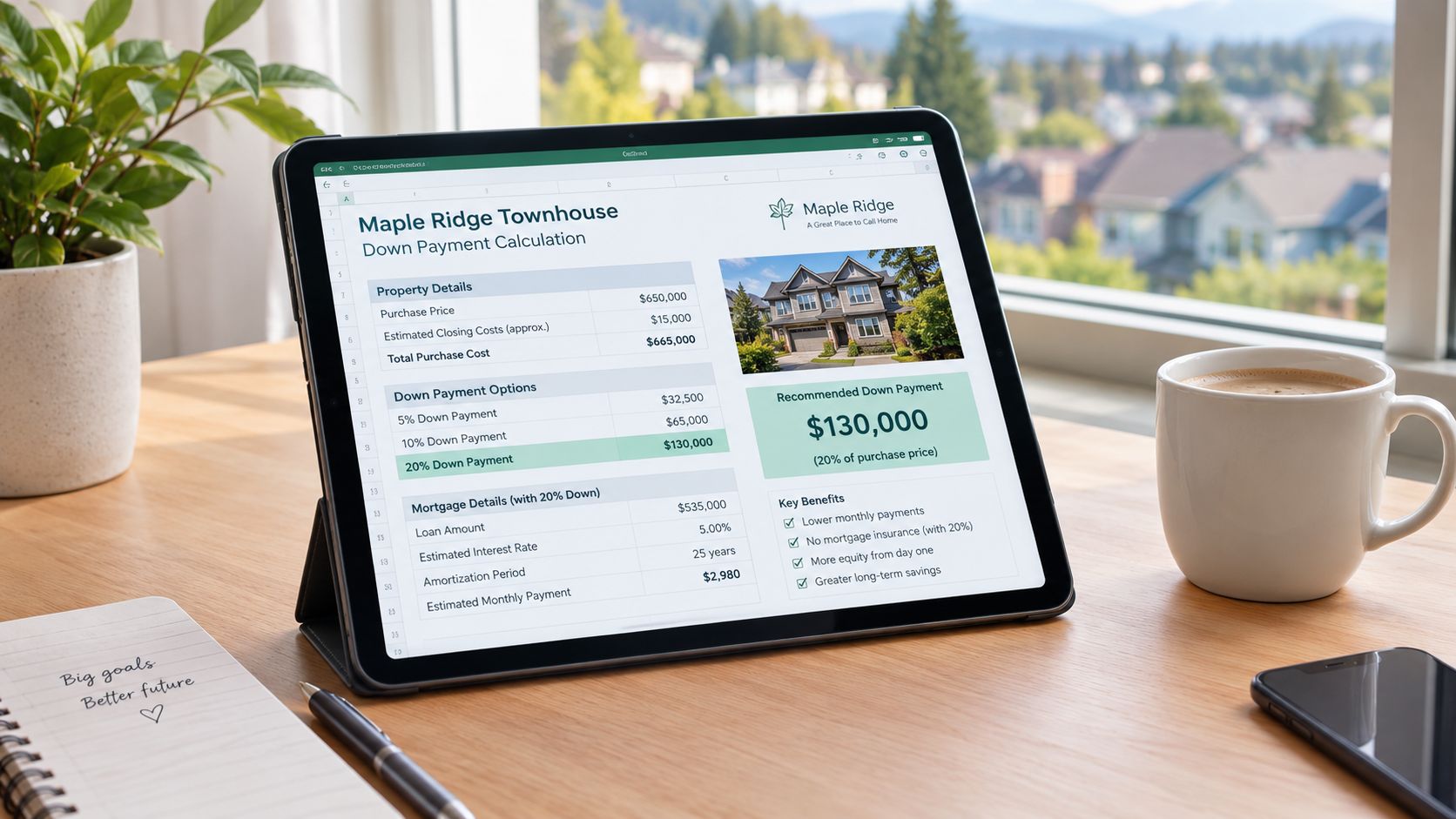
Consider a $650,000 Maple Ridge townhouse bought as a pure rental, with no owner occupancy. The headline calculation is straightforward: 20% down equals $130,000. That isn't the 5% used for an eligible owner-occupied purchase. It's the conventional cash floor for a non-owner-occupied residential rental under Canadian mortgage rules, as explained in current guidance on financing rental property in Canada.
Two simpler examples make the difference harder to ignore:
- A $600,000 investment property requires $120,000 down at 20%.
- An $800,000 rental property requires $160,000 down at 20%.
Those figures describe the down payment only. They don't include legal work, property transfer tax, an appraisal, inspection, insurance, setup costs or cash reserves. A buyer who has exactly $130,000 available for the $650,000 townhouse doesn't have a $130,000 down payment. That money also has to cover every other cash requirement unless separate funds are available.
Why the 20% floor matters
The rule exists because a pure rental generally falls outside insured high-ratio mortgage financing. The borrower normally needs conventional, uninsured financing, with the lender carrying more exposure and assessing the application under stricter qualification rules. Federal consumer guidance distinguishes owner-occupied purchases from investment properties, and CMHC's purchase guidance explains the mortgage-insurance framework that supports eligible homeownership financing.
For eligible owner-occupied homes, the minimum can be 5%, while owner-occupied small multi-unit properties can use different tiers depending on unit count. That lower threshold doesn't transfer automatically to a duplex, suite or townhouse purchased strictly for rent.
Investors reviewing local affordability can use Brookside's guide to Maple Ridge home prices, but the purchase price is only the starting input. A useful explanation of loan-to-value calculations is PropLab's LTV guide for investors. The practical conclusion is blunt: 20% is the floor, not the complete cash plan.
How Occupancy and Property Type Change the Minimum
Occupancy can change the financing answer before the lender even looks at the rent. A buyer who lives in one side of a Maple Ridge duplex may qualify under owner-occupied rules, while a buyer who rents both sides generally faces the 20% uninsured-investment baseline.
Federal price-based rules state that eligible owner-occupied financing uses 5% on the first $500,000, 5% on the first $500,000 plus 10% on the portion up to $1.5 million, and 20% at $1.5 million or more. The Financial Consumer Agency of Canada's down-payment guidance sets out those tiers.
| Scenario | Property Type | Price Tier | Minimum Down % | Example Cash Needed |
|---|---|---|---|---|
| Owner-occupied | 1–2 units | First $500,000 | 5% | 5% of the eligible price |
| Owner-occupied | 1–2 units | $500,000 to $1.5 million | 5% on first $500,000, 10% on remainder | Tiered calculation |
| Owner-occupied | 3–4 units | Eligible owner-occupied purchase | 10% can apply | 10% of the eligible price |
| Pure rental | Condo, house or small multi-unit | Any standard residential price below the applicable insured threshold | 20% | 20% of purchase price |
| Pure rental | Higher-risk or non-resident file | Lender-specific underwriting | 25% to 35% may apply | Based on lender decision |
A house with a legal basement suite can still be an owner-occupied principal residence if the borrower lives in the home. The lender may count only part of the projected or documented rental income, however, so the lower down payment doesn't guarantee that the buyer qualifies for the desired purchase price.
Property classification creates another fault line
A duplex or small multiplex needs a careful unit-count and occupancy review. Properties with several residential units can move into different underwriting categories, and properties with 5+ units may not be treated like a standard small residential rental. A strata building also needs its own review. Older Maple Ridge condos may have rental restrictions, bylaws or building issues that affect whether the intended use is financeable.
Misrepresenting occupancy is not a shortcut. If a borrower says the property will be owner-occupied but never lives there, the lender or insurer may treat the application as inaccurate. That can create serious consequences, including default-related action and repayment of insurance funds where insurance was improperly obtained. Buyers should describe the intended use accurately from the first conversation and review strata and detached rentals in Maple Ridge before writing an offer.
Calculating the Real Cash You Need to Close
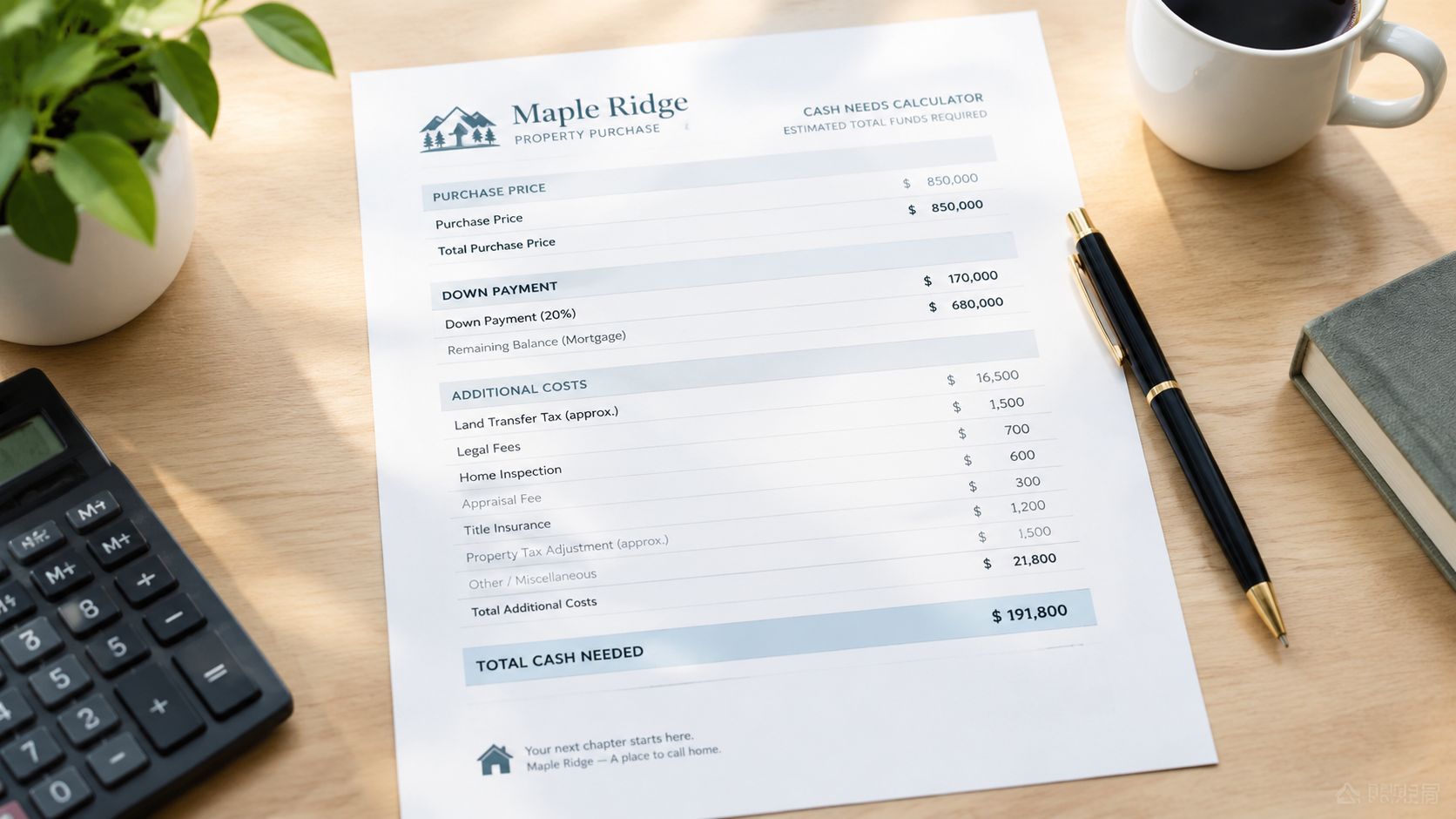
The down payment is the largest line on the worksheet, but it isn't the only line. For a Maple Ridge resale townhouse bought as a pure rental, the first entry is 20% of the purchase price, followed by every cost that must be paid before or shortly after completion.
A practical worksheet includes:
- Down payment. This is the 20% conventional baseline for a standard non-owner-occupied rental.
- Property transfer tax. The applicable BC calculation uses 1% on the first $200,000 and 2% from $200,000 to $2 million, with an additional 2% foreign buyer tax where applicable. Buyers should verify current provincial rules for their circumstances.
- GST. GST can apply to a new build. It generally isn't treated the same way as a resale purchase, so the contract and tax treatment need review before the buyer assumes the advertised price is the final cash requirement.
- Professional and transaction costs. Legal fees, title insurance, appraisal and inspection all belong in the cash plan. A typical legal-fee estimate may be $1,500 to $2,500, an inspection may be $500 to $700, and an appraisal may be $400 to $600. These are planning ranges, not guaranteed quotes.
- Setup and reserve money. The property may need appliances, safety work, cleaning, furnishing or initial repairs before a tenant moves in.
A $650,000 resale townhouse therefore needs more than its $130,000 down payment. A realistic planning range can reach approximately $138,000 to $148,000 before a substantial operating reserve, depending on tax status, professional fees and transaction details.
New construction needs a separate calculation
An $825,000 new-build duplex can require more than $190,000 once the down payment, applicable transaction costs and GST are included. The exact amount depends on the contract, tax treatment, buyer status and closing adjustments, so a buyer shouldn't rely on the resale worksheet for a new build.
Lenders may also want reserves beyond the closing funds. They can assess whether the borrower can carry the mortgage during vacancy, repairs or an unexpected cost. Investors comparing conventional underwriting with DSCR and conventional loan structures should still keep the same discipline, because a property-based qualification method doesn't eliminate ownership expenses.
Brookside's BC closing-cost calculator can help organise the initial worksheet. The strongest approach is to separate completion cash from operating reserves. Down payment money that has to be spent immediately isn't a reserve, and a property that closes with no liquidity is exposed from the first vacancy.
Ways to Source the Down Payment and Other Cash
Maple Ridge and Pitt Meadows investors usually assemble the cash from one or more familiar sources. The source matters because lenders need to verify where the money came from, whether repayment is required and whether the funds create another obligation.
| Source | Lender Treatment | Tax Angle | Speed to Close |
|---|---|---|---|
| Personal savings | Straightforward when statements show accumulation and ownership | No borrowing cost | Usually fastest |
| Immediate-family gift | Requires a gift letter and documented deposit history | A genuine gift generally isn't taxable in Canada | Fast when already deposited |
| HELOC on an existing home | Counts as debt and affects qualification; requires available equity | Interest deductibility depends on how the borrowed money is used | Requires approval or re-advance |
| Partner or co-borrower | Changes title, liability and underwriting for all parties | Spousal attribution and partnership treatment need professional review | Legal setup can take longer |
Savings and gifted funds
Personal savings offer the cleanest story. The borrower can show that the funds belong to the borrower, have remained available and aren't supported by undisclosed debt.
A gift from an immediate family member can work, but it isn't informal money. The lender normally wants a signed gift letter, proof of the donor's ability to provide the funds and a clear deposit trail. The recipient should expect a seasoning review, including 30 days in the recipient's account where required by the lender. A practical explanation of the paperwork appears in this mortgage gift letter guide.
Home equity and partnerships
A HELOC can release equity from an existing Maple Ridge home, but the borrowed funds appear as debt on the mortgage application. The lender must assess the HELOC payment alongside the new rental mortgage, and a re-advance may require separate approval.
A partner can contribute cash, income or borrowing strength, but the arrangement changes who owns the property and who remains liable. A written agreement should address contributions, repairs, vacancies, sale decisions and an exit plan. Tax treatment can also become more complicated, particularly between spouses, so buyers should obtain professional tax advice rather than assume that shared ownership produces the intended result.
Brookside's guide to buying an investment property can help investors organise the purchase process. The speed ranking is practical: savings close fastest, deposited gifts can follow, HELOCs need approval, and partnerships usually take the most coordination.
Why More Than the Minimum Often Makes the Deal Work
The cheapest entry point isn't always the most workable investment. A buyer who puts 20% down on a rental may preserve cash for another purchase, but the larger mortgage can leave less room for vacancy, repairs and lender qualification.
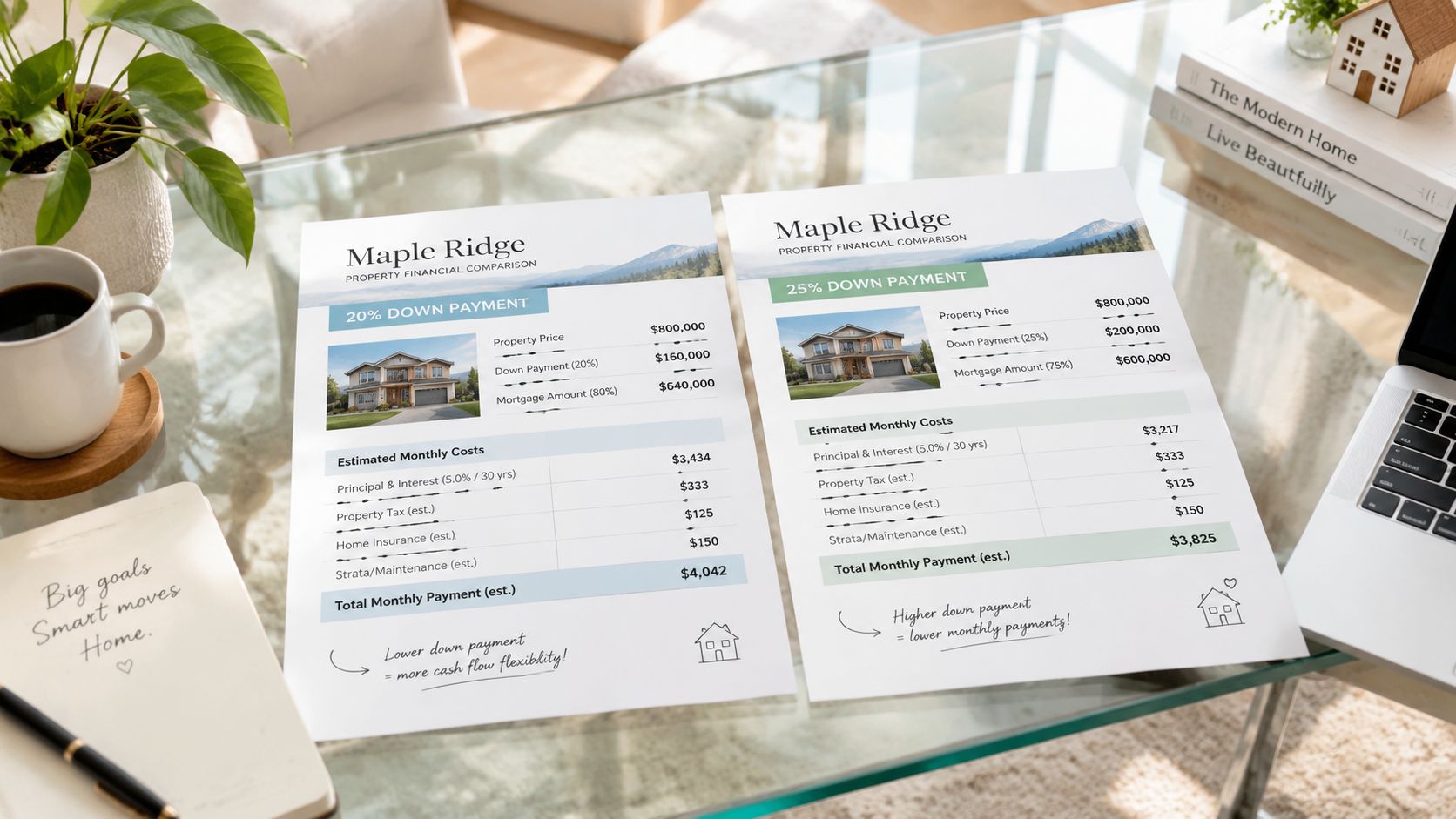
Consider a $750,000 Maple Ridge duplex or single-family rental. At 20% down, the buyer contributes $150,000 and finances the remaining purchase balance before other adjustments. At 25% down, the buyer contributes $187,500, which is $37,500 more cash, and reduces the mortgage principal by the same amount. At 30% down, the contribution becomes $225,000, or $75,000 more than the 20% scenario.
The precise monthly payment depends on the rate, amortisation and lender, so a responsible comparison should use the actual mortgage quote rather than a generic estimate. The direction is certain: more equity means less borrowed principal and a lower payment, all else being equal.
The cash-flow lever
A lender may also view the file more comfortably when the borrower contributes more equity. Some lenders use 25% or even 25% to 35% down for higher-risk or non-resident files, depending on the property, borrower income and rental assumptions, as discussed in BC investment-property down-payment guidance.
Rental income treatment varies by lender and product. Some lenders may recognise a larger share of documented rent when the overall file is stronger, while a thinly capitalised application can face more conservative treatment. Investors shouldn't build a deal around gross rent alone.
Practical rule: The extra 5% or 10% isn't idle cash when it prevents a vacancy month, special assessment or renewal shock from turning a manageable rental into a personal cash drain.
The right comparison has two columns: 20% down versus 30% down, with mortgage payment, eligible rent, property taxes, strata costs, insurance, maintenance and reserves shown separately. If the 20% version only works when every month is fully occupied, the property isn't ready for an offer.
How Lenders Underwrite an Investment File in BC
An underwriter doesn't approve a rental because the rent appears attractive in a listing. The file is tested through occupancy, property type, borrower income, existing debt, rental documentation and the lender's treatment of the subject property.
The first question is classification. A pure rental generally requires uninsured conventional financing, while an owner-occupied strategy may fit a different insured framework. The underwriter then reviews the purchase price, proposed loan-to-value, property condition and whether the building is a straightforward residential asset or a more complex strata or multi-unit property.
Rental income and debt service
Lenders may use a portion of market or lease income, but they don't automatically count every dollar. Treatment varies by lender, and a borrower should ask specifically how rental income will be added back, what documents are required and whether the lender uses a conservative vacancy assumption.
Debt-service coverage is another important lens. A rental whose income barely covers the mortgage can be difficult to approve or difficult to operate, even if the borrower has strong employment income. The lender also reviews the applicant's broader debts, including existing mortgages and any HELOC used to fund the investment.
BC Assessment information and a recent appraisal can influence the lender's view of value. A clean, well-documented single-family rental in Maple Ridge may present a simpler file than a strata property with rental restrictions, uncertain fees or building concerns.
The preparation standard
Borrowers should prepare:
- Income evidence: T4s, tax returns, notices of assessment and employment documentation.
- Rental support: Lease information, comparable rent evidence and a clear explanation of the proposed use.
- Asset statements: Bank and investment statements showing the down payment and closing funds.
- Reserve evidence: Separate liquid funds that won't be consumed at completion.
- Property documents: Strata minutes, budgets, bylaws and insurance information where relevant.
A mortgage pre-approval conversation should address the actual investment scenario, not only a principal-residence borrowing limit. The investor with documented funds, clean records and a realistic rental worksheet will present a stronger file than the investor who only meets the minimum down payment.
Next Steps for a Maple Ridge Investor
The most effective investors settle the financing facts before becoming emotionally attached to a listing. The process should be organised around evidence, not an optimistic rent estimate.
A practical sequence
- Confirm the cash trail. Pull 12 months of statements and verify that the down payment and closing funds sit in accounts the lender can understand. A joint line of credit or unexplained transfer can create avoidable questions.
- Arrange the correct pre-approval. Use a broker familiar with non-owner-occupied files. Ask how rental income will be treated, what stress-test assumptions apply and whether a HELOC on an existing Maple Ridge home can be blended into the plan.
- Set the buy box. Define the maximum price, preferred property type, target rent and acceptable monthly shortfall. Comparable rents from CMHC reports are more useful than optimistic listing assumptions, and current figures should be checked because rental conditions change.
- Prepare the documents. Gather T4s, two years of notices of assessment, draft lease information, property-tax estimates and strata minutes where applicable.
- Search with discipline. A local search can focus on target pockets such as Silver Valley and Albion, while keeping the financing ceiling visible. Property condition, strata rules and likely tenant demand still need separate review.
- Write with financing certainty. Offer timing, subject clauses and deposit decisions should reflect the actual approval status, not the buyer's hope that the lender will accept a thin reserve.
The down payment is only one part of the investment decision. A Maple Ridge or Pitt Meadows rental should survive a conservative rent assessment, a period without a tenant and an ordinary repair without forcing the owner to borrow again.
Royal LePage Brookside Realty can help an investor connect the financing plan to a local property search, review suitable houses, townhomes or small multi-unit opportunities and coordinate the buying process in Maple Ridge and Pitt Meadows.
Visit Royal LePage Brookside Realty to discuss a financing-ready investment search in Maple Ridge or Pitt Meadows. Bring the proposed down payment, available reserves and target rent, so the next conversation can focus on properties the investor can carry.