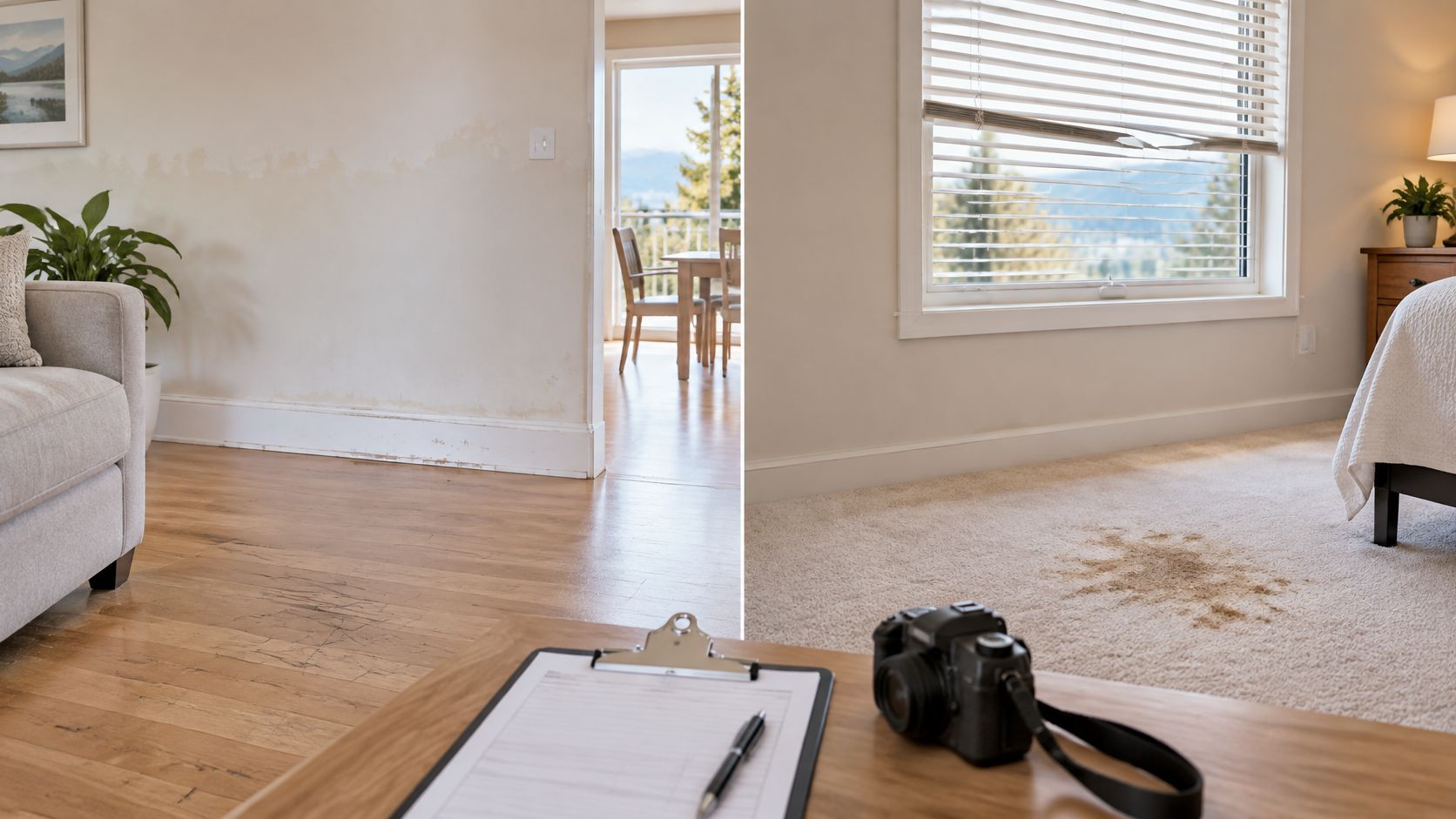
The furniture is out, the keys are ready to change hands, and the empty rental suddenly shows every scuff, stain and faded patch. A landlord may see a repair bill; a tenant may see the ordinary signs of living in a home. Neither impression settles who should pay.
For Maple Ridge and Pitt Meadows rentals, the useful questions are what caused the condition, what existed at move-in, and what loss can be proved. Even genuine damage doesn't automatically justify a brand-new replacement, and a legitimate disagreement doesn't let a landlord hold a deposit indefinitely.
Table of Contents
- How BC Separates Wear from Damage
- Room by Room Situations in Local Rentals
- How to Document Move-In and Move-Out
- When Repair Beats Full Replacement
- How Deposit Deadlines Decide the Claim
- Taking a Wear or Damage Dispute to the RTB
- Next Steps for Maple Ridge and Pitt Meadows Readers
How BC Separates Wear from Damage
Normal wear and tear vs tenant damage in BC turns on cause and reasonable use, not only on whether something needs work. Natural deterioration belongs to the landlord's maintenance responsibilities. Damage caused deliberately or through neglect by a tenant, guest or pet can become the tenant's responsibility.
The BC government's repairs and maintenance guidance identifies faded wall paint, minor floorboard scuffs and worn carpet or tiles as reasonable wear, while section 37(2) of the Residential Tenancy Act requires tenants to leave the premises reasonably clean and undamaged except for reasonable wear and tear. A security deposit isn't available to pay for ordinary aging.
Wear and damage at a glance in BC
Maple Ridge and Pitt Meadows follow the same provincial Residential Tenancy Branch standard. Neither municipality has a separate test that turns normal aging into tenant damage.
| Condition | Typical classification | Who generally pays | Deposit use |
|---|---|---|---|
| Faded wall paint | Natural aging from ordinary use | Landlord | Not for ordinary wear |
| Minor floorboard scuffs | Natural aging from ordinary use | Landlord | Not for ordinary wear |
| Worn carpet or tile from traffic | Natural aging from ordinary use | Landlord | Not for ordinary wear |
| Broken fixture from impact or misuse | Deliberate act or neglect | Tenant if causation is shown | Only with written agreement or an RTB order |
| Unauthorized alteration | Beyond reasonable use | Tenant if causation is shown | Only with written agreement or an RTB order |
| Concentrated stain, impact mark or pet damage | Neglect linked to occupant, guest or pet | Tenant if causation is shown | Only with written agreement or an RTB order |
| Cleaning back to the move-in standard | Restoration, not an upgrade | Tenant for the proven cleaning only | Only the agreed or ordered amount |
These are starting classifications, not automatic findings. The RTB's landlord and tenant responsibility guideline supports assessing reasonable use and responsibility rather than treating every changed surface as damage.
A tired-looking room isn't, by itself, evidence that a tenant damaged it.
What must connect the condition to the tenant?
A landlord seeking compensation needs more than proof that work would improve the home. The landlord needs a connection between the tenant's conduct and a specific loss. The item's age and useful life also matter when deciding what restoration reasonably costs.
For example, repainting a faded hallway before another tenancy may be sensible property maintenance. That doesn't make the outgoing tenant responsible for the painting invoice.
The plain-language explanation of BC's Residential Tenancy Act provides broader tenancy context. This article explains public rules and practical documentation, not legal advice.
Room by Room Situations in Local Rentals
A faded hallway, a broken blind and a carpet stain can all appear on the same move-out report, but they do not point to the same cause. In Maple Ridge houses and Pitt Meadows condos, look at the pattern, severity and likely cause. Even if a tenant caused damage, the reasonable remedy may account for the item's age and condition rather than charge for a full new replacement.
The BC government's resources for renters outline the broader responsibility framework. Apply it to each item: compare its move-in and move-out condition, then consider what work would restore it.
What tips common Maple Ridge and Pitt Meadows disputes
| Item | More like wear | More like tenant damage | What tips the call |
|---|---|---|---|
| Walls | Even fading or a few small picture holes | Many large holes, unauthorized colour, or impact craters | Move-in notes, hole size and number |
| Floors | Traffic wear and minor scuffs | Deep gouges, burns or concentrated stains | Pattern versus a single event |
| Carpet | Thinning in walkways | Pet odour, spills or tears tied to use | Dated photos and odour or stain location |
| Appliances | Age-related decline | Cracked parts, missing pieces or neglect | Age plus whether function was abused |
| Fixtures and blinds | Loosening with age | Broken by impact or removed | Move-in presence and break pattern |
| Cleanliness | Ordinary dust after reasonable use | Soil, waste or odour beyond the move-in standard | Comparison with the move-in report |
A few small picture holes may be consistent with ordinary use. Large mounting holes, torn drywall or uneven patches call for closer attention. The number and size of holes, move-in notes and any reasonable hanging instructions help distinguish a small repair from more extensive damage.
Age matters with appliances, too. An older refrigerator that cools poorly is different from one with a cracked shelf or missing drawer. Poor cleaning may support a cleaning charge, but it does not by itself show that the appliance needs replacement.
Carpet discolouration needs a closer look before anyone assumes another cleaning pass will fix it. J.G. Carpet Cleaning LLC explains when carpet bleach damage needs professional help, including treatment methods for bleach spots.
How would these situations be assessed?
Consider three hypothetical local rentals:
- A five-year Maple Ridge tenancy: The hallway paint has faded evenly, with light traffic scuffs. Without signs of misuse, that pattern is more consistent with routine maintenance than a tenant-funded repaint.
- A one-year Pitt Meadows tenancy: A blind is broken, and a bedroom has pet odour absent from the move-in record. These conditions warrant investigation. Any claim still needs evidence connecting them to the tenancy and supporting the proposed remedy.
- A condo with an existing chip: The move-in report records a chipped countertop corner. If the chip remains unchanged at move-out, its presence alone does not show new damage.
For cleaning, compare the rental's condition at both inspections. The aim is to restore reasonable cleanliness, not charge a tenant to improve a home that was already imperfect.
How to Document Move-In and Move-Out
A dated photo of a chipped counter can show its condition clearly. Pair it with the move-in report and a photo from the same angle at move-out, and the record becomes easier to compare. An unsupported invoice proves that work was billed, but not when the condition arose or who caused it.
What should the inspection record contain?
Complete the move-in inspection together.
Walk through the rental and record existing marks room by room. “Chip on the kitchen counter beside the sink” gives both parties a clearer starting point than “kitchen acceptable.” The rental property inspection checklist can help organise the walkthrough.Deliver the completed move-in report promptly.
Under BC's inspection process, provide the tenant with a copy within 7 days after the move-in inspection. The BC government's moving-out guidance explains the report requirements. Prompt delivery gives both parties a shared record while the condition is fresh.Photograph each detail and its location.
Take dated room views and close-ups of scratches, stains, broken fixtures and missing items. Use the same room names in the photos, notes and report, and preserve the original files rather than relying only on cropped screenshots.Compare move-out with the starting record.
Examine the same surfaces and fixtures, using matching photo angles where possible. For cleaning preparation, Maid in America's tenant cleaning guide offers a practical checklist. The move-in report and photos remain the reference for comparing condition.Provide the move-out report within the applicable deadline.
Give the tenant a copy within 15 days after the move-out inspection, or within 15 days after receiving the tenant's forwarding address in writing. Keep evidence that the report was delivered, such as a dated email or other delivery record. A completed report that was never provided leaves a gap in the inspection record.Record non-participation accurately.
Keep invitations, responses or refusals, along with the report completed at the inspection. If the tenant does not attend, follow the official inspection process rather than treating the missed appointment as permission to skip it.
Documentation rule: Match each move-out photograph to the closest available move-in view, so a reader can see both the condition and its location.
A consistent record makes it easier to distinguish an existing defect from a change during the tenancy, and to assess what the evidence supports.
When Repair Beats Full Replacement
The compensation question is the proven loss, not the size of the newest invoice. A contractor may reasonably recommend replacement for convenience, appearance or warranty reasons, but that recommendation doesn't automatically establish what a tenant owes.
The BC government's moving-out guidance on damage claims explains the importance of proving actual loss, connecting it to non-compliance and taking reasonable steps to minimise avoidable loss. Where significant loss isn't established, nominal damages rather than the requested compensation may be the result.
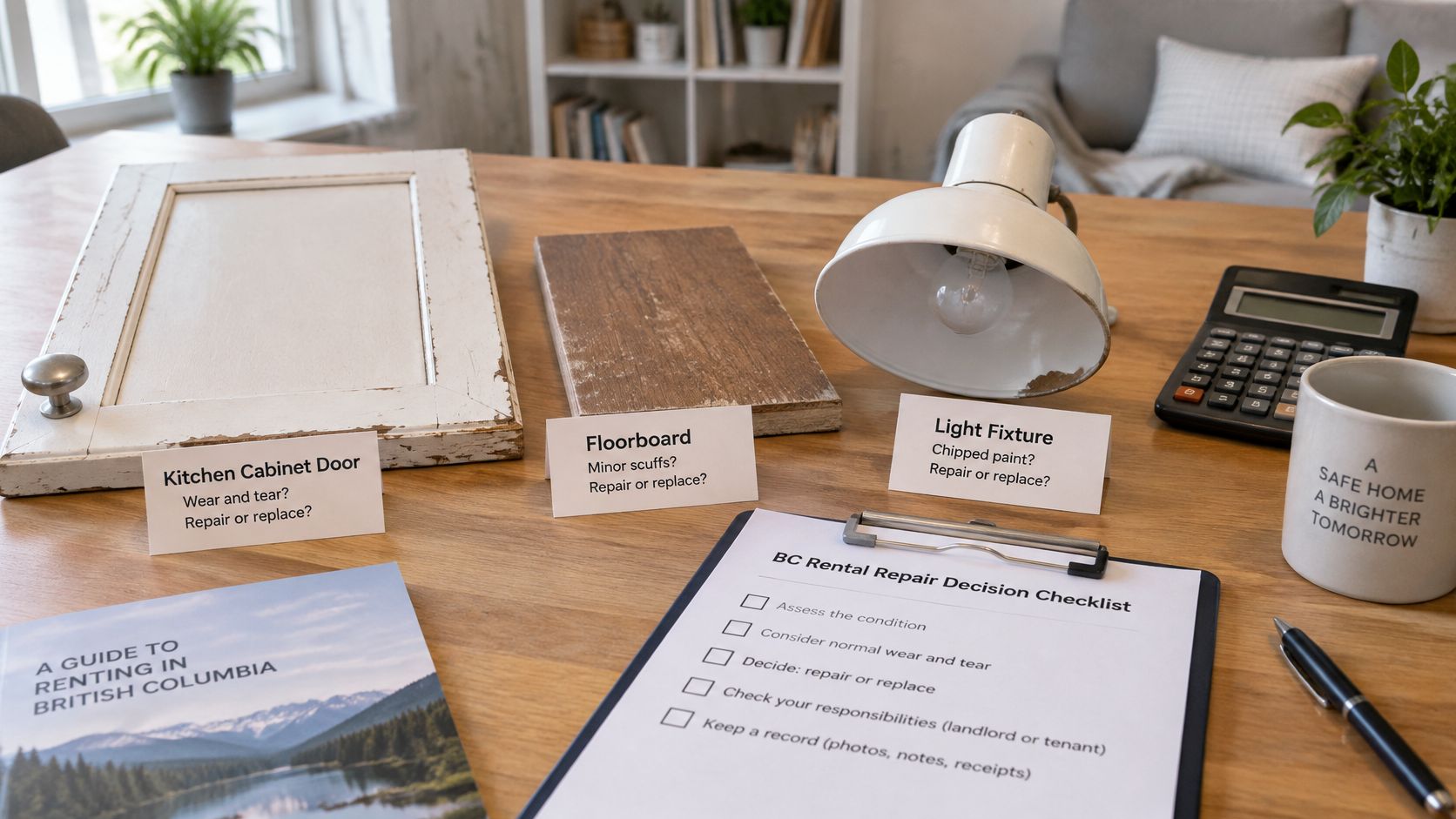
A repair assessment should distinguish necessary restoration from elective improvement.
What changes the reasonable amount?
The assessment should work through these factors in order:
- Age of the item: Installation records, purchase receipts and earlier inspection photographs help establish whether the damaged item was recent or already old.
- Remaining useful life: An item close to the end of its serviceable life doesn't carry the same remaining value as a comparable item recently installed.
- Condition at move-in: Existing wear, stains, cracks or unreliable operation affect what was lost during the tenancy.
- Repairability: Cleaning, patching or replacing a component may restore function without discarding the whole item.
- Betterment: A new item may leave the landlord with something substantially better than the tenant received. That improvement shouldn't automatically be included in the tenant's charge.
How do an older carpet and a nearly new blind compare?
Say an older carpet develops a concentrated stain during a tenancy. A specialist determines that local treatment can restore the affected area. The reasonable assessment starts with that repair option and the carpet's previous condition, not an invoice for replacing flooring throughout the rental.
Now consider a nearly new blind broken through misuse, with no suitable replacement component available. Comparable replacement may be necessary, and the lost remaining service could be much greater than in the carpet example. Neither scenario justifies an automatic result, but each explains why the payable amount may differ.
Even proven damage may not equal the invoice for brand-new materials.
For repairable wall marks, Alex Trend Painters' wall preparation tips for Dublin homeowners provide practical context on patching and preparation, not BC legal obligations. The relevant question remains whether a targeted repair can restore the surface.
A minor pet stain or a guest's broken fixture isn't automatically free of responsibility. Equally, a landlord should arrange timely repairs and avoid unnecessary replacement rather than letting a manageable defect become a larger claimed expense.
How Deposit Deadlines Decide the Claim
A landlord can identify genuine damage and still mishandle the deposit. The deposit process is separate from the question of whether a repair was needed, and an informal hold isn't a substitute for the required steps.
Under section 19(1) of the Act, the security deposit cannot exceed one-half of one month's rent; the BC government's deposits and fees guidance also explains the 15-day return-or-claim process after the later of tenancy ending or receipt of the tenant's written forwarding address. For a hypothetical rental at $1,600 per month, that cap produces a maximum security deposit of $800.
BC report and deposit clocks
| Event | Clock | What must happen |
|---|---|---|
| Move-in report | 7 days after the move-in inspection | Landlord gives the tenant the completed report |
| Move-out report | 15 days after the move-out inspection, or 15 days after the written forwarding address | Landlord gives the tenant the completed report |
| Security deposit cap | When the tenancy starts | No more than one-half of one month's rent |
| Return or claim | 15 days after the later of tenancy end or written forwarding address | Return deposit plus interest, get written consent, or apply for dispute resolution |
The landlord's practical choices are to return the deposit with applicable interest, obtain the tenant's written agreement to a specific deduction, or apply for dispute resolution within the required period. A message saying that money will be held until repairs are priced doesn't replace those choices.
What makes an informal hold risky?
Failing to handle the deposit properly can mean losing the right to retain it and facing double-deposit consequences. A disagreement about damage doesn't, by itself, excuse late handling.
The distinction between a cleaning allegation and a proven cleaning amount matters too. A landlord who establishes limited cleaning work hasn't necessarily established the broader repair claim, so the unproven balance isn't automatically available from the deposit.
The guide to BC damage deposit rules offers additional context for owners planning their end-of-tenancy administration. If the alleged loss exceeds the available deposit, a separate monetary claim may be needed rather than an informal deduction.
CMHC rental-market averages for Maple Ridge and Pitt Meadows are time-sensitive and should be checked against the current rental-market survey. For deposit planning, however, landlords should calculate the permitted amount from the rental's actual monthly rent, not a neighbourhood average.
Taking a Wear or Damage Dispute to the RTB
When a landlord and tenant cannot agree on a repair charge, the Residential Tenancy Branch (RTB) can decide whether the condition is ordinary wear or tenant-responsible damage. The Residential Tenancy Act sets out the statutory framework, and RTB dispute resolution applies it to the evidence in a specific case.
A landlord seeking compensation must prove damage beyond ordinary wear, an actual loss, a connection to the tenant or someone for whom the tenant is responsible, and reasonable efforts to limit the loss. A worse-looking item still requires proof of each element. Even when damage is established, the amount may depend on the item's age, remaining useful life and the cost of a reasonable repair, rather than the price of a brand-new replacement.
What belongs in the evidence file?
Organise the records so each claimed loss can be traced from the rental's starting condition to the work and cost being claimed.
- Both condition reports: The move-in and move-out descriptions establish the comparison.
- Dated photographs: Matching views help show whether a defect was present at the start or appeared later.
- Item age information: Receipts, installation records or credible maintenance records can help explain the item's remaining value.
- Separated invoices and estimates: Show cleaning, repair, comparable replacement and elective upgrades as distinct costs.
- Relevant communications: Messages about the defect, repair arrangements or an agreed deduction may help clarify what happened.
A complete repaint invoice may include ordinary maintenance alongside work on an impact hole. If the invoice does not separate those tasks, it may not show how much of the total relates to the tenant's damage.
What can the decision resolve?
An RTB decision can determine whether compensation is owed and, if so, the amount supported by the evidence. A new invoice is not automatically a payable loss: the proposed work, its cost and any adjustment for age or betterment still need to be justified.
The guide to the RTB-34 form for BC tenancy disputes explains the form used to apply for dispute resolution. Follow the official RTB instructions for the applicable forms and submission requirements.
A deposit dispute concerns money already held, while a claim for additional compensation concerns a further alleged loss. Each claim needs evidence to support the amount requested. No checklist can predict the outcome; the decision-maker assesses the evidence under the applicable rules.
Next Steps for Maple Ridge and Pitt Meadows Readers
When a tenant gives notice, start the move-out file that day. Keep the tenancy's condition records and repair decisions together so any later disagreement can be assessed item by item.
Maple Ridge and Pitt Meadows landlords and tenants follow the same provincial tenancy rules. For landlords, the practical next step is to assess each claimed loss against the item's condition and age, then choose a proportionate repair. Real damage does not automatically make a full replacement charge payable: the amount claimed should account for the item's remaining useful life and avoid charging the tenant for an upgrade.
What should each party do next?
- Tenants: Review the move-out condition report against the move-in record and identify any pre-existing defects. Refer to the earlier deposit guidance for the forwarding-address requirement and the applicable timeline.
- Landlords: Assess the condition, age and remaining useful life of each damaged item. Price a suitable repair before considering replacement, and follow the required deposit process promptly rather than holding funds while a disagreement continues.
Owners who prefer help with inspections, tenant placement and deposit timelines can explore licensed property management. Pitt Meadows property management services explain one option for owners who do not want to administer a tenancy themselves.
What should rental-property buyers and sellers consider?
A buyer reviewing an occupied rental can separate routine maintenance from a disputed tenant-damage claim when estimating near-term costs. A seller can make the same distinction when preparing a listing: keep a disputed deposit claim separate from the repair budget, rather than treating the deposit as money available to fund improvements.
Start the move-out file when notice arrives, then keep the condition record, repair assessment and deposit steps together. Royal LePage Brookside Realty provides licensed residential property management and local guidance for buyers, sellers and rental-property owners in Maple Ridge and Pitt Meadows. Landlords considering help with tenancy administration, or buyers and sellers assessing a rental property, can visit Royal LePage Brookside Realty to discuss options.