
For 2026, the maximum ordinary rent increase for eligible existing standard residential tenancies in BC is 2.3%, with at least three full months' written notice on the approved form. The increase cannot take effect before January 1, 2026.
A Maple Ridge landlord may already have the next rent adjustment marked on a calendar, only to discover that the notice deadline falls much earlier than expected. The calculation may be right, but a late notice or an overlooked previous increase can prevent collection on the planned date.
The practical way to approach BC rent increase rules for landlords is to work backward from the proposed effective date. The landlord checks the tenancy, confirms eligibility, counts the notice months and prepares the required paperwork before changing the rent ledger. This is general educational guidance, not legal advice.
Table of Contents
- The 2026 Limit and Timing Rules at a Glance
- How the Annual Cap Is Calculated and What It Means in Dollars
- Tenancies Outside the Standard Cap
- How to Serve a Valid Rent Increase Notice
- Latest Notice Dates and a Sample Notice Timeline
- Above-Cap Increases, Disputes and Enforcement
- Maple Ridge and Pitt Meadows Landlord Notes
- When to Bring in a Property Manager or Lawyer
The 2026 Limit and Timing Rules at a Glance
The Province's 2026 rent increase announcement sets the ordinary maximum at 2.3%, effective no earlier than January 1, 2026, and confirms that landlords must still provide three full months' notice using the correct form. The percentage is a ceiling, not an automatic adjustment to every tenancy.
A landlord must choose whether to increase rent and complete the required process. An anniversary reminder in a spreadsheet doesn't change the tenant's rent by itself.
Which checks come before the calculation?
The basic requirements work together:
- Eligible tenancy: The landlord must establish that the residential rent-increase framework applies.
- Annual timing: An ordinary increase generally occurs only once every twelve months.
- Correct starting point: Eligibility runs from when rent was first established for that tenant or the effective date of the last lawful increase.
- Continuity: A sale of the property or assignment of the tenancy doesn't restart that clock.
- Proper notice: The landlord must use the approved form and allow the full notice period.
- Above-limit authority: A larger increase requires the tenant's written agreement or the appropriate Residential Tenancy Branch process.
The annual percentage is time-sensitive. The provincial government sets the limit each year, so a saved calculation from a previous notice shouldn't become the default for the next one.
Planning rule: A lawful percentage doesn't fix an ineligible effective date or an incomplete notice.
Three checks decide most routine cases: the tenancy type, the time since rent was established or last lawfully increased, and the notice timing. Keeping those checks separate prevents a common mistake, treating a correct dollar calculation as proof that the entire increase is valid.
How the Annual Cap Is Calculated and What It Means in Dollars
Start with the rent you intend to charge on the effective date. Work backward to confirm the cap and calculate the dollar change before preparing a notice. Under the Province's residential tenancy guidance, the 2026 maximum is 2.3%, down from 3.0% in 2025. The annual limit is calculated using the twelve-month average percentage change in BC's all-items Consumer Price Index ending in July of the preceding year.
The previous limit also shows why a landlord should check the figure for the relevant year rather than carry forward an old spreadsheet rate. The Province's earlier announcement recorded a 3.0% limit for 2025, down from 3.5% in 2024.

What amount belongs on the notice?
Use the tenant's current monthly rent as the starting figure. Comparable-property asking rents and the landlord's preferred rent do not change that calculation.
Maximum 2026 increase on common monthly rents
| Current monthly rent | Maximum increase at 2.3% | New monthly rent |
|---|---|---|
| $2,000 | $46 | $2,046 |
| $3,000 | $69 | $3,069 |
For example, $2,000 multiplied by 2.3% gives a maximum increase of $46, bringing monthly rent to $2,046. At $3,000, the same calculation gives a $69 increase and new rent of $3,069. These are examples of the maximum ordinary increase under the provincial guidance, assuming the tenancy qualifies.
To calculate the amount, multiply current rent by the permitted percentage, then add that result to the current rent. Put the dollar change on the notice, not just the percentage. If the effective date is set first, this calculation becomes one item on the calendar: confirm the applicable limit, work out the dollar amount, and allow enough time for the notice process.
Keeping Expense Budgets Separate From the Notice Calculation
Operating costs help shape a property budget. The statutory cap sets the ordinary increase for an existing tenancy. A higher insurance bill or repair cost does not change the percentage calculation.
Keep the expense forecast and rent notice worksheet separate. Before preparing a notice or reusing a spreadsheet, confirm the applicable year's limit with the Residential Tenancy Branch (RTB) and check whether the tenancy is within the standard framework. Mixing expenses into the cap calculation can produce a notice with an incorrect dollar amount.
Tenancies Outside the Standard Cap
Existing standard residential tenancies are the starting point for the ordinary cap. A landlord shouldn't assume that every agreement involving property belongs in that category, or that an exclusion leaves rent changes entirely unrestricted.
How the 2026 cap applies by tenancy type
| Tenancy or situation | Standard cap applies | What to confirm |
|---|---|---|
| Existing standard residential tenancy | Yes, 2.3% for 2026 | Months since last increase and notice timing |
| Commercial tenancy | No | Governed by a different set of rules |
| Non-profit housing where rent is geared to income | No | Tenancy type and rent-setting arrangement |
| Co-operative housing | No | Membership and housing agreement type |
| Certain assisted-living facilities | No | Whether the facility falls within the exclusion |
| Manufactured-home site | Yes, 2.3% plus qualifying levy and utility adjustment | Only qualifying common-property levies and regulated utility fees |
| Fixed-term tenancy | Standard residential limits generally still apply | Agreement wording, eligibility and RTB guidance |
The commercial, income-geared non-profit, co-operative and certain assisted-living exclusions concern the type of arrangement. A landlord needs to identify the actual arrangement rather than relying on the building's appearance or the label attached to a payment.
How are manufactured-home sites different?
The Province's manufactured-home rent increase guidance permits 2.3% for 2026 plus a proportional adjustment for qualifying local-government levies and regulated utility fees for park common property, while still requiring three full months' written notice, the exact dollar increase and the effective date.
School taxes and hospital levies aren't included in that qualifying adjustment. This calculation applies to manufactured-home sites, not to ordinary residential rentals just because a landlord's utility or tax expenses have increased.
Do fixed terms or newer buildings create an exemption?
A fixed-term agreement isn't, by itself, permission to contract around the residential rent-increase rules. The landlord should review the agreement alongside RTB guidance, including whether the proposed change falls during the fixed term or after the tenancy becomes periodic.
Likewise, a landlord shouldn't assume that a newer unit is exempt because of its first-occupancy date. The provincial material supporting this guide doesn't establish a new-building exemption from BC's standard residential cap. Any claimed exemption needs confirmation before a notice is prepared.
The guide to BC's Residential Tenancy Act provides broader context for classifying the arrangement. Where classification remains uncertain, the RTB or a lawyer should review the facts before the landlord selects a rent-increase process.
How to Serve a Valid Rent Increase Notice
The notice process begins with the tenancy file, not a blank form. The RTB's rent increase guidance requires the approved written notice, at least three full months' notice, and generally twelve months between lawful increases, measured from the original rent-setting date or the last lawful increase's effective date.
The same guidance confirms that a change of ownership or tenancy assignment doesn't restart that eligibility period. A buyer taking over a rental therefore needs the previous rent-increase records, not just the current rent amount.
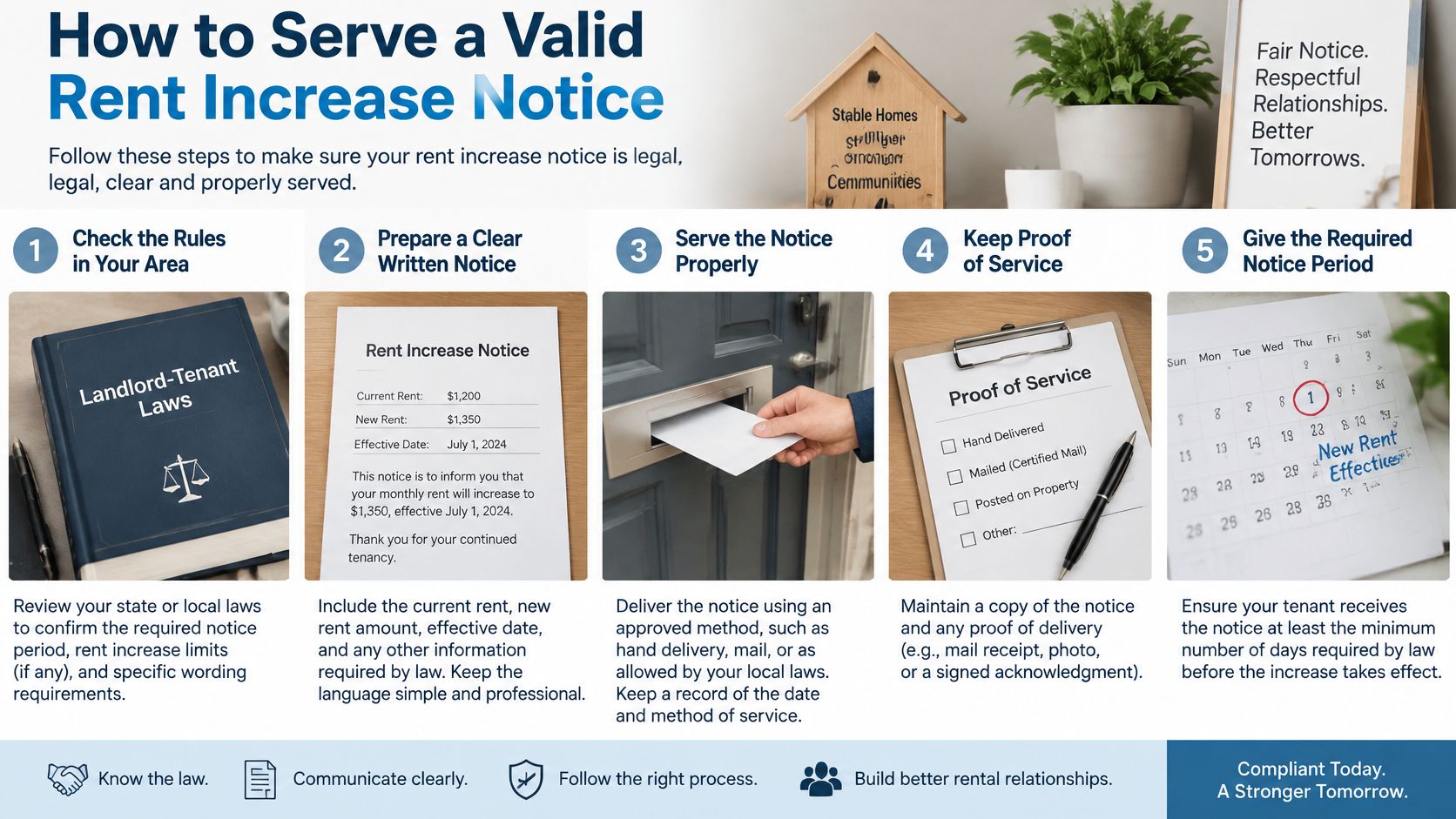
What should the landlord do in order?
- Confirm the tenancy category, because commercial, income-geared non-profit, co-operative and some assisted-living arrangements don't follow the standard residential cap.
- Check the date rent was first established or last lawfully increased, because the proposed effective date must satisfy the eligibility interval.
- Calculate the maximum dollar increase from the current monthly rent, because the notice needs a specific amount rather than a percentage alone.
- Choose the effective date and count backward through complete calendar months, because part of the delivery month doesn't replace a full notice month.
- Complete the approved Notice of Rent Increase form with the exact dollar increase and effective date, because incomplete details leave the notice open to challenge.
- Deliver the notice using a permitted service method and retain the completed copy and delivery evidence, because the landlord may need to establish when service occurred.
- Save the calculation, notice and service record together, because a complete file makes later questions easier to resolve.
- Collect only the existing rent until the lawful effective date, because preparing or delivering the notice doesn't make the increase immediately payable.
What belongs in the tenancy file?
The file should connect the agreement, current rent ledger, earlier lawful increase and new notice without requiring someone to reconstruct the history from messages. The lease agreement guide can help landlords organise the underlying agreement information.
Before serving anything, the landlord should check the RTB guidance for the current approved form and service rules. An informal letter explaining the calculation can support communication, but it doesn't replace the prescribed notice.
Latest Notice Dates and a Sample Notice Timeline
Latest notice date for each effective date
| Effective date | Latest notice date |
|---|---|
| January 1 | September 30 of the previous year |
| February 1 | October 31 of the previous year |
| March 1 | November 30 of the previous year |
| April 1 | December 31 of the previous year |
| May 1 | January 31 |
| June 1 | February 28, or February 29 in a leap year |
| July 1 | March 31 |
| August 1 | April 30 |
| September 1 | May 31 |
| October 1 | June 30 |
| November 1 | July 31 |
| December 1 | August 31 |
This calendar applies the full-month notice rule to increases beginning on the first day of a month. It assumes the notice is legally considered delivered by the listed deadline and that the tenancy is otherwise eligible.
The table isn't a mailing calendar. Different service methods can affect when a notice is considered received, so a landlord working close to a deadline must check the RTB service rules before selecting a delivery method.
How does a May increase work?
For a hypothetical May 1 increase, the landlord could arrange valid delivery on January 15, ahead of the January 31 deadline. February, March and April then provide the complete notice months before the proposed change.
The working file would show:
- Preparation: The landlord checks the agreement, rent history, eligibility and calculation before completing the form.
- Delivery: The landlord records the service method and retains evidence of when the tenant is considered to have received the notice.
- Waiting period: The existing rent remains payable while the notice period runs.
- Effective date: The rent ledger changes only when the lawful increase takes effect.
A deadline should be treated as the last permissible date, not the preferred date for starting the paperwork.
Early preparation gives the landlord time to correct a missing name, reconcile the rent ledger or check an uncertain service method. It doesn't remove the need to verify the tenancy's separate eligibility date.
What information should the notice contain?
The following is an information worksheet for transfer onto the approved form, not a substitute letter:
Tenant name or names: [Names]
Rental address: [Full address and unit]
Current monthly rent: [Current amount]
Increase: [Dollar amount], representing [Percentage]
New monthly rent: [New amount]
Effective date: [Date]
The landlord should reconcile every field against the calculation and tenancy records before signing. A clear accompanying explanation may help the tenant understand the change, but the approved form remains necessary.
If a deadline has been missed, the landlord shouldn't assume that dating the form earlier repairs service. The proposed effective date needs to be reassessed against the actual delivery circumstances.
Above-Cap Increases, Disputes and Enforcement
Higher property taxes, insurance, utilities, financing costs or repairs don't, on their own, authorise an above-cap increase. The RTB's additional rent increase guidance identifies the written-agreement or application routes and sets capital-expenditure criteria, including costs incurred within eighteen months before applying, work not expected to recur for at least five years, calculation over 120 months, and an additional increase capped at 3% per phase.
An application isn't the same as permission to collect. A landlord pursuing an additional increase should establish eligibility and obtain the required authority before treating the proposed amount as payable.
What makes a capital expenditure claim different?
Eligible work must involve a major system or component and be completed before application. The calculation considers eligible expenditure amounts and dwelling-unit counts; the annual increase is added separately from an authorised capital-expenditure increase.
Amounts above the phase cap can't be carried into another annual period. Before applying, the landlord should assemble:
- Cost records: Invoices and contracts identifying the work and amounts claimed.
- Completion evidence: Documents showing that the work was finished before application.
- Unit information: Accurate dwelling-unit counts used in the calculation.
- Eligibility support: Records explaining why the work meets the required criteria.
- Calculation worksheet: A traceable connection between the documents and requested increase.
Which mistakes should be caught before service?
Common increase errors and their likely effect
| Issue | Rule that applies | Likely effect |
|---|---|---|
| Increase taken before twelve months have passed | Once every twelve months, from the rent-setting date or last lawful increase | Increase generally cannot be collected on the proposed date |
| Notice shorter than three full months | At least three full months before the effective date | Increase generally cannot be collected on the proposed date |
| Notice not on the approved form | Approved Notice of Rent Increase form required | Notice may be challenged; re-serve on the correct form |
| Notice missing the exact dollar amount or effective date | Both must be stated | Notice may be challenged; re-serve with complete details |
| Above-cap increase without consent or approval | Tenant's written agreement or RTB application process | Increase cannot be imposed unilaterally |
| Capital expenditure claim without records | Invoices, contracts, completion evidence and unit counts | Application may fail the criteria; gather records before applying |
| Increase justified only by higher taxes or insurance | Rising costs alone don't permit an above-cap increase | Increase limited to the annual maximum without approval |
A tenant who believes an increase is improper can seek RTB dispute resolution. Branch decisions have legal consequences, so landlords should respond with the agreement, ledger, notices, calculations and service records rather than relying on recollection.
The RTB dispute resolution guide outlines the broader process. Where a notice is challenged, the landlord should obtain case-specific guidance before collecting a disputed increase or deciding how to correct the paperwork.
Maple Ridge and Pitt Meadows Landlord Notes
A Maple Ridge rental with three suites can have three different rent-increase dates. The provincial rules still apply to each covered tenancy, but the landlord must track the dates separately. A Maple Ridge or Pitt Meadows address does not create a different ordinary cap or notice calendar.
Local checks focus on how the property is used. For suite registration, occupancy requirements or business licensing questions, contact the City of Maple Ridge or City of Pitt Meadows office responsible for the relevant property or licence. If an agreement combines residential and business use, confirm whether the arrangement is a covered residential tenancy before applying the standard rent-increase process.
What should local landlords keep separate?
- Provincial tenancy compliance: Keep each tenancy's rent records and notices with its agreement.
- Municipal property checks: Confirm any applicable suite, occupancy or business-licensing requirements with the relevant city.
- Tenancy calendar: Record each rental's anniversary date and eligible increase date separately.
For example, if three suites have different anniversary dates, the landlord should work backward from each intended effective date and track its notice deadline on its own calendar. A single building-wide reminder can lead to one tenant receiving notice too early or too late.
Municipal permission to use a property and compliance with tenancy rules are separate checks. A city approval does not make a rent increase valid, and a completed notice does not confirm that the suite meets municipal requirements.
The Pitt Meadows property-management guide offers context for organising local rental responsibilities. Keep records clear enough that an authorised person can identify which suite, tenancy and date each document relates to, without searching personal messages or relying on memory.
When to Bring in a Property Manager or Lawyer
The RTB rent increase guidance explains the forms and process, while the Province's annual announcement gives the applicable percentage. For each increase, the landlord still needs a clear record of the tenancy, effective date and steps taken to prepare and serve the notice.
A licensed property manager can organise the notice calendar, maintain service records and handle tenant communication. Consider hiring one if you manage more than three tenancies with different anniversary dates, take over a property with tenants already in place, or cannot consistently prepare notices and record service. A missed deadline can delay when an increase takes effect.
Which kind of help fits the problem?
- Administrative support: Ask a licensed property manager to track dates and coordinate routine notices when several tenancies need separate timelines.
- Legal interpretation: Consult a lawyer when eligibility is uncertain, an arrangement is unusual or fixed-term, a tenant contests a notice, or a statutory exception may apply.
- Complex applications: Seek case-specific advice before preparing an above-cap or capital-expenditure application, especially when the calculation or proposed collection date is unclear.
The comparison of self-management and hiring property management in Maple Ridge can help owners decide which responsibilities to keep and which to delegate. Choose support based on the work your properties require, including tracking different dates, keeping service evidence and responding to tenant questions.
Bring the tenancy agreement, rent ledger, previous notices, service evidence and proposed effective date to an adviser. Together, these records show how the increase fits the tenancy's history and where a deadline or documentation gap may affect the next step.
Royal LePage Brookside Realty offers licensed residential property-management support for landlords, including rent-increase timing, required notices and tenancy records. Maple Ridge and Pitt Meadows owners seeking help with an upcoming increase can visit Royal LePage Brookside Realty to discuss their notice calendar, forms and record-keeping needs.