
A Maple Ridge landlord has a vacant suite coming up, a mortgage payment to cover and several nearby rental ads showing different prices for apparently similar homes. Or a long-term tenant is paying less than those ads suggest, and the owner wants to know whether the rent can catch up. Those situations need different answers.
For an occupied unit, the lawful rent-increase rules come first. For a vacant unit, the target should come from comparable properties, adjusted for features and tested against vacancy costs. The highest advertised rent isn't automatically the amount a tenant will pay, or the amount that produces the strongest annual income.
Table of Contents
- Maple Ridge Rent Benchmarks by Bedroom Count
- How to Calculate a Lawful Increase for a Current Tenant
- How to Build a Comparable-Rent Set for a Vacant Unit
- Which Features Move a Maple Ridge Rent Up or Down
- Testing Your Price Against Vacancy and Net Income
- Confirm Your Rent and Move-In Total Before You List
Maple Ridge Rent Benchmarks by Bedroom Count
For a Maple Ridge rental, the most defensible starting point is the bedroom-count benchmark below, followed by adjustments supported by current comparable properties. These are approximately $1,420 for a one-bedroom, $1,651 for a two-bedroom and $2,045 for a three-bedroom, according to CMHC's 2025 rental-market data for Maple Ridge and Pitt Meadows.
CMHC 2025 average purpose-built rents, Maple Ridge and Pitt Meadows
| Unit type | CMHC 2025 average monthly rent | How to use it |
|---|---|---|
| One-bedroom | Approx. $1,420 | Starting benchmark for a purpose-built one-bedroom, then adjust for features and condition |
| Two-bedroom | Approx. $1,651 | Starting benchmark for a purpose-built two-bedroom, then adjust |
| Three-bedroom | Approx. $2,045 | Starting benchmark for a purpose-built three-bedroom, then adjust |
| Studio, townhouse, basement suite or detached home | No applicable average provided in this set | Build the figure from current comparables |
The table summarises the linked CMHC survey. Its Zone 25 combines Maple Ridge and Pitt Meadows, making it a more local reference than a Metro Vancouver-wide average, but not a property-specific appraisal.
What the benchmark doesn't establish
These figures describe purpose-built rental apartments, not every home available for rent. A private condominium, basement suite, townhouse or detached house may attract a different rent because its layout, condition, inclusions and tenant alternatives differ.
An apartment average also doesn't establish the asking price for a newly renovated unit coming onto the market. The useful comparison is between homes a prospective tenant could realistically choose at the same time, with differences in parking, laundry and utilities made explicit.
Older municipal documents require particular care. The City's historical housing action material used 2014 data showing a one-bedroom average of $708. That is a dated reference, not a defensible current rent quote.
How to use the starting figure
The landlord should identify the relevant bedroom row and record the survey year alongside the amount. For an apartment comparable to the survey category, that figure can serve as the provisional centre of a pricing band until current listings confirm or correct it.
For other property types, the table provides context rather than a target. The latest available survey should be checked before quoting a benchmark, and the eventual asking rent should be explainable through actual competing properties.
How to Calculate a Lawful Increase for a Current Tenant
Market rent doesn't reset an occupied tenancy. A landlord dealing with an existing tenant needs a statutory calculation, not a fresh estimate based on nearby advertisements.
The Province's 2026 rent-increase announcement sets the annual limit at 2.3%. That limit is time-sensitive and shouldn't be carried into another year without checking the applicable provincial guidance.
Follow the calculation and notice requirements
The following process and example follow British Columbia's residential rent-increase guidance:
- Confirm the current monthly rent. Check the tenancy agreement, any lawful subsequent increases and payment records. The original agreement alone may not show the amount currently payable.
- Check the timing. At least 12 months must have passed since the tenancy began or the last increase took effect. An increase is permitted only once within that interval.
- Calculate the new maximum. Multiply the current monthly rent by 1.023 for an increase subject to the stated annual limit.
- Separate the increase from the new total. In the provincial example, $2,500 × 1.023 = $2,557.50, meaning a maximum monthly increase of $57.50.
- Serve the approved form with sufficient notice. The tenant must receive at least three full months' notice. The effective date needs to satisfy both the notice requirement and the timing restriction.
A correct multiplication doesn't cure a defective notice. Before serving the form, the landlord should verify the proposed effective date and the applicable service requirements rather than assuming that an informal message is sufficient.
Keep the market estimate separate
Comparable listings above the calculated maximum don't change the amount legally collectible from the current tenant. Renovations, rising ownership expenses and a strong rental advertisement elsewhere aren't substitutes for following the provincial process.
Practical rule: Keep the market-rent worksheet separate from the occupied-tenancy increase calculation.
An above-limit increase requires the tenant's written agreement or an application to the Residential Tenancy Branch under the applicable additional-increase process for qualifying expenses or capital expenditures. Approval shouldn't be assumed just because the owner has incurred costs.
The guide to BC rent-increase rules for landlords and tenants provides further context for reviewing an increase. This is general information, not legal advice. An unusual tenancy, disputed rent history or proposed above-limit increase warrants a check with the Residential Tenancy Branch or a qualified adviser.
How to Build a Comparable-Rent Set for a Vacant Unit
A vacant two-bedroom suite and a nearby two-bedroom townhouse may compete for some of the same tenants, but their asking rents are not automatically comparable. Build a worksheet that records the property type, location, condition and total monthly cost before using any listing to set a target.
The legal limit for an occupied tenancy is a separate calculation. A market estimate helps set the asking rent for a vacant unit; it does not authorize ending an existing tenancy.
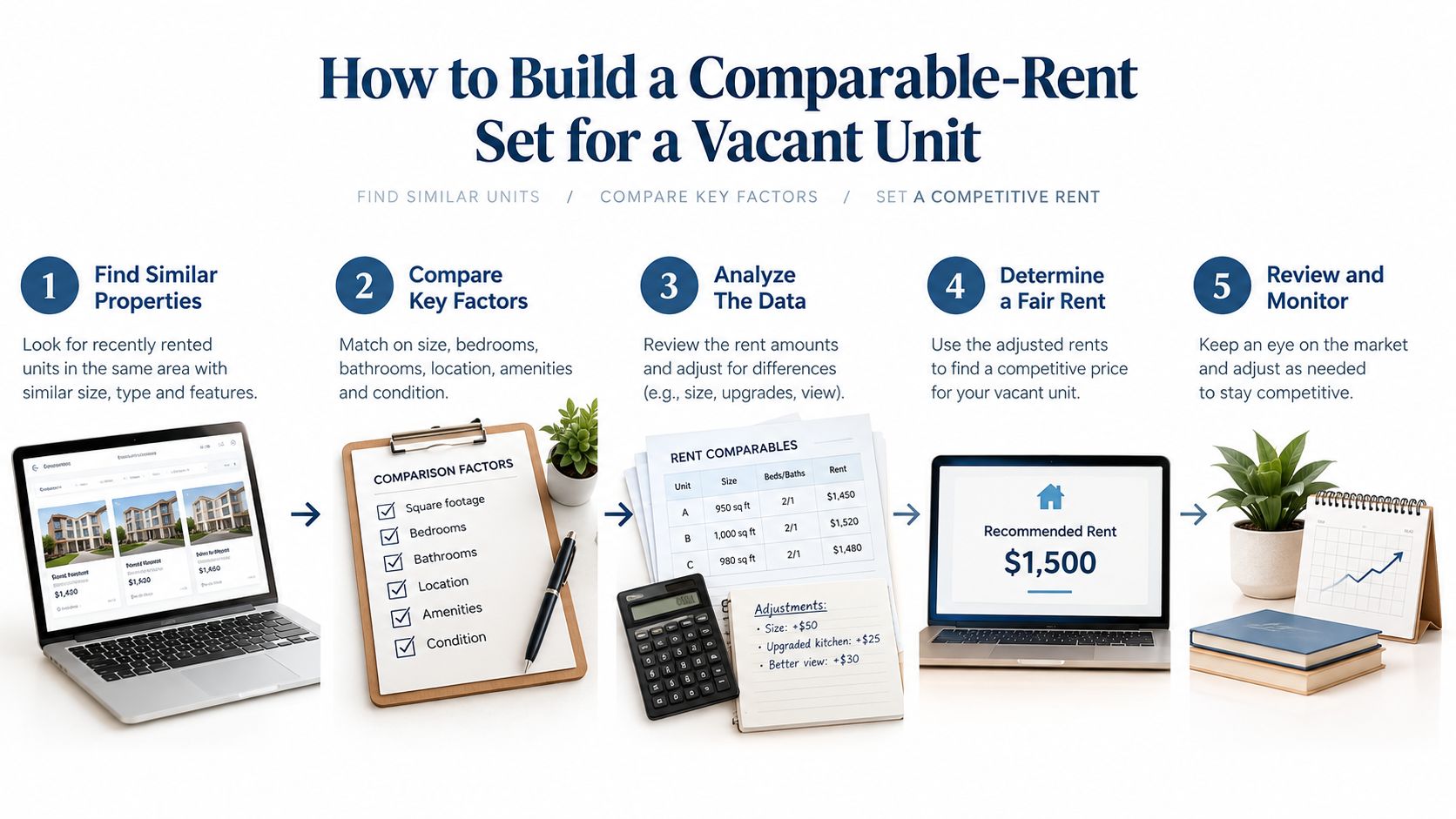
Build a worksheet that can be checked
Use at least five comparable nearby listings or recent rentals. Keep enough information to explain why each property belongs in the set and how its terms compare with the vacant unit. The City of Maple Ridge's economic and market update provides local economic and market context; use the worksheet below to assess individual rental options.
- Match the property before comparing the price. Begin with the same bedroom count and property type. A basement suite and a townhouse are different rental options, even if they have similar sleeping accommodation.
- Record the asking rent, the date you checked it, the availability date and whether it has leased. If you cannot confirm the achieved rent, label the figure as an asking rent.
- Calculate the effective monthly cost. Add mandatory costs charged separately and spread any advertised incentive across the period it covers. Do not subtract a one-time incentive from every month.
- Record what is included. List utilities, parking, furnishings and storage separately so the headline rent can be compared on the same basis.
- Adjust for meaningful differences, then find the median. Use factors such as floor area, age, renovation quality, outdoor space, laundry and transit access to explain adjustments. Leave out dollar premiums you cannot support.
The current Maple Ridge rental listings can help identify available properties to review. Confirm availability and asking terms when you prepare the worksheet, since listings can change.
Keep the search geographically relevant
A unit in Silver Valley, near the town centre or in West Maple Ridge may face a different set of rental alternatives. Start with properties in the same immediate area where possible. If nearby evidence is limited, widen the search deliberately and record the location difference rather than presenting distant listings as direct matches.
Timing matters too. The City update describes Maple Ridge as relatively tight while broader Metro Vancouver vacancy conditions have been changing. An older advertisement or historical summary may not reflect the competition a vacant unit faces now, so note when each comparison was observed.
A listing that remains unrented for months does not establish that tenants accept its asking rent. It may indicate that the price is above what the available demand will support. Use the adjusted set to choose a market target, then test whether expected income still makes sense after allowing for vacancy.
Which Features Move a Maple Ridge Rent Up or Down
A covered parking space and an assigned outdoor stall may both appear as “parking” in a listing, but they offer different benefits. Check what a tenant can use, and compare that arrangement with similar rentals before adjusting the proposed rent.
| Feature | Usual direction | What to verify |
|---|---|---|
| Parking, including extra stalls | Up | Whether parking is included in the rent or charged separately |
| In-suite laundry | Up | Whether machines are inside the unit or shared with the building |
| Utilities included, such as heat, hot water and electricity | Depends | What the rent includes and what the tenant pays separately |
| Furnished or partly furnished | Up | Whether furnishings are included or charged as an add-on |
| Renovated kitchen, bathroom or flooring | Up | When the work was done, its quality and the condition of comparable units |
| Age and general condition | Down if dated | Appliance age, wear and deferred maintenance |
| Legal secondary suite or separate entrance | Depends | Whether the suite is legally established under City rules |
| Transit access and commute | Up | Distance to bus routes and employment centres relevant to the tenant |
| Outdoor space and storage | Up | Whether the yard, deck, locker or shed is exclusive to the unit |
These are directions to test against the comparable set, not a fixed adjustment schedule. Change the proposed rent only when similar listings support the difference. Count each benefit once, even when the listing describes it in several ways.
Verify the benefit behind the description
Parking needs more detail than a check mark. Covered parking, an assigned outdoor stall and shared driveway space differ in protection, access and availability. Confirm which space the tenant can use and whether that use is restricted.
Utilities also affect the monthly cost. Identify what the rent includes, what the tenant pays separately and how any shared arrangement works. Without those details, two advertised rents may not represent comparable costs.
A separate entrance does not establish that a suite is legal. Verify its status with the City before treating it as a feature that supports a higher rent. An unresolved approval question calls for a check, not a pricing adjustment.
Condition matters beyond the photographs
Ask for the renovation dates, a clear description of the work and representative photos. Fresh paint may improve presentation, but it does not resolve worn appliances, persistent maintenance issues or an awkward layout.
For a strata property, confirm that advertised parking, storage and amenity access are available to the tenant. The strata property management overview explains the distinction between an individual unit and shared building arrangements.
Several verified benefits can support a position toward the upper end of the comparable range. Check the proposed rent against a similar unit a tenant could view that day. If the difference cannot be tied to a clear benefit, reconsider the adjustment.
Testing Your Price Against Vacancy and Net Income
Estimated net rental income = expected rent collected over the year minus vacancy-related loss and relevant operating costs. This calculation separates a vacant unit's market target from the lawful limit on an occupied tenancy. A market comparison can guide a new listing, but it does not permit an increase above the legal ceiling for a current tenant.
Compare a rent band, not a single hopeful number
Test three asking-rent scenarios: the adjusted comparable median, a modest amount above it, and a modest amount below. For each, estimate how long the unit may take to lease, the rent likely to be collected over the year, and the costs of securing a tenancy.
For example, if a higher asking rent could mean more vacant time, compare the extra rent from that price with the income lost during the delay. A lower asking rent may produce more net income if it shortens the vacancy enough to offset the difference. Use consistent assumptions across scenarios, and don't deduct vacancy twice if expected collected rent already accounts for it.
Expected collected rent minus turnover, advertising, leasing and other relevant operating costs equals estimated net rental income.
The rental property ROI calculator guide can help organize the broader ownership calculation. For pricing, focus on how each rent point changes expected collected income after vacancy and leasing costs.
Review the advertising response
After the first 7 to 10 days, review inquiry volume, the share of showings that lead to applications, and time on market. The CMHC rental-market dataset for Maple Ridge and Pitt Meadows separates rental data by unit category. Use the relevant category as context, not as a demand forecast for one property.
Leasing signals, likely causes and next moves
| Signal | Likely meaning | Next step |
|---|---|---|
| Few inquiries during the initial review period | Price or presentation may be misaligned | Compare the listing text and photos with the comparable set, then reassess the price |
| Many inquiries but few applications | Costs, description or showing experience may be discouraging applicants | Clarify utilities and parking, then review the showing process |
| Quick applications and several strong applicants | The current rent may be below what this tenancy would support | Hold the agreed price for this tenancy and consider a modest increase at the next lawful vacancy |
| Repeated questions about utilities or parking | The monthly cost or arrangement may be unclear | State the costs and terms before showings |
| Vacancy lasts longer than expected | The lost rental income may outweigh the proposed premium | Recalculate net income using the additional vacant time |
Treat these signals as working hypotheses. Few inquiries can reflect weak photos or limited showing access, not just the price. Check the presentation and leasing process before changing the rent.
Record inquiries, applicant feedback, listing changes and results. That gives the next pricing decision a practical basis and shows whether the chosen target produced the expected net income.
Confirm Your Rent and Move-In Total Before You List
A rent is ready to advertise when the owner can explain its basis, its inclusions and the amount payable at move-in. A precise-looking monthly figure isn't enough if the tenancy status, deposit or parking arrangement remains unclear.
The final review should produce a clean listing and a consistent tenancy agreement. It should also leave a record of the evidence used, rather than a number chosen because it covers the mortgage.
Follow a clear decision path
- If the unit is occupied, confirm the legal ceiling first. Use the statutory process already outlined and stop treating nearby asking rents as a replacement for that calculation.
- For a vacant property, check the relevant benchmark, adjusted comparable median and feature worksheet. Resolve unexplained differences before choosing the asking price.
- Choose a rent within the band supported by the income test. The preferred price should reflect both the likely tenant response and the cost of waiting.
- Confirm the inclusions and move-in amount. The advertisement and agreement should describe the same parking, utilities, furnishings and storage arrangements.
- Refresh the evidence when new official information becomes available. A later CMHC survey or City update may justify revisiting an unleased property's target.
Calculate deposits separately from income
Under BC's deposit and fee rules, a security deposit can generally be no more than one-half of the first month's rent, based on the initial tenancy agreement. A separate pet damage deposit can be no more than one-half of one month's rent, so the maximum combined deposits can equal a full month's rent.
For illustration, applying those provincial limits to $2,000 monthly rent produces a maximum $1,000 security deposit and a $3,000 first-month total before any pet deposit. This is an arithmetic example, not a Maple Ridge market-rent recommendation.
A later lawful rent increase doesn't automatically increase the original security deposit. The province also states that a landlord can't retain a deposit at the end of a tenancy without the tenant's written agreement or a Residential Tenancy Branch order.
The guide to BC damage-deposit rules provides additional context. Deposits shouldn't be treated as unrestricted extra rent or counted as ordinary operating income in the pricing worksheet.
Use the right help for the unresolved question
- Residential Tenancy Branch: Check tenancy rules, approved forms and the applicable dispute-resolution process.
- CMHC: Consult annual rental-market data and confirm the geography and rental category.
- City of Maple Ridge: Review local market updates and verify property-specific municipal questions.
- Licensed property manager: Seek help with the unit's rent review, leasing process and ongoing rent collection when the owner prefers not to manage those tasks directly.
The legal ceiling comes first, the market sets the target, and the vacancy test confirms it.
The final listing should leave a prospective tenant able to understand the offer without repeated clarification. Clear terms also give the landlord a more useful test of whether the asking rent fits the property.
Royal LePage Brookside Realty offers licensed residential property management, including tenant placement, rent collection and ongoing management for local landlords. For a rent review of a specific Maple Ridge property, visit Royal LePage Brookside Realty and start a conversation with the unit's details, tenancy status and proposed availability date.