

A BC landlord must generally give the tenant written notice at least 24 hours and no more than 30 days before entry, stating a reasonable purpose, the entry date and a time between 8:00 a.m. and 9:00 p.m., unless the tenant agrees otherwise.
But does permission to inspect monthly mean a landlord can just announce a regular visit and turn up? That assumption misses the distinction between an inspection frequency limit and lawful access to someone's home.
For Maple Ridge and Pitt Meadows landlords, BC landlord inspection rules and notice requirements work best as a documented process. The notice, delivery record, actual visit and resulting report should tell the same story.
Table of Contents
- How Much Notice a BC Landlord Must Give Before Entering
- Valid Reasons for Entry and How Often Landlords Can Visit
- Entry Without Standard Notice in Limited Cases
- Inspection Timeline From Move-In to Move-Out
- How to Write and Deliver a Compliant Entry Notice
- Common Mistakes and the Pre-Visit Check
How Much Notice a BC Landlord Must Give Before Entering
Written notice is the standard route for ordinary entry. The Province's tenancy communication guidance explains the section 29 framework: notice at least 24 hours and no more than 30 days before entry, an ordinary entry window of 8:00 a.m. to 9:00 p.m., and routine condition inspections limited to once per month.
The notice also needs a reasonable purpose, an entry date and an entry time. Ownership doesn't remove those requirements, and a standing inspection clause in a lease doesn't replace them.
BC landlord entry notice rules at a glance
| Requirement | BC rule | What it means in practice |
|---|---|---|
| Minimum notice | 24 hours before entry | Notice given at 9 a.m. Monday supports entry from 9 a.m. Tuesday at the earliest |
| Maximum notice | 30 days before entry | Notice given earlier than 30 days ahead does not meet the standard |
| Entry window | 8:00 a.m. to 9:00 p.m., unless the tenant agrees otherwise | A 7:30 a.m. arrival needs the tenant's agreement |
| Routine condition inspections | Once per month at most | No more than 12 routine inspections in a year; monthly visits are not required |
| Form of notice | Written | A verbal heads-up does not satisfy the requirement |
| Required contents | Reasonable purpose, entry date and entry time | An open-ended message about visiting sometime next week does not satisfy the requirement |
| Tenant presence | Not required once valid notice has been given | The landlord may enter without the tenant home if the notice was valid |
| Tenancy agreement wording | Cannot authorize entry without notice | Lease clauses cannot replace the 24-hour requirement |
The annual total in the table is a ceiling for routine inspections conducted monthly, not a target. A landlord should choose an inspection schedule based on legitimate property needs rather than treating every available inspection as compulsory.
How should a landlord read the timing rules?
The Monday-to-Tuesday example assumes notice has been given through an appropriate delivery process. Drafting a notice, leaving it unsent or booking a contractor doesn't establish when the tenant received notice.
The early-morning example illustrates a separate requirement. Even with sufficient advance notice, an arrival outside the permitted window needs the tenant's agreement. Advance notice and an acceptable entry time are separate checks.
Practical rule: A calendar appointment records a plan. The notice and delivery record establish how access was arranged.
A verbal conversation can help coordinate schedules, but it doesn't replace the written-notice route. Likewise, the tenant's absence doesn't prevent entry once valid notice has been given.
For broader context, Brookside's explanation of the BC Residential Tenancy Act connects access rules with the tenancy relationship. These thresholds reflect the statutory framework described by the Province and should be checked against its current guidance before reliance.
Valid Reasons for Entry and How Often Landlords Can Visit
How can a landlord tell whether a visit fits the monthly limit? Start with the paper trail. A routine condition inspection is limited to once per month, so the dated notice should identify its purpose and planned visit. The notice and the record of what happened help show whether the visit was a genuine inspection and whether the monthly ceiling was respected. The Province's guidance on condition inspections during a tenancy also explains that people entering on the landlord's behalf remain subject to the access rules.

Entry reasons, notice and frequency limits
This table compares ordinary entries arranged by written notice. Each row has a different purpose, and the notice should make that purpose clear.
| Reason for entry | Written notice required | Frequency or limit | Compliance point |
|---|---|---|---|
| Routine condition inspection | Yes, 24 hours to 30 days ahead | Once per month at most | State the inspection purpose; a vague check-in does not establish a qualifying inspection |
| Repairs and maintenance | Yes, same framework | Each visit needs its own notice | Identify the repair and visit date so the record matches the work |
| Showing to prospective buyers or tenants | Yes, same framework | Each showing needs its own notice | Keep the showing within 8:00 a.m. to 9:00 p.m. unless the tenant agrees |
| Contractor, inspector or manager entry | Yes, same framework | Same limits as the landlord | Give the person the stated purpose and instructions; delegation does not create an exception |
A condition inspection may involve checking for leaks, damaged fixtures or maintenance concerns. Repeated informal visits do not become legitimate inspections just because they are described that way. The date, stated purpose and outcome should tell a consistent story.
Repair access has a distinct purpose. For example, a plumber attending to investigate a reported kitchen leak should be told what repair work is planned. That appointment does not, by itself, explain or justify checking unrelated rooms.
A showing also needs its own clear purpose and notice. It should not be presented as a maintenance visit. For an occupied sale, the landlord can review tenant rights when a landlord sells to understand the tenant-related considerations.
Does sending someone else change the rules?
No. A manager, inspector or tradesperson does not gain broader access by accepting the keys. The person attending should know the stated purpose, scheduled window and areas relevant to the visit. That keeps the actual visit aligned with the notice.
Photography also needs an accurate explanation. A condition check, a contractor's assessment and marketing photography are different activities, even though each may involve entering the home.
The practical test is straightforward: could the tenant read the notice and understand why entry is happening, when someone will arrive and what that person intends to do? “Routine visit” alone leaves those points unclear. A dated notice, followed by a record of the visit's outcome, makes it easier to assess whether the monthly inspection limit was respected.
Entry Without Standard Notice in Limited Cases
Owning a rental property doesn't create automatic permission to enter it. An exception needs an identifiable basis, not merely an urgent preference to get something done.
The Residential Tenancy Regulation identifies limited entry exceptions, including permission given at the time of entry or within the preceding 30 days. The relevant circumstances include the following:
- Emergency protection: Entry is necessary to protect life or property.
- Tenant permission: The tenant authorizes the particular entry.
- Abandonment: The rental unit has been abandoned.
- Authorizing order: An order from the Residential Tenancy Branch director or a court authorizes entry.
- Housekeeping services: Entry occurs at a reasonable time to provide housekeeping or related services.
Where does emergency access stop?
Suppose water starts coming through the ceiling of a Maple Ridge duplex late at night. Entry to shut off the supply and limit damage may be necessary to protect the property.
That emergency doesn't turn the following repair schedule into unrestricted access. Once the immediate threat is controlled, a later non-emergency repair appointment needs an appropriate access arrangement, ordinarily written notice.
An emergency exception addresses the emergency. It isn't continuing permission for every follow-up visit.
Convenience isn't the same as necessity. A contractor arriving earlier than expected or a landlord passing nearby doesn't, by itself, establish an emergency.
How should permission be recorded?
A tenant's verbal permission to come by Tuesday can authorize that agreed visit. It shouldn't be expanded into permission for unrelated work, another day or an open-ended series of visits.
A practical record should identify the agreed purpose and visit window. Written confirmation helps prevent disagreement about what the tenant actually authorized.
After any exception-based entry, the landlord should record the reason, time, attendees and work completed. Emergency photographs should focus on the problem and response rather than unrelated personal belongings.
Brookside's overview of landlord and tenant rights in BC provides broader context for balancing property responsibilities with the tenant's use of the home.
Inspection Timeline From Move-In to Move-Out
Consider a Maple Ridge rental from the day possession begins. The landlord arranges a joint walk-through, records the condition and gives the tenant the completed report; later maintenance visits serve a different purpose from that opening record.
The Residential Tenancy Regulation's condition-inspection provisions distinguish inspections at possession, when a pet is added if no earlier inspection occurred, and at the end of the tenancy. Formal inspections generally take place when the unit is empty of the tenant's possessions, unless the parties agree otherwise.
Inspection types, timing and report deadlines
The provincial RTB-27 Condition Inspection Report directs landlords to provide the signed move-in report immediately where possible and within 7 days of inspection; the move-out deadline is within 15 days after inspection or within 15 days after receiving the tenant's written forwarding address, whichever is later.
| Inspection | When it happens | Notice | Report deadline |
|---|---|---|---|
| Move-in condition inspection | When the tenant becomes entitled to possession | Landlord schedules; both parties attend | Immediately where possible, and within 7 days of the inspection |
| Pet inspection | When a pet is added, if no earlier inspection occurred | Arrange a joint condition inspection | Complete and provide the formal condition report |
| Routine monthly inspection | Once per month at most | Written, 24 hours to 30 days ahead | Keep a visit record; no move-in or move-out report deadline applies |
| Move-out condition inspection | End of the tenancy, generally when the unit is empty | Arrange the joint inspection with the tenant | Within 15 days after inspection, or 15 days after receiving the written forwarding address, whichever is later |
| Emergency entry | As needed to protect life or property | No advance notice under the listed exception | Record the reason, time and work done |
What belongs in the condition record?
The regulation's report-content requirements cover legal names, the rental address, inspection date, rooms, exterior areas, parking or garage areas, appliances, fixtures, floor and window coverings, and identified damage or repairs. The report also needs space for the tenant to agree or disagree and add comments.
At move-in, both parties should view the unit together, then sign and date the report. A note identifying an existing chip in a countertop is more useful than a broad statement that the kitchen looks acceptable.
At move-out, the comparison should address the same areas and items. Dated photographs help explain written observations, but photographs alone don't replace the formal process.
A routine condition check doesn't automatically substitute for a start or end inspection. That distinction matters when the parties disagree about whether damage existed before the tenancy.
Brookside's rental property inspection checklist can help organise the walk-through and supporting records.
How to Write and Deliver a Compliant Entry Notice
Can a tenant tell from the notice exactly what the landlord plans to do and when? A clear notice answers that question without requiring a follow-up conversation. It also creates a paper trail: the notice date and stated purpose help show what access was arranged.
For the timing and delivery rules, see the Province's landlord-access guidance. The routine below focuses on preparing and serving a notice that is clear enough to follow.
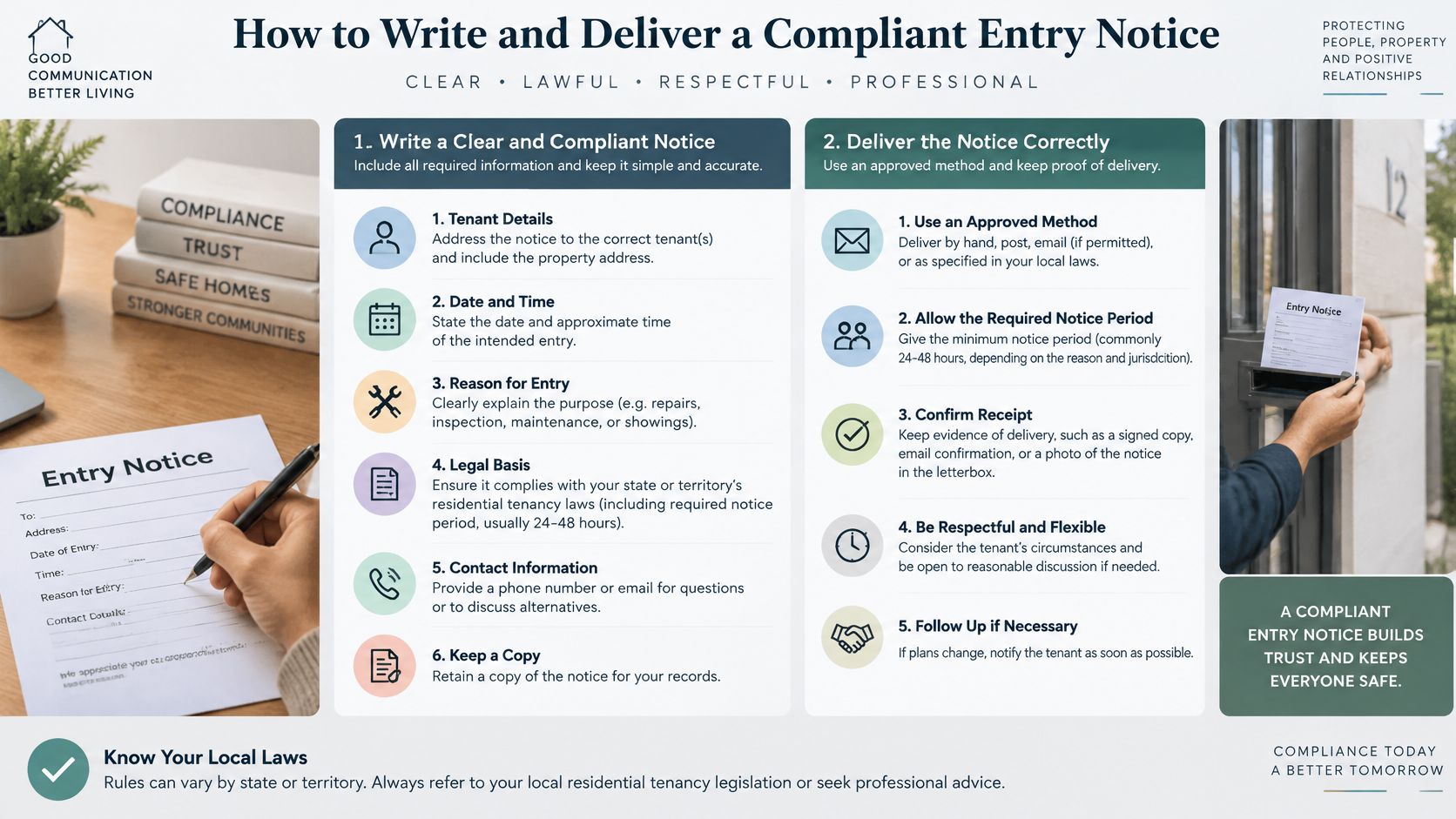
A practical notice routine
Confirm the reason. Describe the actual task, such as investigating reported moisture under the bathroom sink. This gives the tenant a clear picture of why access is requested and what area is involved.
Choose the date and arrival window. Check the required notice period and permitted hours before selecting a time. Confirm contractor availability first, so the proposed appointment reflects a visit that can really happen.
Identify the rental and parties. Include the unit address, tenant names, purpose, entry date, arrival window, and landlord or agent contact details. A notice works like a small appointment record: each detail helps distinguish this visit from another.
Arrange written delivery. Use an authorized delivery method and keep evidence of when and how the notice was given. For example, retain a dated photo showing a notice posted at the rental unit, or the registered mail receipt for a notice sent that way. A saved message alone does not establish that the chosen method met the delivery rules.
Save the version delivered. Keep a copy of the completed notice with its delivery record. An editable blank template cannot show what the tenant actually received.
Keep the notice and visit record together. Use a file name that identifies the property, entry date, and purpose. The notice, proof of delivery, and any contractor notes can then be found as one visit record if a question arises later.
What could a notice look like?
This example shows the information to include. Check the applicable delivery rules before using a particular method.
Notice of entry
Rental unit: [full unit address]
Tenant name(s): [tenant names]
Purpose: [specific reasonable purpose and relevant area]
Entry date: [date]
Entry time or arrival window: [time or window within permitted hours]
Attending person: [landlord or authorized person]
Contact details: [name and contact information]
Notice delivery record: [date, time and method]
A message saying the landlord will inspect sometime next week leaves the date and time unclear. A greeting or polite wording does not fill in those details.
For a Pitt Meadows rental with a reported appliance fault, identify the appliance and the planned attendance in the notice. If the appointment changes, arrange access for the revised visit before sending the technician. The original notice describes the visit it was written for.
Keeping the notice, delivery proof, and visit-related records together makes the paper trail easier to follow. If a disagreement arises, the record can show when notice was given, what purpose it stated, and which appointment it concerned.
Common Mistakes and the Pre-Visit Check
A landlord can avoid many access disputes by checking the visit record before leaving the office. For example, a text saying a visit will happen next week does not identify a specific date, time or purpose. Arriving before the usual permitted hours to check a furnace filter adds another problem, even if the task is brief and the tenant did not object.
The record should let both sides understand what was arranged and what happened. A useful file connects the reason for entry to the people who attended and the work completed.
Which habits create avoidable problems?
- Vague purposes: Describe the actual task, rather than saying only that the property will be checked.
- Out-of-window arrivals: Keep the appointment within permitted hours unless the tenant agrees to another time.
- Stacked visits: A routine inspection does not cover a later repair appointment. Arrange access for each separate visit.
- Reliance on lease wording: A tenancy clause does not replace the statutory entry requirements.
- Unlogged attendance: Record the date, time, attendees and outcome while the details are fresh.
- Delegation without instructions: Give a contractor or manager the relevant access details and written limits on the planned work.
Informal arrangements can be easy to remember differently. A landlord may understand silence as agreement, while the tenant may not know a visit is planned. A clear written record helps avoid that uncertainty.
A strong tenancy file connects the stated purpose, authorized access and completed work. Unrelated messages are harder to interpret.
What makes the record useful in a disagreement?
Someone unfamiliar with the property should be able to reconstruct the visit from the file. Keep the notice date and delivery method distinct from the scheduled attendance and the actual outcome.
For example, a notice might describe investigating a bathroom leak, and the contractor's invoice might confirm replacement of a failed connection. Keeping the records together shows how the visit related to the work performed.
Photographs support the written account, but need context. A photo alone may not show which room it depicts or whether it was taken before or after the work. Add notes describing the location and relevant condition.
The file should also distinguish an access problem from a maintenance problem. If the contractor is unavailable, the appointment needs rescheduling. If the proposed purpose is disputed, clarify it before attendance.
Owners considering whether to handle these tasks themselves can review this guide to property manager responsibilities in Maple Ridge. Whoever coordinates the visit should remain responsible for keeping the record and following up.
What should be checked before leaving for the property?
Use a seven-minute office check to catch practical gaps before setting out:
- Match the visit to the file: Confirm that the planned work still matches the purpose recorded for this visit.
- Check who is attending: Make sure each person, including anyone receiving keys, knows the correct unit and the relevant work area.
- Confirm the access plan: Check the agreed arrival window and the contact person if the work cannot proceed.
- Review the last outcome: Look for any unresolved issue from an earlier visit that could affect today's work.
- Set the close-out task: Decide who will record whether the visit was completed, rescheduled or not carried out, and where supporting notes or photographs will be saved.
This check focuses on the day's logistics and follow-up, rather than repeating the steps for preparing and delivering a notice. If the planned work has changed materially, pause and clarify the task and access arrangement before anyone attends. A broader inspection should not be improvised at the door.
The Residential Tenancy Act and current Residential Tenancy Branch guidance govern specific situations. This article provides general information, not legal advice; uncertain cases may require advice suited to the circumstances.