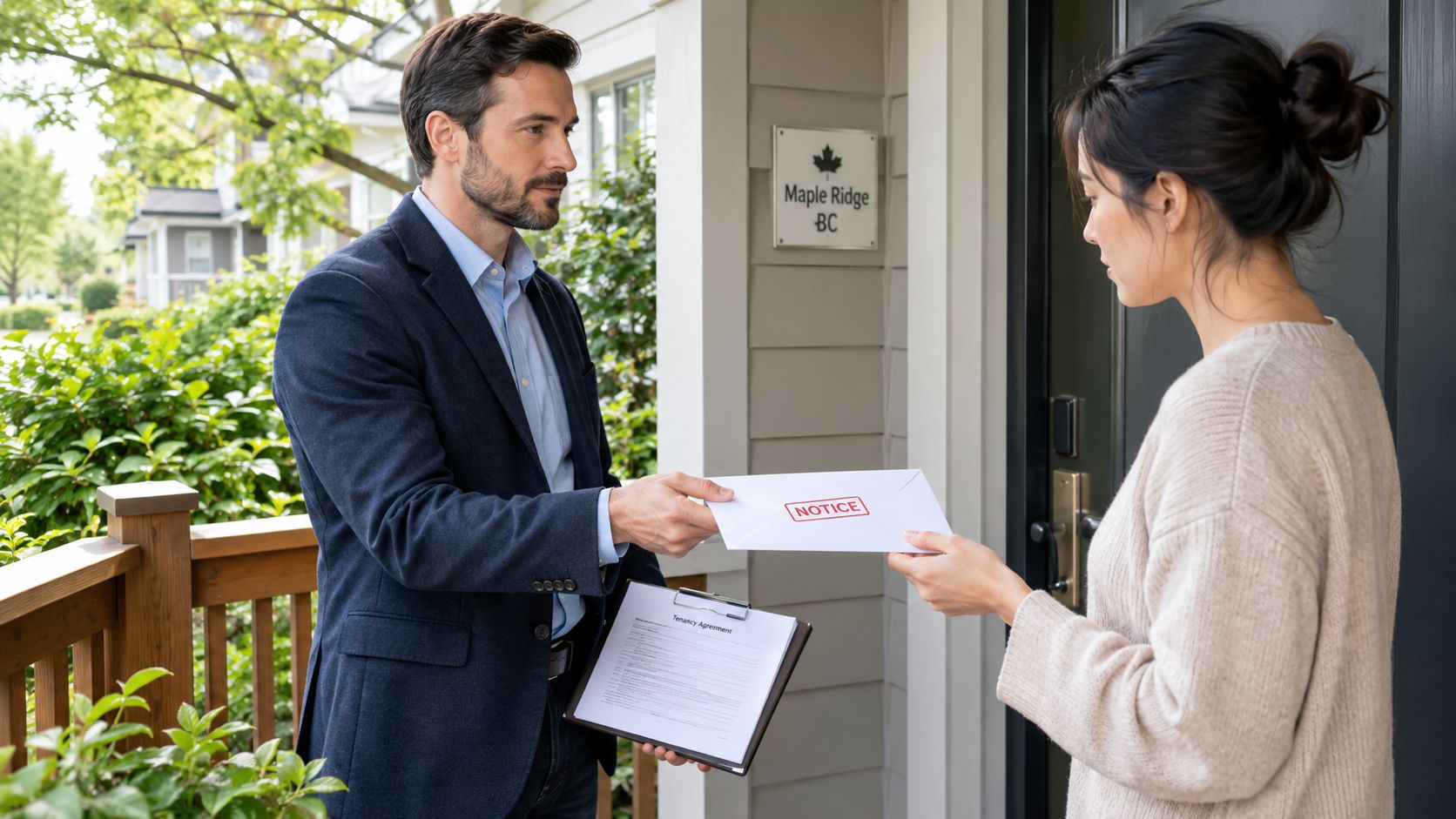

A Maple Ridge landlord can fill a vacancy quickly, collect rent reliably, and still carry significant risk. A notice may use the wrong timeline, a move-in condition report may be incomplete, or a maintenance request may sit unresolved while the owner assumes the tenancy is running smoothly. That's why the practical answer to Maple Ridge BC rental property management services, what do they include goes beyond rent collection. The service combines leasing, documentation, maintenance, reporting, and BC tenancy compliance to protect both income and the physical asset.
Table of Contents
The Reality of Managing Rentals in Maple Ridge
A landlord managing a house, suite, townhome, or condo independently often starts with a straightforward plan. Find a tenant, collect rent, arrange repairs, and deal with issues as they arise. In a tight market, that plan can appear to work until a tenancy ends, a deposit is disputed, or a repair becomes urgent.
Maple Ridge has remained a constrained rental market for years. The City's vacancy rate has fluctuated from 0.4% to 5.7% since 2010, fell to 1.3% in 2023, and the City estimated only 21 vacant purpose-built rental units that year, as reported in this Maple Ridge property management market overview. When available homes are scarce, management isn't about finding someone willing to rent. It's about setting the right price, controlling turnover, keeping records, and following provincial rules precisely.

A typical local management service includes tenant placement and screening, rent collection, routine inspections, maintenance coordination, owner reporting, and compliance with the BC Residential Tenancy framework. A manager may also organise RTB documentation, preserve inspection records, and maintain a clear communication trail between the owner, tenant, and contractors.
Practical rule: In a tight rental market, the manager's value often lies in preventing avoidable mistakes rather than simply filling the home.
Property presentation also affects leasing decisions. Owners planning renovations or new rental construction can use resources such as Vizcraft multifamily rendering to understand how visual planning can support unit layouts and presentation before work begins. For an owner deciding between self-management and professional oversight, the relevant comparison is the workload and exposure carried by each option, as discussed in self-managing versus hiring property management in Maple Ridge.
Tenant Placement and Market Pricing Strategies
Tenant placement begins with a pricing decision, not an advertisement. A manager reviews the property's type, condition, included features, timing, and competing rental supply before recommending an asking rent. A price that's too low can leave income on the table, while an aggressive price can delay showings and create an avoidable vacancy.
Recent market snapshots place Maple Ridge rents around $1,972 to $2,039 per month in 2026, with townhomes near $3,400 and local updates describing vacancy at roughly 2% to 3%. These figures are time-sensitive and should be treated as a starting point rather than a guaranteed value, as shown in the Maple Ridge rental market snapshot.

A disciplined leasing workflow
A professional placement process usually follows a consistent sequence:
- Inspect and prepare the home. The manager identifies repairs, cleaning, safety concerns, and presentation issues before marketing begins.
- Set a defensible asking rent. The recommendation reflects current local evidence, property condition, and the likely tenant profile. Owners can review the principles in how to set a competitive rental price in Maple Ridge.
- Market accurately. The description should state what is included, identify restrictions clearly, and avoid promises the owner can't support.
- Screen consistently. Applications are assessed against the same documented criteria, including identity, income, rental history, references, and credit information where permitted and appropriate.
- Complete the tenancy paperwork. The agreement, deposit records, move-in date, rules, and responsibilities need to be clear before possession.
Tight demand doesn't justify weak screening. A rushed approval can produce payment problems, conflict, property damage, or a difficult move-out. Conversely, screening criteria should be applied consistently and without discriminatory assumptions.
Utility arrangements deserve particular attention in suites and multi-unit homes. A manager should make the agreement clear about which services the tenant pays, how shared usage is measured, and when invoices are due. For background on tenant responsibilities in sub-metered arrangements, landlords can review renter obligations in sub metering.
The process works when pricing, documentation, and screening reinforce one another. A fast lease with unclear terms isn't a successful placement if it creates disputes later.
Condition Inspections and Deposit Compliance
Condition inspections are one of the clearest examples of why property management is a compliance service. In British Columbia, the landlord must arrange the inspection, give the tenant at least two opportunities to attend, complete a signed Condition Inspection Report, and provide the tenant with a copy within 7 days. If the landlord fails to follow the required inspection process, the right to claim against the security deposit can be forfeited, according to the provincial deposit rules and requirements.
A competent manager treats the inspection as a controlled workflow. The file should show when the appointment was offered, whether the tenant attended, what condition was recorded, and which photographs support the written description. The same discipline applies at move-out, when the manager compares the documented starting condition with the ending condition rather than relying on memory.

Deposit limits and deadlines
The Residential Tenancy Regulation limits each security deposit and pet damage deposit to one-half of one month's rent. Both deposits must generally be returned within 15 days of the tenancy ending, unless the tenant provides written authorisation or a lawful claim applies.
| Deposit Type | Maximum Limit | Return Deadline |
|---|---|---|
| Security deposit | One-half of one month's rent | Generally within 15 days of tenancy end |
| Pet damage deposit | One-half of one month's rent | Generally within 15 days of tenancy end |
A pet-friendly tenancy can therefore involve both deposits, each subject to the same limit. The manager's role includes recording the amount received, tracking where it is held, reconciling deductions, and ensuring that the owner doesn't treat a deposit as an informal repair fund.
Evidence protects the file
The strongest inspection record combines a signed report, dated photographs, clear notes, and invoices or estimates where a claim may be considered. A checklist can help structure the process, but it doesn't replace a careful room-by-room assessment. A general Toronto property inspection checklist can offer organisational ideas, although BC landlords still need to follow the province's own tenancy requirements.
Owners can also review BC damage deposit rules before assessing a management proposal. What works is a deadline-driven system. What fails is waiting until the tenant has moved out to reconstruct the condition of the property.
Statutory Maintenance and Repair Coordination
BC landlords must keep rental units in a reasonable state of repair and suitable for occupation. That responsibility covers essential systems and structural components, including heating, plumbing, electricity, locks, walls, floors, and ceilings, as outlined in this BC landlord and tenant law guide.
Professional maintenance coordination turns that broad obligation into an operating process. The manager receives the request, determines its urgency, gives the tenant appropriate instructions, assigns the work, confirms access, tracks completion, and keeps the owner informed about cost and scope.

Triage matters more than the number of vendors
Not every request needs the same response. A manager should separate emergencies, urgent repairs, routine maintenance, and cosmetic work. A failed heating system, active leak, or electrical concern requires a different decision path from a minor fixture issue.
A useful maintenance file records:
- The initial report: What the tenant observed, when it began, and whether conditions are worsening.
- The response: Who was contacted, what instructions were given, and when access was arranged.
- The repair record: The contractor's findings, approved work, invoice, and completion date.
- The follow-up: Whether the tenant confirmed resolution and whether further monitoring is needed.
Regular inspections can identify water damage, ventilation concerns, appliance deterioration, or other problems before they become larger claims. BC rules also place boundaries around landlord access, so inspections must be planned and communicated properly rather than treated as unrestricted visits.
The practical distinction is between coordinating a repair and preserving an asset. A manager who only reacts to messages may close individual work orders without seeing recurring problems. A manager who reviews patterns can help the owner decide when repair, replacement, or capital planning makes more sense.
Navigating Recent Changes to BC Tenancy Laws
A standard service checklist can become outdated even when the headings still look complete. Recent BC changes altered the timing and handling of several tenancy events, so a manager needs a process for reviewing forms, deadlines, and supporting records rather than relying on old templates.
In 2025, BC reduced the notice period for landlord personal-use terminations from four months to three months. The province also shortened abandoned-property storage from 60 to 30 days and raised the abandoned-property threshold from $500 to $1,000, as set out in the provincial announcement on tenancy changes.
Why the change affects daily operations
A personal-use notice now requires the manager to calculate the effective date using the current rule, serve the proper form, retain proof of service, and track the tenant's dispute deadline. An abandoned-property file requires a separate decision about whether the belongings fall below or above the relevant threshold, followed by careful storage and disposal procedures.
Those tasks don't sit neatly inside “administration.” They affect possession dates, turnover planning, storage arrangements, owner expectations, and the risk of an RTB dispute.
A manager should maintain a current compliance calendar that covers:
- Notice forms and effective dates
- Dispute deadlines
- Inspection appointments
- Deposit reconciliation
- Abandoned-property review and storage
- Required owner and tenant communications
The broader BC Residential Tenancy Act explanation can help owners understand the framework, but individual circumstances can change the correct process. Property managers aren't a substitute for legal advice, particularly where a dispute, contested notice, or unusual tenancy arrangement is involved.
Compliance principle: A manager's system should be designed to catch a deadline before it becomes a dispute.
Evaluating Professional Management in a Capped Market
Professional management can look less necessary when demand is strong. If a Maple Ridge home attracts applicants quickly, an owner may reasonably ask why a manager is needed at all. The answer depends on where the operational bottleneck sits.
In a near-full market, the challenge may be pricing accurately, choosing a suitable tenant, coordinating turnover, handling repairs, and staying within tenancy law, not generating inquiries. A landlord who can respond promptly, document every step, coordinate trades, and monitor provincial changes may manage effectively without outside help. The trade-off is the time and responsibility that remain with the owner.
Self-management versus professional oversight
| Self-management | Professional management |
|---|---|
| Direct control over tenant and repair decisions | A repeatable process for leasing, communication, inspections, and maintenance |
| No management service charge | A fee in exchange for ongoing coordination and reporting |
| Owner handles notices, records, and deadlines | Manager tracks administrative and compliance tasks |
| Flexible personal involvement | Separation between the owner and day-to-day tenancy conflict |
The value of professional oversight isn't an ability to ignore the rent increase rules. BC's rent increase cap is 2.3% for 2026, and landlords can generally increase rent only once every 12 months, according to the market guidance referenced for Maple Ridge. A manager can't create revenue growth outside the legal framework.
The financial logic instead centres on preventing avoidable loss. Better turnover planning can reduce the time between tenancies. Accurate records can strengthen the owner's position in a deposit matter. Prompt repair coordination can limit damage and protect the tenancy relationship.
What doesn't work is hiring solely because the market feels complicated, then failing to compare the actual scope of service. The owner should ask whether the proposal covers the work that consumes time and creates risk, not just the visible task of collecting rent.
Essential Questions for Choosing a Local Manager
A management proposal should be evaluated as an operating system, not a list of attractive labels. “Full service” means little unless the manager explains who performs each task, what records are kept, and which events may create additional charges.
Questions about leasing and tenancy administration
Ask how the manager sets rent, markets the property, screens applicants, and documents the approval decision. The manager should also explain how the tenancy agreement records utilities, pets, occupants, access, and other practical terms.
For compliance, ask:
- Which forms are used for notices? The answer should reflect current BC requirements.
- How are deadlines tracked? Look for a documented calendar or file-management process.
- How are inspections completed? The manager should describe attendance opportunities, signed reports, photographs, and copy delivery.
- How are deposits reconciled? The process should account for limits, lawful claims, authorisations, and return deadlines.
Questions about maintenance and communication
The owner should ask who receives routine requests, who handles urgent matters, and how the manager decides whether a repair requires immediate attention. A clear answer will cover tenant communication, vendor coordination, owner approval, invoices, and follow-up.
It's also reasonable to ask how often the manager reports to owners, what an owner statement contains, and how unresolved issues are escalated. Local coverage of houses, suites, townhomes, and condos may require different workflows, so the proposal should match the property rather than assume every rental operates the same way.
A landlord comparing providers can use this guide to choosing a property management company in Maple Ridge as a further decision framework. The right fit is the manager who can explain the ordinary process and the uncomfortable edge cases with equal clarity.
Royal LePage Brookside Realty offers rental management for Maple Ridge and Pitt Meadows properties, including tenant placement, screening, rent collection, inspections, maintenance coordination, owner reporting, and BC tenancy compliance. Landlords who want to compare their current workload with a structured local management process can visit Royal LePage Brookside Realty to discuss their property.