
Approximately 228,700 B.C. properties could be rented as secondary suites, while 214,925 property owners were owner-occupants of multi-unit properties that included secondary suites or accessory dwelling units in 2021. A legal basement suite is a self-contained dwelling created with a building permit, inspected under the BC Building Code and permitted by local zoning, and that legal-versus-illegal distinction affects financing, insurance and rental decisions for every buyer.
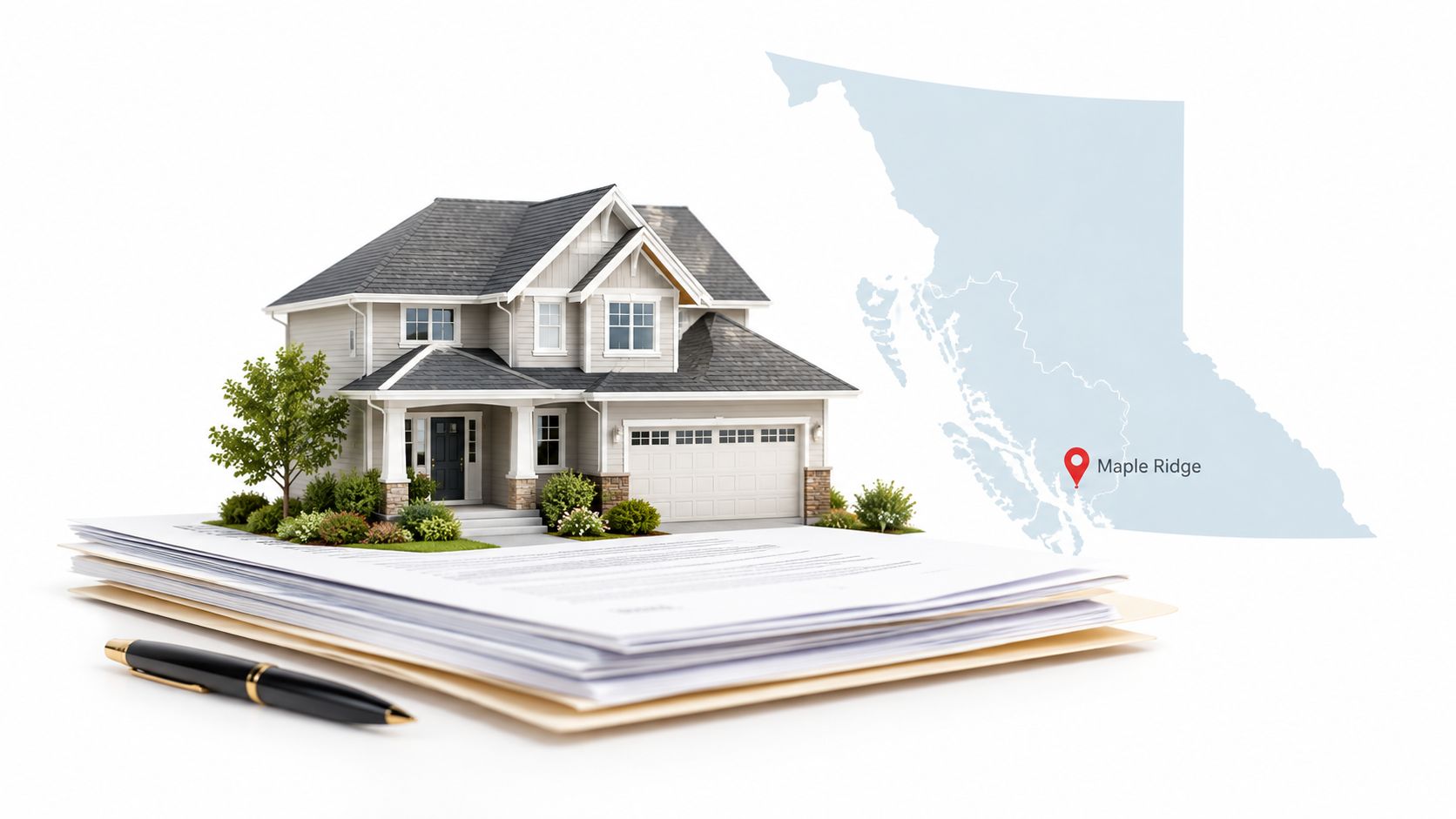
A couple can tour a Maple Ridge home advertised as having a “legal 2-bedroom basement suite,” start planning around the rental income, and then discover during an offer that the seller can't produce a permit file. The finished kitchen, separate entrance and tenant already in place may look convincing, but appearance doesn't establish legal status.
For buyers searching for houses for sale with legal basement suite in Maple Ridge or Pitt Meadows, the central question isn't whether a basement has been renovated. It's whether the suite was approved, inspected and documented in a way that a municipality, lender, insurer and future buyer can recognise.
Table of Contents
What Makes a Basement Suite Legal in British Columbia
A legal secondary suite has three connected foundations. First, the suite must satisfy the BC Building Code, including life-safety requirements such as fire separation between dwelling units, emergency egress, ventilation and suitable alarms. Provincial code material describes fire-resistance-rated separation between units, and certain basement configurations can require sprinklering and rated floor assemblies, which can make an existing conversion much more complicated than a cosmetic renovation. Buyers can review the BC Building Code provisions for residential suites when a listing raises technical questions.
Second, the property must allow a secondary suite under the applicable municipal zoning rules. A building permit alone doesn't cure a zoning problem. Third, there should be a coherent permit trail showing what was approved, what was inspected and whether required work reached completion.

The three questions that matter
A buyer should separate the marketing description from the municipal record:
- Was it created with a building permit? Provincial guidance states that a secondary suite is legal only when it was created with a building permit. Maple Ridge also requires a building permit for a secondary suite.
- Does the finished space meet code? Fire separation, emergency escape windows, ceiling height, interconnected smoke alarms, carbon monoxide alarms and safe access all matter.
- Does zoning permit it? The use must fit the property's zoning and any conditions attached to the lot.
A basement can be fully finished and still be an unauthorised conversion. The phrase “suite,” “mortgage helper” or “in-law accommodation” doesn't change that status. Buyers assessing bedroom windows can also consult this practical guide to basement bedroom egress codes for context, while treating the municipality and qualified inspectors as the decision-makers for a specific property.
The same distinction affects renovation planning. Buyers considering an unfinished or non-conforming basement should review basement completion costs before assuming that a few finishes will create rentable space.
Practical rule: Treat “legal” as a document you can verify, not an adjective in a listing.
Maple Ridge Rules Buyers Need to Verify First
Maple Ridge's municipal requirements provide the first local filter. The city's zoning bylaw limits a secondary suite to one per lot, requires the suite to be within the same building as the one-family dwelling, and sets the floor area between 37 m² and 90 m². Those limits are stated in the Maple Ridge zoning bylaw.
A buyer shouldn't assume that a property with two separate basement living areas can support two rental arrangements. The lot, building form, zoning district and suite layout all need to align. Owner-occupancy conditions may also apply under the applicable zoning rules, so the intended use should be checked rather than inferred from a previous owner's arrangement.
A practical verification sequence
- Confirm the civic address and zoning district. Start with the municipality's records and verify that secondary-suite use is allowed for that property.
- Request the permit history. Ask the Building Division for the suite-related building permit and any electrical, plumbing, gas or sprinkler permits connected with the work.
- Look for final inspections or occupancy documentation. An open permit, incomplete inspection or missing closeout should pause reliance on rental income.
- Check for restrictions. Registered covenants or other property-specific documents can limit how a suite is occupied or used.
- Compare the file with the home. The approved plan should make sense beside the current entrance, bedroom arrangement, kitchen and utility configuration.
Maple Ridge's guidance explains that legalising an existing suite can involve a special inspection application, complete drawings, additional trade permits and certified contractors. If the lot isn't connected to municipal sanitary sewer, provincial sewerage-regulation compliance may also be required. Buyers can review the city's guide to existing secondary suites before making assumptions about a retrofit.
Pitt Meadows requires the same disciplined approach through its own municipal zoning and permit records. A suite that appears acceptable across the river still needs confirmation under the District of Pitt Meadows rules. The practical conclusion is simple: a legal suite in Maple Ridge or Pitt Meadows is only as dependable as the paper trail held by the municipality.
The Physical Checklist for a Legal Suite
Paperwork and physical condition answer different questions. A permit file can establish approval history, but a buyer still needs to inspect whether the current layout matches the approved work and whether obvious safety issues remain.
Start outside the suite. A separate entrance should provide safe, practical access without forcing occupants through private areas of the main home. Bedrooms need emergency egress, and windows must satisfy the applicable BC Building Code requirements for opening size, access and sill height. A bedroom without a proper escape window may be used in marketing copy, but it shouldn't automatically be counted as compliant sleeping space.
Look above, behind and around the finishes
Fire separation deserves close attention. Buyers should ask whether the wall and floor assemblies between units have the required rated construction, whether doors between areas have suitable self-closing hardware, and whether penetrations for plumbing, wiring and ductwork have been properly fire-stopped.
Visual clues can reveal rushed work:
- Patched drywall: Repairs over conduit or plumbing may indicate alterations that weren't reflected in the permit file.
- Recessed lighting: Pot lights installed in soffits or ceiling cavities may not have suitable insulation-contact protection.
- Unsealed penetrations: Gaps around pipes, cables and ducts can compromise the intended fire separation.
- Low ceilings: A basement can feel finished while still failing applicable height requirements in parts of the suite.
Smoke and carbon monoxide alarms should be present in the required locations and connected as required. Ventilation, heating and moisture control also matter because a suite that feels comfortable during a short showing can perform poorly over a full winter.
Separate utility metering isn't automatically proof of legality, and shared systems aren't automatically evidence of illegality. They do affect operating costs, tenant arrangements and future upgrades, so the buyer should understand how heating, hot water, electrical service, laundry and other utilities are divided.
A standard home inspection may not test every suite-specific code issue. The buyer should choose an inspector familiar with secondary suites and pair that inspection with the home inspection checklist for buyers, municipal records and professional advice where technical questions remain.
Financing Rental Income and Insurance Implications
Suite legality matters most when a buyer has built the purchase plan around income. Canadian lenders can treat rental income from a legal secondary suite as qualifying income under certain underwriting approaches, but the treatment depends on the lender, the property and the supporting documentation. Lender-facing guidance commonly refers to possible use of up to 100% of gross suite income in some two-unit owner-occupied cases, while other situations may use a lower proportion or different calculation. The buyer's mortgage professional must confirm the actual policy.
Evidence can include a lease, appraisal support, tax documents and proof that the suite has the required permits. An unauthorised basement may still have a tenant and a history of rent collection, but that doesn't mean the lender will recognise the income. If the income can't be used, the buyer may need to qualify without the anticipated mortgage helper.
Insurance creates a separate exposure. An insurer may request documentation before accepting the risk of a rented secondary unit, and an unauthorised arrangement can create coverage uncertainty or liability concerns. Buyers should never assume that the seller's existing policy will continue on identical terms after closing. A broker should review the permit status, intended occupancy and property details before conditions are removed.
Legal versus unauthorised suite financial impact
| Factor | Legal Suite | Unauthorized Suite |
|---|---|---|
| Mortgage qualification | Rental income may be considered if the lender's requirements and documentation are met. | Income may be excluded or treated cautiously. |
| Insurance | The buyer can present a documented, permitted use for underwriting. | The insurer may request remediation, restrict coverage or decline the risk. |
| Rental use | The suite can be rented subject to applicable rules and agreements. | Rental use may expose the owner to enforcement and compliance problems. |
| Resale | Buyers can verify the suite through municipal records. | Future buyers may discount the space or require costly legalisation. |
| Renovation planning | Approved work provides a clearer starting point. | Hidden code and permit work can remain after possession. |
Before relying on rent, a buyer should discuss the broader lending file, including the credit score needed for rental loans, with a qualified mortgage professional. Insurance planning also deserves its own review, and buyers can use the information on rental property insurance costs as a starting point for questions rather than a quote for a particular home.
Maple Ridge and Pitt Meadows Neighbourhood Context
Neighbourhood context changes the verification workload. Newer construction often makes a suite easier to identify because the secondary unit may have been designed into the original plans. Older homes can offer excellent layouts, but a retrofit requires more careful comparison between the current basement and the city's permit records.
In Maple Ridge, buyers commonly encounter suite discussions in West Maple Ridge, Cottonwood and Silver Valley. Newer homes in these areas may have suites incorporated during construction, while established pockets such as Hammond and Albion can include basement conversions completed after the original home was built. The neighbourhood name doesn't establish legality. It helps a buyer anticipate whether the file is likely to involve original plans or later alterations.
Pitt Meadows presents a similar contrast. Newer subdivisions around South Bonson and Meadows Edge may include secondary dwellings designed from the outset, while an older property elsewhere may require closer review of final inspections, variances and servicing.
Two listings, different levels of risk
Consider two otherwise similar detached homes. The first has a suite shown on the original building plans, a closed permit and a layout that matches the approved drawings. The second has a separate entrance, kitchen and tenant, but the seller can only provide renovation invoices and an old listing description.
The first home gives the lender, insurer and buyer a clearer basis for decision-making. The second may still become a sound purchase, but its value must account for uncertainty, inspection work and possible legalisation costs. Local pricing can reflect those differences, though the premium for a documented suite depends on the home, location, condition and buyer demand.
Families comparing the two municipalities can also review Maple Ridge versus Pitt Meadows for families while keeping suite documentation as a property-level question, not a neighbourhood assumption.
How to Search Listings and Work With a Local Agent
A listing search is useful for finding possibilities, not for proving legality. Buyers can begin with terms such as “legal suite,” “permitted suite” and “secondary suite,” then treat every result as unverified until the municipal record supports the description.
The most efficient process starts before a showing. The buyer or agent should ask whether the seller has the building permit, final inspection record, approved drawings and related trade permits. If the answer is vague, the property may still be worth viewing, but it shouldn't be evaluated as a completed legal suite.

A verification workflow that protects the offer
- Filter broadly, verify narrowly: Search listing language for suite-related terms, then remove properties whose documentation doesn't support the claim.
- Request records early: Ask for permits and final inspection evidence before making rental income part of the offer strategy.
- Compare plans with photographs: Look for differences in room count, entrances, kitchens, windows and utility arrangements.
- Use conditions deliberately: Financing, inspection, document review and insurance confirmation should be addressed before conditions are removed.
- Keep the municipalities separate: Maple Ridge and Pitt Meadows have their own zoning and permit systems, so a process that works for one address doesn't automatically validate another.
A local REALTOR can help coordinate those steps, identify inconsistencies between the listing and municipal information, and arrange an inspection with someone who understands secondary-suite concerns. Royal LePage Brookside Realty serves buyers in Maple Ridge and Pitt Meadows, and a Brookside REALTOR can help organise the search around verified documentation rather than photos alone.
Buyers who are new to the process can also read how to find a real estate agent and use the same interview process for any professional involved in the transaction. The right questions should focus on experience with permit histories, suite conditions, lender documentation and local municipal procedures.
Offer discipline: If the income is essential to the purchase, the suite file should be reviewed before the offer becomes unconditional.
Is Paying Extra for a Legal Suite Still Worth It
A legal suite can be valuable, but it isn't automatically worth any asking-price premium. The buyer has to compare the documented benefit with the price of the home, the condition of the suite, expected rent, operating costs, vacancy risk and the cost of replacing or repairing components.
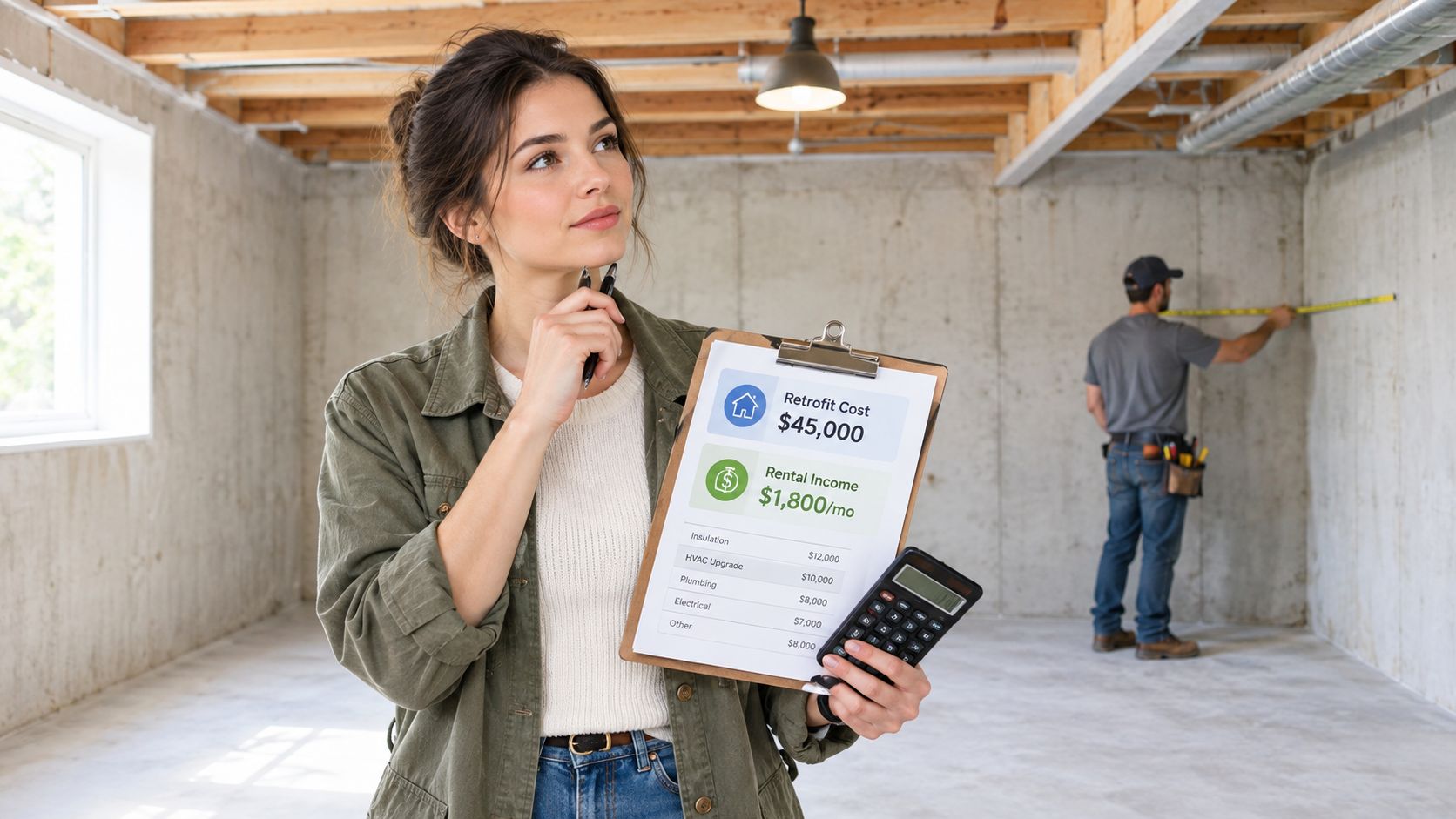
For a non-conforming basement in Metro Vancouver, independent BC-focused guidance places legal-suite renovation costs at roughly $60,000 to $120,000, with some projects exceeding $150,000 to $200,000. Those figures are not a quote for Maple Ridge or Pitt Meadows. They illustrate why a buyer shouldn't value an unauthorised suite as though it were a finished, approved unit.
The cost can include drawings, permits, egress work, fire separation, electrical upgrades, plumbing, ventilation, heating changes, alarms, inspections and corrections. On a rural property, the approval path can become more complicated if the lot isn't connected to municipal sanitary sewer, because sewerage-regulation compliance may be required.
Test the income instead of accepting the promise
The buyer should build a conservative worksheet using the actual suite, not a generic rent estimate. A one-bedroom unit may have a different tenant pool and operating profile from a two-bedroom unit, while a dark layout, shared laundry or limited parking can reduce practical demand.
The worksheet should account for:
- Vacancy: Rent isn't received every month in every ownership scenario.
- Repairs: Appliances, plumbing fixtures, flooring and heating equipment eventually need attention.
- Utilities: Shared services can make the owner responsible for a larger portion of operating costs.
- Management: Tenant communication, screening, inspections and turnover take time or cost money.
- Compliance: A future repair may reveal additional work required to keep the suite usable.
The resale benefit also varies. A buyer may pay more for a documented, move-in-ready suite in a family-oriented area, especially when the layout offers privacy and reliable access. The premium can narrow in price bands where purchasers are focused on total carrying costs, or where the suite's rent is less certain than the listing suggests.
A practical rule is to value the legal suite in three separate ways: the lifestyle benefit, the income benefit and the resale benefit. If the purchase only works when all three perform perfectly, the price is too aggressive. If the home remains comfortable and affordable without full rent, the legal suite provides a stronger margin of safety.
Bringing It All Together for Your Home Search
A serious search for houses with legal basement suites should follow a decision path rather than a listing label.
First, confirm the municipal foundation. Check zoning, verify that only the permitted number of suites is being considered, and obtain the Maple Ridge or Pitt Meadows permit history. Provincial guidance also says a basement suite isn't permitted when the basement floor is more than 5 feet below average grade, so the property's physical siting can affect approval even before interior finishes are reviewed. That requirement appears in the provincial secondary-suite guide.
Next, compare the physical home with the documents. Inspect egress, fire separation, ceiling heights, alarms, entrances, ventilation and utility arrangements. A finished basement that doesn't match the approved drawings should be treated as an unresolved issue, not an attractive bonus.
Then confirm the financial treatment. The lender should explain whether and how the rental income can support qualification, while the insurer should confirm coverage for the intended rental use. These checks belong inside the conditional period because removing conditions transfers more risk to the buyer.
Finally, test the premium against the specific property. A documented suite may improve affordability and resale flexibility, but the buyer still needs to consider condition, tenantability, local demand, servicing and the possibility of future repairs. The feature works best when it supports the purchase rather than rescuing an otherwise unaffordable one.
A Brookside REALTOR can help narrow the search, request permit information, compare listing claims with municipal records and coordinate the buyer's conversations with inspectors and lenders. That process keeps the decision grounded in evidence instead of MLS photos and phrases such as “mortgage helper.”
If a Maple Ridge or Pitt Meadows home looks promising, the next step is to ask for the suite file before treating rental income as part of the budget.
Royal LePage Brookside Realty helps buyers search for homes with documented secondary suites, review local Maple Ridge and Pitt Meadows property details, and coordinate the due diligence needed before conditions are removed. Visit Royal LePage Brookside Realty to start a conversation about finding and evaluating a home with a legal basement suite.