A Maple Ridge landlord lists a townhouse, waits for inquiries, and starts wondering whether the photos are the problem. Often, the issue is the rent. A price copied from a national calculator, an old lease, or a broad city average can leave a property sitting empty while better-positioned competitors attract qualified tenants.
Setting a competitive rental price in Maple Ridge, BC requires more than finding one average and adding a premium. The right number reflects unit type, neighbourhood, condition, vacancy, competing listings, and the difference between what existing tenants pay and what a new tenant will pay today.
Why Maple Ridge Demands a Local Pricing Approach
Consider a common mistake. A landlord lists an Albion townhouse at $2,800, relying on a national rent calculator. The listing sits vacant for six weeks, then the landlord cuts the price twice before finally securing a tenant at $2,450. The lost rent, extra carrying costs, and repeated disruption cost far more than a careful pricing review would have.
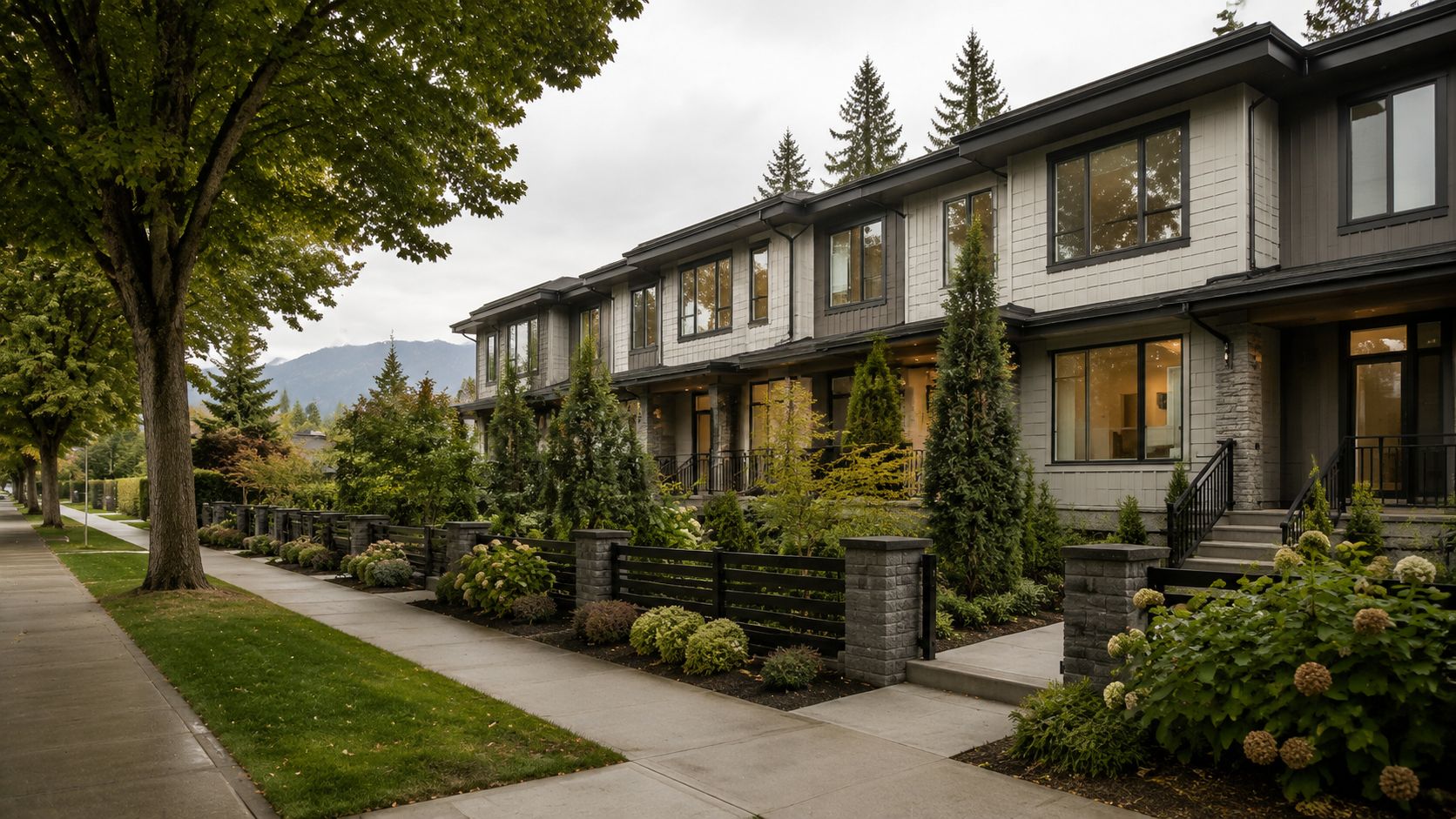
That approach fails because Maple Ridge isn't one uniform rental market. Demand changes between Haney Place, Albion, Silver Valley, Cottonwood, West Maple Ridge, and Kanaka Creek. A newer family townhouse near schools competes differently from an older apartment close to central services. A home beside trails can attract tenants who value outdoor access, while a commuter may prioritise practical access to Lougheed Highway and the West Coast Express.
The local market moves in both directions
Maple Ridge has changed materially over time. A UBCM briefing on Maple Ridge housing reports that median monthly rents increased by 89% between 2010 and 2023, while the city's rental vacancy rate fluctuated from 5.7% to 0.4% during that period. That range proves older lease comparisons can become unreliable when available supply changes.
Recent conditions are softer. Local coverage citing CMHC figures reports that the average Ridge Meadows rent fell by about $110 to $1,465 over the past year, while the one-bedroom vacancy rate rose to 3.1%. Tenants have more choice than they did during tighter periods, so landlords need to justify every premium with a real feature.
Neighbourhood knowledge beats a calculator
Maple Ridge attracts affordability seekers from more expensive Metro Vancouver communities, young families looking for additional space, and downsizers seeking simpler layouts. Those groups don't search the same way or value the same features.
The landlord who understands migration corridors, seasonal leasing patterns, schools, parks, trail access, and commuter routes can price with far greater precision. A useful companion is this guide to accurate home pricing, which explains why correct positioning matters before a listing launches.
For neighbourhood-specific context, owners should also review West Maple Ridge rental considerations rather than treating the entire city as one comparable area.
Understanding Maple Ridge Rental Numbers
A landlord can misprice a home before looking at a single comparable. The common mistake is blending occupied-unit rent with vacant-unit rent. An existing tenant may be paying an older rate after a long tenancy, while a vacant unit must compete for a tenant at today's asking prices. Those figures answer different questions.
CMHC's Rental Market Survey separates vacant and occupied rents and reports conditions by bedroom count, structure type, and unit cohort. Use that framework instead of treating one citywide average as your answer. A new one-bedroom condo should be compared with available one-bedroom condos, not older occupied apartments priced below current market levels.
Use a range, not a headline average
Current market trackers place Maple Ridge rents broadly between $1,615 and $2,050. One-bedroom pricing sits near $1,595 to $1,650, while two-bedroom pricing is near $1,945 to $2,000, according to Apartments.com Maple Ridge rent trends. Another dataset places one-bedroom units around $1,595 to $1,850, two-bedroom units around $1,945 to $2,250, houses around $2,500 to $2,750, and some townhomes at $3,400 or more, as shown in Trulia's Maple Ridge rental trends.
The spread matters. Sources use different samples, property types, and definitions of availability. One tracker reports average rent down 1.1% year over year to $1,615, while another reports a 3.79% decrease to $2,095. Treat both as market context, not as an automatic asking price.
| Unit Type | Typical Neighbourhood | Monthly Rent Range | Avg. Days on Market |
|---|---|---|---|
| One-bedroom condo | Haney and Town Centre | $1,700 to $1,950 | Verify against current listings |
| Two-bedroom townhome | Cottonwood | $2,300 to $2,600 | Verify against current listings |
| Three-bedroom detached home | Silver Valley | $2,800 to $3,400 | Verify against current listings |
These ranges are starting points, not promises. Compare three to five similar active or recently leased units, then adjust for parking, outdoor space, pets, laundry, renovation quality, utilities, and exact location.
Find the right vacant-unit comparisons
Use Realtor.ca rental listings, local property management websites, Facebook Marketplace, and Kijiji. The current Brookside rental listings offer another local reference, but inspect each property's condition before treating it as comparable.
Filter for listings posted within the last 30 days. Days on market provide a useful signal, not confirmed lease data. A unit leased within 10 days was likely priced at or below the market's acceptance point. A listing sitting beyond 25 days may be overpriced, poorly presented, or mismatched with what tenants want.
Micro-markets matter too. Albion and Silver Valley do not attract identical searches, and a Haney or Town Centre comparison may distort a newer suburban property's position. Check the immediate neighbourhood, transit access, schools, parks, and property type before setting the number.
West Coast Express proximity can support a premium of roughly $100 to $150, but only when the unit's condition and access make the commuter benefit obvious. Tenants pay for convenience they can use, not a vague transit reference.
Calculating Your True Cost of Renting Out a Property
Market rent tells a landlord what tenants may accept. It doesn't tell the owner whether the property works financially. A pricing review should begin with a cost floor, then return to the market to decide whether the property is viable as a rental.
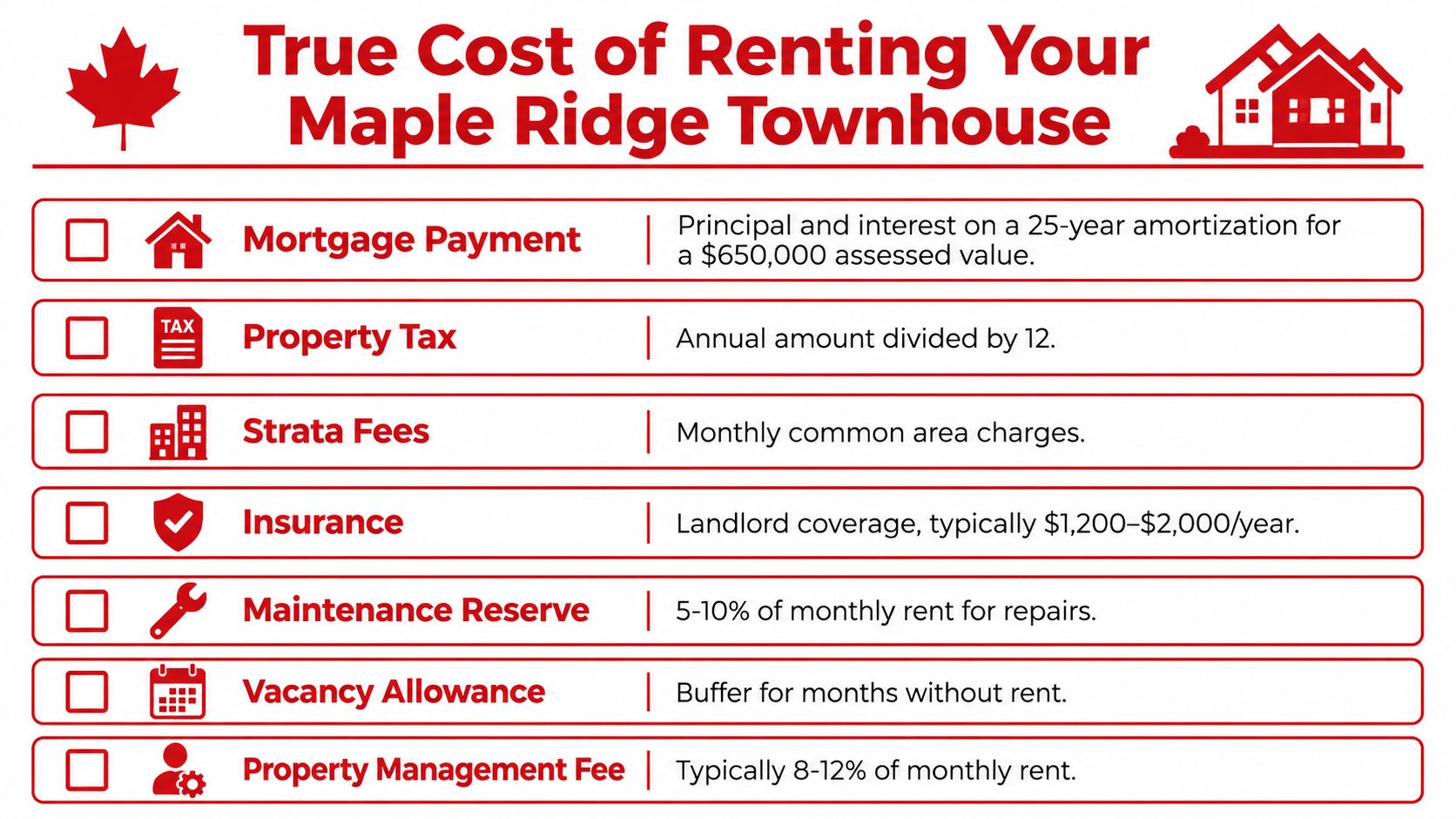
Take a Maple Ridge townhouse with a $650,000 assessed value. The exact mortgage payment depends on the loan balance, interest rate, and down payment, so the calculation should use the owner's actual statement rather than a generic online estimate.
Build the monthly cost line by line
A sensible worksheet includes:
- Mortgage principal and interest: Use the payment for the chosen amortisation. The planning example assumes a typical 25-year amortisation, but no interest rate or loan balance should be guessed.
- Property taxes: The planning allowance is approximately $3,200 per year, divided across the year.
- Strata fees: A townhome may carry monthly fees in the $250 to $400 range, depending on the complex and services.
- Landlord insurance: Obtain a rental-specific quote. The planning range is $800 to $1,200 annually.
- Maintenance reserve: Set aside 1% of the property value annually for repairs and replacement planning.
- Owner-paid utilities: Include hot water, gas, hydro, or other services that the lease assigns to the landlord.
- Management: If a manager is used, budget roughly 8% to 10% of gross rent.
- Vacancy: Reserve 5% to 8% of annual rent for turnover gaps and uncollected income.
Treat the result as a floor
Using the planning assumptions above, the sample calculation arrives at a true monthly cost of approximately $2,680. That figure is a financial floor, not a target rent. The market determines the achievable price, and a landlord cannot pass every ownership cost to tenants if comparable homes offer better value at a lower number.
The vacancy allowance deserves special attention. Owners commonly budget for mortgage, taxes, and strata, then forget the gap between one tenancy and the next. The planning assumption uses two to four weeks between tenants in Maple Ridge, but the actual gap depends on notice timing, repairs, cleaning, listing quality, and price.
Practical rule: If the property only works when every month is fully occupied and no major repair occurs, the asking rent isn't the real problem. The investment needs a deeper review.
A property manager can help organise the worksheet through Brookside's landlord resources, but the owner still needs to understand every assumption. A clear cost model prevents the first repair or turnover from revealing negative cash flow.
Adjusting for Neighbourhood and Property Features
Maple Ridge is a collection of micro-markets, not a single rental zone. A landlord should start with the closest credible comparable, then adjust for the tenant profile that the neighbourhood naturally attracts.
Albion's newer homes and proximity to schools often appeal to young families who want bedrooms, storage, parking, and usable outdoor space. Silver Valley attracts tenants who value quieter surroundings, trail access, and a nature-oriented lifestyle. Cottonwood commonly appeals to families and commuters seeking practical townhome space, while Town Centre and Haney suit renters who prioritise central services and shorter trips to everyday amenities.
Compare the tenant, not just the address
| Neighbourhood / Feature | Typical Tenant Profile | Estimated Rent Adjustment |
|---|---|---|
| Albion, newer family-oriented build | Young families seeking schools, parking, and space | Premium only when the home clearly outperforms nearby alternatives |
| Silver Valley, trail-adjacent home | Professionals and families valuing quiet and outdoor access | Premium supported by condition, storage, and trail convenience |
| Cottonwood, commuter-friendly townhome | Families and commuters seeking practical space | Positive adjustment when access and parking are strong |
| Town Centre or Haney condo | Renters prioritising services, convenience, and central access | Depends heavily on building quality and included amenities |
| Dedicated parking | Tenants with vehicles and seasonal access concerns | Positive adjustment when parking is secure and convenient |
| In-suite laundry | Renters seeking privacy and convenience | Positive adjustment over shared laundry |
| Air conditioning | Tenants sensitive to summer heat | Stronger appeal when comparable units lack cooling |
| Updated kitchen | Renters comparing presentation and move-in readiness | Premium only when finishes are genuinely current |
The table uses qualitative adjustments deliberately. Exact dollar premiums should come from nearby leased evidence, not a universal feature menu. A renovated kitchen may justify more than an older kitchen, but it won't rescue a listing priced above superior competitors.
Features that actually change the decision
Parking matters in Maple Ridge because many tenants rely on vehicles. A dedicated stall, garage, or straightforward visitor-parking arrangement can separate two otherwise similar townhomes.
In-suite laundry removes a recurring inconvenience. Shared laundry may be acceptable in a lower-priced building, but it shouldn't be valued like private machines.
Air conditioning has become an increasingly visible expectation after periods of extreme summer heat. It improves the showing conversation, particularly for upper-floor homes and properties with limited airflow.
Schools, parks, and trails matter most when the listing explains the practical benefit. Albion families may care about morning routines and yard use. Silver Valley tenants may care about trail access and a quieter setting. The owner should market the feature accurately, then price it against actual substitutes.
For buyers or owners evaluating Albion property context, the Albion home search can help ground the discussion in the neighbourhood's housing mix. The same principle applies throughout Maple Ridge. Price the property for its exact pocket, not for the city name alone.
Staying Compliant With BC Tenancy and Rent Increase Rules
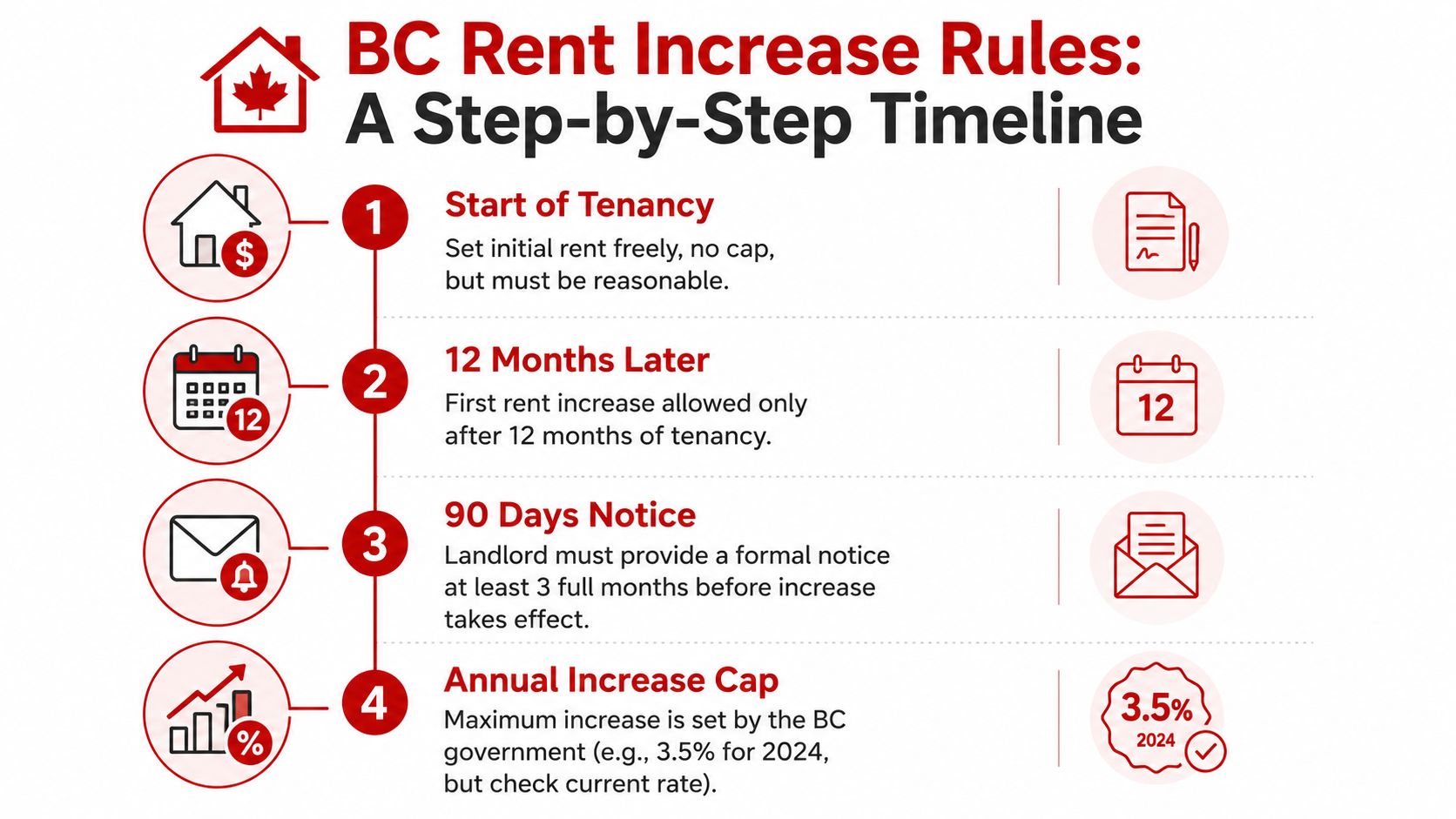
The starting rent and the future rent are governed differently. A landlord generally has more freedom to set the asking rent for a new tenancy, but an existing tenancy is subject to BC's rent-increase rules. That distinction makes the first price decision important, because an owner can't assume an underpriced unit can be corrected quickly later.
For 2026, British Columbia's residential rent increase limit is 2.3%, as set by the provincial government and linked to inflation. The BC government rent increase guidance states that rent can be increased only once every 12 months, with at least three full months' notice using the correct form.
New tenancy versus continuing tenancy
A new listing is the point at which the landlord should establish market rent through current vacant-unit comparisons. Once a tenant occupies the property, ordinary annual increases are limited. The owner needs a compliant tenancy agreement, accurate records, and a calendar that tracks the earliest lawful increase date.
The provincial release confirming the 2026 maximum says the increase can't take effect before January 1, 2026 and identifies exclusions including commercial tenancies, co-operative housing, income-geared non-profit housing, and some assisted-living facilities. Property-specific circumstances can affect how the rules apply, so landlords should use official Residential Tenancy Branch materials or professional advice when uncertain.
Don't plan on fixing an opening mistake later
Some landlords underprice to secure a tenant quickly, assuming future increases will bring the rent into line. That strategy is weak because the allowed annual increase may be much smaller than the gap between an accurate market rent and an overly cautious starting rent.
Capital-expenditure increases and other exceptional processes have their own requirements. They aren't a shortcut around ordinary controls, and frequent turnover can't be used as a casual strategy to bypass tenancy protections. A landlord should price correctly at the start, document the tenancy properly, and follow the official process for every later increase.
Testing Your Price and Knowing When to Call a Property Manager
A listing price is a hypothesis until real tenants respond. Online views, messages, showings, applications, and signed agreements reveal different parts of the demand picture. A landlord who watches only page views can mistake attention for genuine interest.
Read the response pattern
Lots of views with few inquiries usually points to a price or presentation problem. Inquiries that don't become showings may indicate weak scheduling, unclear terms, or a mismatch between the advertised property and the tenant's expectations. Showings without applications often mean the home feels overpriced once tenants see its condition, layout, parking, or competing options.
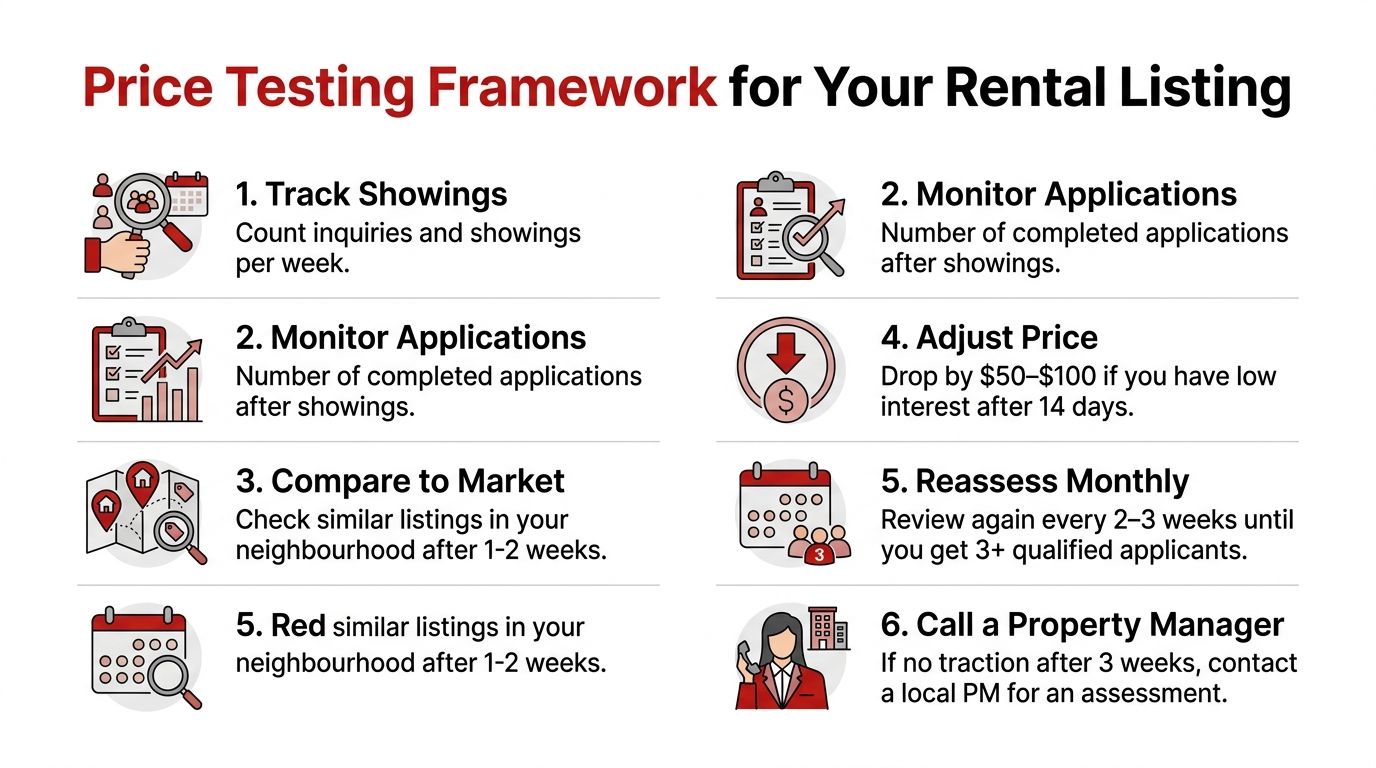
A practical test looks like this:
- Track showings: Count inquiries and completed showings by week.
- Review applications: Note how many qualified applications follow those showings.
- Recheck competitors: Compare similar active listings after the first one to two weeks.
- Adjust decisively: A reduction of $50 to $100 may be appropriate when interest remains weak after 14 days, provided the listing is otherwise accurate.
- Reassess regularly: Review the response every two to three weeks until qualified applicants appear.
- Get outside help: If the listing has no traction after three weeks, ask a local property manager to assess the price and presentation.
A strategic price just below a psychological threshold can create more completed inquiries, but the reduction should be based on competing rents and the owner's cost floor. Chasing multiple applications at any price is also a mistake. Screening quality still matters more than speed.
Decide when self-management stops paying
DIY management can work for a local, organised owner with one straightforward unit. It becomes less attractive when the owner has multiple properties, lives outside Maple Ridge, works unpredictable hours, or doesn't want late-night maintenance calls and tenancy administration.
Royal LePage Brookside Realty Property Management offers local rental assessments, listing strategy, tenant screening, rent collection, maintenance coordination, and ongoing tenancy support. Owners considering that route can request a customized valuation through Brookside's contact page.
Royal LePage Brookside Realty Property Management can assess a Maple Ridge rental using current local comparables, neighbourhood conditions, property features, and the owner's true cost structure. Visit Royal LePage Brookside Realty Property Management to request a rental assessment and get practical guidance before the property goes on the market.