

The popular advice is simple: appeal any BC property assessment that feels too high. That's the wrong starting point. A notice can look uncomfortable without being wrong, and the appeal process rewards owners who can prove a valuation error, not owners who feel the tax bill is unfair.
BC Assessment says about 1% of B.C. property owners appealed their 2026 assessments, while 99% accepted their assessed values without appeal. That doesn't mean every unchallenged assessment is perfect. It does mean a Maple Ridge or Pitt Meadows owner should first ask whether the property has a defensible comparables gap before rushing toward a deadline.
The practical question isn't “Does this number seem high?” It's “What objective evidence shows that the value was wrong on the legislated valuation date?” Frustration is understandable, but it isn't a strategy.
Table of Contents
- Is a Dispute Actually Worth Filing
- Reading Your Maple Ridge Assessment Notice
- Building a Compelling Comparable Sales File
- The PARP and PAAB Appeal Ladder
- Preparing a Tight PARP Evidence Package
- When a Valuation Expert or Agent Pays Off
- A Local Checklist Before You File
Is a Dispute Actually Worth Filing
A useful first screen is to compare the assessment with similar sales, not with the neighbour's rumoured price or a listing that never sold. BC Assessment's appeal guidance makes the acceptance rate clear, and that should change how homeowners approach the decision. A dispute deserves attention when the evidence points to a specific valuation error.
Three questions help a Maple Ridge owner decide quickly:
- Is the gap material? Compare the assessed value with sales around the relevant valuation date. A small difference may not justify the work involved in a deadline-driven complaint.
- Are there real local comparables? Sales should match the property's neighbourhood, size, age, condition and characteristics. A sale across the highway or in a different Maple Ridge pocket may not support the argument.
- Can the evidence identify an error? Incorrect finished area, quality class, effective age, site characteristics or property classification gives a panel something concrete to examine.
A detached home in Albion shouldn't automatically be compared with a substantially different property in Silver Valley. The same caution applies in Pitt Meadows, where lot configuration, waterfront influence, agricultural surroundings and improvements can change the comparison.
Practical rule: A high assessment is a reason to investigate. It isn't, by itself, a reason to file.
Homeowners who want an initial market-value frame can review how much a Maple Ridge home may be worth, then test that estimate against dated, completed sales. Filing without that work usually produces a repeat of the original number.
Reading Your Maple Ridge Assessment Notice
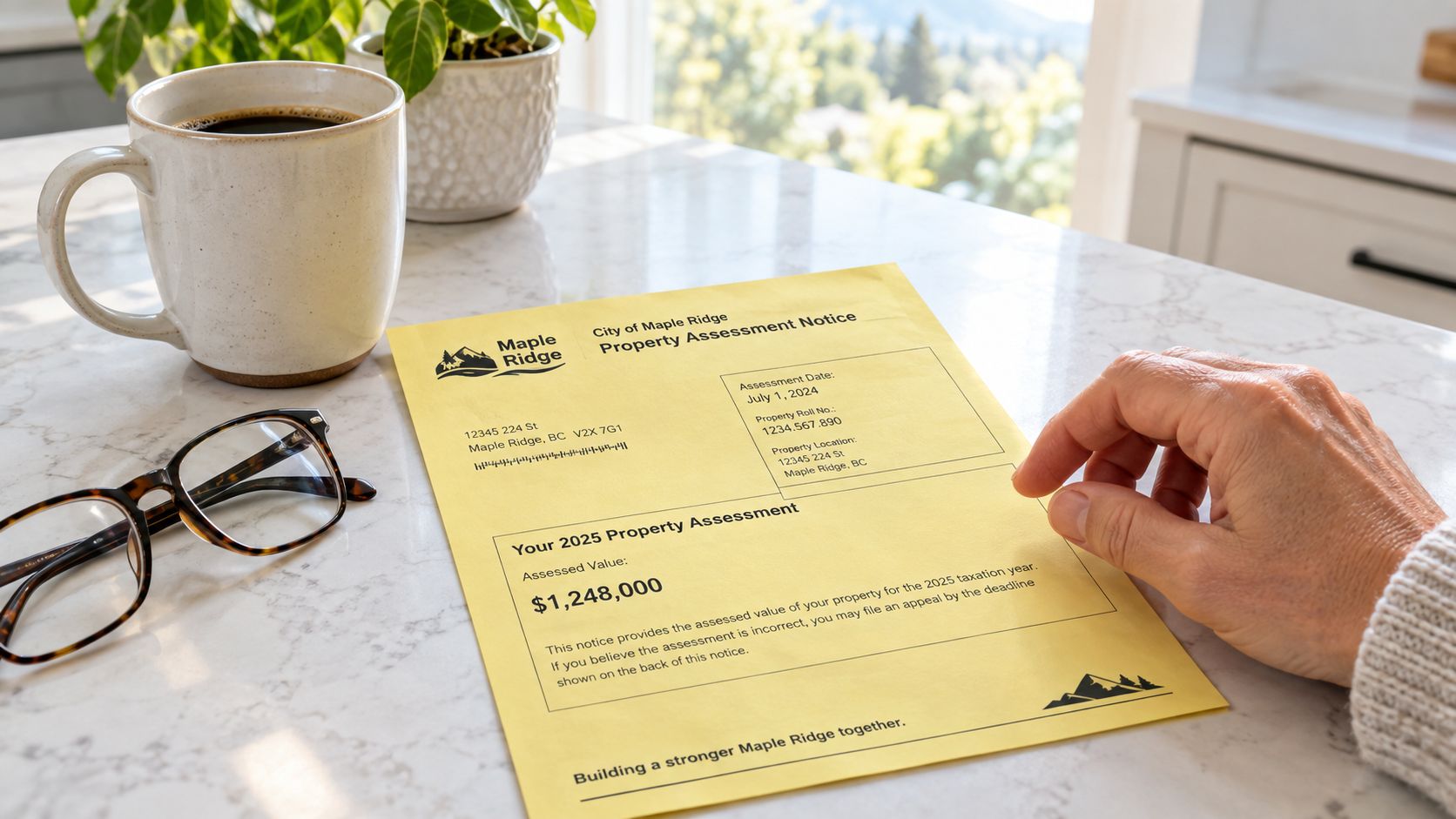
The yellow Property Assessment Notice is easy to skim and easy to misread. It identifies the property through details such as the roll number, legal description, property address and ownership information. A Pitt Meadows strata owner should confirm the strata lot and legal description. A Maple Ridge owner with a larger parcel should check that the land and improvements appear to describe the actual property.
The notice shows the assessed value, generally separated between land and improvements, and compares it with the previous assessment. That is not the same thing as the amount ultimately taxed. The assessment supplies a value and classification used by taxing authorities, while the tax bill applies the relevant municipal and other tax rates.
The notice also refers to the legislated valuation date. The assessment framework uses a valuation date set in legislation, so sales from a different market period may not answer the actual question before the review panel. The notice is an assessment document, not a property-tax bill.
Details that deserve a second look
Property classification matters because it affects tax treatment. Rural Maple Ridge properties and acreages may have land with different treatment, including farm-class considerations, so the classification code deserves more than a passing glance. Exemptions and other status information should also be checked against the property's actual circumstances.
Owners comparing the notice with market evidence should understand the difference between assessed value and market value, as outlined in this explanation of assessment versus market value. The figures answer related but different questions.
Before completing a complaint, the owner should copy the notice details exactly. The roll number, property identification information, assessor details and legal description need to match the complaint form. A mismatch can create an avoidable administrative problem before the panel considers the evidence.
Building a Compelling Comparable Sales File
The strongest file uses completed sales that resemble the subject property as it existed at the valuation date. A polished listing isn't proof of value, an expired listing isn't a sale, and a closing after the legislated cutoff may not be usable just because the property looks similar.
For Maple Ridge and Pitt Meadows, the screening should start with location and physical similarity. A comparable should generally sit in the same neighbourhood or plan area, have a similar lot-size band, and fall within a similar gross floor area. Age, effective age, renovations, view, waterfront influence, parking, suite configuration and bedroom count can all affect the comparison.
For strata units in areas such as Cottonwood or Silver Ridge, the unit type, bedroom count, floor, exposure, parking and building characteristics may matter more than a simple street-radius search. The analysis should explain differences rather than pretend they don't exist.
A practical research file can draw on BC Assessment property information, completed board data available through licensed real estate professionals and other legitimate valuation records. Each candidate sale should then be screened for its sale date, completion status, location, size, condition and relevant features.
What belongs in the file
| Criterion | Acceptable Range | Why It Matters |
|---|---|---|
| Location | Same neighbourhood or closely equivalent pocket | Local demand and property characteristics can vary sharply between sub-areas |
| Lot size | Similar land-size band | Larger or better-configured land can support a different value |
| Gross floor area | Closely similar, with modest differences explained | Finished area affects the comparison, especially among detached homes |
| Age and effective age | Similar construction period or adjusted condition | Renovations and deferred maintenance can change effective utility |
| View or waterfront status | Same influence, or clearly adjusted | These features can create a meaningful value difference |
| Property type | Same housing or strata category | Detached, townhouse and strata comparisons answer different valuation questions |
| Sale timing | Close to the legislated valuation date | Market conditions change, and later sales may not reflect the required date |
A useful file records the address, sale date, sale price, lot size, living area, bedroom count, condition and material differences for every selected sale. Unsold listings can help explain competing inventory, but they should not be presented as completed sales.
The closer the evidence sits to the valuation date, the less the argument depends on broad claims about what the market “felt like.”
Owners who need to understand the difference between board data and a listing service can review what the Multiple Listing Service means. The important point is not the label of the source. It's whether the record documents a completed, comparable transaction that addresses the valuation date.
The PARP and PAAB Appeal Ladder
Filing is only worthwhile when the evidence supports a specific correction. The appeal ladder has two administrative stages, and skipping the first one can end the matter before anyone examines the substance.
BC's first-level complaint goes through BC Assessment to the Property Assessment Review Panel, or PARP. Sending a complaint directly to the panel office does not satisfy the process.
The annual Property Assessment Notice is printed and mailed on December 31, with owners receiving it in early January. The timing and access details are also covered in this overview of how BC property owners can now access 2026 assessment values. Review the notice promptly because the regular January 31 complaint deadline arrives quickly. If January 31 falls on a weekend, the deadline moves to the next business day. For 2026, the first-level deadline moved to February 2, as explained in the Province's property assessment review information.
Obtain the complaint form through BC Assessment's appeals process and submit it by the deadline. The province's process guide states that PARP hearings occur between February 1 and March 15, with a Notice of Decision mailed by April 7. Hearings are typically 30 minutes. A focused valuation argument will serve you better than a broad complaint about taxes, fairness or the market.
| Stage | Deadline | Where You File | What They Review | Typical Outcome |
|---|---|---|---|---|
| PARP complaint | January 31, or the next business day when applicable | Through BC Assessment, not directly to the panel office | Assessment value, classification, exemption or related complaint grounds | A panel decision that may confirm or change the assessment |
| PAAB appeal | April 30 after the PARP hearing | Property Assessment Appeal Board | Whether the PARP decision or assessment issue warrants review under its jurisdiction | A board decision that may confirm or alter the result |
| Court review or appeal route | Within 21 days of a PAAB decision for the applicable Supreme Court of British Columbia route | The applicable court process | Issues permitted by the governing process | A court outcome, subject to its jurisdiction and rules |
The official appeal ladder and deadline guidance identifies a practical compliance risk. PAAB electronic filing can be submitted until 12:00 midnight on the deadline date, while courier or hand delivery must arrive by 4:30 p.m. Treat those as separate requirements. Missing either deadline can place the matter outside the board's jurisdiction.
A PARP complaint should identify the specific error and attach supporting evidence. A PAAB appeal is not a casual restart based on a general objection. Keep submission receipts, timestamps, completed forms and every exhibit. Procedural proof may be examined before the board reaches the valuation evidence.
Preparing a Tight PARP Evidence Package
A PARP member should be able to understand the requested change without digging through an unorganised box of documents. The package should open with the assessment notice, a one-page summary and a clear statement of the alleged error.
A representative Maple Ridge file might concern a detached home whose recorded finished area is materially different from the actual finished area. The owner's summary would state the requested correction, identify the supporting records, and connect the discrepancy to selected sales. It wouldn't spend pages describing general affordability concerns or dissatisfaction with municipal taxes.
A useful file order
- Assessment notice and property facts. Include the notice, roll number, legal description, property identification and a concise description of the home.
- One-page argument. State the assessed value, the proposed value or correction, the specific reason for the difference and the key supporting exhibits.
- Comparable sales schedule. Include a focused group of similar sales. Each record should show the address, sale date, sale price, lot size, living area and relevant differences.
- Condition evidence. Add dated photographs showing the actual condition, especially where the assessment appears to assume a better quality, finish or effective age.
- Supporting reports. Inspection or contractor material can help explain structural, functional or renovation issues that affect value.
- Market context. Unsold competing listings can illustrate inventory, but they should remain secondary to completed sales.
The evidence should be tabbed in the same order as the spoken explanation. A digital copy can sit on a phone as a backup, but paper copies remain useful when the panel is working through a short hearing.
The hearing strategy: identify one or two measurable discrepancies, point to the exhibit, explain the comparable adjustment, then stop.
A prepared script should fit the hearing format. The owner should know the opening sentence, the requested result, the strongest sale and the answer to the obvious question, “Why is this sale more comparable than the others?” A tight presentation sounds more credible than a long account of every disagreement with the notice.
When a Valuation Expert or Agent Pays Off
DIY is sensible when the property is ordinary, the alleged error is easy to document and the owner can find comparable sales without guessing. A straightforward Maple Ridge house with a clear size discrepancy may not need a complex professional report. The owner still needs an organised file and must meet the process deadlines.
Professional help becomes more useful when the valuation problem isn't visible from a basic sales search. A local REALTOR® may help verify neighbourhood differences, identify completed sales and explain why a seemingly similar property isn't comparable. That can be valuable for a property near a transition between sub-areas, where road exposure, lot configuration or surrounding development changes the comparison.
An accredited appraiser or other qualified valuation professional is more appropriate for unusual assignments. Examples include a property with an income suite, farm-class questions, irregular rural land, significant renovation damage or characteristics that require an income or specialised valuation approach.
Choosing the right level of help
| Situation | Practical starting point | Reason |
|---|---|---|
| Clear factual error and ordinary home | DIY file | The issue can be shown through records and focused sales |
| Neighbourhood or condition dispute | Local agent support | Local context may sharpen the comparison |
| Rural, farm-related or unusual land | Valuation professional | The property may require specialised analysis |
| Complex financial or legal issue | Appropriate regulated professional | The question may go beyond a standard assessment comparison |
Cost should be judged against the realistic size and strength of the claim, not against the emotional shock of the notice. No precise fee range should be assumed because professional charges vary by property, scope and provider. A flat-fee package may be enough when it covers comparable research, form preparation and evidence organisation. It isn't enough if the property requires a full valuation analysis.
Owners should also avoid paying multiple professionals to repeat the same work. A useful first step is to define the actual gap, identify the evidence already available and ask the prospective professional what specific task the fee covers. General guidance on house appraisal costs can help frame that conversation, but it shouldn't be treated as a quote.

A Local Checklist Before You File
Maple Ridge and Pitt Meadows owners can reduce wasted effort by making the decision in a fixed order. The process should begin with the notice, move to evidence, then end with a filing choice.
Verify the notice
- Confirm the property: Check the roll number, legal description, address and property identification.
- Separate the figures: Review land value, improvement value, total assessed value and the comparison with the prior notice.
- Check classification: Look for residential, farm-related, exemption or other status information that doesn't match the property.
- Read the valuation date: Use the legislated date governing the assessment, not the date the notice arrived and not a later market peak.
The assessment isn't the tax bill, and a tax increase alone doesn't prove that the underlying value is wrong. The first task is to identify a factual or valuation issue that can be demonstrated.
Check the comparables
At least three sales should be sufficiently similar before an owner treats a complaint as evidence-ready. More records can help, but a long list of weak comparisons is less persuasive than a short group of strong ones.
- Stay local: Compare the same Maple Ridge or Pitt Meadows pocket where possible.
- Match the property: Consider lot size, age, finished area, condition, bedroom count, parking, view, waterfront influence and suite configuration.
- Use completed sales: Don't substitute asking prices, expired listings or unsold inventory for sale evidence.
- Respect the cutoff: Screen every sale against the legislated valuation date.
Confirm the filing path
The first complaint goes through BC Assessment to PARP by January 31, or the next business day when the calendar requires it. A later appeal goes to PAAB by April 30 after the PARP hearing. Owners should save proof of submission, delivery or electronic filing rather than relying on memory.
The Province's overview of the review panel process confirms that a direct filing to the panel office isn't valid. That procedural detail deserves a prominent place in the checklist.
Decide who should present
- DIY: Best for a clean, evidence-heavy case with a clear factual discrepancy.
- Local agent: Useful when comparable selection and neighbourhood context are the main challenges.
- Valuation professional: Better suited to rural land, farm-related questions, unusual improvements or complex valuation methods.
The most useful next step is simple: calendar January 31 as soon as the notice arrives, then shortlist three Maple Ridge or Pitt Meadows sales before doing anything else. Filing without comparable evidence is the fastest way to join the 99% of owners who accepted their assessment, while a focused file gives the complaint a real basis.

Royal LePage Brookside Realty can help Maple Ridge and Pitt Meadows homeowners review local comparable sales and decide whether an assessment concern has enough evidence to pursue. Visit Royal LePage Brookside Realty to connect with a local real estate professional before the filing deadline arrives.