

A buyer can stand in a bright Silver Valley kitchen, look across the mountains, and still have no idea whether the right answer is to offer now, wait, choose a townhouse, or keep renting. The pressure usually comes from headlines and anxious advice about rates, not from a careful review of the buyer's own finances, lifestyle, and tolerance for risk.
So, should a buyer purchase a house in Maple Ridge, BC? The answer can be yes in 2026, but only when the budget works without relying on a quick price rebound, the property fits daily life, and the buyer has checked location-specific risks. A softer market creates room to negotiate, but it doesn't make ownership automatically affordable.
Table of Contents
- Why Maple Ridge Buyers Need a Decision Framework
- Checking Your Financial Readiness Before You Look at Listings
- What the Current Maple Ridge Market Is Telling Buyers
- Neighbourhood Fit and Lifestyle Considerations for Maple Ridge Buyers
- Running the Numbers with a Sample Affordability Calculation
- Your Next Steps and When to Contact Brookside Realty
Why Maple Ridge Buyers Need a Decision Framework
Many buyers begin with listings because listings feel concrete. They compare kitchens, yards, school routes, and asking prices before confirming whether the monthly cost leaves enough room for repairs, emergencies, and ordinary life. That sequence often creates false confidence. A home can look affordable on a listing page while remaining uncomfortable once mortgage payments, property tax, insurance, utilities, maintenance, and strata costs are included.
A better decision separates four questions:
- Can the buyer carry the property? The answer must account for more than lender approval.
- Does the current market create negotiating room? Market conditions matter, but they shouldn't determine the entire decision.
- Does the neighbourhood fit daily routines? Commute, services, recreation, flood exposure, and property type all matter.
- Would renting, renovating, or buying a smaller home solve the actual problem? Ownership isn't the only route to stability.

The order matters more than the headline
A buyer with stable income, accessible savings, and a clear reason to move may be ready to act even when prices could fall further. Another buyer may need to wait despite attractive negotiation conditions because the down payment is tied up, the monthly budget is already stretched, or the preferred property type is out of reach.
Maple Ridge has genuine long-term demand fundamentals. The city grew from 76,052 residents in Census 2011 to 90,900 in Census 2021, and it recorded 33,110 households with a homeownership rate of 79.1% in 2021. The city also built 1,272 of 1,284 units, achieving 99.1% of its two-year cumulative housing target. Those facts support the view that Maple Ridge remains a growing, owner-oriented municipality, but they don't remove the need for careful underwriting. The municipality's housing-target report provides the underlying figures.
Practical rule: A buyer shouldn't ask only whether Maple Ridge is a good market. The useful question is whether a specific property works for a specific household under conservative assumptions.
The framework is simple: finances first, market signals second, lifestyle fit third, and alternatives fourth. If the buyer passes all four checks, acting can make sense. If one fails badly, waiting or changing the property type is usually more sensible than forcing the purchase.
Checking Your Financial Readiness Before You Look at Listings
A pre-approval is useful, but it isn't the same as a comfortable budget. Before opening listings, buyers should calculate the maximum purchase price that leaves room for cash reserves, variable household expenses, and property surprises.
The first gate is total purchase budget. A lender may approve more than a buyer wants to spend. The buyer should set a personal ceiling based on the payment they can manage if expenses rise, rather than treating the maximum approval as a target.
Four gates before the first showing
Gate one, accessible funds. The down payment and closing-cost reserve should be available when needed. Money held in a registered account or investment may not be immediately usable without tax, market, or withdrawal consequences. The calculation should also include moving costs, immediate repairs, and any adjustment for prepaid expenses.
Gate two, full carrying cost. Mortgage principal and interest are only one line. Add property tax, home insurance, utilities, maintenance, and strata fees where applicable. A townhouse with a lower purchase price can still carry meaningful strata costs, while a detached home transfers more exterior maintenance responsibility to the owner.
Gate three, qualification capacity. The mortgage stress test affects the amount a buyer can qualify for. A formal review with a qualified mortgage professional should test income, debts, down payment source, credit history, and the payment at the applicable qualifying rate. Brookside's guide to what mortgage pre-approval actually covers can help organise the questions before that conversation.
Gate four, resilience. A purchase fails the readiness test if one repair, income interruption, or renewal-rate change would immediately destabilise the household. Buyers don't need perfect certainty, but they do need breathing room.
Maple Ridge home purchase budget scenarios
The benchmark prices below come from August 2026 Maple Ridge market data. The payment and annual carrying-cost columns are intentionally not populated because they depend on mortgage rate, amortisation, property tax, insurance, utilities, maintenance, and strata charges that vary by property.
| Property Type | Benchmark Price | 20% Down Payment | Estimated Monthly Payment* | Annual Carrying Cost** |
|---|---|---|---|---|
| Detached | $1,177,800 | $235,560 | Calculate with lender | Calculate by property |
| Townhouse | $704,100 | $140,820 | Calculate with lender | Calculate by property |
| Apartment | $504,300 | $100,860 | Calculate with lender | Calculate by property |
* Mortgage payment depends on the approved rate, amortisation, loan amount, and borrower profile.
** Annual carrying cost should include mortgage payments, property tax, insurance, utilities, maintenance, and strata fees where applicable.
A buyer who can technically qualify for a detached home may still be better positioned with attached housing. The correct pass threshold is not “the lender said yes.” It's “the full ownership cost remains manageable while the household retains a genuine reserve.”

What the Current Maple Ridge Market Is Telling Buyers
August 2026 conditions give buyers more room to negotiate than they'd have in a frantic bidding environment. The Maple Ridge composite MLS® benchmark was $890,800, down 7.0 per cent year over year. Segment pricing was sharply different, with detached homes at $1,177,800, townhouses at $704,100, and apartments at $504,300.
Sales were moderate at 127 transactions, listings spent about 29 days on market, and only 4.1 per cent of sales went above asking in August 2026. Those signals suggest that buyers can negotiate and that asking price is not a reliable substitute for recent comparable sales.
Read absorption, not emotion
A separate dashboard reported 813 active listings, 97 sales, a median 29 days on market, and 4.1 per cent of sales above asking for Maple Ridge in August 2026. The wider Fraser Valley remained in buyer's-market territory, with 941 homes sold and the composite benchmark down 0.9 per cent month over month. The Fraser Valley board package provides the regional context, while the Maple Ridge market dashboard shows the local indicators.
The practical reading is not that every seller will accept a low offer. It's that buyers should establish value from sold comparables, sale-to-list behaviour, days on market, and available inventory. A listing that has sat for weeks may offer negotiation room, but condition, location, and seller motivation still determine the outcome.
Negotiation works best when it's evidence-based. A buyer should know which comparable sales support the offer and which property defects justify a reduction.
Detached homes deserve particular caution. The benchmark gap between detached and attached housing is substantial, so buyers who assume every detached listing has intense competition may stretch beyond a sensible ceiling. Attached buyers face a different risk, namely underestimating strata fees, contingency exposure, insurance changes, and restrictions that affect long-term carrying costs.
Readers comparing local representation can also find hyperlocal real estate agents, but the useful test is practical local knowledge, not a slogan. A buyer should expect clear explanations of sold data, offer terms, property documents, and neighbourhood-specific risks. For a broader local overview, Brookside's Maple Ridge real estate resource offers additional context.
Neighbourhood Fit and Lifestyle Considerations for Maple Ridge Buyers
A benchmark cannot tell a buyer whether a neighbourhood suits the household. Albion, Silver Valley, Kanaka Creek, Cottonwood, and the Lougheed Highway corridor offer different trade-offs in setting, convenience, housing form, and daily travel. The right choice depends less on which area sounds appealing and more on how the home supports ordinary routines.
Families who want newer-feeling communities and access to outdoor space may focus on Albion or Silver Valley. Their due diligence still needs to include traffic patterns, school arrangements, lot grading, and the practical time required to reach services. Kanaka Creek can appeal to buyers who value a natural setting, while buyers considering Cottonwood may prefer older homes, established streets, and the possibility of more varied lot characteristics.
Convenience has a price beyond the purchase amount
The Lougheed Highway corridor can make errands and commuting more convenient, but proximity to a major route may bring more traffic exposure and a different streetscape. A first-time buyer may prefer an attached home closer to services, while a move-up buyer may accept a longer drive for additional space. Downsizers often weigh quiet surroundings against access to shops, healthcare, transit, and maintenance simplicity.
A neighbourhood decision should include a morning and evening drive, a walk around the immediate block, and a review of the property documents. Buyers comparing design priorities can also consider which high-end home features after moving in are practical rather than being distracted by finishes that don't improve the household's daily experience. Brookside's Maple Ridge neighbourhood guide can support that local comparison.

Flood exposure needs a property-by-property review
Flood risk isn't uniform across Maple Ridge. The city identifies spring snowmelt, fall and winter rainstorms, and Fraser River conditions as factors that can increase risk. City materials also warn that heavier rainfall and sea-level rise can raise Fraser River levels, while a UBC project estimates that a one-in-500-year Fraser River event could see peak discharge rise 21 per cent in the 2050s and 45 per cent in the 2070s. The more exposed areas identified include northwestern Maple Ridge, Alouette River communities, and Albion Flats and Industrial areas. Buyers should review the City of Maple Ridge flood-readiness information before making an offer.
That isn't a reason to reject an entire neighbourhood. It's a reason to check flood maps, insurance availability, drainage, elevation, retaining structures, and potential mitigation costs. A buyer who skips that review may discover too late that the cheapest property carries the greatest uncertainty.
Renting can be the better choice when flexibility matters or the household hasn't built an adequate reserve. Renovating an existing home can work when the lot and location are right, but only after confirming the project's financing, permits, timing, and scope. Lifestyle fit often decides the purchase more reliably than a small difference in list price.
Running the Numbers with a Sample Affordability Calculation
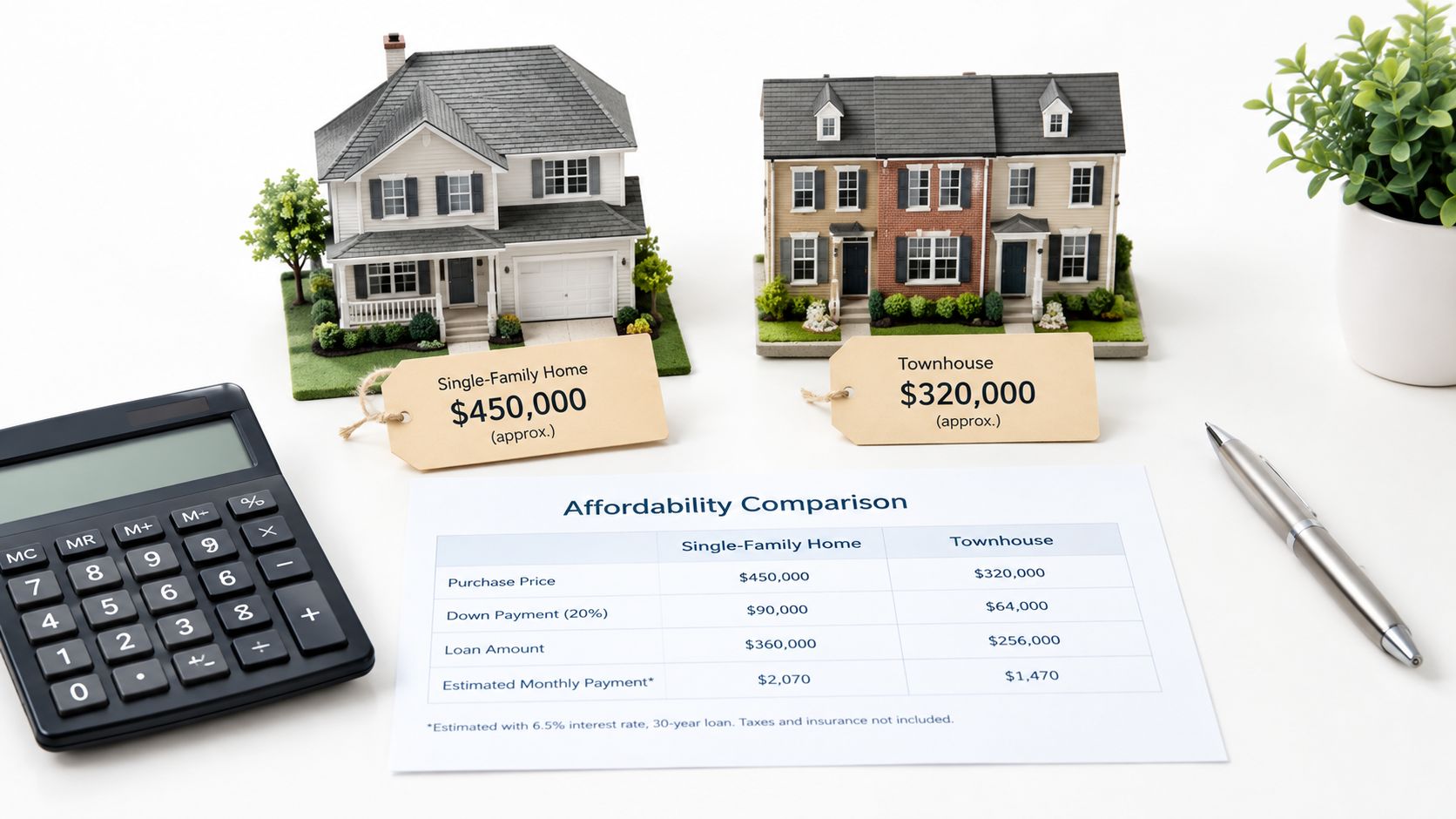
A side-by-side calculation shows why the question isn't only whether a buyer can qualify. It's whether the chosen property leaves enough monthly capacity for the rest of life.
Consider two benchmark-based examples from August 2026: a townhouse at $704,100 and a detached home at $1,177,800. These are market reference points, not promised listing prices or personal borrowing recommendations.
The down payment is only the starting point
With a 20 per cent down payment, the townhouse example requires $140,820, leaving a mortgage principal of $563,280 before any other adjustments. The detached example requires $235,560, leaving $942,240 before other adjustments. The detached scenario therefore ties up substantially more cash and creates a larger mortgage, even before property tax, insurance, utilities, repairs, and any strata cost are added.
A fixed-rate mortgage comparison should use the buyer's actual lender quote, amortisation, and qualification result. The phrase “estimated monthly payment” is misleading without those inputs. Buyers should ask the lender to show the payment, qualifying payment, and the effect of a higher renewal rate rather than relying on an online calculator alone.
| Scenario | Benchmark Price | 20% Down Payment | Mortgage Before Adjustments | Main Cost Questions |
|---|---|---|---|---|
| Townhouse | $704,100 | $140,820 | $563,280 | Mortgage, strata, tax, insurance, utilities, maintenance |
| Detached home | $1,177,800 | $235,560 | $942,240 | Mortgage, tax, insurance, utilities, repairs, exterior maintenance |
Property transfer tax can change the cash required
British Columbia's first-time home buyer property transfer tax exemption provides a full exemption at or below $500,000, an exemption of up to $8,000 for homes over $500,000 and up to $835,000, and a phase-out for homes over $835,000 and under $860,000. A townhouse at $704,100 may fall within the partial-exemption range if the buyer meets every eligibility condition. A detached home at $1,177,800 is outside those thresholds. The provincial exemption amounts are time-sensitive and should be confirmed before closing.
Eligibility also matters. The purchaser must meet provincial residency and ownership requirements, and the exemption applies to a qualifying principal residence, not a rental or investment property. The BC eligibility rules should be reviewed with the appropriate professional because this article isn't legal or tax advice.
The practical conclusion is uncomfortable but useful: targeting detached homes first can weaken approval odds and reduce cash-flow resilience. Switching to a townhouse or apartment may preserve more flexibility while still providing ownership. Buyers organising the rest of their closing budget can use Brookside's BC closing-cost calculator. A broader relocation comparison, such as the ReloMaps PNW cost ranking, can provide general context, but it shouldn't replace Maple Ridge-specific figures.
Your Next Steps and When to Contact Brookside Realty
The decision becomes clearer when buyers attach actions to each stage. A vague intention to “watch the market” rarely produces useful information. A short, organised process does.
Complete the financial check first
The first step is to write down accessible funds, maximum comfortable purchase price, expected monthly carrying costs, and the reserve that must remain untouched. A lender can then test the purchase against the mortgage stress test and identify whether the realistic target is detached, townhouse, apartment, or no purchase yet.
Next, select a narrow property brief. It should identify the preferred neighbourhoods, minimum space, tolerance for strata fees, commute requirements, flood-risk review, and critical condition issues. Buyers who view everything often lose the ability to compare homes properly.
Use the market to improve the offer, not to justify the purchase
Once finances and criteria are clear, buyers can monitor comparable sales and listings with similar age, size, condition, and location. A property that sits longer may offer negotiating room, but the offer still needs to reflect repairs, documents, and resale considerations.
A formal pre-approval should be in place before serious offer activity. Viewings should include more than finishes. Buyers should ask about maintenance history, strata documents where relevant, insurance, drainage, additions, permits, and any location-specific concerns. If the property fails the carrying-cost test or raises unresolved flood questions, stepping back is the correct action.
Know when to call and when to pause
Local guidance becomes useful when a buyer has a defined budget but needs help comparing neighbourhoods, interpreting comparable sales, reviewing offer strategy, or narrowing property types. Royal LePage Brookside Realty works with Maple Ridge and Pitt Meadows buyers on local purchase decisions, and buyers can use the brokerage's contact page when they're ready to discuss a focused search.
A buyer should pause when the down payment depends on uncertain funds, the monthly budget leaves no reserve, the desired property requires optimistic repair assumptions, or the household is buying mainly because of fear about future rates. The decision to buy isn't a race against a headline. It's a test of whether finances, lifestyle, and risk tolerance align with the property available.
Royal LePage Brookside Realty provides local buyer guidance, property searches, showing coordination, and practical advice for comparing Maple Ridge and Pitt Meadows homes. Visit Royal LePage Brookside Realty to move from a general “should I buy?” question to a focused plan based on budget, property type, neighbourhood fit, and current market evidence.