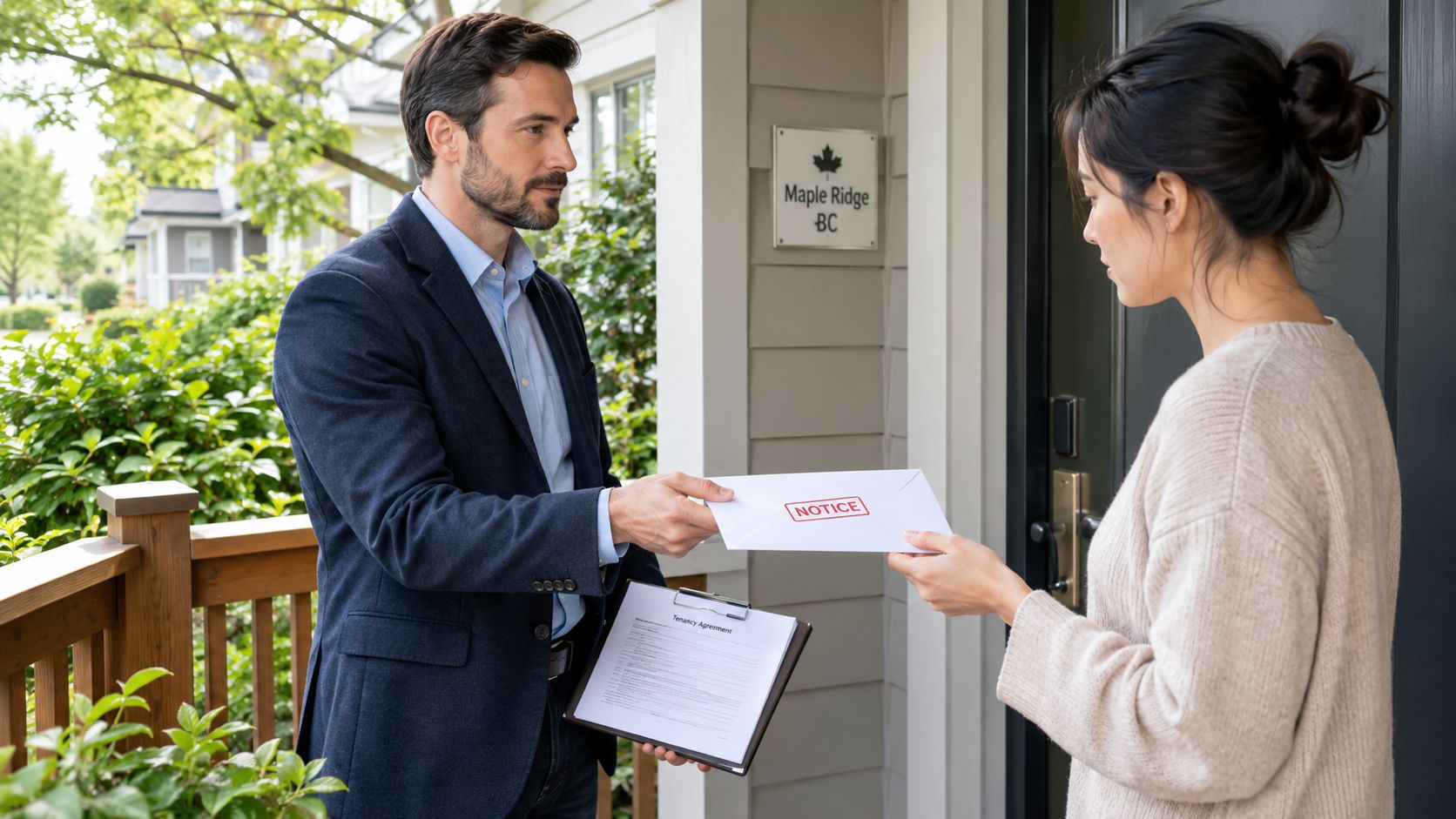
A landlord in Maple Ridge hands a tenant an envelope and immediately wonders whether the notice should be delivered at the door, posted on the unit, or mailed. The tenant asks whether the date is valid. The landlord starts counting calendar days, then discovers that the form, service method, effective date, and dispute deadline all depend on the reason for ending or changing the tenancy.
That's the practical question behind a Maple Ridge BC tenant FAQ about what landlords should know about notices. Which notice applies, which RTB form is required, when can the tenancy end, and what evidence will hold up at the Residential Tenancy Branch? A notice can look perfectly reasonable and still fail because the wrong form was used, the effective date doesn't align with the rental period, or the landlord can't prove service.
The following guide focuses on the rules that most often affect Maple Ridge and Pitt Meadows rental homes, including unpaid rent, cause-based notices, landlord use, purchaser use, rent increases, entry notices, and tenant move-out notices. It also addresses the changes introduced in 2024 and 2025, which have made older templates particularly risky.
Table of Contents
A Quick Note Before the Notices Start Flying
A printed Notice to End Tenancy is sitting in a Maple Ridge landlord's hand outside a townhouse. The landlord knows the tenant hasn't paid rent, but isn't sure whether the envelope should be handed over directly, posted somewhere noticeable, or mailed from the post office on Lougheed Highway. Each option creates a different evidence trail, and an informal shortcut can create trouble later.
The Residential Tenancy Branch doesn't decide a notice only by asking whether the landlord had a valid concern. It also looks at whether the landlord selected the correct statutory pathway, completed the proper form, calculated the effective date correctly, and served the document using an accepted method. A correct reason cannot rescue an incorrectly served notice.
Practical rule: Before serving anything, identify the reason for the notice, confirm the current RTB form, calculate the effective date from the tenancy's payment cycle, and preserve proof of delivery.
The core categories are straightforward once separated. Unpaid rent or utilities may lead to a 10 Day Notice to End Tenancy. Cause-based problems may require a One Month Notice or another prescribed notice. A landlord or purchaser needing possession has a different process, while a rent increase and a unit-entry appointment each use their own written notice requirements.
The Province's eviction guidance for British Columbia landlords sets out the principal notice rules, including the 24-hour written entry notice requirement. These are procedural rules, not suggestions, and landlords who rely on an old template or a text message often have to start again.
The Notices BC Landlords Actually Use in Maple Ridge
Landlords should begin with the trigger, not the form number. A notice designed for unpaid rent can't be repurposed for a renovation, and a landlord-use notice isn't a substitute for evidence of tenant misconduct.
The main notice categories
The 10 Day Notice to End Tenancy applies to unpaid rent or utilities. Under the Residential Tenancy Act, the effective date can be no earlier than ten days after the notice is given, as set out in the British Columbia legislation on unpaid rent notices. The provincial eviction guidance identifies RTB Form 30 for this situation.
A One Month Notice to End Tenancy for Cause is used for recognised cause-based grounds. Depending on the facts, the file may involve repeated late rent, an unauthorised pet or guest, damage, or another breach. The landlord needs supporting records, because the notice itself doesn't prove the allegation.
A Two Month Notice for Landlord Use of Property and the newer Three Month Notice for Landlord Use of Property belong to the landlord-use category. The correct pathway depends on the reason, the date the notice is generated, and the current provincial rules. A sale alone doesn't automatically end a tenancy. Purchaser occupancy has its own notice route.
Tenants also use a written Tenant's Notice to End Tenancy. For a periodic tenancy, the notice must be received at least one full rental month before the effective date and before the day rent is due. That means it must align with the rental period, rather than counting 30 calendar days, as explained in the Province's tenant move-out notice guidance.
Common BC Notices at a Glance
| Notice Type | RTB Form | Trigger | Effective Period |
|---|---|---|---|
| 10 Day Notice to End Tenancy | RTB Form 30 | Unpaid rent or utilities | No earlier than ten days after service |
| One Month Notice to End Tenancy for Cause | Current prescribed RTB cause form | Cause, such as repeated late rent, pets, guests, or damage | One rental month, subject to the applicable rule |
| Two Month Notice for Landlord Use | Current prescribed landlord-use form | Qualifying landlord use under the applicable rule | Two months where that pathway applies |
| Three Month Notice for Landlord Use | Current prescribed landlord-use form | Qualifying landlord use under the updated rule | Three months under the current landlord-use pathway |
| Tenant's Notice to End Tenancy | Written tenant notice | Tenant ending a periodic tenancy | At least one full rental month, aligned with the rental period |
| Notice of Entry | Written notice | Landlord or agent entering the unit | At least 24 hours' written notice |
| Notice of Rent Increase | RTB-7 | Lawful rent increase | At least three full months' written notice |
Most eviction notices also need the RTB-1 Information for Tenants form attached. Landlords who want a broader explanation of the statutory framework can review Brookside's BC Residential Tenancy Act explained. For readers dealing with tenancy disputes in another jurisdiction, Olson & Sons also provides a separate resource on Hawaii landlord disputes help, but its rules don't apply to a Maple Ridge tenancy.
How the Landlord-Use Notice Rules Quietly Changed
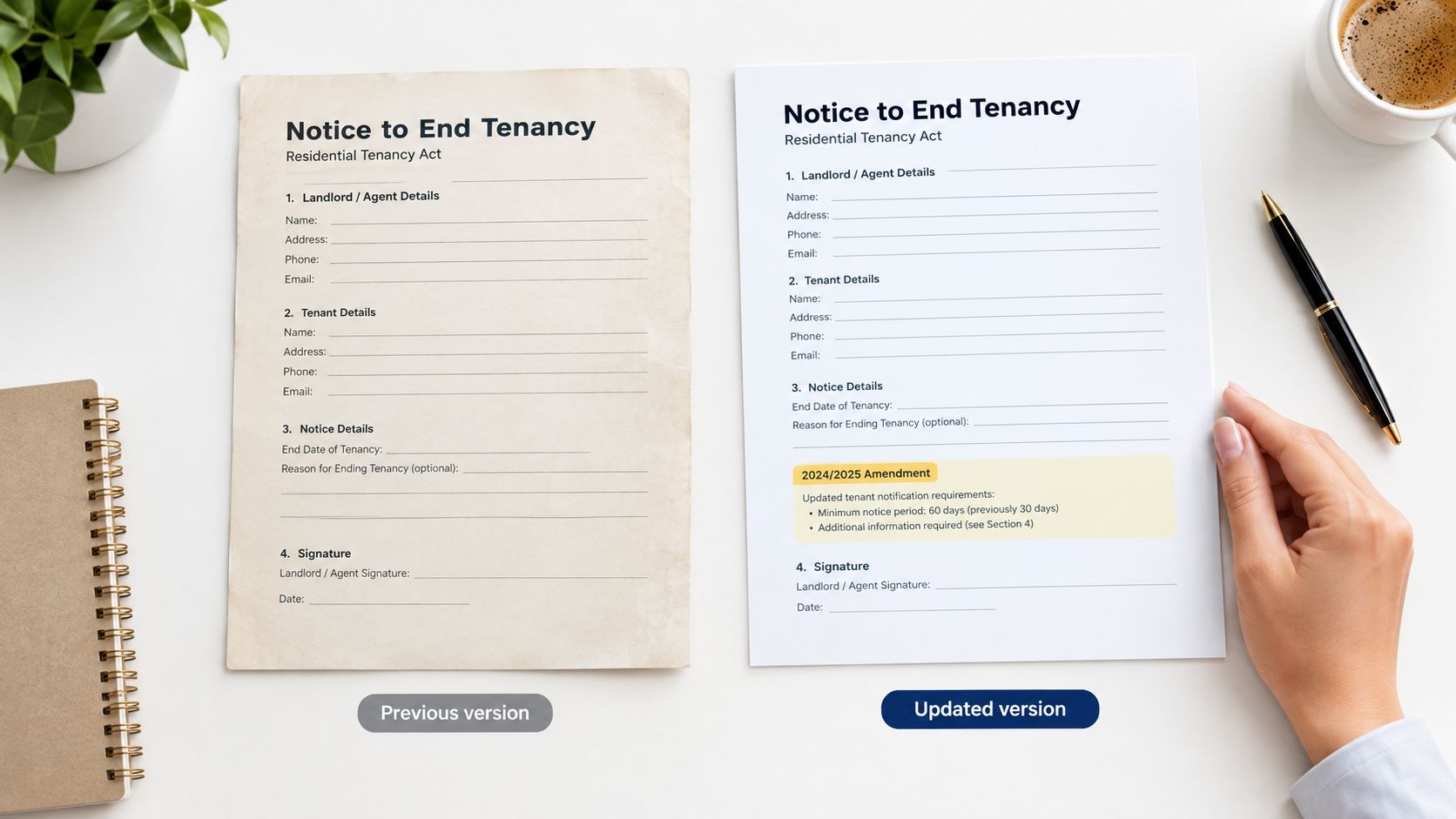
Landlord-use notices have gone through a transition that makes old online explanations unreliable. For purchaser-use notices, BC rules changed on August 21, 2024. Notices generated before that date required four months' notice and allowed tenants 30 days to dispute. Notices generated under the updated regime require three months' notice, and tenants have 21 days to dispute, according to the Province's current eviction notice guidance.
The Province later announced another change in April 2025, effective June 18, 2025. The landlord-use notice period shifted from four months to three months, and the tenant dispute period moved from 30 days to 21 days, as described in the provincial announcement about the tenancy rule changes.
Why the transition matters
The practical trap is assuming that the date on an old template controls the legal regime. It doesn't. Landlords need to establish when the notice was generated, which statutory reason applies, and which current form is required.
A landlord-use notice also demands more than a claimed intention. The landlord must use the appropriate pathway and be prepared to show that the stated use is genuine. The legislation includes compensation rules for certain landlord notices. Where a landlord serves a three-month or four-month notice, the tenant must receive compensation equal to one month's rent, paid on or before the effective date of the notice period, as set out in the Residential Tenancy Act.
For a Maple Ridge owner preparing a sale, family move, or other qualifying use, the safest practice is to stop using archived forms. A notice that was valid under the previous four-month regime may not be the right document for a current file, and a missed 21-day dispute window can affect how quickly the tenant challenges it.
Serving the Notice So It Actually Sticks
Service is where many otherwise organized files weaken. BC guidance permits specific delivery methods, including direct delivery, mail, and posting in a noticeable place. The landlord's job isn't to send the notice. It's to prove what was served, when it was served, and how it reached the tenant.
Accepted delivery methods
Direct delivery is usually the clearest option when an adult tenant receives the document at the unit. A landlord should record the date and time, the person who accepted it, and the identity of any witness. If direct delivery isn't practical, registered mail creates a paper trail through the mailing receipt and delivery record.
Posting the notice in a noticeable place at the rental unit may also be permitted, but the landlord should photograph the location and preserve the date. A document tucked under an interior bedroom door, a photograph sent by text, or an email sent without an agreed method of electronic service can be challenged. The issue isn't whether the tenant eventually heard about the notice. The issue is whether the statutory service requirement was met.

Portal generation and proof
Newer RTB guidance indicates that some landlord-use notices must be generated through the official system to be valid. The Province's communication and service guidance explains accepted service methods and the importance of proper delivery. Portal generation also changes the proof-of-service process because the system can create a record linked to the notice.
Landlords who need to transmit supporting paperwork should still distinguish between sending a document and legally serving a notice. A fax may help preserve a communication record in an appropriate situation, and a landlord can review options to send a document via fax, but transmission alone doesn't replace the service method required for the specific RTB notice.
The service entry should be written immediately, not reconstructed after the tenant files a dispute.
A useful log includes the exact date, time, method, address, recipient or posting location, witness information, tracking details, and a scan or photograph of the served copy. That record often matters more than the landlord's recollection months later.
Matching the Situation to the Right Notice
The fastest way to avoid a defective notice is to match the problem to the legal pathway before entering any dates. Rent increases, unpaid rent, cause-based breaches, and landlord use are different processes with different forms and timing.
BC Tenancy Notices at a Glance for Maple Ridge Landlords
| Notice Type | RTB Form | Trigger | Notice Period | Tenant Dispute Window |
|---|---|---|---|---|
| Rent increase | RTB-7 | Lawful rent increase | At least three full months, and only once every 12 months | Governed by the tenancy dispute process |
| Unpaid rent or utilities | RTB Form 30 | Rent or utilities remain unpaid | Effective no earlier than ten days after service | Tenant rights and response process apply under the Act |
| Cause-based ending | Current prescribed cause form | Repeated late rent, pets, guests, damage, or another recognised breach | Commonly one rental month where the one-month pathway applies | Depends on the notice and applicable process |
| Landlord use | Current prescribed landlord-use form | Qualifying personal or landlord use | Three months under the updated current pathway | 21 days under the updated regime |
| Purchaser use | Current prescribed purchaser-use form | Purchaser's qualifying occupancy | Three months for notices under the updated regime | 21 days under the updated regime |
The errors that create avoidable disputes
A rent increase cannot be folded into a casual email. BC landlords must give at least three full months' written notice, increase rent only once every 12 months, and use the approved RTB-7 form with the exact new rent and effective date, according to the official RTB-7 form.
A landlord-use notice shouldn't be used as a general-purpose renovation notice. Cause notices also need evidence that matches the stated ground, such as dated communications, inspection records, photographs, or payment records. For a broader explanation of the landlord's position within BC's tenancy framework, landlords can consult Brookside's guide to landlord rights in BC.
Decision point: If the reason would sound different when written in a hearing package, the selected notice may be the wrong one.
Why Documentation Saves Landlords More Than Any Form
A form starts the process. Documentation proves what happened. In Maple Ridge tenancy files, the landlord with a plain, organised record often has a stronger position than the landlord with a polished notice and no supporting evidence.
Consider entry notices. The Province requires 24 hours' written notice before a landlord or agent enters a rental unit, as stated in its residential tenancy eviction and notice guidance. A dated entry log should identify the reason, proposed time, delivery method, and whether the tenant responded.
The file that can survive questions
A landlord's notice file should contain:
- The tenancy agreement: Keep the signed agreement and any amendments together.
- The notice copy: Preserve the exact version served, not just a blank template.
- Proof of service: Record the method, date, time, recipient, posting location, or mailing record.
- Evidence of the underlying issue: Save payment records, photographs, inspection notes, and written communications.
- A deadline calendar: Track the tenant's dispute period and the notice's effective date separately.
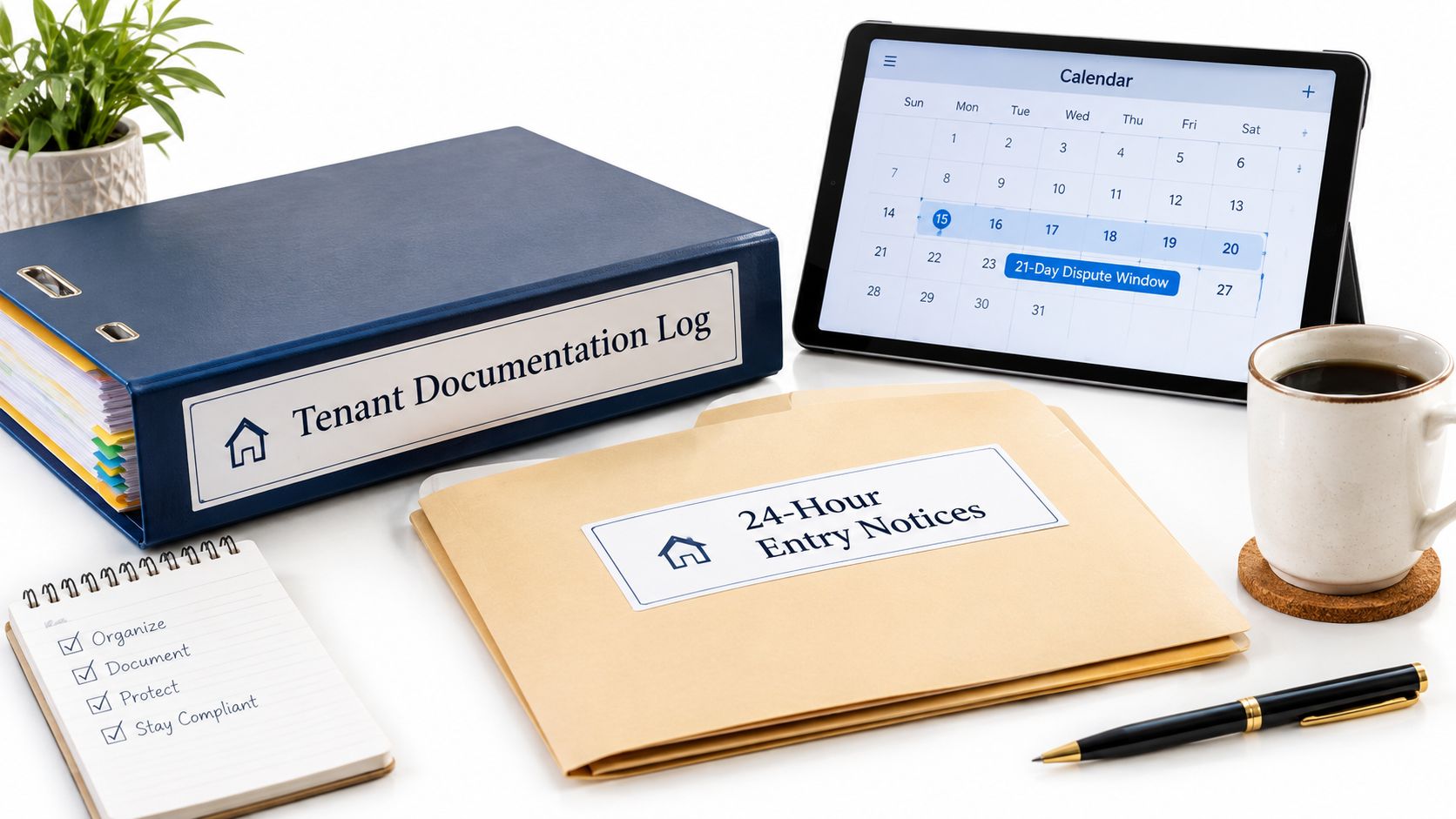
The 21-day dispute window is a useful example of why calendars matter. A landlord may know the tenant received a notice, but without a reliable receipt date, the parties can disagree about when the deadline began. A spreadsheet that records each event as it occurs turns a memory-based argument into a chronological file.
Deposit records deserve the same care. Landlords handling move-out damage should keep inspection evidence and payment records alongside the notice documents, then review the applicable BC damage deposit rules. Documentation doesn't guarantee an outcome, but missing documentation can make a sound position difficult to prove.
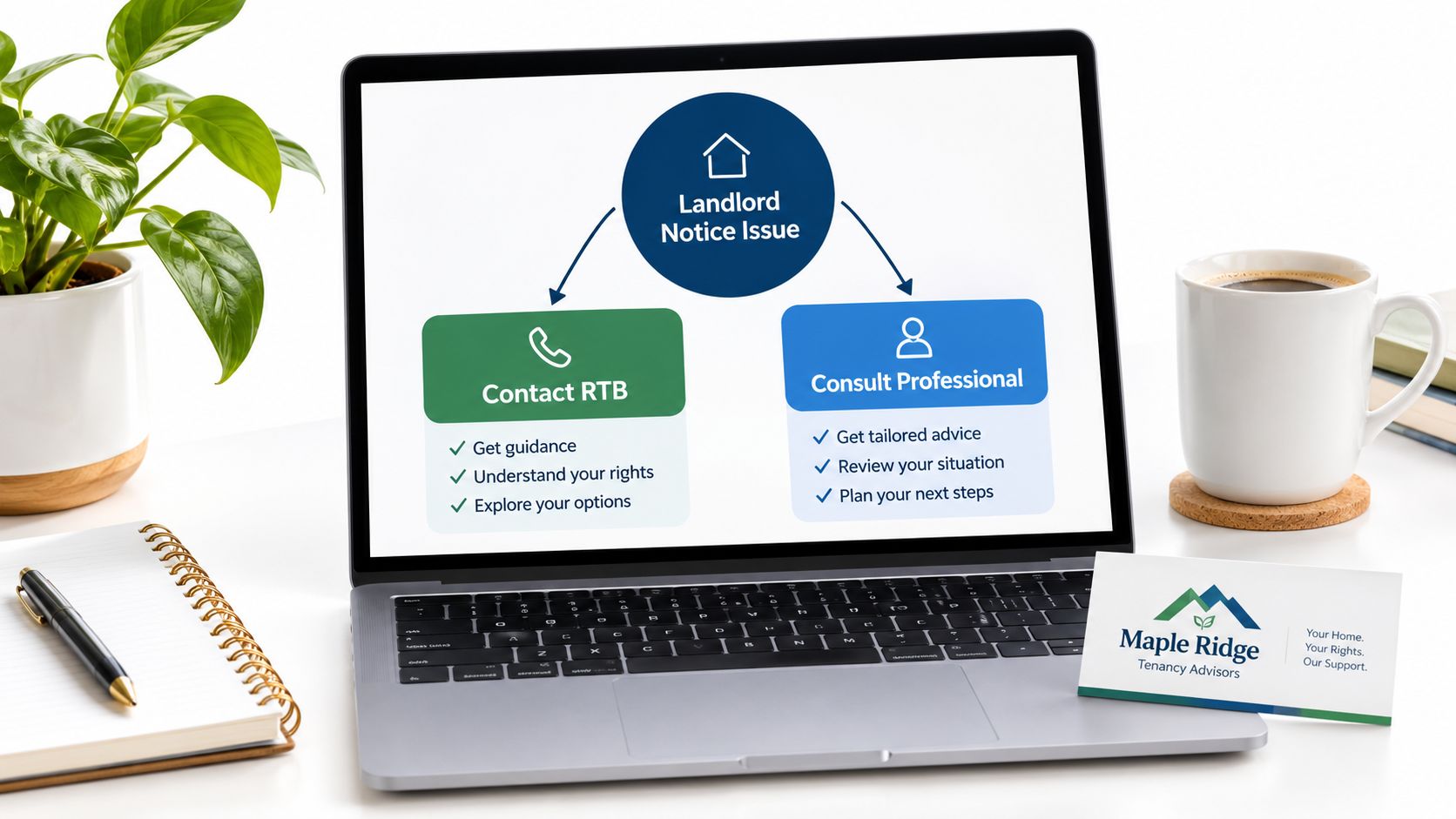
When to Call the RTB and When to Call a Professional
The Residential Tenancy Branch is the natural route when the dispute concerns a notice governed by the Residential Tenancy Act. A tenant who challenges an unpaid-rent notice, disputes landlord or purchaser use, alleges improper service, or contests a rent increase should use the RTB process rather than treating the notice as a private negotiation.
Situations that belong at the RTB
An RTB file generally needs the notice, tenancy agreement, service evidence, rent ledger, inspection records, and relevant written communications. Landlords should preserve these documents before filing or responding, because the hearing process turns on evidence rather than confidence.
The portal-generated notice pathway also matters here. If the applicable landlord-use notice must be generated through the official system, the landlord should confirm that step before relying on a downloaded or copied form. A landlord facing a procedural question can review Brookside's guide to the RTB-34 form for BC tenancy disputes as part of the preparation process.
Situations that need tailored advice
A lawyer or licensed property manager may be the better first call where the cause allegation is ambiguous, several people share the tenancy, the home falls within a manufactured-home-park arrangement, or the dispute may move beyond the RTB and toward Supreme Court proceedings. These files can involve overlapping agreements, complicated evidence, or consequences that extend beyond possession of the unit.
The choice isn't necessarily adversarial. The RTB is designed for tenancy disputes and can be the efficient path when the issue is a clear notice and a focused procedural disagreement. Professional advice becomes more valuable when evidence needs to be preserved, the legal basis is uncertain, or a landlord risks taking an irreversible step.
For landlords in Maple Ridge and Pitt Meadows, the sensible test is risk. If the problem is a straightforward form, date, or service question, verify the rule and organise the file. If the facts are contested or the consequences are serious, obtain advice before serving or enforcing the notice.
A Practical Notice Checklist for Maple Ridge Landlords
Memory works poorly once a tenant disputes a notice. A written notice log gives the landlord a reliable sequence of events, from the first missed payment or inspection observation to service, response deadlines, and the proposed end of the tenancy.
Before service
- Confirm the tenancy facts: Identify the parties, unit address, rent cycle, and whether the tenancy is periodic or fixed term.
- Identify the legal trigger: Separate unpaid rent, cause, landlord use, purchaser use, rent increase, and entry.
- Use the current RTB form: Check whether the notice must be generated through the official portal.
- Complete the grounds accurately: Use the applicable statutory reason and avoid vague wording.
- Check the effective date: Align the date with the notice period and, where relevant, the rental payment period.
- Sign and date the notice: Ensure the served copy is complete and legible.
- Attach required information: Include the RTB-1 Information for Tenants form where required.
At and after service
Choose a method that produces evidence. Direct delivery, registered mail, or posting in a noticeable place may be appropriate under BC rules, but the landlord must document the specific method used. A photograph, scan, receipt, tracking record, or witness note can prevent a later argument about whether service occurred.
Record the exact date and time in a dedicated log. Then set separate calendar reminders for the tenant's dispute deadline, the effective date, compensation obligations where applicable, and any inspection or key-return appointment.
Preserve every email, letter, text message, photograph, payment record, and inspection report. Landlords who want to understand how organised management can support this type of ongoing compliance can read about why landlords choose a property manager in Maple Ridge.
A landlord doesn't need an elaborate system. The system needs to be current, chronological, and complete enough that another person can understand the file without relying on memory.
Royal LePage Brookside Realty provides licensed residential property management for landlords in Maple Ridge and Pitt Meadows, including practical support with notices, documentation, tenant communication, and RTB-related processes. Landlords who want help managing the details can visit Royal LePage Brookside Realty to discuss their rental property.