Maple Ridge landlord rental property insurance is commonly quoted at about $90–$180 per month, with final pricing driven by property value, location, and rental type. Across British Columbia, many rental policies fall around $800–$2,500 per year, but that broad range hides major differences between a detached home, condo, basement suite, and short-term rental.
A landlord in Albion may open a renewal notice expecting a routine adjustment and find that the premium has moved sharply. Another owner in a Silver Valley condo may pay far less, until a large strata deductible or earthquake endorsement changes the calculation. The address matters, but the building, rebuilding exposure, occupancy, claims record, and coverage choices matter more.
The useful question isn't just, “What does rental property insurance cost?” It's, “What does this particular rental setup cost when the necessary endorsements are included?” That distinction keeps owners from comparing a basic condo policy with a broad detached-home policy and assuming one insurer is overcharging.
What Maple Ridge Landlords Actually Pay for Rental Insurance
A Maple Ridge landlord reviewing a renewal should begin with the local benchmark, not a national calculator. Local landlord rental property insurance is commonly quoted at $90–$180 per month, according to Maple Ridge landlord insurance pricing guidance. That works out to a meaningful annual operating expense, especially for an owner managing a single rental where every recurring bill affects cash flow.
The wider British Columbia range is often estimated at $800–$2,500 per year for rental properties, but it isn't a universal price card. A detached house in Cottonwood or Kanaka Creek generally carries more replacement exposure than a condo unit, while a seasonal or intermittently occupied property attracts a different underwriting response altogether.
Practical rule: A premium outside the local range isn't automatically wrong. It deserves an explanation tied to the property's rebuild value, use, deductible, claims history, and endorsements.
Insurance should sit beside property taxes, utilities, repairs, strata fees, and management costs in the owner's operating budget. Landlords comparing the full picture can use this guide to understand operating expenses for rental property before deciding whether a policy is affordable.
Landlord coverage isn't tenant coverage
A landlord policy protects the building, the owner's liability exposure, and selected rental-income risks. It doesn't replace a tenant's furniture, clothing, electronics, or personal liability coverage. Tenant insurance is usually much cheaper, often around $15–$35 per month in British Columbia, according to BC tenant insurance guidance, but it serves a different purpose.
Owners should also avoid treating ordinary home insurance as a substitute for rental coverage. The insurer needs to know that the property is rented, whether it has a basement suite, and whether occupants stay long term or for short periods. A policy built around owner occupancy may not respond properly to a rental claim.
For a broader comparison of household policies and pricing considerations, landlords can review this BC home insurance cost overview. The key is to compare like with like, then assess whether the coverage matches the actual rental arrangement.
Understanding What Rental Property Insurance Covers
Landlord insurance works best when owners view it as three layers wrapped around the rental asset. The first protects the physical property. The second protects against liability claims. The third protects rental income when a covered event makes the home uninhabitable.
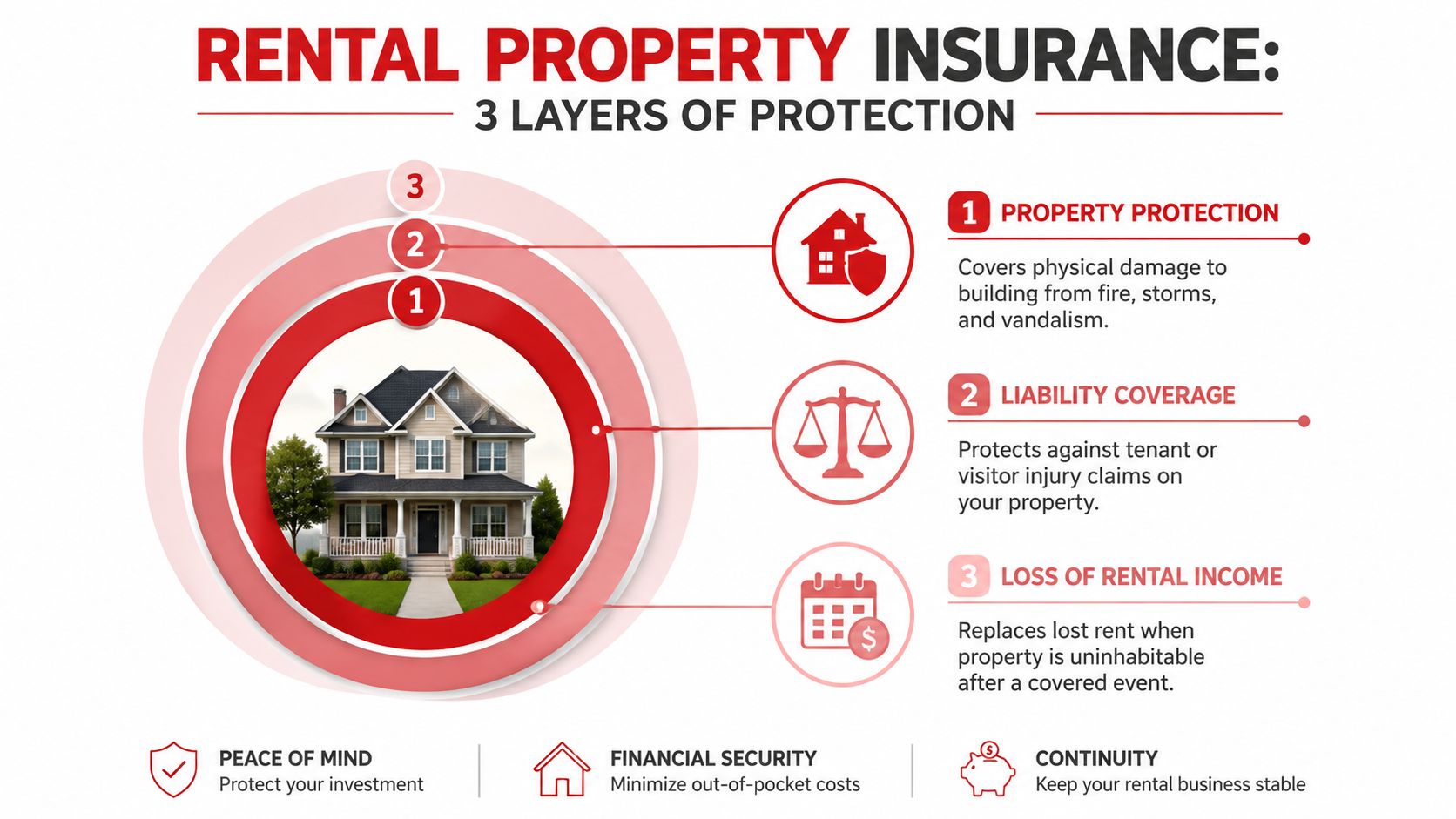
Layer one protects the building
The property layer addresses covered damage to the structure and, depending on the wording, fixtures, appliances, detached structures, and other items the owner supplies. For a detached rental in Albion, that can include the home's envelope, roof, plumbing, electrical systems, and attached improvements. For a condo, the owner's responsibility usually focuses on the unit and improvements inside it, while the strata corporation insures common property under its own policy.
Replacement value deserves careful attention. The purchase price isn't the same as the cost to rebuild, and a policy limit that looks adequate beside the mortgage balance may still leave an owner exposed after a serious loss.
Layer two responds to liability
Tenants, visitors, contractors, and delivery workers can all create liability exposure on a rental property. The liability portion can respond to eligible injury claims and associated legal defence, subject to the policy terms and limits.
A landlord's responsibility also differs from a tenant's. The tenant's insurance should address personal belongings and the tenant's own liability. The owner's policy addresses the owner's property and legal exposure connected with ownership and rental operation.
Layer three protects the rent stream
Loss-of-rental-income coverage can replace eligible rent when a covered event leaves the property uninhabitable. It isn't rent-guarantee coverage for a tenant who stops paying. The trigger generally relates to insured physical damage and the resulting interruption, so owners need to read the conditions, limits, waiting periods, and duration carefully.
Strata properties add another layer of complexity. BC strata deductible insurance can provide limits up to $500,000, with a minimum deductible of $25,000, but some policies exclude short-term rentals, earthquake, flood, fire, rental income, and additional living expenses, as outlined by BC strata deductible insurance information.
That exclusion list is why a landlord should navigate the landlord claim process before a loss occurs, not while water is spreading through a ceiling. A plain-English review of the policy can reveal gaps that a low premium conceals. Owners comparing building, liability, income, and strata responsibilities can also consult this rental property insurance coverage guide.
The Five Factors That Drive Your Premium Up or Down
Insurers don't price a Maple Ridge rental from the postal code alone. They evaluate the asset and the way it operates. Five variables consistently do the most work.
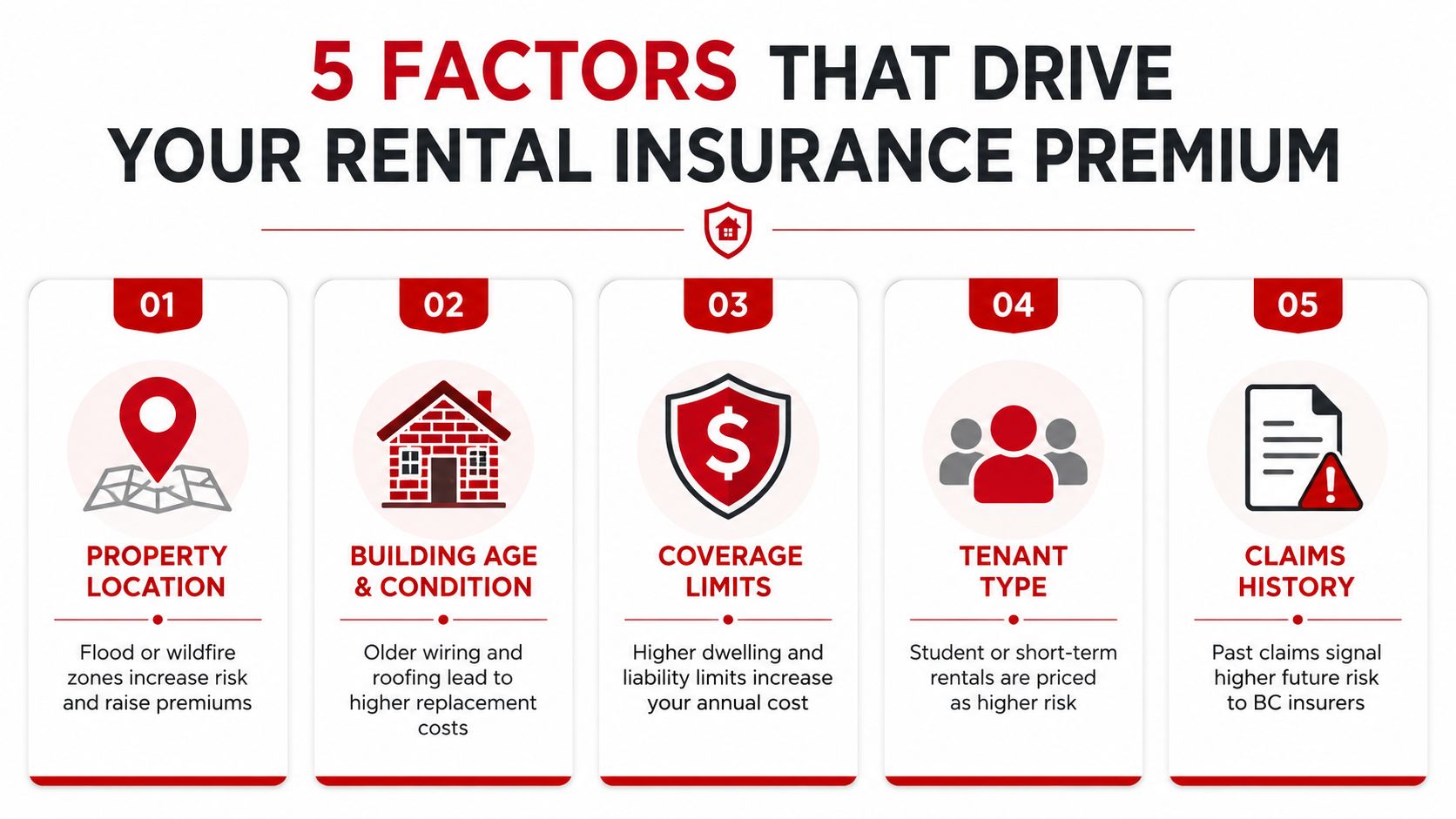
Replacement value
A larger detached home, a complex roofline, higher-grade finishes, or costly building systems can increase the amount an insurer may need to pay after a major loss. A newer home in Silver Valley and an older bungalow in West Maple Ridge may sell for similar prices while presenting different rebuilding assumptions.
Owners should ask whether the dwelling limit reflects current reconstruction requirements, not just the property's assessed value or purchase price.
Deductible selection
A lower deductible generally shifts more small-loss cost to the insurer and can increase the premium. A higher deductible can reduce the recurring bill, but only if the owner can fund that amount immediately after a claim.
The right choice depends on cash reserves and the property's risk profile. Selecting a deductible solely to achieve the lowest monthly quote is poor management if the owner can't comfortably absorb the out-of-pocket amount.
Claims history
Insurers examine prior claims because the record can signal future risk. Water losses, repeated maintenance-related incidents, or other claims may affect underwriting and renewal terms, even when the owner believes each event was isolated.
That makes prevention more valuable than chasing a small claim for every repair. Landlords should document maintenance, respond quickly to leaks, and understand the difference between an insured sudden loss and ordinary wear.
Coverage limits
Higher dwelling, liability, and income-protection limits can raise the premium. Underinsuring may look economical at renewal, but it leaves the owner carrying the difference after a major loss.
Coverage should reflect the actual asset and rental operation. A furnished short-term rental, a detached home with a suite, and a standard condo don't need identical limits or endorsements.
Added perils and rental-use endorsements
Earthquake, loss of rental income, tenant-damage protection, and short-term rental coverage can materially change the quote. A BC insurance guide states that short-term rental coverage can add 30%–50% to the premium, while tenant-damage add-ons commonly add $15–$30 per month. The same source cites typical annual pricing of $800–$2,500 for many BC rentals in its landlord insurance coverage guidance.
A roof inspection and documented maintenance can also help an owner present a stronger risk profile. For practical roofing information, landlords can review reliable advice from HIBCO ROOF LLC, then discuss which improvements the insurer will recognize.
Property managers and owners assessing the combined effect of building condition, occupancy, and coverage limits can also review property management insurance coverage.
Real Cost Scenarios by Property Type in the Fraser Valley
A single average is misleading in Maple Ridge and Pitt Meadows because the local rental stock varies widely. The following buckets are more useful for an owner deciding whether a quote fits the property.
Detached rental home
A detached home in Albion, Cottonwood, or Kanaka Creek typically carries the greatest building exposure among standard long-term rentals. The insurer is pricing the full structure, exterior envelope, roof, mechanical systems, liability, and potentially loss of rent.
The broad BC reference point for many detached rentals is $800–$2,500 per year, or approximately $67–$208 per month, based on BC landlord insurance pricing information. A Maple Ridge quote around the local $90–$180 monthly range may be reasonable, but the owner should confirm whether earthquake, tenant damage, and rental-income protection are included.
Condo rental
A standard condo unit can cost less because the strata corporation insures common property, although the unit owner remains exposed to interior improvements, liability, contents supplied by the landlord, and strata deductible obligations.
BC condo insurance is often estimated at $400–$900 annually. Units in buildings with strata deductibles of $50,000–$100,000 may fall around $600–$1,200 annually, while earthquake coverage can add $200–$600 annually, according to Maple Ridge condo insurance guidance. Owners should compare the unit policy against the strata corporation's certificate and bylaws, not against a detached-house quote.
Basement suite
A legal basement suite inside a West Maple Ridge home needs accurate disclosure. The insurer should understand whether the owner occupies the main dwelling, whether the suite has a separate entrance, how utilities are arranged, and whether the suite is a long-term rental.
There isn't a reliable single price for every suite because the suite changes the occupancy profile without creating a separate standalone building. The relevant cost drivers are the combined replacement value, liability exposure, fire separation, plumbing, claims record, and whether the policy recognises the rental use.
Short-term rental
A short-term rental is not a long-term rental with more frequent move-ins. The occupancy pattern, guest turnover, furnishing, and use of booking platforms can require specific coverage. Short-term rental coverage can add 30%–50% to the premium, according to the BC landlord insurance source cited above.
| Property Type | Base Annual Cost | Common Endorsements | Estimated Total Monthly |
|---|---|---|---|
| Detached long-term rental | $800–$2,500 | Loss of rental income, earthquake, tenant damage | About $67–$208 before property-specific additions |
| Standard condo rental | $400–$900 | Unit improvements, liability, strata deductible review | About $33–$75 before optional additions |
| Higher-deductible condo | $600–$1,200 | Strata deductible, earthquake | About $50–$100 before optional additions |
| Basement suite | Property-specific | Rental-use disclosure, liability, loss of income | Quote required |
| Short-term rental | Long-term base plus 30%–50% | Short-term rental, tenant or guest damage, income protection | Quote required |
Investors comparing these options should also consider strata versus detached rentals in Maple Ridge, because insurance is only one part of the ownership decision.
Proven Ways to Lower Your Landlord Insurance Premium
The safest savings come from removing unnecessary risk and correcting mismatched coverage. Cutting an essential endorsement just to win a cheaper quote is false economy.
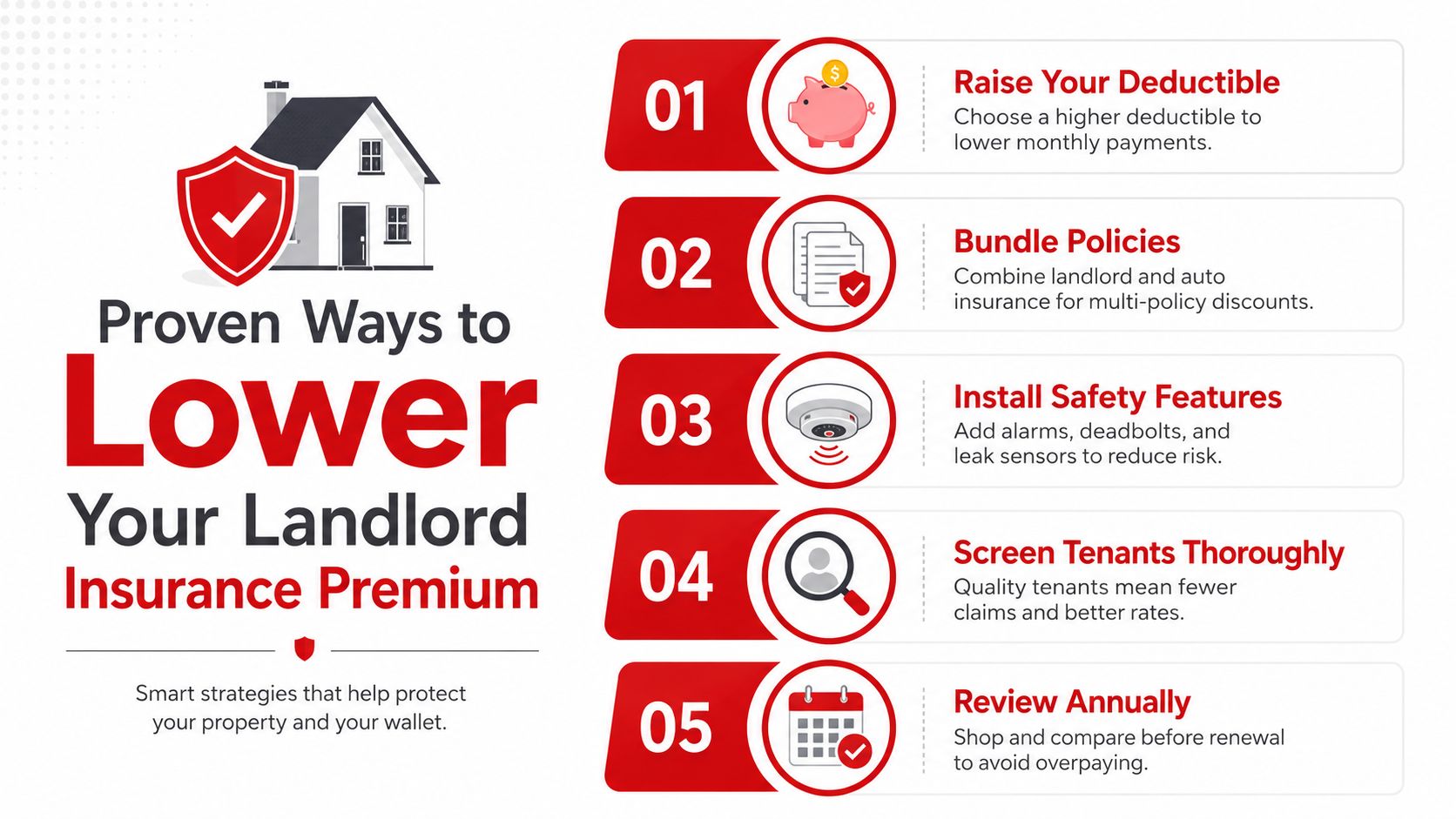
Test a higher deductible. Ask the broker to quote the current deductible and a higher option side by side. The owner should compare the premium difference with the cash available for an unexpected loss. A higher deductible only makes sense when the reserve is ready.
Bundle where the insurer rewards it. Owners with multiple rentals, a personal home, or auto coverage should ask whether one insurer can coordinate the policies. The discount varies, so the comparison must use equivalent limits and exclusions.
Document risk improvements. Smoke alarms, deadbolts, leak sensors, updated plumbing, and a well-maintained roof can reduce the chance or severity of a loss. The insurer may require documentation before considering any pricing benefit.
Screen tenants carefully. A clear application process, references, rental history, and written tenancy records help an owner manage risk. Tenant selection doesn't replace insurance, but it supports a disciplined operating model. Landlords can review this guide on how to find good tenants.
Review endorsements at renewal. Remove coverage that no longer matches the property, but don't remove protection merely because the building has performed well. A converted basement suite, new furnishing package, change in occupancy, or strata deductible adjustment should trigger a policy review.
A BC broker benchmark illustrates why the asset itself matters. It cites about $39 per month for a condo, $94 per month for a house, and $262 per month for a seasonal home, as shown in BC rental property insurance benchmarks. Those figures aren't quotes for every Maple Ridge property. They demonstrate that building type and exposure profile can matter more than occupancy status alone.
Switching insurers makes sense when coverage is equivalent and the current renewal no longer reflects the risk. Negotiation makes more sense when the existing insurer understands the property and a broker can correct outdated details, add documented improvements, or remove an obsolete endorsement.
Your Action Plan for Getting the Right Coverage at the Right Price
A landlord can prepare a cleaner quote package before speaking with a broker. The preparation reduces avoidable back-and-forth and makes comparisons more meaningful.
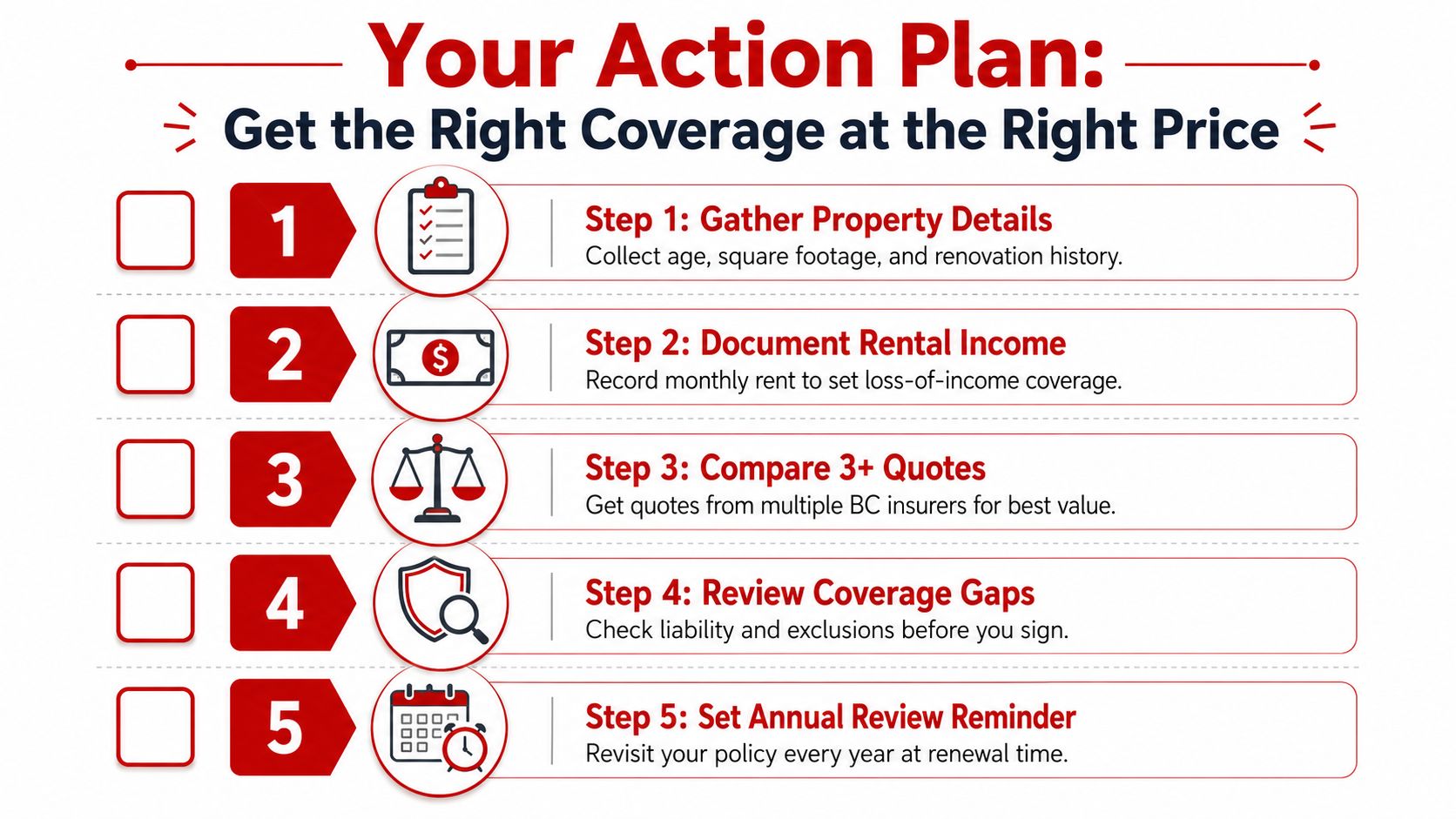
Gather property details. Record the construction type, age, square footage, roof information, renovation history, heating system, suite details, and strata documents where applicable.
Document rental income. Keep the lease terms and current rent available so the broker can assess appropriate loss-of-income protection. The owner should explain whether the rental is long term, furnished, seasonal, or short term.
Compare equivalent quotes. Obtain quotes from multiple BC insurers, but compare the same dwelling limit, liability limit, deductible, exclusions, and endorsements. A lower premium isn't a better deal if it removes earthquake, rental income, or strata deductible protection.
Review coverage gaps. Ask direct questions about tenant damage, vacancy, water loss, earthquake, flood, fire, short-term occupancy, and additional living expenses. An owner who can't explain the exclusions doesn't yet know the policy's real value.
Set an annual review reminder. Revisit the policy at renewal and after any renovation, occupancy change, suite conversion, strata deductible change, or significant shift in rental strategy.
The right quote is the one that matches the property's actual use, not simply the one with the lowest annual premium.
Local context matters beyond insurance. Floodplain exposure, neighbourhood access, property condition, and the intended tenant profile can affect both risk and investment performance. Owners considering a purchase, sale, or change from a detached rental to a condo should evaluate the insurance setup alongside rent, maintenance, financing, and resale considerations.
Royal LePage Brookside Realty Property Management offers coordination around insurance documentation and rental-property operations for owners in Maple Ridge and Pitt Meadows. Landlords planning to buy, sell, or reposition a rental can visit Royal LePage Brookside Realty Property Management for local real estate and property-management guidance.