

A Maple Ridge family finds a detached home they want to view, only to learn that the property is being marketed after the owner stopped paying the mortgage. The listing mentions a court-appointed sales process, the asking price looks appealing, and the family's first question is straightforward: is this a foreclosure, or is it something different?
In British Columbia, the practical answer is that the terms often describe the same distressed-sale situation, but the legal process matters more than the label. A buyer must understand who controls the sale, whether court approval is still required, how long the borrower can redeem the mortgage, and whether the property can be inspected and financed on ordinary terms.
Table of Contents
- What Buyers in BC Mean by Foreclosure or Court-Ordered Sale
- How the BC Supreme Court Process Moves From Default to Sale
- How Often Court-Ordered Sales Are Happening in 2026
- How a BC Court-Ordered Sale Differs From a Power of Sale in Other Provinces
- Due Diligence and Financing Steps Before You Write an Offer
- What This Means for Buyers and Sellers in Maple Ridge and Pitt Meadows
- Common Misconceptions and the Right Next Step to Take
What Buyers in BC Mean by Foreclosure or Court-Ordered Sale
In British Columbia, buyers often use foreclosure to describe a property being sold after a mortgage default. The legal route is usually judicial. The lender files a foreclosure petition in the BC Supreme Court, and the court may order a sale when that step is necessary or appropriate. The transaction is therefore commonly a court-ordered sale, rather than a private lender sale controlled solely by the lender. The BC foreclosure process overview explains why both terms appear in local listings and buyer conversations.
The label can obscure who controls the property and the transaction. A mortgage charge does not automatically make the lender the registered owner. The borrower remains connected to the property during the court process, including any redemption period set by the court. An Order Absolute, if granted, can transfer title to the lender. A property marketed under an Order for Conduct of Sale follows another route, with the court still involved in approving the eventual offer.
Practical rule: Treat the listing as an introduction, not the complete file. The court order, title and sale terms determine what a buyer is purchasing.
The process commonly starts with an Order Nisi. It recognises the mortgage default and sets a redemption period, often about six months, although the court may adjust that period. If the borrower does not redeem the mortgage, the lender can seek an order for conduct of sale. That order gives the lender, or another person appointed by the court, authority to market the property and present an accepted offer for approval.
Why the wording changes the buying strategy
A conventional seller can generally accept an offer, negotiate conditions and move toward completion without a judge reviewing the transaction. In a court-supervised sale, the court may examine the price, closing date, commission, distribution priorities and other terms before the purchaser has binding approval.
The buyer carries more process risk. Money spent on an inspection, appraisal or legal review does not guarantee that the proposed transaction will be approved. If the procedure permits competing bids, the accepted offer may be challenged and the final approved price may change.
For a Maple Ridge or Pitt Meadows buyer tracking 2026 transaction volume, that distinction matters at the offer stage. A quieter segment may reduce competing bids, while stronger activity can make court approval more competitive. Volume does not remove the need to confirm financing, inspection access and the bidding rules in the specific court order.
Power of sale creates another source of confusion. It generally refers to a lender selling outside the BC judicial process. In a BC foreclosure, the Supreme Court can direct a sale on terms it considers just. Buyers should confirm whether the lender holds title or whether the court still controls approval before treating the property like an ordinary resale.
This is practical information, not legal advice. A buyer should have a BC real estate lawyer review the order, title and contract terms before bidding.
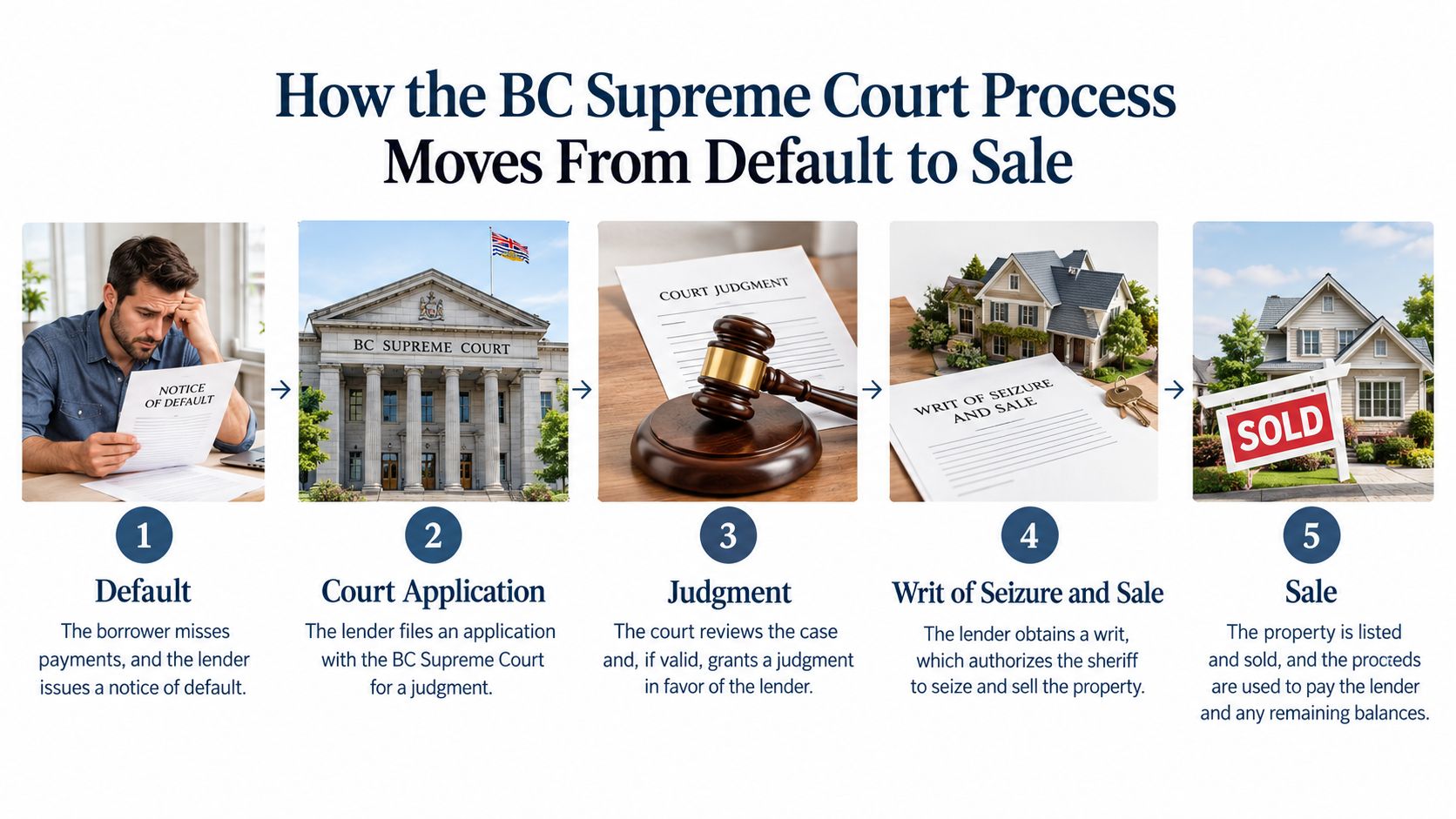
How the BC Supreme Court Process Moves From Default to Sale
A distressed listing in Maple Ridge or Pitt Meadows can look like a normal resale, yet the property may still be under the control of the BC Supreme Court. Buyers need to identify the legal stage before they decide how much to offer, how quickly to inspect, or whether their financing can meet the court's requirements.
The main stages in the file
Petition and Order Nisi. The lender starts the case by filing a foreclosure petition in the BC Supreme Court. The court may issue an Order Nisi and set a redemption period, often about six months. During that period, the borrower may still redeem the mortgage and keep the property. The Legal Aid BC foreclosure guide outlines the petition, Order Nisi and redemption structure.
Redemption expires or changes. If the borrower does not redeem, the lender may apply for an Order for Conduct of Sale. The court can make different orders based on the circumstances. A listing described as a foreclosure may therefore be at a different procedural stage from another distressed property.
Conduct of sale. The court can decide who handles the sale, how the property is marketed, whether competing bids are permitted, and whether a reserve or minimum price applies. A real estate professional may market the property, but an accepted offer can still require approval by the court.
Offer review. The court examines the proposed sale and its terms. Depending on the order and the hearing procedure, offers may be reviewed at a hearing, through sealed submissions, or through another court-directed bidding process. A buyer's accepted offer is not necessarily the final approved sale.
Completion and filing. After approval, the court order generally sets the sale price and completion terms. It may also address vacant possession at completion and require the result to be formally documented.
What the process means for an offer
Court review does not replace property due diligence. A judge may assess whether the marketing and sale process produced a fair result, but that review does not determine whether a purchaser can accept an unfinished renovation, moisture concern, unregistered alteration or title issue.
Financing must be arranged before bidding. If the order requires an unconditional offer by the approval hearing, an appraisal or underwriting delay can put the transaction at risk. Buyers should confirm deposit arrangements, inspection access, offer wording and completion dates before submitting anything.
The redemption period can also affect timing. The property may remain under court control for months, and the sale remains subject to the court's approval rather than ordinary private-contract completion. That distinction matters for buyers watching 2026 activity in Maple Ridge and Pitt Meadows, where bidding conditions can vary while inspection and financing deadlines remain fixed.
The BC court-ordered sale guidance provides a useful process reference. A BC real estate lawyer should review the court order, title, contract terms and bidding procedure before a buyer commits funds. This information is practical guidance, not legal advice.
How Often Court-Ordered Sales Are Happening in 2026
Court-ordered sales are no longer a legal curiosity in the Lower Mainland and Fraser Valley. They remain a small part of the wider resale market, but the available 2026 figures show a meaningful increase in activity across the Greater Vancouver, Fraser Valley and Chilliwack real estate boards.
A regional summary recorded 232 completed court-ordered residential sales between 1 January and 31 July 2026, compared with 140 during the same seven-month period of 2025, an increase of 66%. The same summary reported that court-ordered sales represented 1.10% of tracked residential sales, the highest share in its records since 2019. Those figures describe completed sales, not every court filing or every listing. They shouldn't be treated as a precise Maple Ridge or Pitt Meadows resale rate.
Another regional commentary reported 773 court-ordered listings in 2025 across the broader Greater Vancouver and Fraser Valley market, roughly triple the annual average reported for 2017 to 2022. It also reported 845 listings during the first eight months of 2026, already exceeding the full 2025 total. The figures are time-sensitive and cover a broader area than Maple Ridge and Pitt Meadows. The regional court-ordered sale commentary provides the underlying context.
Court-ordered sale activity in 2026 by region
| Region | 2026 YTD Court-Ordered Filings | % of Total Resale Activity | Avg. Discount to Benchmark |
|---|---|---|---|
| Greater Vancouver, Fraser Valley and Chilliwack boards combined | 232 completed sales reported through 31 July, not a filing count | 1.10% of tracked residential sales | About 19% below market in the cited regional summary |
| Maple Ridge | A separate verified count was not supplied | A separate verified share was not supplied | A separate verified average was not supplied |
| Pitt Meadows | A separate verified count was not supplied | A separate verified share was not supplied | A separate verified average was not supplied |
The reported discount should be treated as a broad regional observation, not a guaranteed formula for an individual property. A lower price may reflect condition, title complications, occupancy issues, a difficult strata file or a court-approved bidding outcome. It may also disappear when several buyers compete.
The practical conclusion for a Maple Ridge or Pitt Meadows buyer is clear. Court-ordered inventory is recurring and appears to be rising in the wider region, so buyers should learn the process before a suitable home appears. The monthly market context in June 2026 Metro Vancouver housing market trends can help place a distressed listing beside ordinary resale activity, but it cannot replace property-specific comparable analysis.
How a BC Court-Ordered Sale Differs From a Power of Sale in Other Provinces
A buyer in Maple Ridge may see a lender-backed listing and assume the lender can accept an offer and close the transaction privately. That assumption can create problems. In BC, the BC Supreme Court controls a court-ordered sale, including approval of the successful offer. The lender may support a transaction, but the sale remains subject to the court process.
A non-judicial power-of-sale system generally gives a lender a route to sell after mortgage default without the same judicial approval of the final transaction. The rules differ by province and by mortgage documents. A process familiar to an out-of-province buyer may not apply to a property in Pitt Meadows or elsewhere in BC.
| Issue | BC Court-Ordered Sale | Power of Sale in Other Provinces |
|---|---|---|
| Primary control | The BC Supreme Court can direct the sale and set terms it considers just. | The lender generally follows the applicable statutory and contractual process without the same court approval of the winning offer. |
| Borrower's position | The borrower's redemption right can continue until the court approves a sale or makes a final foreclosure order. | Redemption and notice rights depend on provincial legislation and the mortgage documents. |
| Listing authority | The court can direct who conducts the sale and how the property is marketed. | The lender or its appointed representative generally manages the sale under the applicable rules. |
| Price approval | The court reviews the proposed sale and can approve price-related terms, including a reserve or minimum price. | The lender must follow statutory duties and sale requirements, but the mechanism is not a BC approval hearing. |
| Competing bids | Bidding may occur through a court-directed process, including sealed or chambers procedures. | Competing offers are generally handled through the lender's sale process. |
| Buyer's risk | A negotiated offer may not become binding until the court approves it. | Risk centres on the statutory process, contract terms, title and possession. |
The distinction changes how a buyer should bid. A lender may accept an offer as part of the conduct-of-sale process, yet the court still considers whether the result is appropriate. A low bid can fail even when the lender appears willing to proceed, particularly if competing evidence or the marketing record does not support the proposed price. Regional 2026 court-ordered activity means a qualified buyer should expect competition, court timing and financing conditions to matter, rather than treating the listing as a routine discount purchase.
The borrower's continuing rights also affect timing. The lender may remain exposed to unpaid debt while the action continues, and the court may address sale proceeds and priority issues. Listing remarks cannot resolve those matters. Buyers should rely on the order, filed materials and legal advice rather than informal assurances.
Title review deserves separate attention. A purchaser can read our explanation of BC title insurance, and can also review what BC title insurance covers in real estate transactions, before asking a lawyer whether coverage fits the specific court file. Insurance does not replace a review of the court order, registered charges, easements, covenants, possession terms or other sale conditions. This article provides practical information, not legal advice.
Due Diligence and Financing Steps Before You Write an Offer
A court-ordered sale rewards preparation, not speed for its own sake. The buyer's checklist should be completed in an order that exposes deal-breaking risks before money is spent on an offer or inspection.
Start with the legal and title position
A current title search should identify the registered owner, mortgage charges, judgments, easements, covenants and other encumbrances. Listing remarks can be incomplete, particularly when the lender or sales representative has limited knowledge of the property's history.
The court documents and Schedule A should be read before the offer is drafted. They may alter standard contract terms, set a court-approval condition, establish deposit requirements or describe possession. A real estate lawyer's pre-offer review is essential when the buyer cannot clearly identify whether the transaction remains subject to approval.
Test the property, not just the asking price
A buyer should arrange a professional inspection where access is available and the sale terms permit it. A vacant home may have maintenance or moisture concerns that aren't obvious during a short showing. An unfinished renovation, an unapproved suite or an unregistered improvement can affect both financing and resale.
The review should also cover:
- Condition: Check the roof, structure, plumbing, electrical systems, heating, drainage and visible moisture. “As is, where is” language means the buyer must understand what remedies may be limited.
- Municipal and tax information: Confirm property taxes, outstanding utility balances and available permit information through the appropriate authorities.
- Strata records: For a townhouse or condominium, review meeting minutes, budgets, bylaws, insurance information, depreciation material and any disclosed special assessment concerns.
- Occupancy: Establish whether the home is vacant, occupied by the former owner or occupied under a tenancy. Possession assumptions should never be based only on photographs or a listing note.
- Value evidence: Compare recent, closely similar sales and account for repairs. The BC Assessment value is a reference point, not a promise that the court will approve a particular offer.
Secure financing before the court date
A mortgage pre-approval helps establish borrowing capacity, but it isn't the same as final approval for a specific distressed property. The lender may require an appraisal, additional documentation, insurance confirmation or review of the court terms. The buyer can review how mortgage pre-approval works before treating a pre-approval letter as sufficient.
The buyer should also decide the maximum price before any competing bid appears. If the court requires an unconditional offer, financing, inspection and legal questions must be resolved early. A deposit should be handled exactly as the court order and purchase documents require, with the lawyer confirming where and when funds are delivered.
The court may reject a price that doesn't satisfy the order or the evidence before it. No purchaser should spend more than the budget allows just because a competing bid changes the atmosphere.
What This Means for Buyers and Sellers in Maple Ridge and Pitt Meadows
Maple Ridge and Pitt Meadows buyers face the same BC court process as purchasers elsewhere, but local decision-making still matters. A distressed detached home, townhouse or condominium should be compared with nearby ordinary sales, not with a broad regional discount.
Court-controlled listings may be marketed by a person given conduct of sale, an asset manager or a real estate professional familiar with the file. The important question isn't the title used in the listing. It is whether the seller has authority to accept an offer, whether court approval is required and what the order says about possession, deposits and completion.
Local buyers need a file-specific strategy
A buyer searching around Maple Ridge should first establish whether the property is under conduct of sale or has already moved into a different ownership position. The title search, court materials and Schedule A should answer that question more reliably than casual use of the word “foreclosure.”
Pitt Meadows buyers should apply the same discipline to price. A lower asking price may reflect repairs, an unusual legal condition or limited market exposure rather than a guaranteed bargain. A property with a clean title position and manageable repairs may suit one purchaser, while the same terms may be unacceptable to a buyer who needs a firm possession date or conventional financing.
Current inventory should be confirmed from the listing materials and official court records available for the file. A general search for “foreclosure” can miss important distinctions, and a listing can change status as the court process develops. The local market context available through Maple Ridge and Pitt Meadows real estate guidance is useful for orientation, but it doesn't replace a title search or legal review.
Sellers should act before the court process narrows choices
A homeowner who has received mortgage-default notices should obtain legal advice promptly. The possible consequences can include credit damage, ongoing debt exposure and questions about any shortfall after sale, but the result depends on the mortgage, the court orders, the sale proceeds and other claims.
A willing co-borrower may create more room for a negotiated solution, particularly if that person can help address the arrears or refinance the debt. That possibility should be assessed with legal and financial advisers, not assumed from a real estate conversation.
For buyers, the practical steps are modest but effective:
- Shortlist active files: Separate properties subject to court approval from ordinary lender-owned listings.
- Confirm the order: Ask for the relevant sale terms before paying for an inspection or drafting an offer.
- Set a ceiling: Establish the maximum price after reviewing comparable sales and repair exposure.
- Use experienced help: A local professional who has attended a conduct-of-sale hearing can explain the mechanics, while a lawyer addresses the legal terms.
The right local assistance is not about promising an automatic discount. It is about identifying the risks early enough for the buyer or seller to make a controlled decision.
Common Misconceptions and the Right Next Step to Take
The lender owns the house as soon as payments stop
That isn't the usual BC position. The lender starts a Supreme Court process, and the borrower's redemption right can continue until the court approves a sale or makes a final foreclosure order. An Order Nisi and an Order Absolute have different consequences, so the registered title and court file matter more than the word used in the advertisement.
A foreclosure price is automatically below market
A court-ordered sale can sell below ordinary market expectations, but the price reflects the property's condition, marketing, title terms, buyer competition and the court's assessment of the transaction. The regional data reported 232 completed sales through 31 July 2026, with court-ordered sales representing 1.10% of tracked residential sales, but those figures don't establish the value of one Maple Ridge or Pitt Meadows property. The regional data summary on BC court-ordered sales also reported an average of about 19% below market in the cited period, which should be treated as a broad observation rather than a buyer entitlement.
Nobody else can bid after the lender accepts an offer
An accepted offer may still need court approval. Depending on the court-directed procedure, competing offers can be reviewed through the approval process. A buyer who has paid for an inspection or legal review may still lose the property if another acceptable offer is presented and approved.
The property is vacant and free of liens
Neither assumption is safe. A lender may have limited knowledge of the home's condition, and a title search can reveal charges, judgments, easements or other interests that need legal interpretation. Occupancy, possession and registered encumbrances should be confirmed before the offer is finalised.
Court involvement makes the purchase risk-free
Court supervision protects the integrity of the sale process, but it doesn't inspect the roof, guarantee financing or eliminate condition risk. The court rules governing sale directions allow the court to direct a sale on terms it considers just. That authority doesn't turn a distressed property into a standard, warranty-backed transaction.
A practical buyer's next step is to pull a current title search from the Land Title and Survey Authority and obtain the court-approved sale terms before writing an offer. A short conversation with a real estate professional experienced in Maple Ridge court-ordered sales can clarify the commercial process, while a lawyer should review the legal documents, Schedule A, deposit provisions and court-approval requirements.
This article provides general information only. It isn't legal advice, and buyers, sellers and lenders should obtain advice suited to the specific property and court file.

Royal LePage Brookside Realty helps buyers assess Maple Ridge and Pitt Meadows court-ordered listings, compare local sales, coordinate property due diligence and prepare for the offer and approval process. Buyers and sellers can visit Royal LePage Brookside Realty to discuss a specific court file and arrange the appropriate real estate and legal next steps.