
A tenant reports a leak while the owner is away, the contractor wants approval, and the last inspection photos are somewhere in a message thread. The difficult part isn't the distance between the owner and the rental. It's that nobody has a clear spending limit, an escalation route or a complete record.
Effective property management for out of town landlords in BC starts with assigning local responsibility before anything goes wrong. For owners in Maple Ridge and Pitt Meadows, the practical goal is simple: every task needs a named person, an expected response time and a record that another person can understand later.
Table of Contents
- Which Property Management Services to Outsource
- How to Vet and Hire a Licensed Property Manager
- BC Tenancy Rules to Track From Another City
- How to Run Inspections and Repairs Remotely
- Fees, Contract Terms and Tax Duties to Assign
- Common Problems Out-of-Town Landlords Face and Fixes
- Confirm Your Management Setup Before Handing Over Keys
Which Property Management Services to Outsource
An owner living outside Maple Ridge or Pitt Meadows should outsource tasks requiring local attendance, dated evidence or a same-day response, while retaining decisions about asking rent, major capital spending and whether to sell.
The scale of individually operated rentals makes that division important. Roughly 70% of B.C. renter households occupy secondary-market housing, including privately owned houses, condominiums and basement suites, according to the Union of British Columbia Municipalities' rental-housing report. These properties need their own administration rather than an assumption that building staff will handle tenancy matters.
Property management tasks: outsource, keep or share
| Task | Who handles it | Why it matters at a distance |
|---|---|---|
| Tenant advertising and showings | Outsource | Showings need someone physically present on short notice |
| Tenant screening and applications | Outsource | Consistent checks and reference follow-up need an accountable process |
| Rent level advice | Share | Manager provides local evidence; owner makes the final decision |
| Lease signing and deposit handling | Outsource | Deposit and condition-report procedures need careful administration |
| Rent collection and arrears follow-up | Outsource | Payment records need monthly reconciliation |
| Move-in and move-out inspections | Outsource | Local attendance and dated photographs create the evidence trail |
| Routine maintenance dispatch | Outsource within limits | Owner sets spending authority; manager uses authorized contractors |
| After-hours emergencies | Outsource | Someone must act before the owner sees the message |
| Notices and hearing preparation | Share | Manager prepares records; owner authorizes decisions and attends where required |
| Short-term rental licence | Owner | City requirements must be verified before advertising |
The distinction is delegating execution without surrendering oversight. Brookside's explanation of what a property manager does provides a useful service checklist. For owners deciding which responsibilities to retain, the insourcing guidance from Facility Management Insights offers a broader framework for considering internal capacity versus outside support.
What changes for short-term use?
Under the framework endorsed in April 2025, Maple Ridge requires short-term-rental owners or operators to maintain a City business licence. Owners should confirm the City's current business-licensing requirements before advertising; a long-term management agreement shouldn't be assumed to cover vacation-style operations.
Consider an owner in another province whose Pitt Meadows townhouse needs a repair at 7 p.m. The useful question isn't whether the manager handles maintenance. It's who answers, who can authorize work and when the owner receives the written update.
How to Vet and Hire a Licensed Property Manager
The BC Financial Services Authority's description of rental-property-management services includes finding tenants, advising on rent, advertising, showing properties, assisting with applications, negotiating rent, collecting rent or deposits and managing the property. That scope provides a better starting point than a vague promise to look after everything.
A useful hiring conversation should include a review of the actual agreement and reporting documents.

Which questions reveal how the service operates?
- Confirm the individual's and firm's current licensing with BCFSA. Record the named licence holder before discussing fees. A familiar business name isn't a substitute for identifying who is responsible.
- Separate direct work from subcontracted work. Ask who performs screening, inspections and after-hours intake, and who reviews the results.
- Test the emergency arrangement. Ask who answers on a Saturday night and how quickly a maintenance request should receive an acknowledgement. An answering service without dispatch authority may leave the owner making every decision.
- Request a blank agreement and sample owner statement. Read the termination clause first, then compare the promised services with the written obligations.
- Ask how rent and deposits are held and reported. The explanation should distinguish money received, expenses paid and funds available for distribution.
- Review a sample condition report and inspection notice. Look for dates, clear descriptions, supporting photographs and evidence that documents reach the tenant.
- Compare at least two written proposals against the same service list. Otherwise, a lower fee may exclude work included elsewhere.
A friend who holds keys or occasionally helps with access isn't equivalent to a managed service. Owners should also avoid assuming that informal assistance authorizes someone to provide regulated services on their behalf.
What should stop the hiring process?
Pressure to sign before reviewing the agreement, reluctance to identify the licence holder and no written reporting schedule deserve scrutiny. Promises of guaranteed rent or vacancy outcomes also need careful examination, particularly where the agreement doesn't explain the conditions and exclusions.
Hiring test: A manager should be able to show the paperwork behind the promise, not just describe the service.
The Maple Ridge property-manager selection guide can help organize those comparisons. The owner should finish with a shortlist of two or three candidates and written answers to the seven questions, not merely a collection of fee quotes.
BC Tenancy Rules to Track From Another City
These are tenancy-administration checkpoints, not legal advice. All rule details are time-sensitive: confirm requirements with the Residential Tenancy Branch before acting, recheck them each year and consult a lawyer about a dispute.
BC tenancy rules that a remote landlord must track
| Rule area | Current requirement | What to record |
|---|---|---|
| Security deposit | Capped at one-half of one month's rent at the start; retention requires tenant permission or an RTB order, under provincial deposit guidance | Date paid, receipt, written agreement or order |
| Move-out condition inspection | Joint inspection using official RTB-27, signed and copied to the tenant; offer at least two inspection opportunities | Offered dates, attendance, completed report and photographs |
| Existing-tenant rent increase | Once every 12 months, with three full months' notice, within the applicable annual limit under B.C.’s rent-increase rules | Last increase, notice date and annual limit used |
| Additional rent increase | Tenant's written agreement or an RTB application based on eligible expenses or capital expenditures | Supporting expenses, agreement and application status |
| Abandoned property | Since April 2025, qualifying property generally requires 30 days' storage rather than 60; the minimum value threshold increased from $500 to $1,000, according to the Province's tenancy-reform announcement | Inventory, photographs, storage location and dates |
The inspection and additional-increase requirements above accompany the provincial deposit and rent guidance respectively. Owners should check the applicable conditions rather than treating the table as a complete legal procedure.
Which dates need active monitoring?
A change in market conditions doesn't itself authorize an immediate rent increase for an existing tenant. Nor should an ownership change or new management arrangement be treated as a reset of the existing increase schedule.
Deposit administration needs a separate closing process. A contractor's invoice alone doesn't establish permission to retain a deposit, and photographs don't replace the required inspection procedure.
Maintain a tenancy tracking sheet with deposit dates, inspection offers, notices, the last lawful increase and any abandoned-property storage log. Assign someone to review upcoming deadlines rather than relying on reminders buried in email.
The plain-language explanation of the BC Residential Tenancy Act offers additional context. When an issue becomes contentious, the owner needs an organized chronology, not a retrospective search through messages.
How to Run Inspections and Repairs Remotely
Undocumented decisions and slow responses are more dangerous than distance alone. A workable inspection-and-repair routine identifies what happened, who acted and what evidence remains after the work is finished.
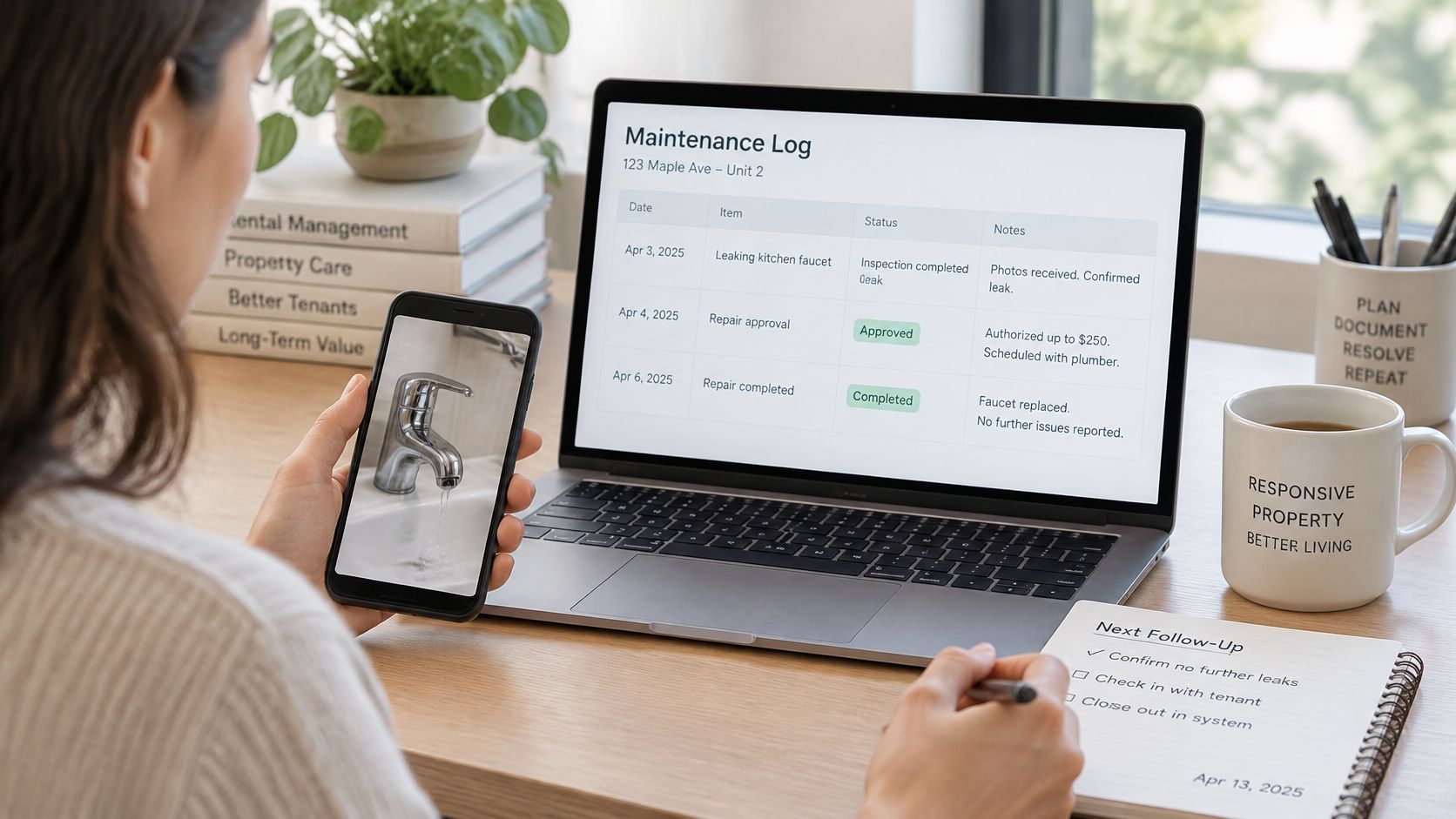
The owner should be able to open a repair file and understand it without calling the manager for an explanation.
What should the inspection-and-repair workflow contain?
- Create the move-in baseline. Complete the condition report with dated photographs, meter readings where applicable, key count, appliance status and tenant signatures. Descriptions should identify the room and item rather than merely say the unit is in good condition.
- Prepare lawful entry notices. B.C.’s condition-inspection guidance requires written notice at least 24 hours and no more than 30 days ahead, stating the date, time and reason, with entry between 8 a.m. and 9 p.m.
- Control inspection frequency. Under that same provincial guidance, schedule no more than one landlord condition inspection per month. The calendar should distinguish condition inspections from repair appointments.
- Acknowledge maintenance requests the same business day. This is a recommended service benchmark, not a promise that every repair can be completed immediately. The reply should identify the next action and who will provide the next update.
- Dispatch urgent work through a local authorized contractor. Water leaks, loss of heat and electrical concerns need a clear escalation route. Set written-estimate requirements above the owner's spending threshold without leaving urgent safety decisions dependent on an unanswered message.
- Maintain an escalation log. Record who received the report, when the contractor was contacted, what was authorized and why. Attach estimates, invoices and before-and-after photographs.
- Close with a comparable move-out record. Repeat the room-by-room inventory and compare it with the original condition documentation rather than relying on recollection.
How should access and evidence be controlled?
Keep a key register showing every copy, its holder and its return. For a strata property, the working file should also include relevant access instructions and the contact route for building-related concerns.
Informal texts and a manager's memory are weak substitutes for a complete file. Important messages should be preserved with the repair record, and inspection notices should follow the required written-notice and service procedures.
A repair isn't administratively complete when the contractor leaves. It's complete when the owner can see what was reported, authorized, repaired and paid.
A rental-property inspection checklist helps keep observations consistent. The owner's audit should test three things: lawful inspection scheduling, prompt acknowledgements and a complete digital record for each entry and repair.
Fees, Contract Terms and Tax Duties to Assign
Fees vary with the manager and service scope. Owners should compare written charging structures, not assume that a headline management fee includes leasing, inspections, maintenance coordination and after-hours work.
The following structures are comparison questions, not quoted market rates. Each proposal should say which charges apply and which services are included.
Management fees and contract terms to compare
| Fee or term | How it is usually structured | What to confirm in writing |
|---|---|---|
| Management fee | Percentage of collected rent or flat monthly amount | Rate, collected versus billed rent, and later changes |
| Tenant placement fee | Charge when a new tenant signs | Amount, payer and whether renewals are excluded |
| Renewal fee | Charge when an existing lease is extended | Whether it applies and how it is billed |
| Maintenance coordination markup | Addition to contractor invoices | Percentage, cap and estimate threshold |
| Inspection and after-hours call-out | Per visit or call | Included service versus extra charge |
| Advertising and listing costs | Owner-paid or manager-paid | Advertising channels and approval requirements |
| Termination and notice period | Notice required to end the agreement | Notice length and transfer of records, keys and deposits |
| Non-resident tax duties | Withholding, remittance and reporting | Named responsible party, deadlines and retained documents |
A fee calculated on billed rent differs from one calculated on money received. Likewise, contractor invoices can become more expensive if coordination charges sit outside the base fee.
The BC property-management fee guide provides further comparison context. Owners should request an itemized explanation of a hypothetical turnover and repair so exclusions become visible before signing.
Who handles non-resident tax compliance?
Living outside Maple Ridge doesn't automatically make an owner a Canadian non-resident. A tax professional should establish residency status before the rent-collection arrangement is finalized.
For a Canadian non-resident, the default withholding is 25% of gross Canadian rental income; after written CRA approval of Form NR6, withholding can generally be 25% of estimated net rental income, with required remittances due by the 15th of the following month and annual NR4 reporting, under CRA's rental-income filing and reporting requirements.
Submitting NR6 isn't approval. Gross-basis withholding continues until written approval applies, and earlier rent remains subject to the gross basis.
The agreement should assign residency documentation, the Canadian collecting-agent role where applicable, remittances, NR4 preparation and year-end reconciliation. A tax professional should confirm whether a section 216 return is required or advantageous.
Cash-flow caution: Gross-basis withholding can leave considerably less money available for operating expenses than an owner expects. Tax administration belongs in the setup conversation, not the year-end cleanup.
Common Problems Out-of-Town Landlords Face and Fixes
A tenant reports damage, rent is overdue, and the manager cannot explain what was agreed or when anyone responded. Distance makes follow-up harder, but missing records and slow decisions are what turn routine issues into disputes.
| Symptom | Likely cause | Fix |
|---|---|---|
| Tenant disputes a rent payment | Transfer confirmation and the rent ledger do not match | Compare the ledger with bank records, save the tenant's confirmation, and log when the discrepancy was raised and resolved |
| Damage appears during an owner visit | Earlier observations and tenant reports were not recorded | Photograph the area, date the images, record what was already known, and assign a follow-up deadline |
| Unit remains vacant | Listing, access or repair issues may be delaying applications | Check inquiry and showing records, then compare expected collected rent under different vacancy assumptions |
| Rent arrears continue | Contact and payment arrangements are not documented | Keep a dated chronology of amounts due, communications and promised payments; confirm formal steps with the Residential Tenancy Branch (RTB) |
| Inspection is disputed | Notice and service records are incomplete | Keep the written notice and proof of service with the inspection file |
When should asking rent change?
A vacancy calls for a specific review. For example, if the showing log shows few inquiries after the listing has been live for two weeks, check the advertised availability date, photographs and showing access that day. If those records reveal no access problem and the listing is accurate, compare the asking rent with geographically matched evidence and decide whether to adjust it. Record the evidence, decision and date for another review so the owner and manager can see what changed.
The CMHC rental-market tables for 2025 identify Maple Ridge/Pitt Meadows as a distinct rental zone. Broad regional comparisons may not reflect demand for a particular suite or townhouse.
Across B.C., asking rents for new one-bedroom apartment listings were 4.9% lower in 2024 than in 2023, according to the provincial government's rental-market update. That provincial figure is time-sensitive, not a valuation for an individual property.
Compare expected annual collected rent after vacancy and turnover costs, rather than relying on the highest advertised monthly figure. Include contractor costs and owner travel where relevant, then document whether a pricing adjustment or a durable improvement better addresses the vacancy.
What changes when a disagreement escalates?
Keep payment records, inspection documents, repair correspondence and notices in one dated chronology. It lets the manager and owner establish what happened, when a response was sent, and whether a service issue now needs formal RTB action. Ask the RTB or a qualified professional to confirm the proper procedure before taking formal steps.
Recheck rental evidence for the current year. A clear record supports a faster, more defensible decision.
Confirm Your Management Setup Before Handing Over Keys
Before the first tenant request arrives, confirm that the manager has the right file, knows the spending limit and can reach the owner. Distance becomes a problem when decisions and response times are undocumented.
- Sign off on the tenancy file. List the lease, deposit record, condition reports, notices and relevant correspondence transferred. Record any missing documents and who will obtain them.
- Set spending authority. Write down the maintenance limit, who approves work above it and the order for contacting people during an emergency.
- Test the emergency number. Call it during the first week and confirm who answers, how an urgent issue is escalated and when the owner will be notified.
- Set reporting deadlines. Agree when the owner receives statements, inspection-notice copies and updates on unfinished repairs.
- Confirm the insurance handoff. Record the insurer's response on whether the arrangement changes coverage requirements or the manager must be named.
- Document unavailable-contact coverage. Name the person who steps in if the regular manager cannot respond, and how the owner will be informed.
Keep the signed file-transfer record and the written contact and authority instructions with the owner's property records. These documents show what was delivered, who can act and how urgent decisions should reach you.
Royal LePage Brookside Realty offers licensed residential property management for landlords in Maple Ridge and Pitt Meadows, including tenant placement, rent collection, inspections and maintenance coordination. Owners preparing to manage from another city can visit Royal LePage Brookside Realty to discuss service scope, reporting expectations and the local responsibilities to assign before handing over keys.