

Maple Ridge landlords are screening in a market where the 2023 primary rental vacancy rate was 1.3%, with an estimated 21 vacant purpose-built rental units. That means tenant screening has to move quickly enough to limit vacancy, but every step still has to fit BC rules on consent, verification, and discrimination.
That combination is what makes tenant screening services in Maple Ridge BC different from generic landlord advice. Fast approval matters, but rushed approval creates avoidable problems. In a tight market, the advantage isn't accepting the first complete application. It's running a consistent process that verifies income, references, identity, and consent before a tenancy starts.
A lot of landlords get squeezed from both sides. One side is operational pressure: inquiries come in all at once, showings stack up, and the unit still needs to be filled. The other side is legal pressure: BC expects a screening process that is documentable, fair, and free from discrimination. The landlords who handle this well usually have one thing in common. They stop treating screening like an informal conversation and start treating it like a workflow.
| Screening approach | Speed | Control | Compliance risk | Best fit |
|---|---|---|---|---|
| Manual self-screening | Can be fast at first, slower during verification | High | Higher if forms, consent, and recordkeeping are inconsistent | One unit or low application volume |
| Structured in-house process with templates | Faster once set up | High | Lower when every applicant gets the same steps | Small portfolios with organised systems |
| Professional screening service | Often faster on verification tasks | Medium | Depends on how well the landlord handles final review and consent | Owners who want administrative support |
| Full property management screening | Fastest for owners with limited time | Lower day-to-day involvement | Lower when the process is standardized and documented | Landlords who want leasing and screening handled together |
Table of Contents
- The Local Rental Market and Why Screening Matters
- Navigating BC Tenancy Laws and Screening Requirements
- Building a Compliant Tenant Application Workflow
- In-House Screening vs. Professional Tenant Screening Services
- Essential Documents and Templates for Landlords
- The Role of Property Management in Streamlining Approvals
- Actionable Strategies for Faster, Higher-Quality Leasing
The Local Rental Market and Why Screening Matters
Maple Ridge isn't a market where landlords can afford a sloppy leasing process. A BC housing progress report for Maple Ridge says median monthly rents increased by 89% between 2010 and 2023, while rental vacancy rates ranged from 5.7% down to 0.4% over that period. In 2023, the city's primary rental vacancy rate was 1.3%, with an estimated 21 vacant purpose-built rental units.
Those figures change the screening conversation. The issue isn't whether there will be interest. There usually will be. The issue is how to sort serious, qualified applicants from people who are incomplete, inconsistent, or not ready to proceed.
Tight supply changes landlord behaviour
When vacancy is low, landlords often feel pressure to move from showing to approval in one step. That sounds efficient, but it usually creates more work later. Applications arrive with missing documents, phone references don't line up, or nobody captured written permission before ordering a credit check.
Practical rule: In a low-vacancy market, speed comes from preparation, not improvisation.
A better approach is to build a system before the listing goes live. That includes a standard application, a separate consent process where needed, a reference-check routine, and a clear file for each applicant. In Maple Ridge, that structure matters because one weak screening decision can turn a short vacancy into a long dispute.
Why a formal process protects income
Landlords sometimes assume a strong rental market lets them be less careful because they can easily choose from many applicants. In practice, higher inquiry volume is exactly why structure matters. More applications create more chances for inconsistent decisions, rushed communication, and incomplete records.
The practical business case is simple:
- Better triage: Pre-screening filters out applicants who won't provide the basic documents needed for review.
- Cleaner comparisons: Standard forms make it easier to compare applicants against the same criteria.
- Fewer gaps in the file: Written records matter if a decision is questioned later.
- Shorter vacancy windows: Organised screening reduces back-and-forth after the showing.
For landlords tracking local conditions, the broader Maple Ridge rental market context is useful because screening decisions don't happen in isolation. Pricing, listing quality, showing logistics, and screening all affect how quickly a property is leased.
What doesn't work in Maple Ridge
A few habits tend to break down fast in this market:
- Ad hoc texting as the application process: It's too easy to miss consent, references, or identity checks.
- Different questions for different applicants: That creates avoidable human-rights and consistency risk.
- Approving based on urgency alone: A tenant who says they can move in tomorrow still needs the same verification steps.
- Credit-first screening without permission: In BC, that's the wrong order.
The strongest operators in Maple Ridge don't confuse a full inbox with a completed screening process. They keep the process narrow, documented, and repeatable.
Navigating BC Tenancy Laws and Screening Requirements
BC is specific about what landlords should collect and how they should collect it. The province says landlords should gather verifiable income and employment information, references preferably from a previous landlord, photo identification to confirm the applicant's name, and a credit check only with written approval. The provincial guidance also says landlords can't use applications to refuse tenants because of protected categories, and Maple Ridge's housing action material points landlords toward those same compliant practices through BC tenancy rules and human-rights obligations in place under the current framework, including the Residential Tenancy Regulation as last amended in 2025. That guidance is reflected in the City of Maple Ridge housing action resources.

What a landlord can ask for
The province's screening guidance is practical. It supports collecting the information needed to verify whether the applicant is who they say they are and whether they can support the tenancy.
A compliant intake usually includes:
Applicant identity
Ask for photo identification to confirm the applicant's name matches the application.Income and employment details
The key word is verifiable. A stated job title without supporting verification isn't much help.Rental references
Previous landlord references are preferred because they speak directly to tenancy behaviour.Written credit consent
If a credit check is going to be run, written approval should be obtained first.
Many informal screening systems fall short here. Landlords often collect everything in one loose message thread. That makes it harder to show what was requested, what was consented to, and what was verified.
What a landlord can't use
The BC Human Rights Code prohibits discrimination in tenancy based on protected grounds including race, colour, ancestry, place of origin, religion, marital status, family status, disability, sex, sexual orientation, age, and lawful source of income. The BC Human Rights Commissioner also states that renter application, eligibility criteria, and waitlists must be free from discrimination.
That means screening criteria have to stay tied to legitimate tenancy factors. Income verification, reference quality, identity confirmation, and consented credit review fit that purpose. Questions or decisions tied to protected characteristics do not.
A legal screening process doesn't just depend on what is asked. It also depends on what influences the decision.
The intake sequence that makes sense in BC
BC's own tenancy guidance supports pre-screening before showings because it can save time and improve fit. It also recommends a structured workflow built around verifiable income, references, photo ID, and written credit consent. That's why a standard intake form matters so much for Maple Ridge landlords handling multiple inquiries in a compressed leasing window. The province sets that out in its guidance on listing and showing a rental unit.
A practical order looks like this:
- Start with pre-screening questions tied to move-in timing, occupancy, and readiness to provide documents.
- Send the same application package to every serious prospect.
- Review the application for completeness before calling references.
- Collect written consent before any credit step.
- Document the reason for the final decision in the file.
Landlords who need a plain-language overview of the rules often find this BC Residential Tenancy Act explained article useful as background. It's not a substitute for legal advice, but it helps clarify the framework screening sits inside.
Building a Compliant Tenant Application Workflow
A workable tenant application process has to do two things at once. It has to move fast enough for Maple Ridge leasing conditions, and it has to be consistent enough that every file can be defended later if needed.
The most efficient workflows don't start with reference calls or credit checks. They start with gatekeeping. If the landlord doesn't control when a file becomes “under review,” the process gets flooded with half-complete applications that waste time.
A workflow that stays organised under volume
This is the sequence that tends to work best for tenant screening services in Maple Ridge BC:
| Stage | What happens | Common mistake |
|---|---|---|
| Inquiry | Respond with a short pre-screen and next-step instructions | Booking everyone for showings without qualification |
| Showing | Confirm interest and explain the application package | Treating verbal interest as a serious application |
| Application intake | Collect the standard form and supporting documents | Accepting partial submissions |
| Review for completeness | Check identity, income fields, landlord history, signatures | Starting verification before the file is complete |
| Verification | Contact references and confirm employment or income details | Calling unverified numbers without checking legitimacy |
| Consent-based credit step | Proceed only after written approval is in the file | Running or requesting a credit check without clear consent |
| Decision and records | Approve, decline, or request clarification, then retain notes | Failing to document why the decision was made |
That sequence matters because each step screens for seriousness. A prospect who can't return a complete application often creates similar friction once the tenancy begins.
In-house control versus outside support
The main trade-off is control versus administrative load.
Manual in-house screening gives the landlord direct contact with applicants and references. That can be useful for a single condo or basement suite. The downside is inconsistency. Different applicants get slightly different questions, consent language gets skipped, and files end up scattered across email, text, and paper notes.
A templated in-house system is stronger. The landlord still controls the process, but everything runs through one form set and one order of operations. That approach works well when the owner has time to respond quickly and keep records clean.
Professional screening support reduces the verification burden. It can help with identity review, credit workflow administration, and reference collection. The trade-off is that the landlord still needs to review the final file with BC rules in mind. Outsourcing the steps doesn't outsource the responsibility.
Working standard: Don't move an applicant to final review until the file is complete, the consent is clear, and the verification notes are in one place.
A practical checklist helps prevent omissions. This tenant screening checklist is useful for landlords who want a repeatable intake and review process without rebuilding the workflow each time.
Where landlords lose time
The most common delays usually come from process design, not applicant quality. Examples include:
- Sending forms too late: If the application package goes out after the showing, the landlord loses momentum.
- No deadline for document return: Files drag because nobody set expectations.
- Mixed communication channels: Text for ID, email for references, phone for consent. That's hard to track.
- No decision rule for incomplete files: Staff or owners keep chasing missing information instead of moving to the next qualified prospect.
A strong workflow doesn't need to be complicated. It needs to be standard.
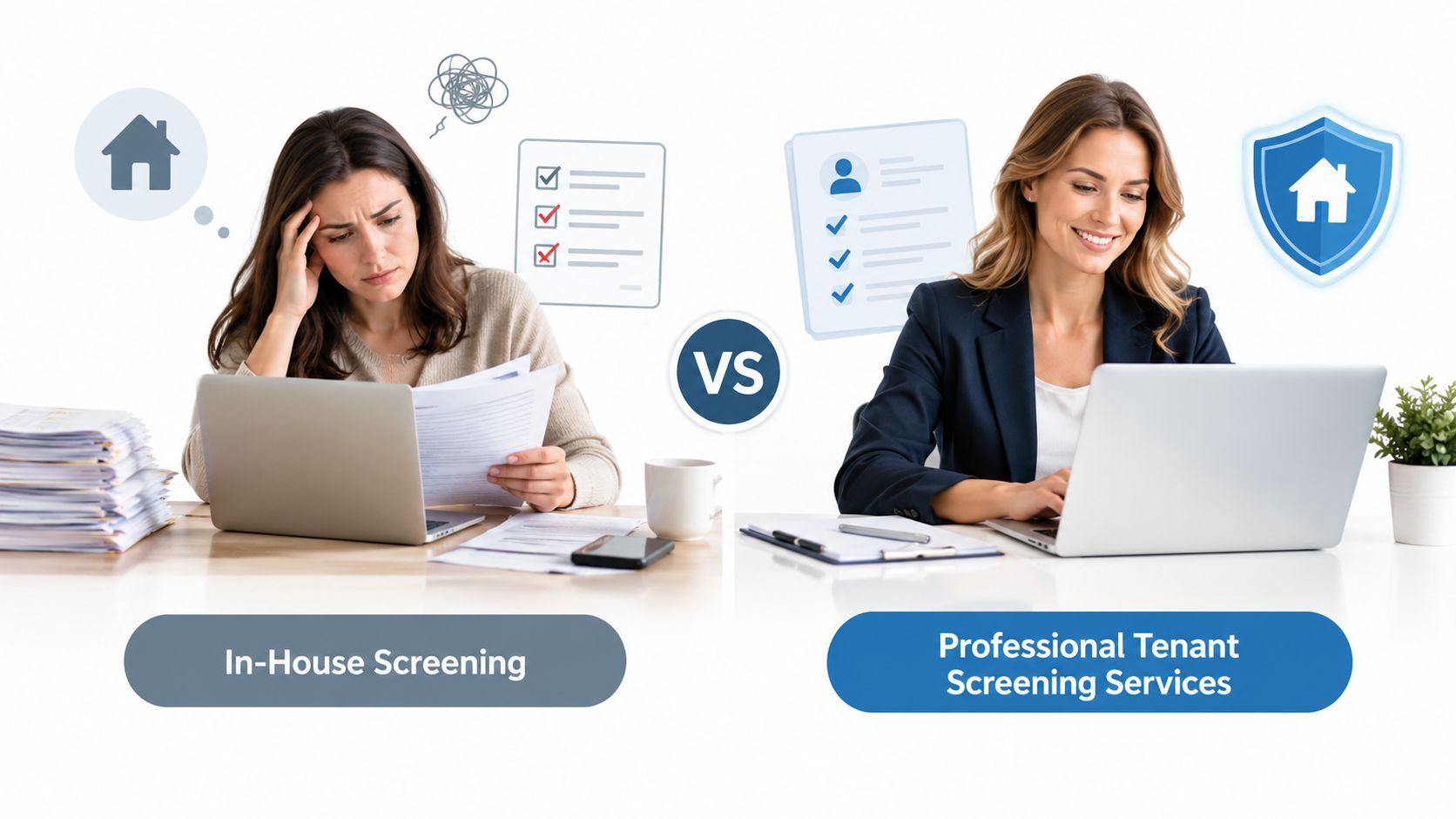
In-House Screening vs. Professional Tenant Screening Services
The decision isn't really about whether screening matters. It's about who should execute it, how much documentation is needed, and how much risk the landlord is comfortable carrying personally.
What self-managed screening does well
Doing everything in-house can work for landlords with a small portfolio and the time to stay highly organised. It offers direct oversight, and some owners prefer hearing from employers and previous landlords themselves.
That model works best when the landlord already has:
- A fixed application form
- A separate consent step for credit review
- A reference-check script
- A filing system for decisions and supporting documents
Without those basics, manual screening usually becomes reactive.
What professional screening services improve
Professional tenant screening services typically help standardise intake, identity handling, credit workflow, and reference collection. That reduces administrative friction, especially when multiple adults are applying or when several files arrive close together.
BC landlords also need to think about privacy. The Office of the Information and Privacy Commissioner for British Columbia says about 1.5 million people live in rental housing in the province, representing roughly 30% of households, which helps explain why screening vendors increasingly combine identity verification, credit data, and reference workflows inside privacy-sensitive processes. That broader context is outlined in the BC privacy commissioner's review of rental housing practices.
For landlords comparing process models, it can also help to read general guidance on FCRA compliant tenant screening help. The American compliance reference isn't a substitute for BC law, but it's useful for understanding how professional screening workflows are usually structured around consent, recordkeeping, and standardisation.
The middle ground most owners overlook
There's a practical middle path between pure DIY screening and one-off screening reports. Some landlords bundle screening into a broader leasing system that includes showing coordination, application management, verification, and move-in administration. Royal LePage Brookside Realty offers licensed residential property management in Maple Ridge that includes tenant placement and screening as part of that wider process.
A screening report on its own can be useful. A leasing workflow is usually more useful because it controls the steps before and after the report.
The right option depends on the property, the owner's availability, and the number of applications likely to arrive at once. A single rental home with one careful owner can often be screened in-house. Multiple units, out-of-town owners, or high inquiry volume usually justify more formal support.
Essential Documents and Templates for Landlords
A compliant screening process is only as good as the paperwork behind it. If a landlord can't show what was requested, what was authorized, and what was verified, the file is weak even if the right decision was made.
The strongest application packages are simple. They ask for the same information from every applicant, separate mandatory disclosures from optional discussion, and create a clean record that can be retained.
The core forms every file should have
Landlords should keep a standard document set for each vacancy. A good package usually includes the following:
Rental application form
This captures identity details, address history, employment information, occupancy information, and landlord references in one place.Credit consent form
Written approval should be separate or clearly distinguished so there's no doubt the applicant authorized that step.Reference request template
Using the same questions for each prior landlord helps reduce inconsistent note-taking.Income verification request
This outlines what supporting documents the landlord will accept to verify employment or other lawful income sources.Decision log
A short internal record that notes when the application was received, whether it was complete, what was verified, and the tenancy-related basis for the final decision.
How these documents support faster leasing
Well-built forms don't just protect compliance. They also help lease units faster. A complete package tells applicants exactly what's needed, which reduces the usual back-and-forth after a showing. It also makes pricing and scheduling easier because the landlord can tell quickly whether a file is serious enough to hold attention.
Screening connects to the wider lease-up plan. If a listing is priced properly, showings are grouped efficiently, and the application package is sent early, better applicants tend to move through the process with less delay. Poorly organised paperwork creates drag even when the listing itself is strong.
Landlords who want a practical starting point can review these documents landlords need in BC to screen tenants. The key isn't collecting more paper. It's collecting the right documents in the right order.
What to avoid in templates
A few drafting mistakes create trouble quickly:
- Open-ended personal questions that invite irrelevant information
- Consent buried inside unrelated text
- No space for multiple adult applicants
- No date fields or signature fields
- No internal note area for verification results
A standard package should feel boring. That's a good sign. Predictable forms usually produce defensible files.
The Role of Property Management in Streamlining Approvals
Property management helps most when the leasing process is treated as one coordinated chain instead of separate tasks. Listing preparation, inquiry handling, showing schedules, applications, screening, approval, deposit collection, and move-in all affect each other.

Workflow design matters more than volume
A property manager can shorten approval timelines by tightening the front end of the process:
- Sharper listing presentation: Clear terms reduce unsuitable inquiries.
- Better showing coordination: Qualified prospects see the property sooner.
- Standard applications: Every serious prospect enters the same review lane.
- Faster follow-up: Missing items are identified immediately instead of days later.
That structure is particularly useful for owners who don't live in Maple Ridge, own more than one rental, or can't respond quickly during the workday.
Why local handling improves consistency
Maple Ridge and Pitt Meadows landlords don't just need paperwork. They need a process that fits the pace of local leasing. A manager who handles the listing, showings, intake, and approval sequence can keep the file moving without skipping BC requirements.
Owners who want a broader look at responsibilities can read more about what a property manager does. The practical value in screening is simple: fewer loose ends, cleaner documentation, and a more organised path from inquiry to possession date.
Actionable Strategies for Faster, Higher-Quality Leasing
Landlords usually get better results when they tighten the process before the first inquiry arrives. That means preparing the listing, standardising the application package, deciding what verification steps are required, and setting response timelines in advance.
A straightforward roadmap looks like this:
- Prepare the application package before marketing starts.
- Use the same intake process for every serious prospect.
- Require completeness before verification begins.
- Capture written consent before any credit step.
- Keep decision notes tied to legitimate tenancy criteria.
- Coordinate pricing, showings, and screening as one leasing process.
The landlords who fill units well in Maple Ridge usually aren't doing anything flashy. They're removing friction. They make it easy for qualified applicants to apply properly, and they make it hard for incomplete files to consume time.
If tenant screening services in Maple Ridge BC are being considered, the right choice depends on workload and risk tolerance. Some owners can run a clean in-house system. Others are better served by handing the process to a licensed property management team that can keep applications moving without cutting corners.
Royal LePage Brookside Realty provides local real estate guidance in Maple Ridge and Pitt Meadows, including licensed residential property management and tenant placement support for landlords who want a more organised leasing process. For owners who need help coordinating showings, applications, screening, and approvals in line with BC requirements, visit Royal LePage Brookside Realty.