
The mortgage pre-approval is in place, the down payment is saved, and a Maple Ridge home looks within reach. Then the question changes from the monthly payment to the amount the lawyer needs before completion. That's where buyers need an itemised budget, not a broad percentage estimate.
Closing costs and taxes when buying a home in BC include property transfer tax, legal or notary charges, disbursements, adjustments and any applicable financing or new-home costs. The useful distinction is between tax calculated under provincial rules and charges that require a quote for the actual purchase. A buyer in Pitt Meadows needs the same separation, even when the purchase price and mortgage payment already look manageable.
Table of Contents
- What a Closing Bill Looks Like at Three Price Points
- What Closing Costs Cover and When You Pay Them
- How Property Transfer Tax Is Calculated
- Exemptions That Lower Your Transfer Tax
- Foreign Buyer Tax and Who Owes It
- Ongoing Taxes After Closing
- Confirm Your Closing Budget Before You Make an Offer
What a Closing Bill Looks Like at Three Price Points
Closing costs at three common BC price points
| Cost item | $400,000 home | $650,000 home | $900,000 home |
|---|---|---|---|
| Property transfer tax, standard rates | $6,000 | $11,000 | $16,000 |
| Property transfer tax after first-time buyer exemption | $0 | $3,000 | $16,000 |
| Legal or notary fees and disbursements | Written file-specific quote needed | Written file-specific quote needed | Written file-specific quote needed |
| Property tax and strata fee adjustments | Completion-date calculation needed | Completion-date calculation needed | Completion-date calculation needed |
| Lender and mortgage registration fees | Lender estimate and legal quote needed | Lender estimate and legal quote needed | Lender estimate and legal quote needed |
These are hypothetical worked examples, not property listings or market-price estimates. All amounts are Canadian dollars, fair market value is assumed to equal the purchase price, and the home is intended as a principal residence in Maple Ridge or Pitt Meadows. The tax calculations use the provincial rules for a 2026 budget, with first-time buyer eligibility assumed only where relief is shown.
The standard-tax and exemption-adjusted rows are alternatives, not amounts to add together. A buyer who qualifies uses the exemption-adjusted result; a buyer who doesn't qualify starts with the standard result. Neither row includes an additional foreign buyer tax or GST on a newly built home.
How to turn the table into a closing budget
The lower-price example shows how qualifying relief can eliminate transfer tax. The middle example shows why being eligible doesn't necessarily mean paying no tax. The higher-price example illustrates a purchase outside the first-time buyer programme's value limits.
The fee rows deliberately don't contain generic allowances. A straightforward resale conveyance and a purchase involving unusual title issues, extra lender instructions or complicated ownership arrangements shouldn't be assigned the same legal bill without a quote. Buyers should request a written estimate separating professional fees, disbursements and anticipated adjustments.
Budgeting rule: A tax calculation can be firm once the relevant facts are confirmed. An unquoted legal fee or adjustment is still an estimate.
The down payment isn't a closing cost. It forms part of the purchase price, while these expenses sit alongside the buyer's purchase funds. Within this comparison, the applicable tax row and the quoted fee and adjustment rows change the extra cash needed at completion; inspection, appraisal and any new-home costs also need their own budget entries.
Exemption amounts and tax rules are time-sensitive. Before relying on the budget, the buyer's lawyer or notary should check the Province's current requirements, select the appropriate transfer-tax result, add the quoted charges and leave a separate buffer for adjustments.
What Closing Costs Cover and When You Pay Them
Closing costs are the expenses required to complete a purchase beyond the purchase price, with the down payment accounted for separately as purchase funding. Some are paid during due diligence, while others appear in the final funds requested by the lawyer or notary.
What each closing cost is and when it is paid
| Cost | What sets the amount | When it is paid |
|---|---|---|
| Property transfer tax | Fair market value at registration and provincial rate bands | At completion, through the lawyer or notary, unless exempt |
| Legal or notary fees | Quote for the specific file | Settled on the file, usually at completion |
| Disbursements | Land Title Office registration, searches and title insurance if chosen | At completion, passed through at cost |
| Property tax adjustment | Portion of the year owned, based on the contractual adjustment date | At completion |
| Strata fee adjustment | Prorated strata amounts for condos and townhomes | At completion |
| Inspection and appraisal | Quotes from the providers involved | Before completion, often before subjects are removed |
| GST on a new home | Purchase contract terms and applicable federal new housing rebates | Treatment and payment obligations set in the purchase contract |
Property transfer tax is a statutory charge rather than a negotiable professional fee. Legal or notary fees pay for the conveyancing work, including reviewing the file, preparing documents and handling registration and funds.
Disbursements are separate third-party expenses. A useful quote identifies registration charges, searches and title insurance where applicable rather than combining everything into an unexplained total. Buyers should also ask whether mortgage registration work is included so the same expense isn't budgeted twice.
Why adjustments can change the final amount
A property tax adjustment allocates the relevant expense between seller and buyer. If the seller has prepaid an amount benefiting the buyer after the agreed adjustment date, the buyer may reimburse that portion; other circumstances can produce a credit instead.
Strata fee adjustments perform similar bookkeeping for the applicable payment period. The contract's adjustment date should be checked rather than assuming it always matches completion or possession.
An adjustment isn't automatically an extra service charge. It may be a reimbursement for an expense the seller has already paid.
Inspection and appraisal charges should be tracked when arranged, not rediscovered on moving day. Lender fees and mortgage insurance premiums, where applicable, belong in the financing estimate, with the lender confirming how each amount will be paid.
For newly built homes, GST may apply and federal new housing rebates may reduce the net amount. The buyer's lawyer and builder should confirm the contract's GST treatment, and the buyer should check the Canada Revenue Agency's current rebate rules before budgeting.
The real estate closing process guide provides context for these milestones. The practical check is a line-by-line comparison of the legal estimate, lender estimate and final statement of adjustments.
How Property Transfer Tax Is Calculated
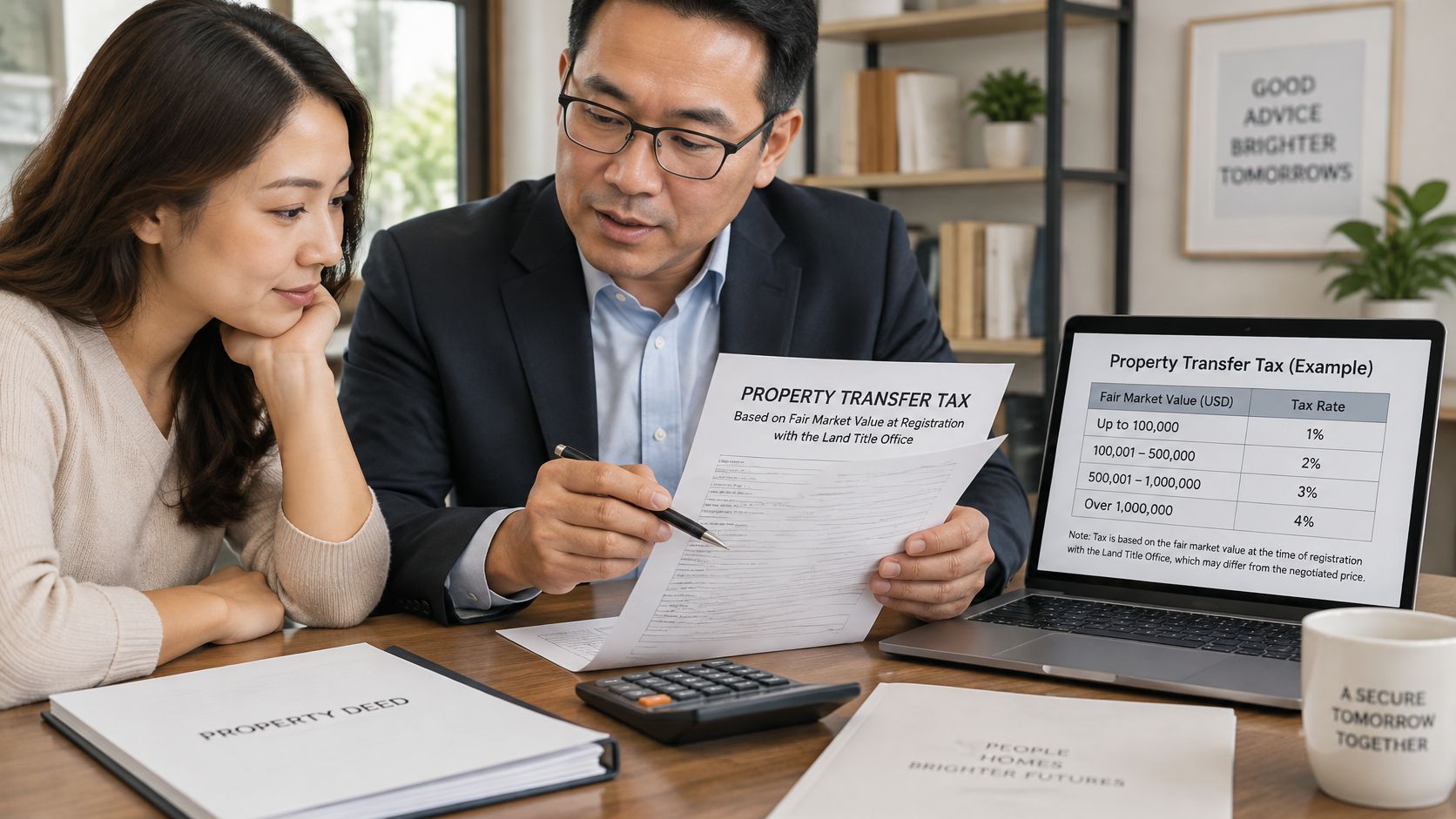
Property transfer tax is calculated on fair market value at registration, which may differ from the negotiated purchase price. The Province's property transfer tax guide sets the general rates at 1% on the first $200,000, 2% on the portion above $200,000 up to and including $2 million, and 3% on the portion above $2 million, plus an additional 2% on residential value exceeding $3 million.
The Province's worked example produces $11,000 in tax on a property valued at $650,000: $2,000 on the first $200,000, plus $9,000 on the remaining $450,000. Each rate applies only to its portion of value, not to the entire property. That split is what keeps the bill predictable, while valuation is where files vary.
BC property transfer tax rate bands
| Portion of value | Rate | Tax on that portion |
|---|---|---|
| First $200,000 | 1% | Up to $2,000 |
| Above $200,000 up to $2,000,000 | 2% | 2% of the portion within this band |
| Above $2,000,000 | 3% | 3% of the portion above $2,000,000 |
| Residential value above $3,000,000 | Additional 2% | 2% of residential value above $3,000,000 |
| Source: Province's property transfer tax guide |
A presale, mixed-use property or purchase involving non-residential improvements needs a file-specific review of the valuation basis. A value near a threshold also deserves confirmation before the buyer commits completion funds. I recommend getting that basis in writing from the lawyer or notary, rather than treating a calculator result as final.
A reliable calculation method
Start with the purchase price and available assessment information as starting points, without treating assessed value as the registration value. Then ask the lawyer or notary how fair market value will be established for this transfer. Apply the bands separately to each portion, then check exemption eligibility before determining the payable amount.
For buyers encountering different terminology, the land transfer tax explanation helps distinguish the general term from BC's property transfer tax. A calculator is useful for comparing scenarios, but it does not verify ownership history, eligibility or the valuation facts behind the return.
Exemptions That Lower Your Transfer Tax
A buyer comparing a $750,000 resale to a $1,050,000 new build faces two different tax questions. The first turns on buyer history and the share acquired. The second turns on first registration, lot size and move in timing. The table sets the dollar limits, the text below covers how to qualify.
PTT exemption thresholds by home type. Thresholds from the Province's exemption guidance.
| Exemption | Fair market value | Relief available |
|---|---|---|
| First-time buyer, full | Up to $500,000 | Full exemption for a qualifying purchase |
| First-time buyer, reduced | Above $500,000 up to $835,000 | Exemption on the first $500,000, maximum $8,000 |
| First-time buyer, partial | Above $835,000 but below $860,000 | Partial relief, reducing to zero |
| First-time buyer, none | $860,000 and above | No first-time buyer exemption |
| Newly built home, full | Up to $1,100,000 | Full exemption for a qualifying principal residence |
| Newly built home, partial | Above $1,100,000 but below $1,150,000 | Relief phases out over $50,000 |
| Newly built home, none | $1,150,000 and above | No newly built home exemption |
Exemptions apply only after you register a claim. Qualifying purchasers apply when registering the eligible transaction, with relief subject to the purchaser's circumstances, ownership share, property size and non-residential improvements.
The first-time home buyers' current exemption amounts set one programme. An eligible buyer can still owe tax. A first purchase can qualify for a reduction while leaving a balance payable, so confirm the expected result with the lawyer or notary before committing funds.
Newly built homes follow a separate programme
The newly built home exemption has its own first registration test, a principal residence requirement, a lot limit and a move in window. Anything marketed as new construction must still meet each condition.
As a hypothetical worked example, a newly built home valued at $1,050,000 would generate $19,000 at standard rates but could have no regular PTT payable if the purchaser and property meet all exemption conditions. That does not establish the home's GST treatment.
Before relying on either programme, the eligibility review should cover:
- Purchaser status: Citizenship or residency facts and supporting documents.
- Ownership history: Previous home ownership relevant to the particular programme.
- Occupancy: The intended move-in date and principal-residence use.
- Property details: Eligible ownership share, lot size and non-residential components.
- Registration timing: The rules applicable when the transfer is registered.
The BC first-time home buyer programmes guide can help organise the questions. Eligibility should be discussed with the lawyer or notary before an offer, not assumed from the listing price.
Foreign Buyer Tax and Who Owes It
A foreign national, foreign corporation or taxable trustee acquiring a residential interest in a specified region may owe additional property transfer tax on top of regular PTT. The Province's additional property transfer tax rules set this tax at 20% of the fair market value of the purchaser's proportionate share, and both Metro Vancouver and the Fraser Valley Regional District are specified regions. That rate is fixed by law. It does not move with the lawyer quote or lender fees.
Buyers looking in Maple Ridge and Pitt Meadows with uncertain status should get a determination before they set an offer budget. Moving from another province is not proof of foreign status. The legal determination decides it on documented facts.
How the ownership share affects the bill
Take a taxable purchaser registering a 50% share of a $650,000 residential property. The proportionate value is $325,000, which produces $65,000 in additional tax. The registered percentage with the Land Title Office controls the calculation, so informal arrangements about who paid the deposit do not change it.
Possible exemptions need careful review. They include certain circumstances involving purchasers exempt from regular PTT and confirmed BC Provincial Nominees. Each carries its own conditions, and none works as an automatic waiver.
The pre-offer review should establish each purchaser's status with supporting documents, registered ownership percentages consistent with the intended transaction, and calculation and payment arrangements confirmed by the lawyer or notary. Carry the additional tax as a separate budget line, apart from ordinary closing expenses.
Relocation buyers can start with this foreign buyers tax overview, then get a legal determination on status and exemptions before an offer is written.
Ongoing Taxes After Closing
The closing bill isn't the full ownership-tax picture. Annual municipal property tax continues after the purchase, and the adjustment settled with the seller doesn't replace the buyer's responsibility to review future municipal notices.
The Speculation and Vacancy Tax is separate again. Under the Province's property tax FAQs, the 2026 rates are 1% for Canadian citizens or permanent residents who aren't untaxed worldwide earners and 3% for foreign owners and untaxed worldwide earners, with liability and exemptions governed by the applicable ownership and use rules.
A newly purchased property may qualify for a temporary exemption where the owner paid PTT or qualified for a PTT exemption. That possibility doesn't remove the need to understand declaration requirements or establish qualifying occupancy.
A practical ownership timeline
| Stage | Buyer's practical task |
|---|---|
| At closing | Retain the tax adjustment statement and transfer documents |
| During the initial occupancy period | Record move-in, ownership and rental arrangements |
| When a declaration is required | Review eligibility and submit the required information |
| When the home's use changes | Recheck exemptions and possible tax exposure |
| When the municipal notice arrives | Review the annual property tax separately from closing adjustments |
The situations needing attention aren't limited to an entirely empty investment property. A buyer renting part of a home, moving in gradually, using it as a secondary residence or holding it for future downsizing should check how the actual arrangement affects eligibility.
A plan to rent doesn't establish that the property meets a rental exemption. Likewise, an intention to move in later isn't evidence of present occupancy.
Keep the evidence: Occupancy dates, rental records and ownership documents make a later declaration review more straightforward.
Assessment information also needs to be interpreted correctly. The assessment versus market value guide explains why an assessment notice shouldn't be treated as a substitute for every other property valuation.
These rules can change. Before relying on an ownership strategy, the buyer should check the Province's current requirements and seek appropriate tax or legal advice about the planned use.
Confirm Your Closing Budget Before You Make an Offer
A buyer with a signed offer has less room to adjust. An unbudgeted lender fee or a missed exemption condition becomes a scramble for cash or a request for an amendment the seller may refuse. The budget review belongs before the offer is written, while price, deposit and dates can still move.
Build one file-specific cash-to-complete sheet before you compare homes. List paid deposits separately from cash still due at completion. Mark each line as quoted or provisional, with a name beside every provisional figure. That sheet shows whether the purchase still works after adjustments, moving and immediate repairs. Compare the remaining cash needed after completion, rather than the purchase prices alone.
A pre-offer checklist
- Close the financing gap: Get the lender statement on fees, insurance premiums and funds that must come as cash.
- Lock the inspection window: Book inspection and appraisal dates that leave time to act before subjects end.
- Record the ownership plan: Put purchaser names, shares, move-in timing and any rental use in writing for the lawyer or notary.
- Fix the calendar: Confirm what completion, adjustment and possession mean in the contract and who holds funds on each date.
- Route each question once: Send registration and tax treatment to the lawyer or notary, loan costs to the lender, and price and timing terms to your licensed agent.
Royal LePage Brookside Realty helps buyers evaluate Maple Ridge and Pitt Meadows homes and organise the property-specific questions that affect a closing budget. Visit Royal LePage Brookside Realty to discuss a purchase before writing an offer, with every tax figure and exemption confirmed by the buyer's lawyer or notary.