
You have a Maple Ridge listing open, and the price sits under the homes on the same street. The remarks say court-ordered sale. The photos look ordinary. It is easy to treat that as a normal offer with a few extra forms.
It is not. How to buy a foreclosure property in BC starts with a court-supervised purchase. The hearing, not the listing, controls the sale. A lender can accept your offer and you can still lose the home to a sealed bid. The keys follow only after a judge approves the sale and the order's conditions are met.
Price the full acquisition before the first bid. Transfer tax, legal and title work, repairs, insurance, and a home that may still be occupied all sit on top of the number in the ad. This is practical guidance for Maple Ridge and Pitt Meadows buyers, not legal advice. Title, the court order, deposit wording, and any tenancy belong with a BC real estate lawyer.
Table of Contents
- The Buying Path From Listing to Keys
- Where to Find Foreclosure Listings and Court Files in BC
- Court Sales, Lender Listings and Auctions Compared
- Due Diligence Before You Make an Offer
- Deposits and Deadlines for Sealed Bids
- Possession and Tenancy Risk After Completion
- Calculating the Full Cost Including Transfer Tax
- Deciding Whether to Bid or Get Local Help
The Buying Path From Listing to Keys
Buying a foreclosure property in BC runs through seven stages. The court file sets the sale method, the conditions, and the date that matters. A buyer who falls for the photos and never opens the sale order will pay for an inspection and tie up a deposit on a bid the court cannot accept. Stages 3 and 4 decide whether the bid is safe to make.
The seven stages
| Stage | What Happens | Who to Involve |
|---|---|---|
| 1. Review the listing and court file | Petition and sale orders are obtained and read | BC real estate lawyer |
| 2. Arrange financing | Lender approves the purchase for the specific property | Lender or mortgage broker |
| 3. Investigate the property | Title, tax status, condition and occupancy are checked | Lawyer, inspector, insurer |
| 4. Prepare the bid | Offer is drafted in the court-approved format with the deposit | Lawyer, bank or certified cheque |
| 5. Attend the approval hearing | Court considers competing sealed bids | Lawyer or authorised representative |
| 6. Complete the purchase | Court order is issued, price is paid and title transfers | Lawyer, lender, Land Title Office |
| 7. Take possession | Keys are handed over or an occupied property is addressed | Lawyer, property manager if renting |
Stage 1 is close reading of the order until the payment direction and the possession promise are both clear to you in plain words. Stage 2 must be approval for this property, on a timeline the court can impose; a pre-approval letter from last spring will not survive a hearing date that moves.
Stage 3 is where ordinary buyers get caught. Registered charges, tax arrears, a roof that needs replacement, and an occupant who has not left all change what the home is worth to you. Stage 4 turns that work into a bid the court will accept. The format, the subjects, and the deposit have to match the order, and a familiar residential offer often falls short of it.
Stages 5 to 7 are execution. You, or someone authorised, attend the approval hearing. If the judge picks your bid, completion follows the order: price paid as directed, documents signed, title transferred. Possession is its own job. Vacant keys are a result you confirm with the seller or the court, and an occupied suite is a tenancy problem that outlasts the transfer.
Investors who are also lining up other purchases can use this closing guidance for property investors to see how a normal completion is sequenced. A court sale compresses that sequence around the order, so the same checklist has to be finished earlier.
Practical rule: If title, condition, occupancy, and the deposit are not settled, you are not ready for the hearing, even if the lender has already said yes.
At the first meeting with a BC real estate lawyer, ask three questions.
- What does this order require? Ask which subjects are barred, where the price must be paid, and what possession the order promises.
- What is still unknown on title and taxes? Ask for charges, arrears, and vesting language in plain words.
- What happens to the deposit if you are outbid or cannot close? Ask before the draft is issued, not after.
Where to Find Foreclosure Listings and Court Files in BC
A BC foreclosure sale has a paper trail, and the route decides where that trail starts. The marketing page may be the first thing you see, but it is a lead source, not a term sheet. The documents behind it are what you need to read.
For a court-supervised sale, the terms sit in the Supreme Court file: the petition and the sale orders. Those set the sale method, any reserve or minimum price, who may bid, and the conditions you must meet. A listing description is advertising copy and does not control the hearing. Title, charge and tax checks belong with due diligence; a listing summary does not replace them.
Use the channel that matches the file.
- Court-supervised sales: The court process and the approval hearing carry the terms. The filed paperwork is the reliable source.
- Lender-listed properties: The lender's sale process produces the listing. The written contract counts, including any possession promise.
- Public auctions: The notice of sale states the terms and bidding rules. Read it before you treat an ad as an invitation to bid.
The same three checks apply to every property. Is the sale method clear? Is occupancy stated? What are the deposit and offer deadlines? Outside Maple Ridge and Pitt Meadows, apply them only once you have the file.
Where a listing and the court file disagree, the court file controls. Confirm the difference with a BC real estate lawyer before you book more viewings. If a detail cannot be confirmed, mark it unknown on the shortlist. Do not fill the gap from memory or from the listing remarks.
Court Sales, Lender Listings and Auctions Compared
Three routes put a foreclosure in front of a buyer. Each one decides who writes the rules and how little time you get before money is committed.
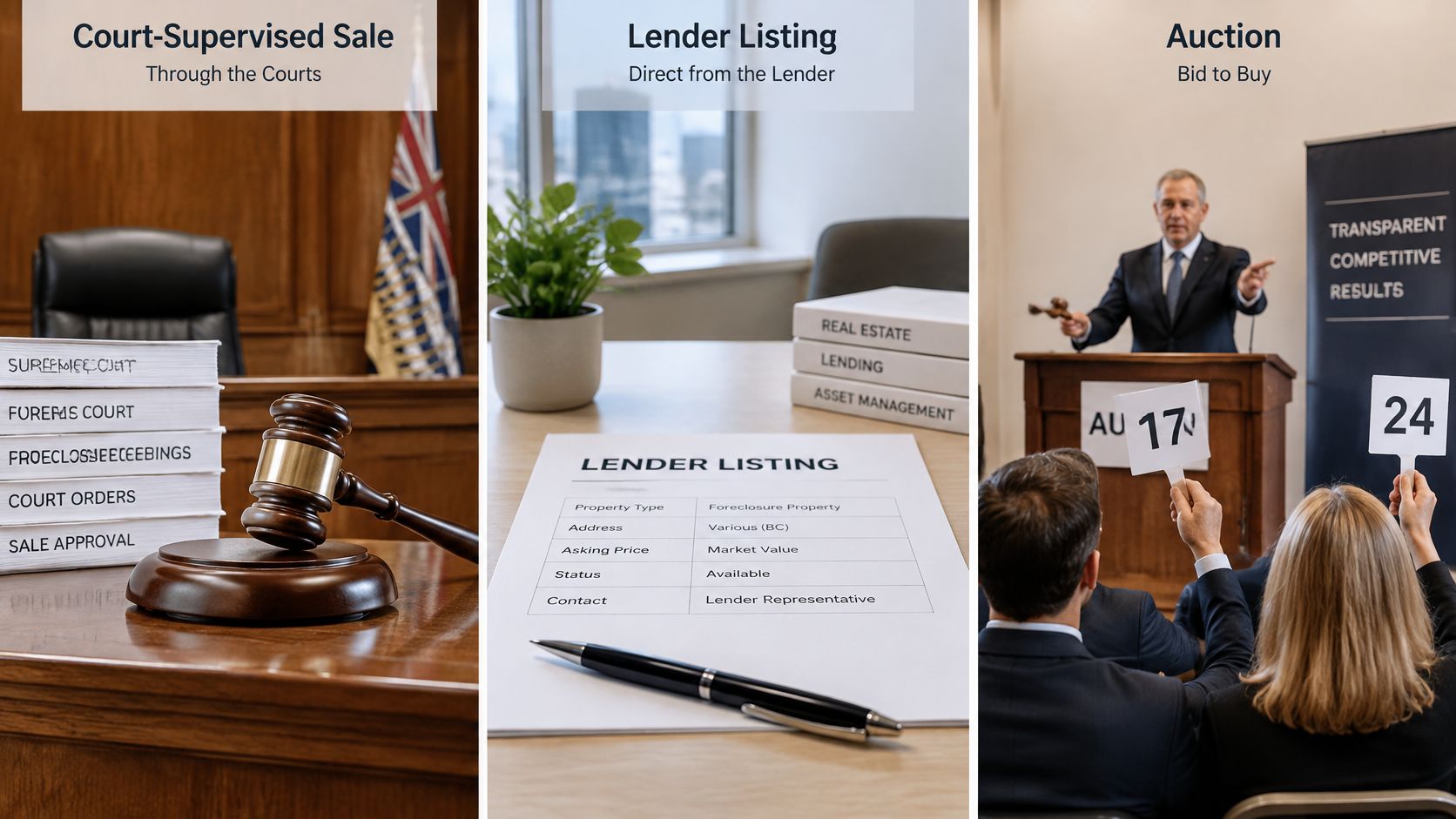
The court-supervised sale governs the picture. Under the Supreme Court Civil Rules, the court can set the method of sale, a reserve or minimum price, who may bid, payment into court or to trustees, the conditions of sale, and evidence of value. A lender's accepted offer stays conditional until a Supreme Court judge approves it. Competing buyers may submit sealed bids at that hearing. The judge selects the offer that best meets the court's requirements. The hearing controls the sale, whatever the listing says. Before the first bid, price the full acquisition cost against those terms.
A lender-listed property is narrower on paper and wider in risk. The lender's sale contract sets the terms, so confirm in writing exactly what is promised, including possession. A public auction is public bidding under the notice of sale or the court order. The notice sets the terms and bidding rules. Once your bid is accepted, your money is committed, so inspection, insurance and financing must be settled before the sale.
| Route | Who Sets the Terms | How You Bid | Due Diligence Room |
|---|---|---|---|
| Court-supervised sale | Supreme Court order and its Schedule A conditions | Sealed bid at the approval hearing | Limited; sold as-is, where-is |
| Lender-listed property | Lender's sale contract, confirmed in writing | Offer as the lender directs | Unknown until that written contract is read |
| Public auction | Terms set by the notice of sale or the court | Bid in public at the auction | Usually the narrowest, with funds committed at the bid |
Across these routes, the British Columbia Real Estate Association notes that the property is sold “as-is, where-is,” without seller warranties or a duty to disclose known defects. Auction rules, and how much investigation a lender will allow, stay unknown until that file's documents say so.
One test covers every route. Who sets the terms, how is the bid made, and how much time is left before money is committed?
Due Diligence Before You Make an Offer
The hearing decides who gets the property, and a higher competing bid can displace yours. The winning bidder still takes the property with the condition, occupancy and closing risk that the order leaves in place. An inspection fee buys information, not a right to complete.
Run the checks in this order, with a named person signing off on each.
Read the sale conditions and exclusions. The order and its schedule set what is sold and what is stripped out. Representations, warranties and inspection conditions are often removed. If a subject is gone, you cannot add it back at the hearing. Your lawyer confirms that reading against the court file.
Confirm title, charges and tax status. This is the lawyer's sign-off. It covers registered charges, property transfer tax and the vesting language that determines which liabilities follow the purchase. The court may direct a sale before or after judgment on terms it considers just, so the listing label does not settle that question, as the Law and Equity Act framework for court-directed sales makes plain.
Inspect and price the work. Walk the property room by room using a home inspection checklist for buyers, then turn defects into allowances. A roof at the end of its life or unauthorised wiring is not a negotiating point after the hearing. It is a line item subtracted from your maximum bid. If the repair allowance rises, the bid falls by the same amount.
Confirm insurance can bind. An insurer or broker must confirm a standard policy will cover the property before the hearing. If it will not, the bid may not be financeable.
Identify occupancy. Find out who is there and what the order says about possession. Do not infer from an empty photo. A tenant or occupant changes the vacancy, eviction and carrying-cost assumptions.
Build the fully loaded cost. Add price, property transfer tax, legal and title work, financing carry, insurance, vacancy or eviction cost, utilities, remediation and a contingency.
Set the maximum bid from that total, not the advertised price. The court controls the sale, so due diligence has to be finished while your deposit is still in your control.
Carry one figure into the bid decision: the most you will pay after repairs, tax, closing costs, and a realistic delay, not the number on the listing.
Deposits and Deadlines for Sealed Bids
The deadline that catches buyers is the one the day before the hearing, not the hearing itself. Financing in place does not save a bid that arrives without a compliant deposit.
The Supreme Court sealed-bid practice direction requires the offer to be accompanied by the applicable deposit. That is a bank draft or certified cheque, or proof that the draft or cheque was delivered to the seller's realtor or held in trust by the purchaser's counsel. For emailed offers, that proof must reach the seller's counsel by 1:00 p.m. on the business day before the sale-approval hearing. A separate current court-sale procedure requires competing buyers who bid in person to submit by 9:45 a.m. on the hearing date, with a copy of proof of deposit.
| Requirement | What Is Required | Deadline |
|---|---|---|
| Deposit | Bank draft or certified cheque, or proof it was delivered to the seller's realtor or held in trust by purchaser's counsel | Must accompany the offer |
| Emailed offer | Proof of deposit must reach the seller's counsel | 1:00 p.m. on the business day before the sale-approval hearing |
| In-person competing bid | Bid in person with a copy of proof of deposit | No later than 9:45 a.m. on the hearing date |
Ordinary residential bidding lets you tidy conditions over a weekend. This process does not. You need funds that can be certified immediately, a lawyer who already knows BC foreclosure procedure, and a subject-free or tightly drafted offer. The deposit amount and the exact conditions change by property. A conventional offer format may be rejected even when the price is attractive.
Work backwards from the hearing
The court file does not publish a standard number of weeks from petition to hearing, so do not plan on one. Build the calendar from the hearing date backward, and treat anything longer as unknown until the file and your lawyer confirm it.
- Hearing morning: In person, with the bid and a copy of proof of deposit, no later than 9:45 a.m.
- The business day before: Emailed proof of deposit in the seller's counsel's hands by 1:00 p.m. Order the draft early enough that a bank lineup cannot sink it.
- Before that day: Legal review of the offer form. A real estate contract review habit matters here, because Schedule A language is where subjects disappear.
- Earlier still: Lender approval for this property, the inspection, and insurance. Those lead times are unknown until your lender and your lawyer put dates on them.
Check the current practice direction again before the bid goes out. A missed deposit deadline, or a hearing arrival without the right papers, can keep you out even when the mortgage is approved. For Maple Ridge and Pitt Meadows purchasers, early lender approval and advance legal review are preparation, not optional polish.
Possession and Tenancy Risk After Completion
Registering the transfer at the Land Title Office does not empty the house. A BC foreclosure purchase can complete with the former owner-occupant still inside, or with a tenant whose rights run under the Residential Tenancy Act. Occupancy is a separate problem from title, and it is the one that wrecks budgets.
The former owner may not leave on the date the order sets, and may leave the property damaged. A tenant is protected by the Act, and that protection can delay possession past the completion date. BC Housing Blog, reporting CBC figures records 946 listings across Greater Vancouver and the Fraser Valley from January 1 through September 30, 2026, more than the annual totals of the preceding decade. That count is time-sensitive and it is not a price forecast.
Before bidding, settle four points. Does the lender's contract promise vacant possession, and in which words? Who pays enforcement costs if the occupant stays? How long a delay can the purchase absorb before it stops making sense? What does the court order itself say about possession?
For a rental plan, rerun cash flow with the rent start pushed back three, six and twelve months. A three-month gap on a Maple Ridge suite means three months of mortgage, property tax and insurance paid from your own funds, with no rent offsetting them. Treat the delayed case as the budget, and a bid that only works with rent from day one is too high.
Where tenancy terms, notices or enforcement are in question, a BC real estate lawyer answers, because the result turns on that tenancy and the Act. Tenancy agreements, inspections, notices and statements are handled in line with the BC Residential Tenancy Act and Royal LePage brokerage standards. A plain account of what happens to tenants when a rental property is sold in BC is companion reading, not a substitute for advice on this file.
If the home is occupied on completion, can the purchase still meet its budget and its timeline? If the answer is no, do not bid.
Calculating the Full Cost Including Transfer Tax
A taxable purchase at a fair market value of $800,000 produces $14,000 in BC property transfer tax: $2,000 on the first $200,000 and $12,000 on the remaining $600,000. Buying through a foreclosure does not remove that tax. The court process and the tax are separate bills.
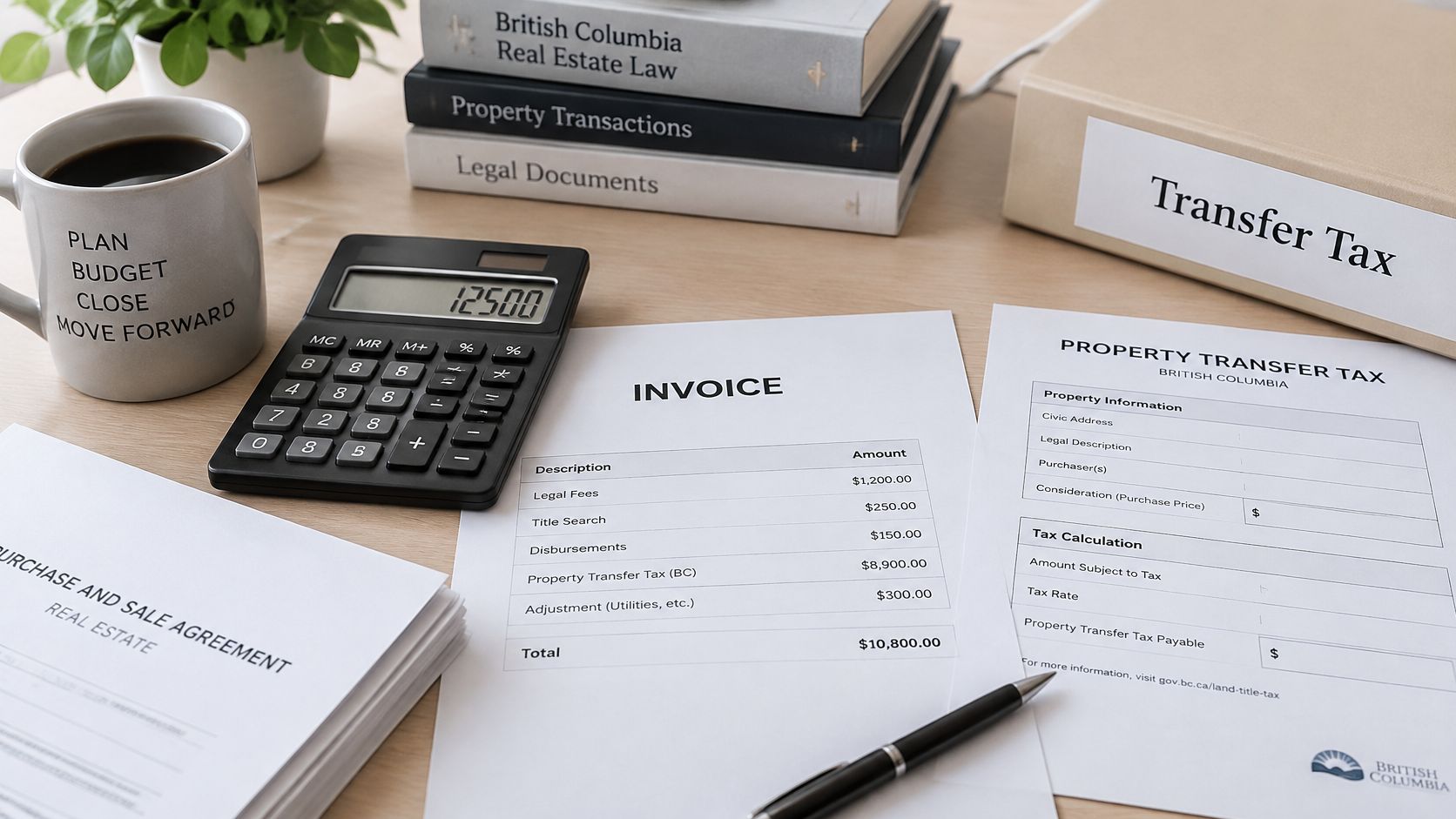
The provincial property transfer tax rules say a purchaser who acquires an interest in land registered at the Land Title Office must file a return and pay the tax unless an exemption applies. The tax is generally based on fair market value, including land and improvements, on the registration date. Check the current bands again before you lock a budget, because rates are set by the province, not by the listing.
| Price Band | Rate | Tax on That Band |
|---|---|---|
| Up to $200,000 | 1% | $2,000 on the first $200,000 |
| $200,001 to $2,000,000 | 2% | $36,000 if fair market value reaches $2,000,000 |
| Above $2,000,000 | 3% | 3% of the amount above $2,000,000 |
From the tax line to one total
A first-time-buyer exemption depends on the provincial rules and on your circumstances. Confirm it with your lawyer or a tax professional before you subtract it. Hoping for an exemption is not the same as qualifying.
Put the tax beside the other completion costs from your diligence file: legal and title work, financing costs, inspections, repairs, and the contingency. A worked stack for that $800,000 example is the $14,000 tax, then your actual legal quote, then the lender's setup costs, then the repair number from the inspection, then a contingency you can defend. Add them. Compare that one total with the advertised price. The gap is the discount, if any discount remains.
Self-employed buyers often need cleaner income records before a lender will approve this specific property. Some people find financial tools for freelancers useful while they organise those records. The tools do not change the tax. A broader look at closing costs and taxes when buying a home in BC helps you see which items show up on an ordinary purchase as well, so the foreclosure file is not the only place they surprise you.
Deciding Whether to Bid or Get Local Help
Bid on your own only when four things are already true. A BC real estate lawyer who knows foreclosure procedure is retained. Deposit funds can be certified now. Financing is approved for this property. You have read the full court file, not a listing printout.
Bring help in sooner when several of those are missing. That includes a Maple Ridge or Pitt Meadows home you have not viewed, an occupied house, unclear title, a large repair estimate, or a hearing that is already close. Score yourself against the four tests and write down which ones fail. If more than one fails, earlier help is the sensible call, not a luxury.
A local brokerage can supply market context, arrange access, and answer practical questions before, during, and after a visit. When buyers inquire about a Royal LePage Brookside Realty listing, the business arranges access to the property and answers questions before, during, and after the visit. The office phone number is 604-467-5000, and the brokerage is licensed with BCFSA. Legal questions about title, the order, the deposit, or a tenancy stay with your lawyer. The broker does not replace that advice. If you are unsure what a buyer's representative does on a file like this, read what a buyer's agent is and then decide who sits on which side of the work.
Book a call to review the court file and the full budget before the hearing date, and bring your lawyer's questions to that conversation.
Royal LePage Brookside Realty helps Maple Ridge and Pitt Meadows buyers sort a court-supervised purchase from a standard offer, including timing, condition, and local value, while your lawyer handles the order and the title. If a foreclosure file is on your shortlist, review the budget and the hearing date with the brokerage before you commit a deposit. Visit Royal LePage Brookside Realty to start that conversation.