A tenant in Albion reports late-night noise, a repair request sits unanswered, and the landlord is already worried that a small disagreement will become a costly vacancy. Across town, a Silver Valley townhouse owner is trying to work out whether a repair problem belongs with the landlord, the strata corporation, or both. These situations rarely begin with legal language. They begin with a text message, a missed call, or a complaint from a neighbour.
For Maple Ridge landlords, tenants, and property managers, the difficult part isn't just knowing that dispute resolution exists. The practical challenge is choosing the right dispute resolution mechanism, preserving evidence, meeting deadlines, and knowing what happens after a decision. The Residential Tenancy Act, strata bylaws, Civil Resolution Tribunal procedures, and court enforcement rules can overlap in ways that make an apparently simple rental conflict harder to route.
The following guide maps each pathway onto the problems that arise in Albion, Cottonwood, Silver Valley, West Maple Ridge, Kanaka Creek, and nearby Pitt Meadows. It focuses on what tends to move quickly, what stalls, and how a party can escalate without losing time or procedural ground.
When a Maple Ridge Rental Dispute Hits Your Door
A basement suite in Albion can become tense over a single weekend. The tenant says the upstairs household is making noise late at night. The owner says the tenant has complained repeatedly but hasn't provided dates, recordings, or messages that show a pattern. At the same time, a repair request involving a bathroom fan remains unresolved, and both sides start treating the noise and repair concerns as one larger dispute.
The first useful move is to separate the issues. Noise concerns need incident records, communication, and sometimes witness evidence. A repair concern needs the original request, reasonable access arrangements, photographs, and a clear record of what remains incomplete. Mixing every complaint into one emotional exchange usually makes settlement harder.
Practical rule: A clear chronology is more useful than a long message written in frustration.
The same problem appears in a Silver Valley townhome, but strata rules add another layer. A landlord may owe a tenant a repair under tenancy legislation while the strata corporation controls access, building systems, or rules affecting contractors. A tenant can be affected by a strata bylaw, yet the tenant's claim against the landlord may still follow the tenancy process. The owner may also have a separate dispute with the strata council or management company.
For a small landlord managing one or two properties, the cost is often measured in time, missed work, and uncertainty about rent. Tenants may have limited money and little flexibility for hearings or repeated document requests. Property managers coordinate between all parties, and a poorly directed complaint can create delay for everyone.
The provincial guidance on landlord and tenant rights in British Columbia is a useful starting point, but general rights information doesn't decide which forum fits a particular conflict. The key questions are more practical. Is the issue urgent? Is the requested remedy a repair, possession, money, or a strata order? Does the decision need to be enforced later?
Those questions determine whether negotiation, facilitation, the Residential Tenancy Branch, the Civil Resolution Tribunal, or a court is likely to produce a usable result.
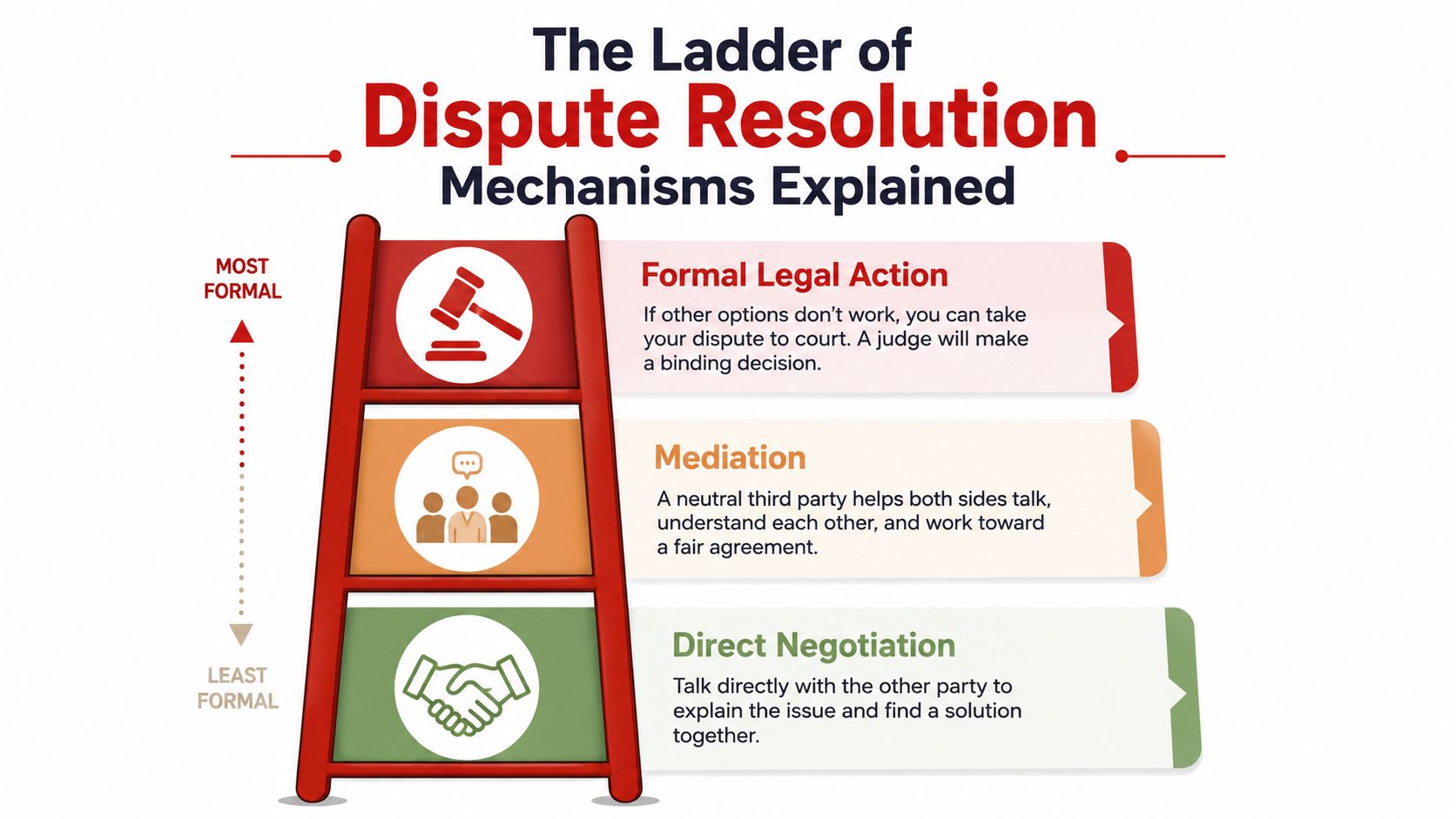
The Ladder of Dispute Resolution Mechanisms Explained
The strongest process usually starts with the least formal step that can realistically solve the problem. That doesn't mean sending an informal text and hoping for the best. It means using each rung to create a record and reserving formal escalation for the point when voluntary cooperation stops working.
Start with documented negotiation
A landlord, tenant, agent, or strata representative should identify the issue, the requested remedy, and a reasonable response date. A property manager's internal complaint log can record calls, emails, notices, repair invoices, photographs, and attempts to arrange access. Negotiation produces an agreement, payment plan, repair schedule, or written position. It doesn't produce a tribunal order unless the parties later formalise the result.
A negotiation-first approach works well for a minor repair, a payment arrangement, or a noise problem where both sides still communicate. It fails when one party denies receiving notice, refuses access, or uses informal discussion to delay a statutory deadline.
Use mediation or facilitated settlement
Mediation places a neutral person between the parties. The mediator doesn't normally decide who wins. Instead, the mediator helps identify an outcome both sides can accept, such as a move-out date, repayment schedule, repair commitment, or agreed conduct terms. BC tenancy matters now include a third-party facilitated mediation option, introduced on May 1, 2024. From May through August 2024, 468 disputes were facilitated, according to the Residential Tenancy Branch service briefing.
Mediation can preserve a working landlord-tenant relationship, but it won't help if a party needs an urgent binding order or refuses to participate. For BC tenancies, see the Province of B.C.'s Residential Tenancy Branch dispute resolution guidance.
Move to a binding forum when voluntary steps fail
Arbitration is a private process in which an arbitrator makes a decision that can bind the parties, usually under an agreement or contract. It may suit a commercial or carefully drafted private arrangement, but a residential tenancy clause can't override statutory rights or force a tenant away from a forum that BC law requires.
The Civil Resolution Tribunal handles online claims, including strata matters and eligible small claims. The CRT identifies a small claims limit of $5,000, while Small Claims Court handles claims up to $35,000 under its jurisdictional framework. The complete guide to the RTB-34 form for BC tenancy disputes can help parties understand a tenancy-specific document before filing.
The Residential Tenancy Branch is the specialised route for disputes governed by residential tenancy legislation. It can make decisions about possession, rent, deposits, repairs, and other tenancy remedies. Small Claims Court may be appropriate for a civil claim outside RTB jurisdiction, while the Supreme Court becomes relevant when the amount, remedy, enforcement route, or legal complexity exceeds the lower forums.
Matching the Right Mechanism to the Right Problem
A Maple Ridge party should choose the forum by remedy, not by habit. A tenant seeking a repair order usually needs the RTB, while a strata owner challenging a bylaw enforcement issue generally needs the CRT's strata jurisdiction. A money claim may belong in a different forum depending on whether it arises from a tenancy, strata relationship, contract, or another civil dispute.
The table below gives a practical first pass. Exact filing fees and processing times can change, so applicants should confirm current details with the relevant body before filing.
Maple Ridge Dispute Resolution Options Compared
| Mechanism | Typical Cost | Timeline (weeks) | Enforceability | Best Fit In Maple Ridge |
|---|---|---|---|---|
| Direct negotiation | Usually limited to staff, communication, and document costs | Variable | Agreement depends on compliance unless formalised | Repair coordination, payment plans, noise concerns |
| Mediation or RTB facilitation | Depends on the service and eligibility | Can be shorter than a contested hearing | Settlement terms may be enforceable if properly recorded | Issues where both parties still want a workable agreement |
| RTB direct request | Official filing costs may apply | Often designed for specific, document-based issues | RTB decision or order, subject to enforcement rules | Certain rent, possession, or monetary applications |
| RTB participatory hearing | Official filing costs may apply | Depends on scheduling and evidence | Binding RTB decision or order | Repairs, deposits, rent arrears, conduct, and contested tenancy claims |
| CRT | Filing costs depend on claim type and current fee schedule | Online process, timing varies | CRT orders can require enforcement steps | Strata disputes and eligible civil claims |
| Small Claims Court | Court fees and possible legal costs | Generally more formal and variable | Court judgment | Civil claims within court jurisdiction and outside RTB or CRT scope |
| Arbitration | Private arbitrator and contract costs can be significant | Set by agreement or arbitrator | Binding result if the agreement is valid | Contractual disputes where privacy and flexibility justify the expense |
| Supreme Court | Legal and court costs can be substantial | Often slower and more complex | Court judgment or order | Claims requiring superior court remedies or outside lower forums |
A $1,500 deposit dispute should normally be assessed first as a tenancy issue rather than sent automatically to court. The BC damage deposit rules help identify whether the RTB is the natural starting point, especially where the requested outcome concerns a residential tenancy obligation.
A tenant generally should consider the RTB when the dispute arises directly from the tenancy agreement or the Residential Tenancy Act. A strata owner should look at the CRT when the conflict concerns strata governance, bylaws, common property, or council conduct. Private arbitration only makes financial sense when the contract supports it and the privacy, speed, or specialist process justifies the cost.
The fastest forum isn't automatically the right forum. A quick filing in the wrong jurisdiction creates delay rather than saving it.
How BC's RTB and CRT Actually Work in Practice
For a Maple Ridge tenancy dispute, the RTB process starts with identifying the correct application pathway and collecting proof before submission. Direct Request is limited to specific situations and relies heavily on written material. A standard participatory hearing is more suitable when the parties disagree about facts, credibility, repairs, conduct, or the meaning of communications.
The RTB's operational data shows why route selection matters. The branch handles about 200,000 information and help calls annually and more than 20,000 dispute-resolution applications, while applications in 2023 increased 10% year over year to an average of 2,005 per month. At the same time, application processing averaged about 1.4 days, compared with nearly 10 days in late 2022, according to the BC government release on Residential Tenancy Branch improvements.
The relevant deadline depends on the remedy. A party may face 10-day or 30-day statutory deadlines, and the notice or application must be served using the required method. Hearings can be conducted by telephone or video, so a landlord in Albion or a tenant in Kanaka Creek doesn't necessarily need to attend in person at a courthouse.
RTB versus CRT practical snapshot for Maple Ridge filings
| Factor | RTB | CRT |
|---|---|---|
| Main role | Residential tenancy disputes | Strata disputes and eligible civil claims |
| Typical parties | Landlords, tenants, and occupants within the tenancy framework | Owners, strata corporations, councils, managers, and civil claimants |
| Process style | Direct Request or participatory hearing | Online tribunal process |
| Common remedies | Possession, rent, repairs, deposits, and tenancy-related orders | Strata orders and eligible monetary or civil remedies |
| Enforcement | Orders may require filing through the Provincial Court or another authorised enforcement route | Tribunal orders may require court enforcement steps |
CRT throughput provides useful context. In 2019/20, the CRT closed 6,079 disputes, with 38% resolved by consent or withdrawn, 21% ending in a binding decision after a hearing, and 90% resolved within 183 days. Its average time to resolution that year was 79.3 days, while the following period reported a median of 59 days and 42.3% resolved by consent or withdrawal, as recorded in the CRT annual report for 2019/20.
More recent reporting shows 4,755 disputes closed in 2022/23, with 47.4% resolved by consent or withdrawn. The median time to resolution for all dispute types was 64.3 days, and the average was 108.4 days. The report also recorded only 2.8% of applications found outside CRT jurisdiction when received, according to the CRT annual report for 2022/23.
Your Step-by-Step Escalation Flow and Sample Lease Clauses
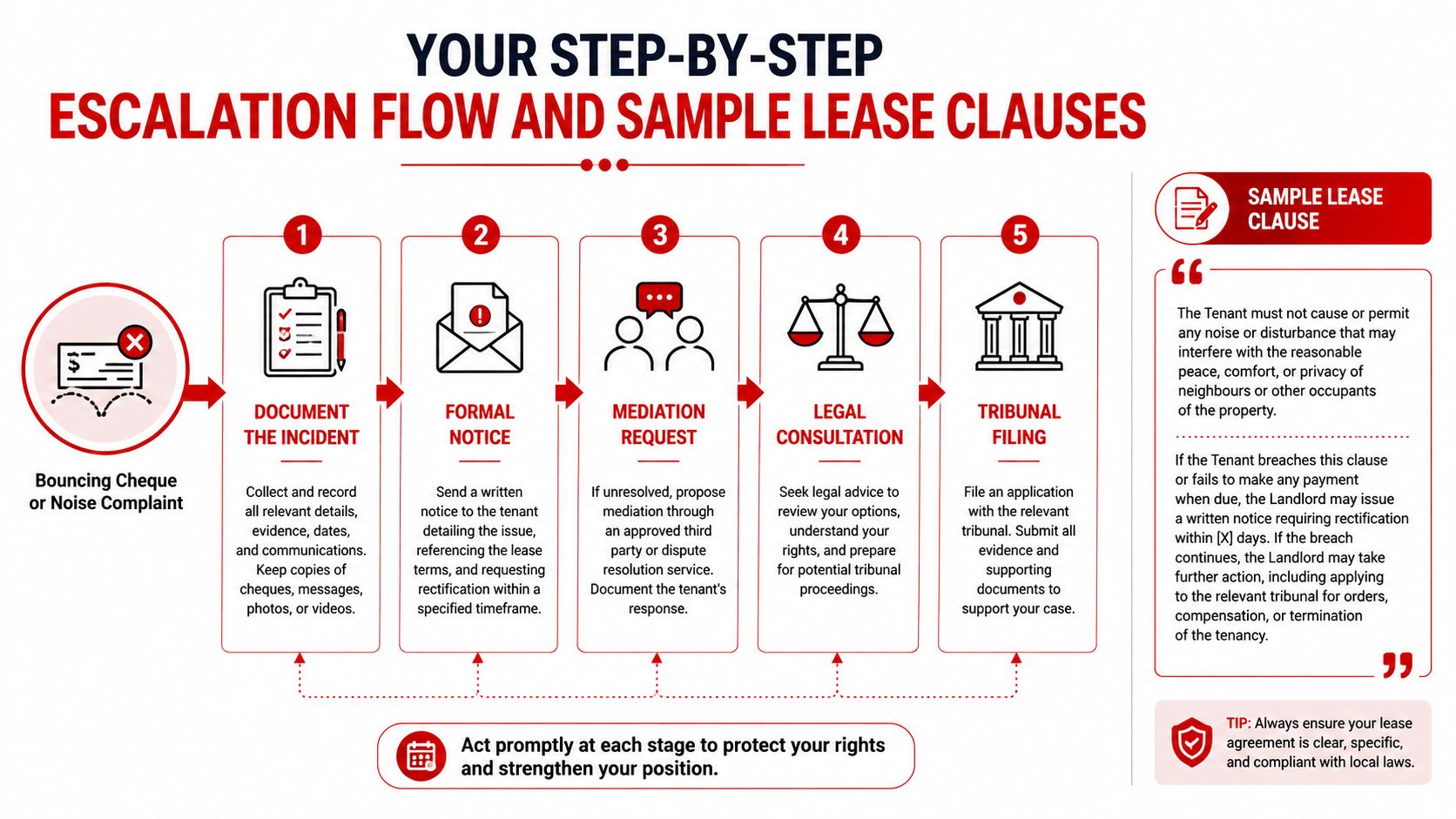
A useful escalation file starts when the first problem appears, not when a hearing date arrives. Whether the trigger is a bounced rent payment, a noise complaint, or a damaging online review, the property manager or party should preserve the original evidence and keep unrelated issues separate.
A practical escalation sequence
Document the incident. Record the date, time, people involved, exact complaint, photographs, payment history, repair requests, and any response. Save original files rather than relying only on screenshots.
Send a formal written notice. State the issue, the requested action, the relevant agreement term or statutory concern, and the response date. Use the legally required notice form where one applies. Informal wording can't replace a prescribed notice.
Attempt a structured settlement. Offer a specific repair schedule, payment plan, access arrangement, or conduct agreement. If the matter qualifies for facilitation or mediation, identify that option without suggesting that participation removes statutory rights.
File in the correct forum. Use the RTB for tenancy matters and the CRT for eligible strata or civil claims. Check the deadline before spending time on extended correspondence.
Enforce the outcome. A decision may require filing or registration through the Provincial Court or, for larger monetary orders, the Supreme Court. The RTB materials state that monetary orders over $35,000 must be filed and enforced in Supreme Court, as reflected in the BC housing decision material.pdf).
A lease can encourage cooperation, but it can't rewrite legislation. A negotiation clause might read:
“The parties will first exchange written details of a tenancy concern and make a genuine effort to resolve it before starting a formal proceeding, unless an urgent statutory remedy or deadline applies.”
A mediation referral clause could say:
“Where both parties agree that mediation may assist, they may jointly select a qualified local mediator and confirm the scope, cost allocation, and settlement terms in writing before mediation begins.”
A forum clause might state:
“The parties acknowledge that the Residential Tenancy Branch or Civil Resolution Tribunal may be the initial forum where required by British Columbia law, and this clause doesn't limit any statutory right or remedy.”
An RTB arbitrator won't enforce a clause that waives mandatory statutory protections, prevents a party from using the legally required tribunal, authorises unlawful fees, or permits self-help remedies that legislation doesn't allow. The tenant lease agreement template can support drafting, but every clause still needs to fit the actual tenancy and current BC rules.
Real Scenarios From Maple Ridge Rentals and Stratas
The mechanism becomes clearer when the facts are local. The following examples use common Maple Ridge property types and neighbourhood settings to show how a dispute can progress, without treating informal resolution as a substitute for legal advice.
Cottonwood noise and conduct dispute
A basement-suite tenant in Cottonwood receives repeated complaints about late-night parties. The property manager begins with a written warning and asks for incident dates rather than relying on general accusations. The parties attempt a facilitated meeting, but the conduct continues and the landlord proceeds through the RTB for a possession remedy.
The useful lesson is separation of evidence. The landlord's strongest material concerns dated incidents, communications, and proof that the tenant received the warnings. A court action would add cost and complexity when the tenancy-specific RTB pathway is available.
Silver Valley damage claim
A townhouse owner in Silver Valley faces a disagreement over damage after a tenancy ends. The parties can't agree on responsibility or the amount of the claim, so the matter is directed to the appropriate tenancy process rather than treated as a general civil action. An online tribunal route can reduce travel and make document organisation easier, but it still depends on condition reports, photographs, invoices, and service records.
The wrong choice would be waiting for a conventional court date before checking whether the RTB has jurisdiction.
West Maple Ridge strata enforcement
A strata council in West Maple Ridge discovers an owner using a unit for short-term accommodation contrary to the bylaws. The council documents notices, meeting decisions, and evidence of the activity before considering a CRT strata claim. If the owner instead has a complaint about the licensed strata manager, the regulatory path is different. Complaints about licensed strata managers or companies are generally expected from the strata council and must include minutes showing a motion to complain, according to the provincial guidance on resolving strata manager concerns.
An individual owner or tenant whose council won't act may request a council hearing and can requisition a general meeting with 20% of the owners. A resolution directing the council or ending the management contract requires a 3/4 vote, unless the contract says otherwise. Those figures come from the same provincial guidance.
Albion rent arrears
A small landlord in Albion has an unpaid-rent claim of $3,800. The landlord first checks whether the claim is a tenancy matter, preserves the rent ledger and notices, and uses the RTB process rather than assuming the CRT is the correct forum. If a monetary order is obtained and the tenant doesn't pay voluntarily, enforcement may require filing through the appropriate court process.
Sending the claim directly to a higher court would likely add procedural burden without improving the underlying evidence. The decision matters, but enforcement planning matters just as much.
A Local Playbook, Resources, and Next Steps
A Maple Ridge dispute file should answer five questions before anyone files: what happened, what remedy is wanted, which body has jurisdiction, what deadline applies, and how the resulting order will be enforced. That checklist is more valuable than a large folder of unlabelled screenshots.
For tenancy matters, parties may encounter forms such as RTB-1, RTB-8, and RTB-12, depending on the transaction or notice involved. The Vancouver Regional RTB office serves the Maple Ridge area, while local community and tenant organisations can help parties understand options before a formal application.
The provincial tenancy system now presents four distinct paths: direct request, facilitation, participatory hearings, and expedited hearings. Direct request is limited to specific situations, facilitation aims to settle quickly without a participatory hearing, and expedited hearings are reserved for urgent matters, as set out in the BC tenancy dispute resolution guidance.
Resources worth contacting
- Tri-Cities Community Justice Centre: A local option to investigate for lower-cost mediation support.
- Tenant Resource and Advisory Centre: Tenant coaching and information can help a renter organise facts before filing.
- BC Housing helpline: Provincial housing information can help identify the right public pathway.
- Maple Ridge Pitt Meadows Chamber of Commerce: A useful local business contact for owners and operators dealing with commercial or operational concerns.
- Property management support: A professional manager can maintain service records, organise evidence, and coordinate communications, but parties should still confirm legal deadlines and jurisdiction.
Screening and dispute prevention begin before a tenancy starts. For background on rental applicant screening regulations, owners and managers should compare the guidance with current BC privacy, human rights, and tenancy requirements rather than adopting a generic screening process.
Maple Ridge Dispute Resolution Resources at a Glance
| Resource / Body | What It Covers | Filing Fee | Typical Timeline |
|---|---|---|---|
| Residential Tenancy Branch | Tenancy notices, rent, repairs, deposits, possession, and related disputes | Check the current RTB schedule | Depends on pathway and scheduling |
| Civil Resolution Tribunal | Strata matters and eligible civil claims | Check the current CRT schedule | Online process, timing varies |
| Small Claims Court | Civil claims within its jurisdiction, including claims up to $35,000 | Check the current court schedule | More formal and variable |
| Supreme Court of British Columbia | Monetary orders above $35,000 and matters requiring superior court remedies | Check the current court schedule | Usually more complex |
| Tri-Cities Community Justice Centre | Community dispute support and mediation options | Confirm directly | Depends on service and availability |
| TRAC | Tenant information and coaching | Confirm directly | Depends on capacity |
| BC Housing helpline | General provincial housing information | No fee stated here | Depends on call volume |
Where a regulator makes a real estate discipline decision, an affected licensee may appeal to the Financial Services Tribunal within 30 days and must include the $850 appeal fee, according to the BC Financial Services Authority discipline procedures. For unresolved strata concerns, consumer guidance points people toward the regulator first, followed by legal advice or the CRT for most strata claims, as described by Consumer Protection BC's real estate complaint guidance.
Royal LePage Brookside Realty Property Management can represent owners through the RTB process by helping match the issue to the correct form, check dates, keep service records, organise evidence, and prepare for a hearing. A landlord, tenant, or property manager facing a live issue can also consider a focused dispute triage call, the Maple Ridge Tenancy Watch newsletter, or a companion escalation checklist before the matter grows.
Royal LePage Brookside Realty Property Management offers Maple Ridge owners practical support with tenancy documentation, RTB dispute preparation, and property-management decisions that affect cash flow and vacancy risk. Visit Royal LePage Brookside Realty Property Management to discuss a dispute, prepare a rental strategy, or plan a confident property move in Maple Ridge or Pitt Meadows.