A landlord in Silver Valley can leave for a weekend in Vancouver and return to a very expensive surprise: a second-floor toilet supply line has leaked for two days, damaging the suite below and part of the strata common area. The tenant needs somewhere to stay, the lower unit needs drying and repairs, and the owner suddenly has to determine which policy responds first.
That's why property management insurance coverage isn't one product. It's a layered safety net involving the building, the rental income, liability, management decisions, and the tenant's belongings. A Maple Ridge rental also carries risks that a primary residence may not, including tenant turnover, periods when the owner is away, and shared plumbing or building systems.
The local market has become less forgiving. In 2020, average BC condo insurance premiums rose about 40% across the province and 50% in the Lower Mainland, while deductibles in many cases exceeded $100,000, according to the BC condo insurance market reporting. Since July 1, 2023, BC's Insurance Council has also prohibited an insurance licensee from conducting insurance business for a strata corporation managed by an affiliated property management company under Rule 7(11.2), as explained in the BCFSA advisory on the affiliated-management rule.
For a landlord, the practical question isn't whether insurance exists. It's whether the policy matches the property, tenancy, strata obligations, and loss scenario that could occur.
Why Property Management Insurance Coverage Matters in Maple Ridge
A rental in Albion, Cottonwood, Silver Valley, or Pitt Meadows can put three insurance arrangements beside one another. The strata corporation may insure the building and common property. The landlord usually insures the unit, fixtures, liability exposure, and rental income. The tenant's policy generally covers personal belongings and temporary living costs. Trouble begins when an owner expects one policy to answer for all three.
The responsibilities work like strata bylaws assigned to the unit, building, and common areas. Each document sets its own rules. If a pipe damages a rented condo, the strata policy may address shared building components, the landlord's policy may respond to the unit and lost rent, and the tenant's policy may address belongings or relocation costs. A missing policy leaves a specific responsibility unassigned, rather than strengthening the other coverage.
BC guidance explains that strata and landlord policies do not cover a tenant's contents or temporary living expenses during remediation. Tenants are not legally required to buy insurance in BC, although landlords commonly make it a lease condition for that reason, as described in the BC government guidance on strata owner and tenant insurance.
Practical rule: Requiring tenant insurance in the lease supports the tenancy arrangement, but it does not replace the landlord's own property management insurance coverage.
The lease, strata documents, declarations page, and claim records should tell the same story about who occupies the property and who handles each loss. Owners can review what you lose without insurance and compare how full-service property management handles inspections, rent records, maintenance coordination, and insurance documentation. That preparation matters when a Maple Ridge landlord must report damage, respond to a strata deductible, or show an insurer that the rental was properly managed.
The Core Policy Types Every Rental Property Needs
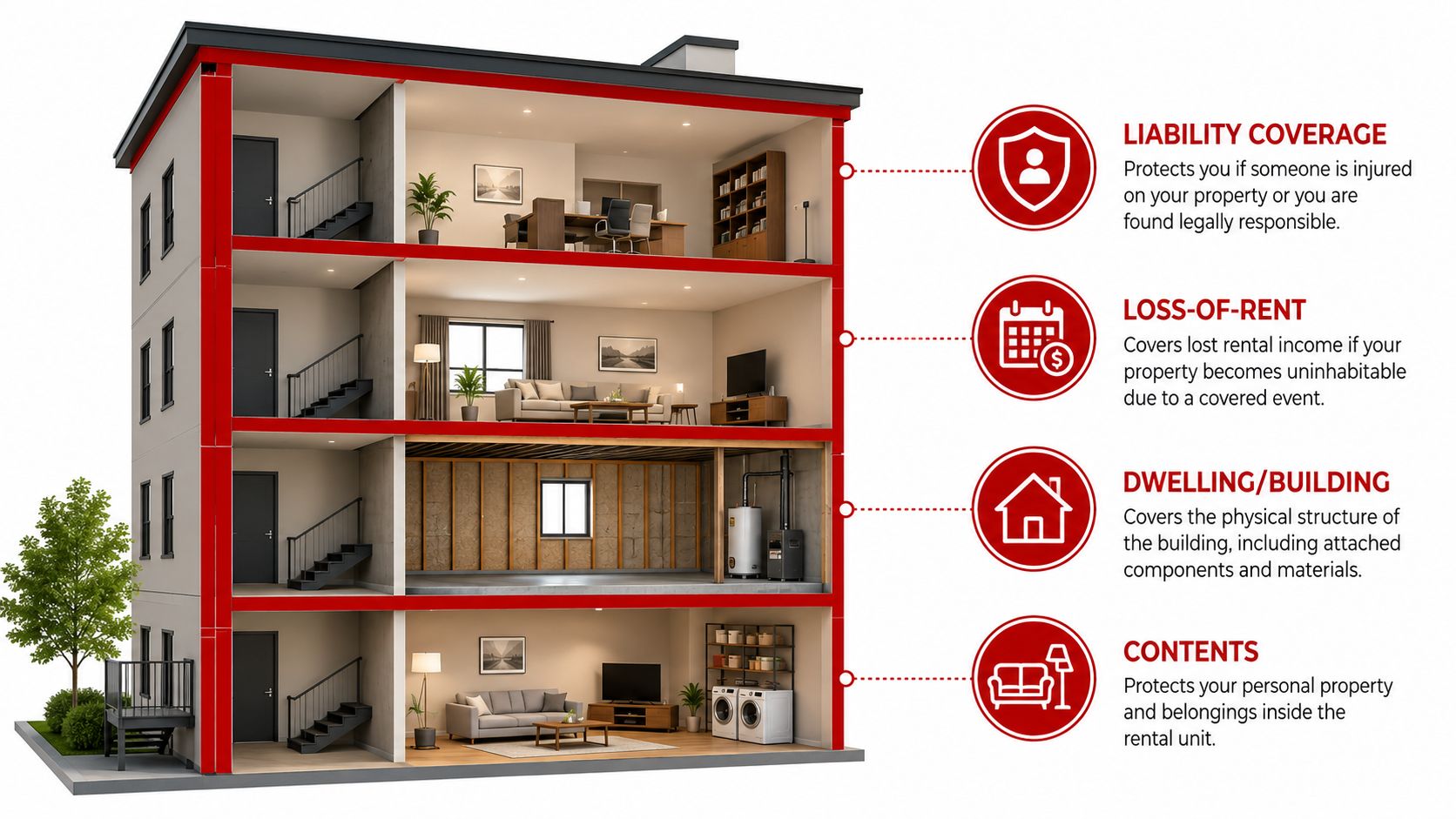
A rental portfolio works like a building with separate floors. Each policy supports a different part of the risk, and a strong foundation doesn't protect a missing upper floor.
The property and income layers
Building or property insurance covers the physical structure, fixtures, and sometimes other structures, subject to the policy wording. For an owner of a detached rental or a small multi-unit property, the declarations page should reflect how the property is occupied and maintained.
A dwelling fire policy can be relevant for an older, non-conforming home or a property that doesn't fit a standard owner-occupied form. The insurer needs accurate information about construction, heating, occupancy, and renovations before binding coverage.
Landlord or owner liability coverage addresses claims involving tenant or visitor injuries, property damage caused by the owner's negligence, and legal defence costs covered under the contract. A rental owner has regular contact with tenants, contractors, delivery workers, and visitors, so liability deserves separate attention from building protection.
Loss-of-rent coverage, sometimes described as fair rental value coverage, helps replace rental income while a covered loss leaves the property uninhabitable. That layer matters for an Albion or Cottonwood duplex where water damage can stop rent from arriving while repairs, drying, and inspections take place.
The management and financial-integrity layers
Errors and omissions coverage, or management liability coverage, responds to certain allegations that a manager made a wrongful decision or failed to perform a professional responsibility. It becomes particularly relevant where a manager handles strata fees, tenant deposits, maintenance instructions, notices, and owner reporting for properties in Pitt Meadows or Maple Ridge.
Surety bonds address financial loss arising from dishonest acts, subject to the bond's terms. They're distinct from property insurance because the concern is trust and financial handling rather than a fire, escape of water, or physical damage.
A landlord should ask whether the policy is written for an owner managing one property or for a professional manager handling multiple owners. Those are different risk profiles.
For restoration coordination after a covered event, owners should follow the insurer's notice and contractor requirements. A resource explaining how to file a claim with Restore Heroes can help clarify the type of information a restoration provider may need, although the policy and insurer remain the controlling documents. More BC-specific context appears in this guide to rental property insurance coverage.
Common Exclusions and Coverage Limits to Watch For
A Maple Ridge rental can suffer a loss that sounds covered but falls outside the policy wording. A tenant's damaged furniture, for example, usually belongs under the tenant's contents policy, not the landlord's claim. Wear and tear describes gradual deterioration, while sudden accidental damage and intentional damage may receive different treatment.
Vacancy provisions need careful review. Coverage may be restricted or changed after the property is unoccupied beyond the stated period. The same concern applies when short-term rental activity, unreported occupants, or renovation work changes the risk the insurer originally assessed. Tell the insurer what is happening before a claim, not after it.
BC hazards create separate questions. Sewer backup, overland flood, wildfire smoke damage, and earthquake may be excluded, limited, or available only through endorsements with separate deductibles. For a Maple Ridge property near drainage-sensitive areas, ask whether water entering from outside is covered. A strata owner should also ask how earthquake or major water deductibles could reach the unit owner.
Read the strata corporation's policy beside the landlord policy. BC requires strata insurance for the building and common property at full replacement value, but deductibles can be set at 10% to 20% of the building's full replacement value, rather than 10% to 20% of the claim. The province's strata insurance guidance explains this distinction. After a loss, the strata bylaws and policy wording may determine whether the owner receives a deductible chargeback.
| Exclusion or Limit | Typical Impact | Endorsement to Consider |
|---|---|---|
| Tenant belongings | The tenant may have no recovery for furniture, electronics, or clothing | Tenant contents insurance |
| Wear and tear | Gradual deterioration generally isn't treated as a sudden insured event | Maintenance plan, equipment endorsement where available |
| Extended vacancy | Coverage can be restricted if occupancy changes | Vacancy permit or vacancy endorsement |
| Intentional damage | Deliberate acts may be excluded or handled under narrow wording | Confirm tenant-damage wording |
| Sewer backup and overland water | Water origin determines whether the claim falls within coverage | Sewer backup and overland water endorsements |
| Earthquake and wildfire-related losses | Separate hazards may carry exclusions, limits, or deductibles | Earthquake, wildfire, or smoke-related endorsements |
Ask about sub-limits for landscaping, debris removal, code upgrades, and by-law requirements. Also confirm how the policy handles delayed repairs, required inspections, and documentation after a loss. The BC Residential Tenancy Act explained can help clarify the tenancy obligations that sit beside the insurance contract. Keep the policy, strata documents, lease, inspection reports, and receipts together so the file is ready when the insurer asks for proof.
How the Layers Work Together in a Maple Ridge Rental
A kitchen fire starts in one unit of a Maple Ridge duplex and damages the adjoining unit. Smoke affects both interiors, firefighters open parts of the building, and the occupants can't safely return while repairs proceed.
The first file concerns the strata corporation's master policy, assuming the property is within a strata arrangement. That policy generally addresses the building and common property, including covered damage to the structure and shared areas. If the loss crosses unit boundaries, the strata corporation's deductible becomes a central question. The owner may face a chargeback depending on the strata bylaws, the cause of the loss, and the applicable policy wording.
The second file is the landlord's. The owner's dwelling or unit policy may respond to covered interior finishes, appliances, fixtures, and owner-owned contents that fall outside the master policy. The landlord's loss-of-rent coverage can address the rental income lost while the units are uninhabitable, subject to the policy limit, qualifying event, and coverage period.
The third file belongs to each tenant. A tenant's contents policy can address personal belongings damaged by smoke or fire and may provide temporary living expenses if the tenant's home cannot be occupied. Without that policy, the tenant may have to absorb those costs personally, while the landlord still needs to manage the vacant, damaged unit.
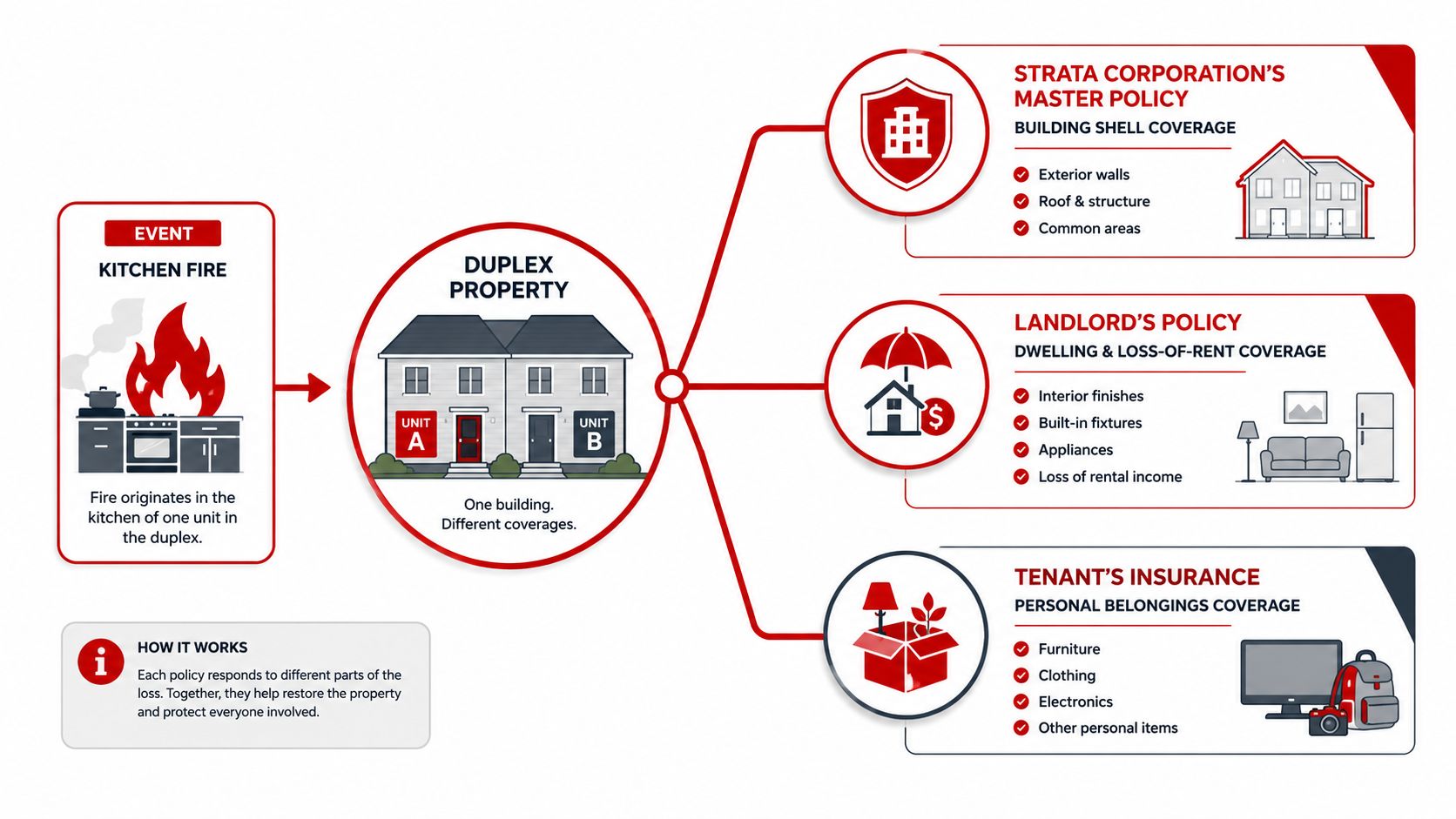
The policies don't duplicate one another. They divide the loss according to ownership, responsibility, and wording. A landlord without loss-of-rent protection may have a repairable property but no rental income during the interruption. A tenant without contents insurance may have a temporary place to sleep but no policy paying to replace damaged belongings.
Landlords managing shared buildings can review the responsibilities involved in strata property management before an incident forces those responsibilities into separate claim files.
The following video provides a visual introduction to the way property insurance coverage can be separated after a loss.
What Drives the Cost of Property Management Insurance
A Maple Ridge landlord can insure two similar duplexes on the same street and receive different quotes. Insurers review more than floor area and neighbourhood. Building age, construction, heating equipment, claims history, occupancy, and the deductible selected all shape the risk assessment.
The hard market that began in 2020 showed how quickly pricing and deductibles could change. BC owners faced sharply higher premiums and, in some cases, deductibles above $100,000, as noted earlier in the reported condo insurance findings. A lower annual premium can therefore leave an owner responsible for a much larger payment after a strata chargeback or property loss.
Quotes may also reflect higher reinsurance costs and updated replacement values. If an insurer reassesses the amount required to rebuild a Maple Ridge rental, the insured value can rise even when the property's market value has not changed. That figure affects both the premium and the amount available for a covered repair.
| Factor | Effect on Premium | Why It Matters in Maple Ridge |
|---|---|---|
| Building age | Older systems can raise underwriting concern | Plumbing, wiring, roofing, and heating may need stronger documentation |
| Construction type | Wood-frame and non-standard construction can affect pricing | Local rental properties vary in age and construction details |
| Claims history | Previous losses can influence eligibility and price | Repeated water claims may bring stricter terms or exclusions |
| Flood exposure | Water risk can affect endorsements and deductibles | Ask about nearby flood-prone areas and the Alouette River |
| Wood stoves or solid-fuel heating | Fire-related questions may apply | Installation, inspection, and maintenance records matter |
| Short-term rental use | Different occupancy may require different underwriting | A long-term rental policy may not fit nightly or frequent stays |
| Deductible choice | A higher deductible may reduce the premium while increasing owner exposure | Include strata chargebacks and available reserves in the decision |
The July 2023 affiliated-management rule can also affect how an owner describes the arrangement. If the owner manages an affiliated property or handles management work for others, the broker should know. Ordinary landlord liability may not address every management responsibility, and a claim can turn on the exact role recorded in the application.
Describe the property, occupants, heating, and management relationship accurately. Choosing the cheapest form and leaving out a material detail can create coverage problems when a claim is filed. General guidance on home insurance costs in BC provides context, but a Maple Ridge rental still needs property-specific underwriting.
Choosing the Right Policy and Reducing Claim Risk
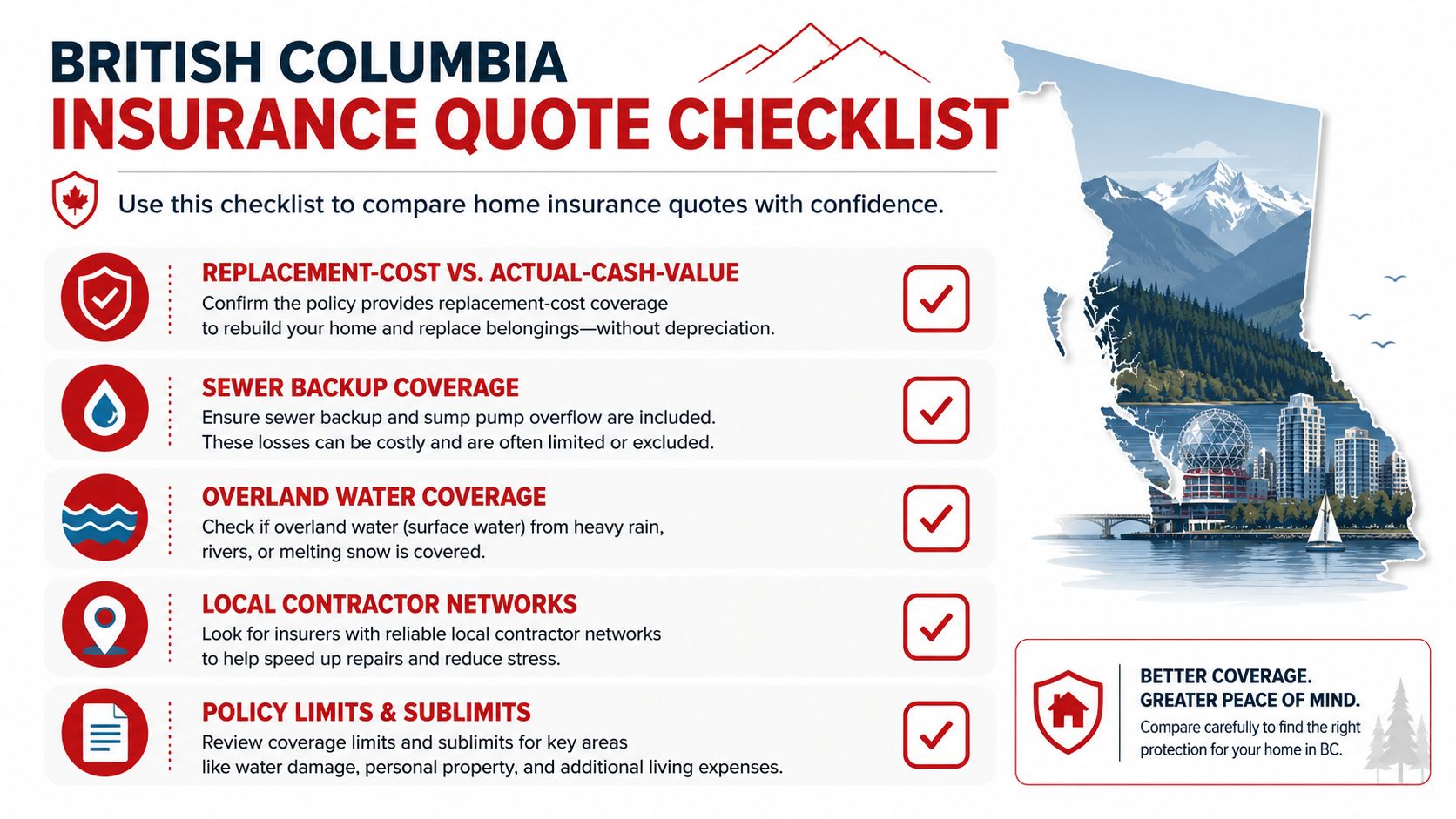
A quote comparison should begin with the settlement basis, not the premium. Replacement-cost coverage aims to address the cost of repairing or replacing insured property under the contract, while actual-cash-value coverage accounts for depreciation. The declarations page may look similar at a glance, so the owner should ask the broker to identify the difference in writing.
The following checklist keeps the conversation focused:
- Confirm the property use: State whether the home is a long-term rental, partly owner-occupied, vacant, or used for short-term accommodation.
- Check water endorsements: Ask specifically about sewer backup, overland water, and the deductible that applies to each.
- Review strata exposure: Obtain the strata corporation's current policy summary, identify the relevant deductible, and confirm whether the unit owner's policy responds to a chargeback.
- Test the income protection: Ask how loss-of-rent coverage is calculated, what triggers it, and how long it can continue during a covered repair.
- Verify the settlement basis: Request confirmation of replacement cost, actual cash value, code-upgrade coverage, debris removal, and applicable sub-limits.
- Match liability to the role: An owner managing other properties should ask about management liability or errors and omissions coverage rather than assuming ordinary landlord liability is enough.
Claim documentation matters just as much as the selected endorsements. An unsigned tenancy agreement, incomplete rent roll, unreported occupant, or missing annual inspection record can make the insurer question the facts surrounding a loss.
Before binding coverage: The owner should have the policy wording, endorsements, strata documents, tenancy agreement, rent records, inspection reports, and property photographs organised in one accessible file.
A broker or manager can also use an instant property risk assessment as one source of property information, but any data record should be checked against the actual home. A checklist can identify missing documents before renewal, not after a claim denial.
Filing Claims and Planning Your Next Steps Locally
After water, fire, or liability damage, the first priority is safety and mitigation. Once people and pets are safe, the landlord should create a clear record before damaged materials are removed.
The first claim file
Timestamped photographs and videos should show the source area, affected rooms, visible contents, flooring, walls, ceilings, and any steps taken to prevent further damage. The insurer should be notified within the timeframe stated in the policy, and the owner should keep confirmation of the notice.
Strata and personal claims should be separated into distinct files. The strata manager can address the master policy and common-property process, while the landlord's insurer handles the owner's unit, rental income, and liability issues under its own contract. Combining everything into one informal email chain makes responsibility harder to track.
Tenant cooperation needs to be handled carefully. The tenant may need to provide access, a contents inventory, photographs, and details of temporary accommodation, while the landlord should avoid promising that another party's insurer will pay.
During adjustment and dispute
A written log should record every adjuster conversation, inspection date, instruction, invoice, and unanswered question. Receipts for emergency drying, board-up work, hotel accommodation, alternate housing, cleaning, and repairs should be retained, but the owner should confirm which work the insurer authorises before committing to non-emergency costs.
Canada's claim environment reinforces the importance of reading the wording. Verisk's Q4 2025 Canadian Property Report states that Canada ended 2025 9.9% below 2024 claims volume and 10.2% below the five-year average, while catastrophic claims still represented 16% of annual volume (Verisk's Canadian Property Report). Canadian Underwriter's summary of CCIR data reported 104,301 P&C claims rejected in 2024 because of exclusions and 84,339 denied because the claims weren't covered, making exclusions and proof requirements practical concerns rather than fine print.
If a denial appears unreasonable, the owner can use the insurer's internal complaint process and consider an Insurance Bureau of Canada complaint route. Independent legal advice from a local solicitor may make sense where the dispute involves a major strata deductible, liability allegation, coverage interpretation, or a contested responsibility between the corporation, landlord, tenant, and insurer.
Every claim should lead to an annual review. Maple Ridge and Pitt Meadows owners should confirm vacancy provisions, occupancy details, water and earthquake endorsements, loss-of-rent protection, strata deductible exposure, and inspection records before the next renewal. A local property manager can also help keep tenancy files, maintenance records, owner reports, and claim communications organised.
Royal LePage Brookside Realty Property Management offers property management services for owners in Maple Ridge and Pitt Meadows, including practical coordination around tenancy records, maintenance, strata responsibilities, and insurance documentation. Owners considering a rental purchase, a sale, or professional management can visit Royal LePage Brookside Realty Property Management to discuss the property and its next steps.