
The Sunday-night browser tabs are open, the saved listings all look promising, and every one of them seems to have a different problem. One condo has weak rent potential, one townhouse needs too much cash up front, and the detached house that looks perfect on paper probably won't work once taxes, insurance, and vacancy are added. That's where how to buy investment property becomes less about chasing listings and more about choosing a deal that survives the numbers in Maple Ridge or Pitt Meadows.
In this market, the smartest buyers don't start with the prettiest home. They start with a clear target, a conservative budget, and a neighbourhood-by-neighbourhood read on where rental demand still supports a purchase. That approach matters in British Columbia because investor ownership is already part of the mainstream market, not a fringe strategy, and province-specific patterns can change how competition shows up in a given area. Statistics Canada reported that in 2020, 21.9% of owners across British Columbia, Manitoba, Ontario, New Brunswick, and Nova Scotia combined were investors, and condominium apartments were used as investments more often than houses in those provinces (Statistics Canada).
Setting Your Investment Goals and Financial Foundation
A lot of buyers start by refreshing listings before they've answered the two questions that matter most, what job should the property do, and how much risk can the household carry. If the goal is monthly income, the property choice looks very different than if the goal is long-term appreciation with a lighter monthly lift. In Maple Ridge, that difference can mean comparing a compact condo near Haney Place with a detached home in Albion that may need more capital and patience.
Define the job before defining the property
The cleanest way to start is to separate cash flow, equity growth, and hands-on effort. A buyer with limited reserves usually needs a property that can absorb a vacancy or repair without derailing the household budget. A buyer who can tolerate more complexity may look at a small multi-unit or a suite property, especially if the numbers still work after expenses.
Practical rule: if a property only works when everything goes right, it doesn't really work.
That means listing the actual capital available, not the hoped-for number after a refinance or sale. It also means being honest about management style. Some owners want to self-manage, answer tenant calls, and coordinate repairs. Others would rather pay for management and protect their time.
A useful outside reference for buyers comparing financing structures is UK buy-to-let mortgage advice, because it reinforces the same basic discipline, secure the right financing first and treat the purchase like a business decision. For local buyers, the other half of the equation is closing cost planning. A separate guide on closing costs when buying a home in BC helps keep the early budget from being unrealistically thin.
Match the timeline to the asset
A shorter hold period usually favours simplicity. A condo can be easier to finance and manage, but it may come with strata rules and fees that tighten returns. A detached home can offer more control and potential upside, but repairs and carrying costs can quickly outgrow a new investor's comfort zone.
A longer horizon gives more room for appreciation and mortgage paydown, but only if the property can carry itself along the way. That's why the right first purchase is rarely the one with the most curb appeal. It's the one that fits the investor's cash position, tolerance for vacancy, and plan for the next five years, not just the next five minutes.

Understanding Investment Property Financing in British Columbia
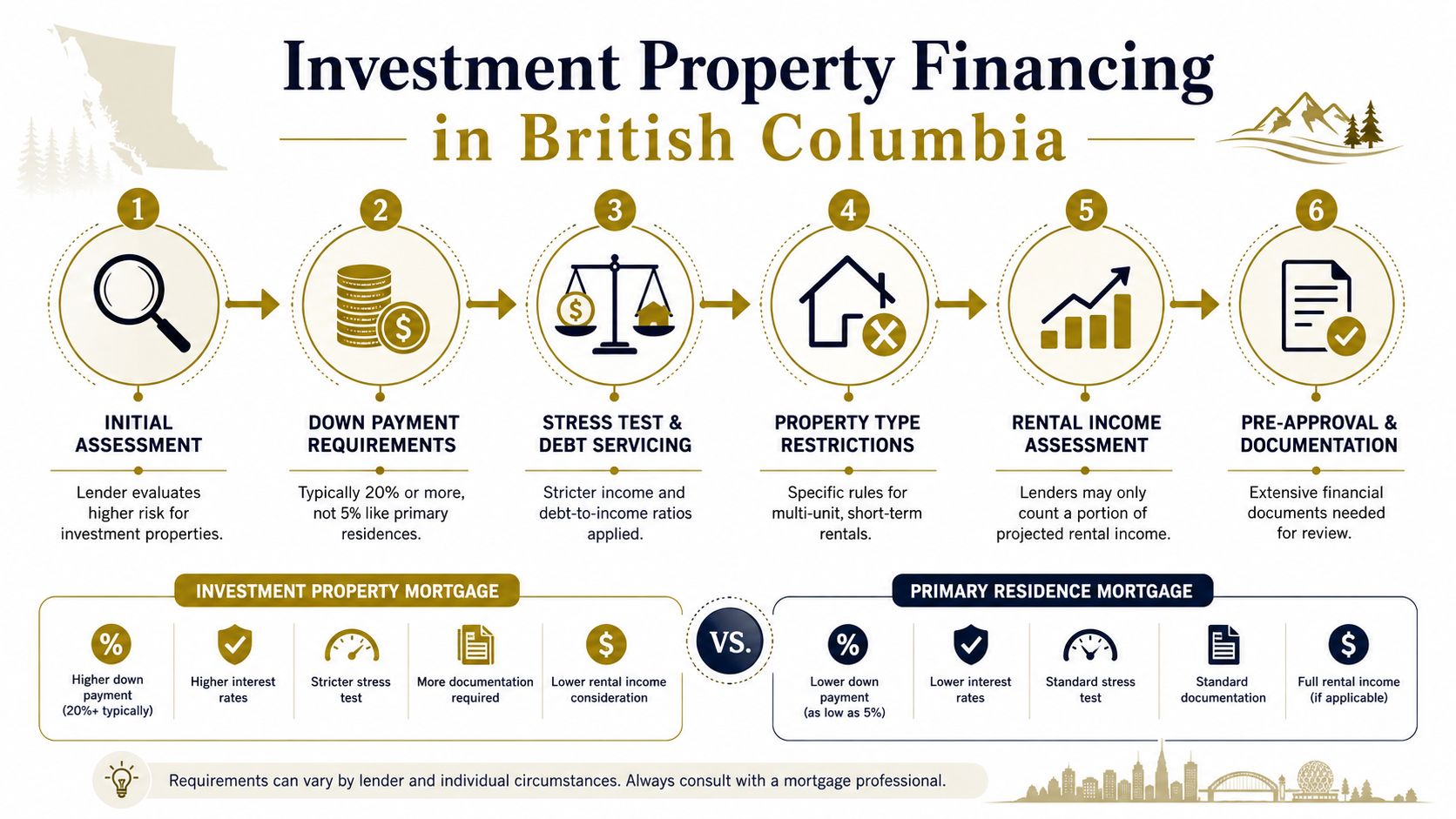
Financing a rental property is not the same as financing a home to live in. Lenders treat investment properties as higher risk, and buyers need to plan for that reality before they start offering on listings. In British Columbia, the standard minimum down payment for a 1-unit rental property is 20%, and for 2- to 4-unit rentals it is 15% of the purchase price, as noted in the provided CMHC-based guidance (U.S. Bank financial planning overview).
Why pre-approval comes before the search
Pre-approval is not a paperwork exercise. In the Fraser Valley market, subject-removal windows can be tight, and a buyer who waits to arrange financing until after an offer is accepted is exposing the deal to unnecessary risk. A strong pre-approval also tells the buyer whether the target property type is realistic, or whether the budget needs to shift.
Lenders care less about what a property could be worth someday and more about whether the file works today.
That's why rental property underwriting usually asks for more documentation than an owner-occupied purchase. Buyers should expect scrutiny around income, debts, reserves, and the property's own carrying costs. The lender wants to know whether rent, taxes, insurance, and debt service can coexist without stress.
How different property types affect the file
A one-bedroom condo in Cottonwood usually presents a cleaner underwriting story than a basement-suite property in West Maple Ridge, but that doesn't automatically make it the better investment. A condo may have simpler maintenance, while a suite property can produce more flexibility if the layout and location support it. The financing conversation should happen before the excitement conversation.
For a clear explainer on lender language and process, what mortgage pre-approval means is a useful companion read. Buyers who want to stretch into a rental purchase often also look at home equity, but that move only works when the household keeps enough buffer after the new debt is added.
The key discipline is simple. Get the financing framework first, then shop inside it. Buyers who reverse that order tend to waste time on properties that never had a viable approval path.
Evaluating Maple Ridge and Pitt Meadows Neighbourhoods
The best returns in Maple Ridge and Pitt Meadows are usually hiding in the details, not the city name. Two homes can sit only a few blocks apart and produce very different outcomes because of school catchments, transit access, rental stock, and the type of tenant each pocket attracts. That's why a micro-market lens beats a broad “buy where prices are rising” approach.
Compare by tenant fit, not just by address
Albion tends to attract buyers who want newer housing forms and family-oriented demand, while Silver Valley draws interest from people who value proximity to trails, newer builds, and a different pace of living. Kanaka Creek often appeals to buyers who like the outdoor setting and a more residential feel, and Cottonwood can offer a mix of convenience and renter familiarity near established shopping and schools. Pitt Meadows pockets near the West Coast Express can command strong attention because commuting access is a real draw, but that same convenience can also create more investor competition.
| Maple Ridge Neighbourhood Investment Comparison | Avg. Home Price Range | Typical Monthly Rent | Tenant Demand | Investment Profile |
|---|---|---|---|---|
| Albion | Varies by property type | Varies by unit type | Steady family interest | Better for buyers who want newer neighbourhood feel and balanced demand |
| Silver Valley | Varies by property type | Varies by unit type | Moderate to strong | Often suits buyers who value outdoor access and newer housing stock |
| Kanaka Creek | Varies by property type | Varies by unit type | Consistent local demand | Can appeal to renters who want quieter streets and a residential setting |
| Cottonwood | Varies by property type | Varies by unit type | Strong convenience-driven demand | Useful for buyers who want everyday amenities close by |
| Pitt Meadows near transit | Varies by property type | Varies by unit type | High commuter appeal | Can support stronger rent interest, but deal quality matters more because competition is sharper |
The table shouldn't be read as a shortcut. It's a starting point for comparing where rent-to-price balance still looks reasonable and where the buyer may be overpaying for a lifestyle label. A property near transit can be attractive, but if the rent doesn't support the purchase price, the convenience doesn't save the deal.
For broader local context, the brokerage resource on real estate in Maple Ridge and Pitt Meadows helps buyers anchor their search in actual neighbourhood differences. A key advantage comes from looking block by block. Infrastructure changes, school catchments, and nearby employment access can create pricing gaps that aren't fully reflected yet in list prices, which is exactly where careful investors find opportunities.
Running the Numbers on Potential Properties
A clean-looking listing can still be a poor asset if the monthly math collapses after real expenses are added. That's why the underwriting process needs to go beyond mortgage payment estimates and include every recurring cost that will hit the property after closing.
Build the pro forma before the offer
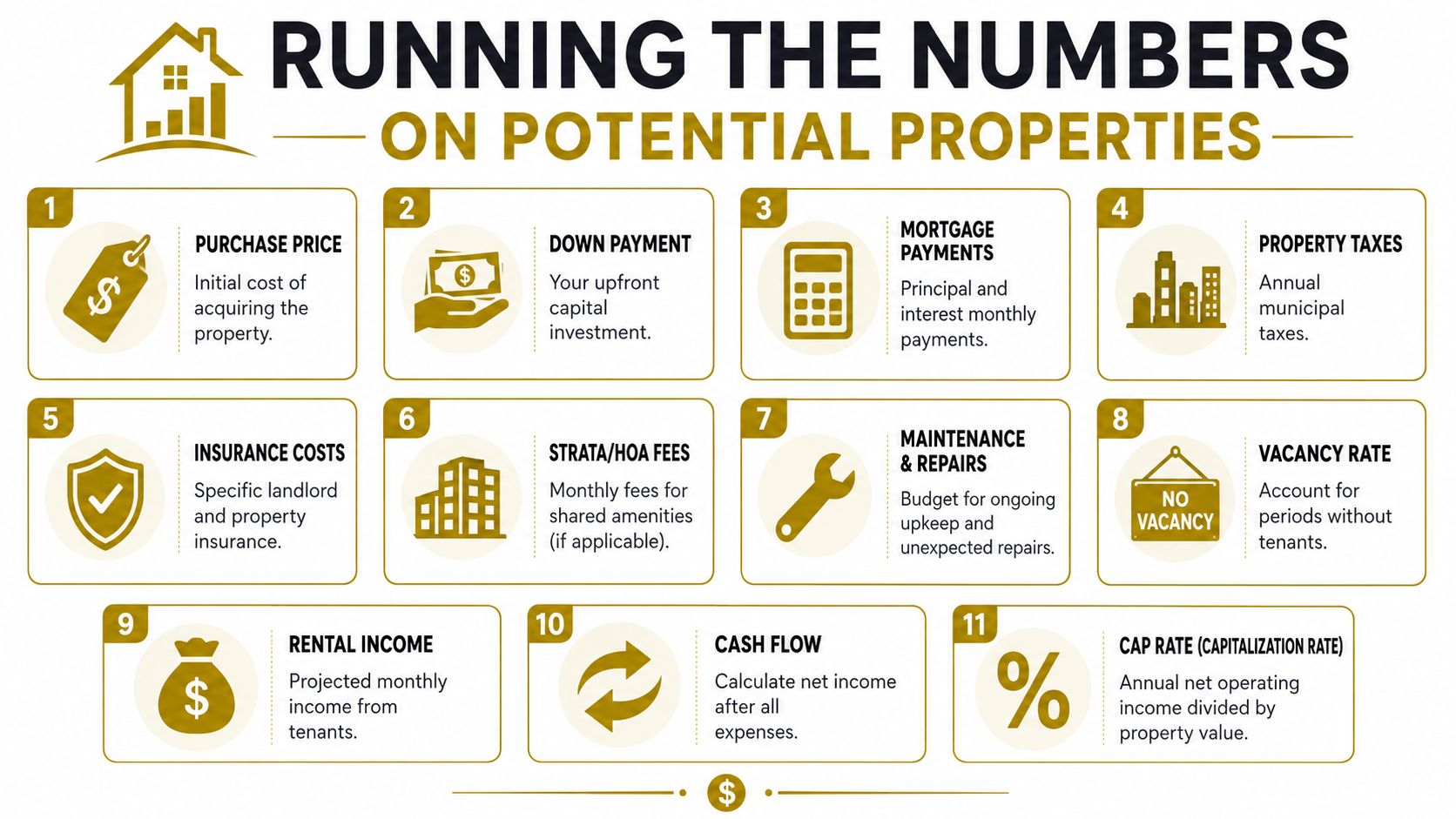
The first pass should include purchase price, down payment, mortgage payment, property taxes, insurance, strata fees if applicable, maintenance, and vacancy allowance. From there, the buyer can estimate whether the property is likely to produce positive cash flow after debt service. If the deal only works on the assumption that nothing breaks and the tenant stays forever, the file is too fragile.
Practical rule: if the vacancy line was ignored, the deal wasn't really analysed.
The useful habit is to compare the projected rent with the total acquisition cost, not just with the mortgage. That view is especially important in Metro Vancouver and the Fraser Valley, where a property can look “affordable” in isolation and still fail the investment test once ownership costs are included.
For a plain-language definition of the metric, Pie Assets' cap rate guide is a helpful reference point for buyers who want to understand why cap rate matters but doesn't tell the whole story. Cash flow is different from cap rate because mortgage payments sit in the equation, and buyers need both numbers before making a move.
Use a conservative buffer
Many new investors overestimate rent and underestimate repairs. A better approach is to assume the rent might not be as strong as the listing agent suggested, then pressure-test the deal against a turnover, a repair, or a slower-than-expected lease-up. That's also where a tool like the brokerage's rental property ROI calculator can help organise the numbers before an offer is written.
The short version is blunt. A property that only works with optimistic appreciation is risky, while a property that can carry itself on modest rent is much easier to live with. In this market, durable monthly income matters more than a hopeful exit story.
This investor video on property analysis can also help buyers recognise where the major cost buckets usually hide, especially if they're comparing their first few rental candidates.
Conducting Thorough Due Diligence Before You Commit
A strong offer can still become a weak purchase if the buyer rushes the subject period. Hidden issues surface here, and it's how disciplined investors protect themselves from expensive surprises. A property that looks tidy during a showing may still have inspection issues, rental rule problems, or document concerns that change the whole decision.
What gets checked, and why it matters
The inspection is the obvious piece, but it shouldn't be the only one. Buyers also need title review, zoning confirmation, strata documents if applicable, and a close look at any existing leases or operating costs. Environmental concerns, insurance availability, and legal review matter because they can affect whether the property is usable as an investment.
A common mistake is assuming tenant-occupied means income-ready. In reality, the buyer still needs to confirm lease terms, who pays what utilities, and whether the rent level supports the underwriting assumptions. In British Columbia, tenancy rights and obligations matter from day one, so the paperwork has to line up with the purchase strategy.
A property can be structurally fine and still be a bad investment if the legal or strata documents limit how it can be used.
The strongest buyers also ask what's coming next. A special levy, a renovation plan, or a maintenance backlog can change the return profile fast. That's especially true in strata settings where the monthly fee may look manageable until the documents reveal upcoming pressure.
A simple red-flag pattern
A deal deserves extra caution when more than one warning sign appears at once. A tired roof, weak rental history, and ambiguous strata rules are not separate problems, they're a cluster. In those cases, walking away is often better than trying to “save” the purchase with a small price reduction.
For a broader point of comparison, inspecting your London rental shows how another market treats inspection discipline as a core investment habit, not an afterthought. The principle is the same in Maple Ridge. If the buyer wouldn't be comfortable owning the problem for years, it's not worth taking on because the photos looked good.

Negotiating the Deal and Planning for Long-Term Management
A good negotiation in Maple Ridge or Pitt Meadows doesn't start with asking for the moon. It starts with understanding what the seller needs, where the property is overpriced, and which terms matter more than the sticker price. An experienced buyer uses that information to protect the upside while keeping the offer credible.
Negotiate the right things
Price matters, but so do subject clauses, completion timing, and repair credits. In some cases, a seller will move more on possession flexibility or closing conditions than on list price. That can be just as valuable for an investor who is trying to line up financing, tenancy, or renovation work after closing.
The post-offer phase should include a management plan, not just a key handoff. If the property will be self-managed, the buyer needs a system for rent collection, screening, and maintenance calls. If the property will be handed to a manager, the handoff needs to happen before the first tenant issue appears.
One option for buyers who want that back-end support is Royal LePage Brookside Realty Property Management, which handles tenant placement, rent collection, routine inspections, maintenance coordination, and owner reporting. That kind of service is most useful when the owner wants the property treated as a business instead of a weekend project.
Keep the operations simple
A practical management checklist looks like this:
- Screen carefully: confirm income, references, and tenancy history before approving anyone.
- Set rent deliberately: price it against comparable local stock, not just against the mortgage payment.
- Respond fast: maintenance delays usually become tenant-retention problems.
- Use reliable trades: contractors who already understand local rental timelines save time and hassle.
Self-management can work for a buyer with time, proximity, and patience. Professional management makes more sense when the investor values distance from the day-to-day or wants cleaner systems from the start. A stable rental property isn't just purchased well, it's run well after closing.
For buyers who want a practical operational checklist, the local page on Maple Ridge property management is a useful companion to the purchase process.
If you're weighing a rental purchase in Maple Ridge or Pitt Meadows, Royal LePage Brookside Realty Property Management can help with tenant placement, rent collection, routine inspections, and maintenance coordination so the property runs like an investment, not a headache. Visit Royal LePage Brookside Realty Property Management to take the next step with local support that fits this market.