
A buyer searching for Maple Ridge waterfront property for sale often starts with a simple wish: a quiet morning beside the Fraser River, a private dock, or a home where the Alouette becomes part of the view. After several late-night listing searches, the situation usually becomes clear. There are far fewer genuine waterfront options than ordinary detached homes, and the attractive ones can appear to resist the broader market's softer pricing.
That scarcity can be misleading. Waterfront ownership in Maple Ridge isn't just a matter of paying extra for a view. Floodplain status, restrictive covenants, flood construction levels, riparian permits, slope stability, insurance, and lender requirements can determine whether a property is practical to renovate, finance, insure, or resell. The right question isn't only whether the home touches the water. It's what the title, land, and regulations allow the owner to do.
Why Waterfront in Maple Ridge Feels Different Right Now
A buyer scrolling listings from Hammond, Whonnock, Silver Valley, and the Fraser River corridor may see only a small selection of homes that offer direct water frontage. Some listings advertise a river view from a high lot. Others sit near a creek, drainage channel, or public shoreline without offering private access. The distinction matters because waterfront title, riparian frontage, water access, and water views are different forms of value.
Maple Ridge's broader market gives useful context. Greater Vancouver Realtors data placed the city's benchmark home price at about $907,600 in May 2026, down 7.7% year over year, while a July 2026 report placed the benchmark at $897,000, down 7% from July 2025 and 10.8% from three years earlier. The same market material reported 139 sales and 364 new listings in Maple Ridge and Pitt Meadows in May 2026, producing a 38.2% sales-to-new-listings ratio, below the level generally associated with supply keeping pace with demand. These figures are reported in the Maple Ridge market update.
That broader softness doesn't automatically make waterfront cheap. A compliant riverfront home with usable shoreline, privacy, and clear access can still attract serious competition because the supply can't easily expand. However, a floodplain-flagged property, a steep-bank home with difficult access, or a listing with unclear dock rights may take longer to sell than a comparable dry-land house.
Practical rule: Waterfront scarcity protects the lifestyle feature, not every asking price.
The market has created a more selective buyer. Some purchasers will still move quickly when the title, flood documentation, and insurance are clean. Others will use unresolved covenants, incomplete engineering, or uncertain shoreline rights to negotiate firmly. Sellers who price only from the view often discover that buyers and lenders value the legal and physical condition of the waterfront just as heavily.
The Maple Ridge Market Setting Waterfront Pricing
Waterfront pricing needs a baseline, and the citywide baseline is moving. The May 2026 benchmark of about $907,600 and the July 2026 benchmark of $897,000 show that Maple Ridge buyers aren't operating in a rising-price environment across the board. The July figure was reported as 7% below July 2025 and 10.8% below three years earlier in the same market source, so a seller's historical purchase price doesn't establish today's value. See the broader Maple Ridge real estate market context before comparing a waterfront listing with citywide sales.
The sales-to-new-listings ratio adds another layer. Maple Ridge and Pitt Meadows recorded 139 sales against 364 new listings in May 2026, a 38.2% ratio. June 2026 market reporting showed ratios around 38.2% to 41.3%, with active inventory around 870 to 898 listings and approximately 7.0 months of inventory. The composite benchmark was near $907,600, while the detached benchmark was near $1.205 million, according to the June 2026 Maple Ridge market infographic.
For waterfront, those numbers don't create a formula. They establish negotiating conditions. A rare, well-documented property can outperform the citywide trend, while a home with floodplain complications can underperform it even if the view is excellent. A premium must be supported by usable land, access, condition, privacy, and clean documentation.
IndicatorCurrent ReadingWaterfront ImplicationCity benchmarkAbout $907,600 in May 2026 and $897,000 in July 2026Establishes the broader residential reference point, not a waterfront valuationDetached benchmarkNear $1.205 million in June 2026Provides a more relevant starting point for detached riverfront and lakefront homesSales-to-new-listings ratio38.2% in May 2026Supply was outpacing demand, creating room for careful negotiationJune months of inventoryNear 7.0Buyers can take more time with due diligence, although rare compliant homes may still move quicklyJuly median home price$949,000Shows that median and benchmark measures can differ across the marketJuly days on marketAround 21 daysA citywide reference only, because regulatory complexity can lengthen waterfront marketing periods
Mortgage qualification also matters. Waterfront homes often sit above the detached baseline, so a change in lending conditions, household income, or debt servicing can affect the buyer pool more sharply. The prudent approach is to price the property from recent comparable waterfront sales, documented rights, and effective ownership costs, not from the listing's premium language.
Where Waterfront Homes Actually Sit in Maple Ridge
Genuine waterfront in Maple Ridge appears in several distinct settings, and each one attracts a different buyer.
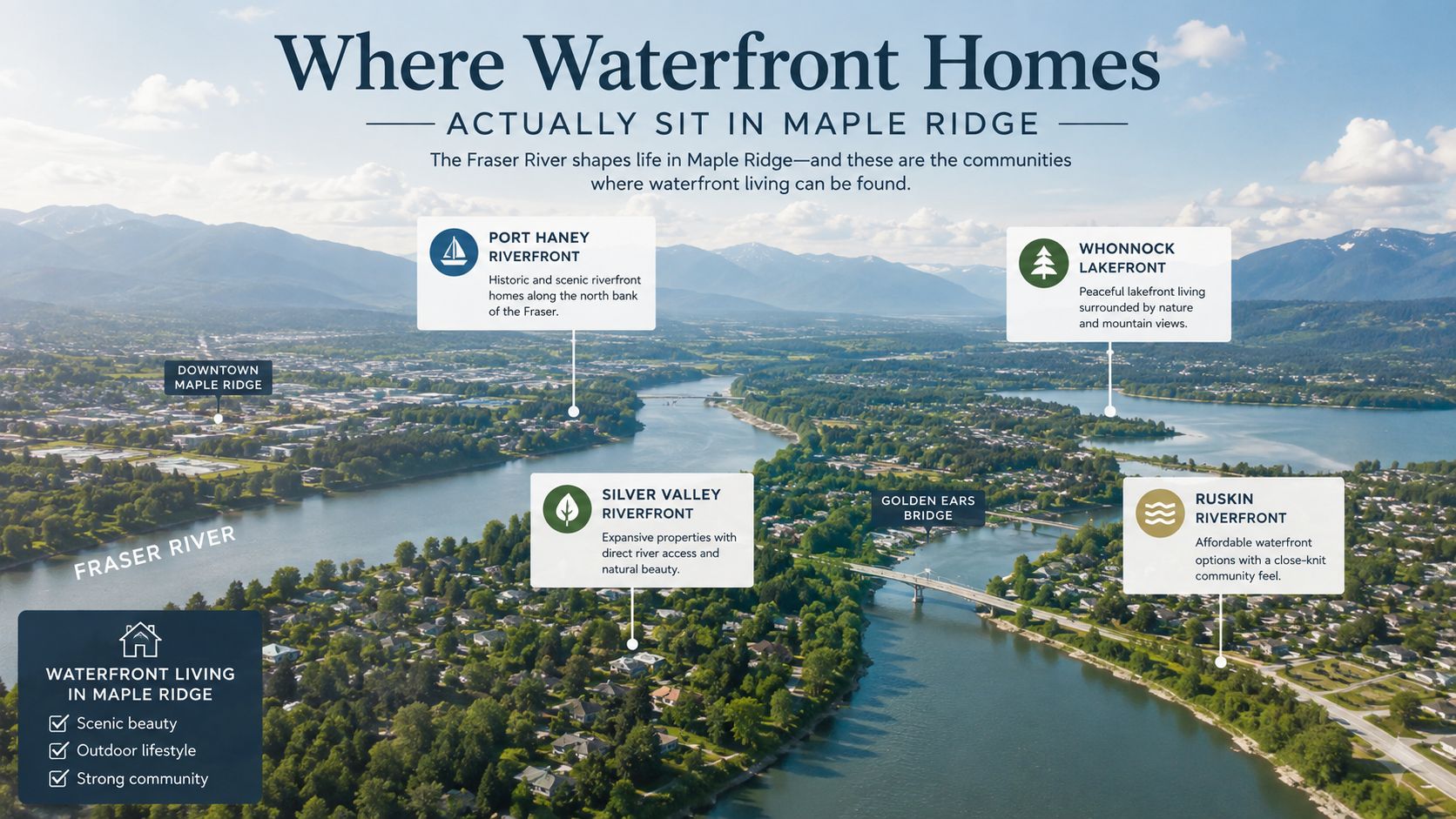
Fraser and Pitt River corridors
The Fraser River and Pitt River corridors include low-lying parcels, older homes, industrial influences, and raised properties with broad water views. Flat floodplain lots may offer easier outdoor use, but they can bring more demanding elevation, covenant, and flood documentation. Bluff and escarpment homes may avoid some lowland conditions while introducing slope, stair, geotechnical, and access questions.
These locations suit buyers who value open river views, boating potential, and proximity to established services. Commute patterns depend heavily on Lougheed Highway, access toward Pitt Meadows, and the Golden Ears Bridge. School catchments must be checked by address rather than assumed from the neighbourhood name.
Hammond and central riverfront strips
Older riverfront areas near Hammond and downtown Maple Ridge can offer mature landscaping and a more established community setting. Lot sizes, building ages, shoreline conditions, and access arrangements vary sharply from property to property. The Hammond Maple Ridge homes guide can help orient a buyer, but a waterfront title search remains essential.
Whonnock and the Alouette area
Whonnock and the Alouette River area appeal to buyers seeking privacy, trees, and a more rural rhythm. Some parcels are flat or gently sloped, while others require careful review of access, drainage, setbacks, and riparian conditions. These homes can trade below the most polished riverfront offerings when the road, house, shoreline, or commute is less convenient, even though the lifestyle value remains strong.
Pitt Lake and northern pockets
Pitt Lake and northern shore locations are defined by remoteness, access logistics, and the practical question of how the water is reached and used. A buyer looking for a primary residence will assess travel time, services, school access, and year-round practicality differently from a recreational purchaser. Dock potential is never enough on its own. Ownership, tenure, permitting, and maintenance responsibilities must be documented.
Silver Valley and lakefront segments
Silver Valley and nearby lakefront pockets offer a different setting, with forested slopes, newer development patterns, and access to parks and trails. A lake view or water-adjacent lot may command a premium, but a protected cove with usable shoreline can be more valuable than a steep parcel with only visual access. For sellers, professional presentation matters because waterfront light changes dramatically through the day. Resources on twilight photography real estate explain why evening imagery can show a property's setting more accurately than a standard midday photograph.
Zoning overlays, environmental development permits, floodplain rules, and accessory-use restrictions can affect every one of these pockets. The neighbourhood sets the lifestyle expectation. The title and municipal file establish the actual property rights.
Floodplain Covenants and Riparian Rules That Change the Deal
A waterfront offer in Maple Ridge can change materially after the title, floodplain file, and proposed use are reviewed. The property's effective value depends on four regulatory layers: flood construction requirements, registered covenants, riparian approvals, and shoreline or escarpment controls.
The City's floodplain framework includes Floodplain Management Bylaw No. 6303-2005, with a 200-year flood construction level for the Fraser, Alouette, and Pitt rivers described in the applicable property guidance. City information states that the Floodplain Management Bylaw was adopted on July 28, 2026 and is scheduled to become effective January 1, 2027. Confirm which provisions apply to the property and transaction date through the city's climate and environmental planning information.
A restrictive covenant may impose tighter limits than the buyer expects. Maple Ridge states that floodplain properties require a covenant to be registered or updated on title, supported by an engineer's sealed Flood Hazard Assessment and Flood Construction Level determination. In the Lower Hammond floodplain, certain later-created lots cannot place habitable floor space below the Flood Construction Level, while some lots cannot have rental accommodation suites under zoning rules. Review the City floodplain construction document alongside the title and building plans.
The buyer's document sequence
- Order title and plan documents early. Check for restrictive covenants, statutory rights of way, easements, and references to the natural boundary.
- Request the FCL evidence. A listing statement saying “above flood level” does not replace an engineer's sealed assessment, certificate, or supporting survey information.
- Test the proposed project. An existing house may be lawful even when a new suite, addition, fill placement, shoreline alteration, or replacement structure requires further approval.
- Treat riparian work as a permitting issue. Work near a watercourse can require an assessment and affect vegetation removal, docks, bridges, wharves, and shoreline improvements. Provincial updates under the Water Sustainability Act and Riparian Areas Protection Act, together with regional development permit rules, can add another review. The 2026 British Columbia regulatory publication provides relevant background.
- Confirm dock and seawall authority. Provincial and federal approvals may apply to docks, moorage, seawalls, and work affecting fish habitat. An existing structure is not automatically permitted or transferable.

A missing FCL determination or unresolved covenant can concern a lender and reduce resale confidence. The Fraser River Escarpment policy also applies to land within 300 metres of the crest of the Fraser River Escarpment. Within 100 metres, a single-family building permit requires a written, signed, and sealed geotechnical report addressing potential retrogression. Subdivision in South Haney requires a river scour protection commitment. Review the Fraser River Escarpment policy before pursuing a steep-bank purchase.
A shoreline feature should not be assumed to be grandfathered, insured, or buildable. The British Columbia court decision involving flood damage and a $2.6 million home illustrates why disclosure, title review, and flood documentation should be addressed before a deposit becomes difficult to recover.
Financing, Insurance, and Appraisal Realities for Waterfront
Lenders, insurers, and appraisers assess waterfront risk differently from a conventional detached home. A lender may accept the property, but add conditions related to flood coverage, engineering, title restrictions, or the proposed use of lower-level space. A property that sits below the applicable Flood Construction Level, or carries a covenant restricting habitable space below it, can require more investigation before financing becomes firm.
Appraisers also face a thin comparable set. Riverfront, lakefront, bluff, and water-view sales are not interchangeable, and a home on higher ground with no private access shouldn't be compared casually with a flat parcel that includes usable shoreline. A citywide benchmark can help establish the general direction of the market, but it can't resolve a waterfront adjustment.
Insurance is often the sharper test. Buyers should ask whether an insurer will quote the address, whether the policy includes overland flood and sewer back-up, what exclusions apply, and whether the deductible is acceptable. If a claim is denied or coverage is disputed, practical guidance on how to appeal a denied water claim can help explain the documentation process, although coverage decisions remain policy-specific.
Cost ItemTypical Range or NoteFlood Hazard AssessmentEngineer-led review, with cost and scope depending on the lot and proposed useFCL confirmationMay require sealed professional documentation or survey supportInsuranceAvailability and terms vary by flood mapping, construction, drainage, and insurer appetiteOverland flood coverageConfirm whether it is included, excluded, or subject to a separate deductibleShoreline reviewNecessary where erosion, retaining works, docks, or seawalls are presentAppraisalBest supported by genuinely comparable waterfront sales, not only the city benchmarkFinancing conditionsMay include additional lender review of title, engineering, insurance, or habitable space
Before writing, a buyer should obtain an insurer's preliminary view, discuss the property with the lender, and make the offer conditional on satisfactory review. The British Columbia waterfront property guide can provide broader purchase context, but it cannot replace address-specific underwriting.
A Practical Path to Buying or Selling Waterfront Here
A waterfront transaction works best when the documents arrive before the emotional commitment. Buyers should begin by identifying the water body, confirming whether the listing offers direct frontage or only a view, and reviewing the lot plan, natural boundary, and access arrangements.
The buyer's sequence
- Define the water relationship. Confirm whether the property borders the Fraser River, Pitt River, Alouette River, Pitt Lake, a creek, or a private pond. Ask whether the shoreline is on title, shared, leased, or separated by public land.
- Pull title promptly. A title search should identify floodplain covenants, easements, rights of way, and Section 219 restrictions. The title plan may reveal that the apparent backyard ends before the water.
- Obtain FCL evidence. Request the Flood Construction Level determination, flood hazard assessment, survey, and any building records available for the home. A buyer considering an addition or suite needs information about the future project, not just the existing structure.
- Test insurance before removing conditions. Obtain quotes from more than one carrier and ask specifically about overland flood, sewer back-up, sump failure, shoreline damage, and exclusions.
- Investigate shoreline history. Ask the city and relevant provincial authorities about dock, wharf, bridge, seawall, vegetation, and riparian permits. Existing construction should be matched against permits and approved plans.
- Inspect the water-related systems. The inspection should cover sump pumps, drainage, weeping tile, back-flow valves, retaining structures, erosion, access stairs, and dock integrity. A conventional home inspection may not fully assess a shoreline structure.
- Negotiate from the evidence. If the FCL, title, insurance, or permit results create risk, the price and conditions should reflect that risk. A view alone doesn't cure an uninsurable basement or an unusable dock.
The seller's preparation
A seller can reduce friction by ordering current flood and engineering documentation, locating permits for docks and seawalls, resolving known riparian issues, and assembling insurance history for the buyer's review. The listing should describe the waterfront accurately, including whether access, moorage, foreshore rights, and shoreline structures are included.
The city's zoning framework is governed by Zoning Bylaw No. 7600-2019, adopted on December 8, 2020, so proposed suites, additions, and accessory uses should be checked against the current zoning rules rather than older assumptions. Municipal property taxes are calculated from the BC Assessment taxable value multiplied by the municipal tax rate for the applicable property class, as explained in the city's zoning bylaw information.
Both parties should allow a realistic closing period. Waterfront files can require coordination among the realtor, lender, insurer, lawyer, surveyor, engineer, inspector, and permitting authorities. A clean resale story centres on verified FCL compliance, clear shoreline rights, documented maintenance, and permitted improvements, not the word “waterfront” in the listing headline. Buyers who want help understanding representation and offer strategy can review what a buyer's agent does.
Putting It Together for Your Next Move
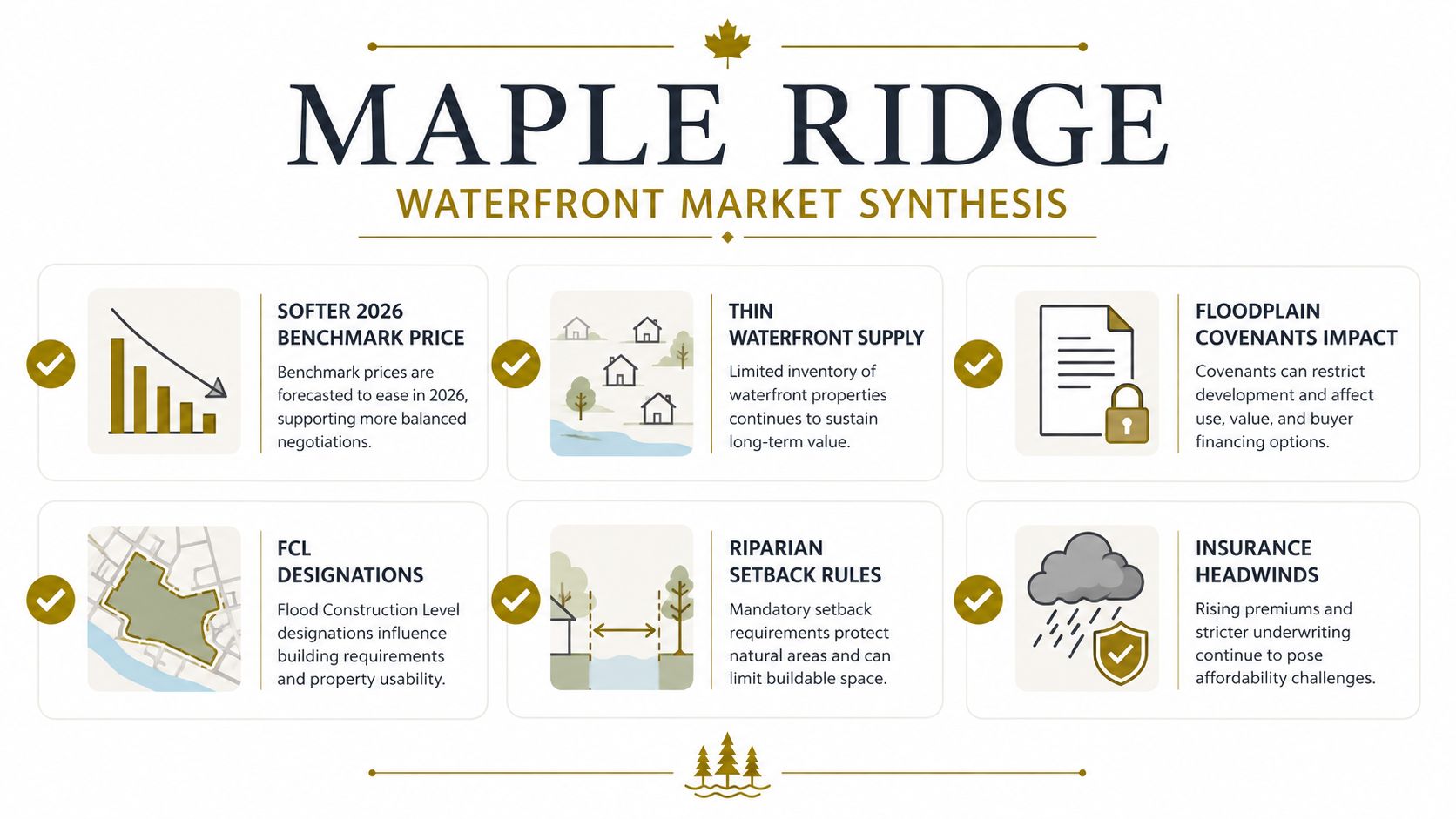
The Maple Ridge waterfront decision rests on several facts that pull in different directions. The broader benchmark softened in 2026, inventory created more negotiating room, and yet genuine waterfront remained scarce. Floodplain covenants, FCL designations, riparian setbacks, insurance restrictions, and slope requirements can narrow the buyer pool further, which can support a compliant property's value while making a problematic one harder to trade.
Before committing, a serious buyer should confirm:
- Title status: Floodplain covenants, easements, access rights, and Section 219 restrictions.
- FCL evidence: A completed Flood Hazard Assessment or other acceptable professional determination.
- Riparian permissions: Whether the intended renovation, vegetation work, dock, wharf, or shoreline improvement requires approval.
- Waterfront ownership: Whether the dock, moorage, foreshore, and natural boundary belong to the property or another party.
- Financial readiness: Lender acceptance and insurance quotes for the exact address.
- Comparable value: A CMA that separates direct waterfront, water view, water access, and dry adjacent lots.

A local waterfront review should begin with the address, not a generic price-per-square-foot estimate. Buyers and sellers can email the property address for a preliminary floodplain and pricing read before arranging an in-person walkthrough, so the conversation starts with the property's actual constraints and opportunities.
Waterfront Questions Buyers and Sellers Ask Most
Can a floodplain waterfront home have a legal secondary suite? Not always. Maple Ridge notes that some floodplain lots, including certain Lower Hammond properties, restrict rental accommodation suites, so zoning and title must be checked before including suite income in the budget.
Who owns the dock and foreshore? The answer may not appear in the listing. Title, survey plans, leases, licences, and permit records should establish whether the structure and water access transfer with the property.
What should buyers expect from a steep Fraser River lot? A geotechnical report, slope and retrogression review, access stairs, setbacks, and potentially significant maintenance deserve attention before an offer.
Does waterfront hold value better than dry inventory? It can, but the 2026 benchmark decline and supply-demand readings don't justify a blanket assumption. Compliant, usable waterfront may retain buyer interest, while a property with insurance, FCL, or permit uncertainty can face a smaller resale market.
Royal LePage Brookside Realty Property Management offers local guidance for Maple Ridge and Pitt Meadows buyers, sellers, and owners assessing waterfront homes, including pricing, transaction coordination, and property management considerations. Visit Royal LePage Brookside Realty Property Management to discuss a specific address, arrange a local market review, or plan the next step.