A deposit is normally the first instalment of your down payment, not an extra cost on top of it, and it's paid when the offer is accepted rather than at closing. On a $600,000 home, a $20,000 deposit at acceptance plus $15,000 at completion adds up to the $35,000 minimum down payment.
So here's the question most buying guides skip: if the total is already approved and sitting in an account somewhere, can a buyer still be unable to write a valid offer on a Maple Ridge townhome this weekend? Yes, and it happens for a reason that has nothing to do with the price or the lender's decision. It's the calendar.
The deposit has to be liquid on the offer date. The rest of the equity has to be liquid on completion day, which can be weeks later on a resale or years later on a presale. Those are two different tests of the same bank account, and passing the second one doesn't guarantee passing the first.
Table of Contents
- A Deposit Is Usually Part of the Down Payment
- Deposit and Down Payment Compared Side by Side
- When Each Payment Falls Due, Stage by Stage
- Minimum Down Payment by Purchase Price in Canada
- What Happens to a Deposit and Presale Deposits
- Confirm Your Deposit and Down Payment Before You Offer
A Deposit Is Usually Part of the Down Payment
"Does the deposit come out of my down payment, or is it another cheque?" Buyers ask this while they're drafting an offer, usually with a spreadsheet open. It comes out of the down payment. The deposit is one payment toward the same equity contribution, made earlier and held by someone else until the deal completes.
The down payment is the total amount you contribute up front, expressed as a percentage of the purchase price, with the mortgage covering the rest. The federal guide to choosing a mortgage defines it exactly that way: money paid up front when buying a home, with the mortgage generally being the home price minus that contribution. That guide doesn't treat the deposit as a separate mortgage category, because it isn't one. It's a contract term.
The arithmetic on a $600,000 purchase
Run the numbers on a hypothetical Maple Ridge purchase and the relationship becomes obvious:
- Minimum equity required: $35,000, being 5% of the first $500,000 ($25,000) plus 10% of the remaining $100,000 ($10,000).
- Deposit written into the offer: $20,000, payable on the deadline the contract sets after acceptance.
- Balance to deliver before completion: $15,000, which your lawyer or notary collects along with the lender's funds.
Nothing in that sequence adds a fourth payment. The deposit amount is negotiable, and the split between the two dates depends on your contract and your lender's instructions, so a buyer could put down more at the offer stage and less at closing without changing the total. If you're still working out what a lender will advance, the plain-language explanation of what mortgage pre-approval covers is worth reading before you commit to a number in an offer.
Practical rule: before signing anything, put three figures side by side on one page: the deposit in the draft offer, the minimum down payment for that price, and the cash you can move within the deposit deadline.
The one place the two diverge is timing, and timing is where deals get into trouble.
Deposit and Down Payment Compared Side by Side
| Feature | Deposit | Down payment |
|---|---|---|
| Purpose | Shows the buyer is committed and secures the accepted contract | Total equity the buyer contributes toward the purchase price |
| How it is calculated | Agreed in the purchase contract | Percentage of the purchase price under the minimum rules, with the figure shaped by mortgage rules |
| Relationship to the other | Normally credited toward the down payment | Includes any deposit already paid |
| Who holds the money | Brokerage, lawyer, notary or prescribed trustee in trust | Lawyer or notary at completion |
A deposit and a down payment can come from the same cash plan, but they do different jobs. The deposit is the buyer's commitment money under the contract. The down payment is the equity the lender needs before it can fund the purchase. That distinction matters because the deposit is usually due early, while the down payment balance is delivered near completion. A buyer can be approved for the full down payment and still lack ready cash for a valid offer.
Purpose and calculation
The deposit gives the seller something real while the contract is conditional and while everyone waits for completion. The down payment exists because a lender will not finance the entire price. The B.C. government's explanation of minimum down payment and insurance rules describes a deposit as money paid after an offer is accepted to demonstrate the buyer's commitment and secure the contract, generally credited toward the total down payment when the transaction completes.
That same provincial material defines an insured high-ratio mortgage as one with less than 20% down. The deposit amount is negotiated in the offer. The down payment total is tied to the purchase price and mortgage rules.
Use a fixed example. On a $600,000 purchase, the minimum equity is $35,000. If the offer calls for a $20,000 deposit, the remaining $15,000 belongs in the cash plan for completion, subject to the lender's instructions and the conveyancer's requirements. The deposit does not replace the down payment calculation. It becomes part of it.
A deposit in the range of 5% to 10% is commonly seen in British Columbia, although the amount is negotiable and not mandated. Treat that range as a starting point for discussion, then confirm the figure against the contract in front of you.
The clause that controls each row
The deposit clause in your purchase contract sets the amount, the deadline, the trustee and what happens if you do not pay. The financing documents set the equity total. If a contract is drafted so that a payment is not credited toward the price, that is the wording to catch before signing, not after.
Check the "relationship to the other" row first in your own offer. If the deposit is properly credited, the rest is a scheduling problem. If it is not, the offer needs fixing before it goes further.
When Each Payment Falls Due, Stage by Stage
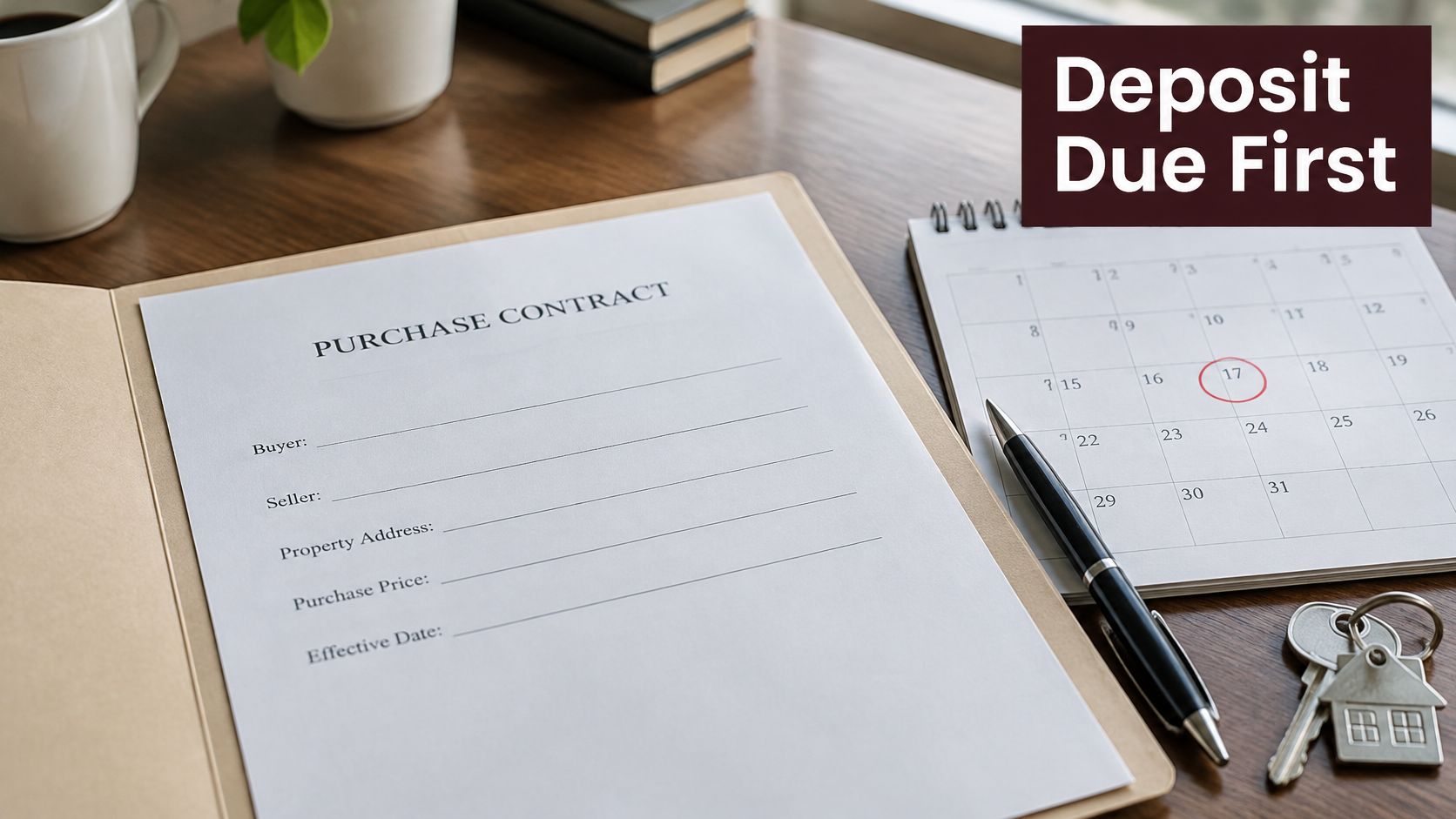
Money moves in a fixed order on a B.C. purchase, and a buyer who budgets only the total can still miss the deadline that comes first. The BCFSA consumer guide to deposits sets out the sequencing plainly: a deposit of 5% to 10% is typical in British Columbia although the amount is negotiable, the deposit is provided when the offer is made, the balance is paid at closing, and the deposit becomes part of the down payment after completion.
| Stage | Deposit | Down payment balance |
|---|---|---|
| Offer accepted | Paid under the contract, often 5% to 10% of price | Not yet due |
| Conditions removed | Held in trust; can be forfeited if the buyer defaults | Not yet due |
| Presale instalments | Additional deposits scheduled under the development contract, held in trust | Not yet due |
| Completion | Credited toward the down payment | Paid with lender funds and the buyer's own funds |
| Closing costs | Not automatically covered by the deposit | Due separately, with adjustments |
From acceptance to completion
- Acceptance. The contract's deposit deadline starts running. This is the date to circle, because a bank draft, an interbank transfer or a withdrawal from an investment account may not clear as fast as you expect.
- The conditional period. The deposit stays with the trust holder while you finish financing, inspection and any strata or title review. Before subjects come off, an unsatisfied condition can still end the deal under the contract's terms. After removal, that deposit stands behind your promise to complete, and a buyer who walks away can forfeit it.
- Completion. The deposit is credited, and your conveyancer collects the remaining equity alongside the mortgage advance.
A $700,000 scenario
Say a Pitt Meadows buyer agrees to $700,000, writes a $35,000 deposit into the offer and plans a further $35,000 at completion. That's $70,000 of equity in total, or 10% of the price, which sits above the federal minimum for that price band. The useful number is the timing: $35,000 is needed on one date and another $35,000 on a different date.
A lender's approval letter doesn't move money between accounts. If the $35,000 sits in an investment account that can't be withdrawn in time, the offer can still fail its deposit deadline even though the full equity amount is approved.
A buyer can be approved for the entire down payment and still be unable to deliver a deposit on time.
What the deposit doesn't pay for
Legal fees, property transfer tax, inspections, appraisal costs, moving expenses and adjustments for taxes or strata fees are separate. Paying $35,000 on acceptance doesn't reduce a single one of them. Budget them as their own line, and walk through the dates and amounts in the Canadian home buying process with your lawyer or notary before you assume any part of it is refundable.
Minimum Down Payment by Purchase Price in Canada
The minimum down payment is an underwriting rule, not a deposit convention. The Financial Consumer Agency of Canada's down payment guidance sets three bands: for a home costing $500,000 or less, the minimum is 5% of the purchase price; for homes above $500,000 but below $1.5 million, the buyer provides 5% of the first $500,000 and 10% of the portion above $500,000; and for homes priced at $1.5 million or more, the minimum is 20% of the full purchase price.
The $800,000 calculation, line by line
That federal guidance works the middle band through an $800,000 purchase: $25,000 on the first $500,000 plus $30,000 on the remaining $300,000, for a minimum down payment of $55,000. Once you can do that one, you can do any price in the band. Split the price at $500,000, apply 5% below the line and 10% above it, then add the two results.
| Purchase price | Minimum down payment | How it is calculated |
|---|---|---|
| $500,000 or less | 5% of the price | 5% of the full price |
| $600,000 | $35,000 | $25,000 on the first $500,000 plus $10,000 on the next $100,000 |
| $700,000 | $45,000 | $25,000 on the first $500,000 plus 10% of the portion above $500,000 |
| $800,000 | $55,000 | $25,000 on the first $500,000 plus $30,000 on the next $300,000 |
| $1,500,000 or more | 20% of the price | 20% of the full price, which is $300,000 at $1.5 million |
Where the minimum stops being the answer
A minimum is a floor, not a quote. A lender can require more than the band calculation because of the property, the file or its own policy, and your deposit can be smaller than, equal to or larger than the minimum without changing what you owe at completion. These thresholds are time-sensitive, so confirm them against current federal rules and your lender before you rely on a number you read months ago.
Property type shifts the answer too. The federal consumer mortgage publication notes that an owner-occupied three- or four-unit property may require at least 10% down, while a non-owner-occupied investment property generally requires at least 20%. For a Fraser Valley buyer weighing a duplex or fourplex as a home-plus-rental plan, whether you live in one of the units changes the cash you need before you ever write an offer.
Buyers looking at raw land instead of a finished home face a different lending conversation altogether, and this Dollar Land Store financing breakdown on land down payments is a useful illustration of why residential band math shouldn't be copied onto a vacant parcel. Confirm land financing terms directly with a lender who writes those loans.
Turning the figure into a plan
Take the minimum for your target price, add the deposit deadline from your draft contract, and check that the cash on hand covers both dates plus closing costs. First-time buyers in Maple Ridge can pair that exercise with the B.C. first-time home buyer guide so the savings plan and the offer plan line up.
What Happens to a Deposit and Presale Deposits

A buyer who waives financing on a $35,000 deposit assumes it comes back if the loan is declined. That is the expensive misunderstanding. A deposit is consideration paid under the purchase contract, and if the buyer fails to complete, it can be forfeited or exposed to a seller's claim for damages. The cash-flow risk starts at the offer, when the deposit is due, long before the down payment balance is delivered at closing.
Trust holding and the stakeholder role
B.C.'s Real Estate Act generally requires money received in connection with a real-estate transaction to be held in trust, and absent a written agreement to the contrary an agent holds it as a stakeholder rather than for one principal. The rule governs custody of the money. It leaves the deposit exposed to forfeiture or a damages claim if the buyer doesn't complete, while the balance of the down payment is normally delivered to the conveyancer at closing and isn't independently at risk before then.
The practical difference is sharp. Money still in your savings account can be redirected. Money paid under the contract comes back only on the terms the contract and the trust rules allow.
What a waived financing condition can cost
The B.C. Ministry of Finance warning about condition-free offers is direct on this point: financing failure can result in loss of the deposit, especially where buyers waive financing conditions, and the province reported industry estimates that more than 70% of offers in competitive B.C. markets had been made without conditions during the referenced period. That figure describes a specific past period and a competitive market, not every street in Maple Ridge today, but the mechanism hasn't changed.
Use the same $35,000 example at the decision point. A buyer waives financing, then the mortgage is declined because the appraisal came in low or the lender re-scored the file. The deposit is exposed, and the buyer may still face a damages claim on a resale. Retaining a financing condition where negotiation allows is the cheapest protection available. Where a seller won't accept one, use a smaller deposit you can afford to have at risk. Before signing, get a careful real estate contract review so the amount at risk is clear in writing.
Once subjects are removed, the deposit stops behaving like savings and starts behaving like a penalty.
Presale deposits held under statute
Presales work differently because the money is committed long before the home exists. Under the Real Estate Development Marketing Act, a deposit is money paid by a purchaser to a developer before the purchaser acquires title or another interest in the unit, and the developer must promptly place it with a brokerage, lawyer, notary or prescribed person, who holds it as trustee in a trust account at a savings institution in British Columbia. If the developer wants to use those funds, the statute requires a deposit-protection contract and notice to the purchaser, and the Insurance Act requires that contract to cover loss of a qualifying deposit if the developer fails to return it under the purchase agreement.
The purchase agreement still controls what happens when a buyer misses a later instalment or the balance when it's due. Buyers comparing mortgage sequencing in other jurisdictions will find the same tension in this look at mortgage timing and payment protection after signing a property contract in Israel. The lesson that travels is to read the payment schedule and the default clause together, never separately.
Five confirmations before signing
- Name the trust holder and verify the payment instructions independently.
- Write out every deposit amount and due date, including instalments.
- Ask exactly what triggers release of the funds.
- Read the default and forfeiture wording, not the summary.
- Take all four answers to a real-estate lawyer or notary before assuming any portion is refundable.
None of this is legal advice, and only your own lawyer or notary can tell you how your contract reads.
Confirm Your Deposit and Down Payment Before You Offer
Can you fund the offer today, then fund the balance on completion? That is the cash-flow test. A buyer can be approved for the full down payment and still be unable to write a valid offer if the deposit is due before gifted funds, sale proceeds or a tax-free savings withdrawal are ready.
Start with the offer-date cash. Name the exact deposit amount the offer will require and confirm which account will clear it. Then set the balance date beside that number. A first-time buyer needs gift letters or withdrawal records ready in a form the lender will accept. A move-up buyer needs a fallback source if the sale has not completed when the next deposit is due. A presale buyer needs every instalment mapped against savings that will exist on each due date.
Keep closing costs in the same plan, because some costs land on completion day while the deposit lands at offer stage. The breakdown of closing costs when buying a home in B.C. helps separate the upfront cash from the completion-day cash.
For clients buying and selling at the same time, Brookside coordinates the listing timeline, subject dates and possession dates on both transactions together. That helps expose a gap between a deposit deadline and a sale completion. No sale outcome is guaranteed, and every property and market is different, so the plan has to survive a slow sale as well as a fast one.
Before the offer is drafted, narrow the checklist to the decisions that change the offer itself. If financing is not certain, decide whether to include a financing condition. If the seller will not accept one, set a deposit amount you could absorb if financing falls through. Check that the trust holder named in the offer matches the payment instructions and that the due dates are specific enough to calendar.
Royal LePage Brookside Realty has served Maple Ridge and the surrounding communities since 1982. Bring your pre-approval and savings timeline to Royal LePage Brookside Realty while the deposit amount, due dates and financing terms can still be changed.