You're staring at listings in Cottonwood, Albion, and West Maple Ridge, and the numbers just aren't lining up the way they did a few years ago. A condo that looked comfortable last month now feels tight once you add the down payment, closing costs, and the reality of commuting, insurance, and strata fees. That's the point where a first time home buyer guide BC becomes useful, because buying in Maple Ridge and Pitt Meadows is its own game, not a copy of Vancouver or Toronto.
The first thing to understand is simple. In this market, the right first purchase is usually the one that gets you stable, builds equity, and doesn't wreck your monthly life. For a lot of buyers, that means a condo or townhome first, then a detached home later if the numbers and neighbourhood make sense.
Why Buying Your First Home in Maple Ridge Feels Different
A lot of first-time buyers start with the same kitchen-table conversation. One partner is refreshing listings in Albion, the other is comparing townhomes in West Maple Ridge, and both are asking why the budget feels so small compared with what the market is showing. That reaction is normal here, because Maple Ridge and Pitt Meadows sit in a real Fraser Valley trade-off zone, where commute, value, and home type matter more than a pretty listing photo.
The local rhythm is different from a big-city search. Buyers here think about West Coast Express access, school catchments, and whether daily errands are easier in a condo near services or a townhome tucked deeper into a family neighbourhood. That's why a generic first time home buyer guide BC usually misses the part that matters most, the first purchase is rarely about “perfect,” it's about workable.
What first-time buyers actually buy here
In Maple Ridge, first purchases usually start in condos or townhomes, not detached homes. That's not a failure, it's a practical entry strategy in a market where many buyers want outdoor space, reasonable strata fees, and a shot at staying close to the communities they already know. For a broader sense of the city's lifestyle and why people keep choosing it, the local area overview at is Maple Ridge a good place to live gives helpful context.
Practical rule: if the first home keeps the monthly budget steady and the commute tolerable, it's doing its job.
The other thing that separates this market is inventory. Newer builds in places like Silver Valley can feel very different from older resale stock in central Maple Ridge, and that changes everything from inspection risk to subject periods. Buyers who understand that difference stop wasting time on homes that were never a fit in the first place.
BC First-Time Buyer Programs You Should Claim First
The first program to check is British Columbia's Property Transfer Tax exemption. If the home's fair market value is $500,000 or less, eligible first-time buyers can get a full exemption. If the value is over $500,000 and up to $835,000, the exemption becomes a flat $8,000, and the partial exemption phases out between $835,000 and $860,000, according to the provincial program details at BC first-time home buyers' current exemption amounts.
That matters in Maple Ridge because a condo or smaller townhome may sit squarely inside the full-exemption band, while a detached home often lands in the partial zone. On the urban-rural edge of Maple Ridge and Pitt Meadows, the land-allocation formula also matters, because larger-lot properties can push the eligible fair market value calculation higher than buyers expect.
Eligibility is strict, so check it early
To qualify, the buyer must be a Canadian citizen or permanent resident, must have lived in British Columbia for 12 consecutive months before registration or have filed two BC tax returns in the previous six years, and must have never owned a principal residence anywhere in the world. The property must be 0.5 hectares or smaller and used as the buyer's principal residence, which is why acreage-style properties need extra attention.
A separate summary of the program also notes that the home must be registered after February 16, 2016, the exemption can fully eliminate property transfer tax up to $835,000, and the new-home version applies to a home valued at $1,100,000 or less. For a plain-language breakdown of the tax itself, the local guide at what is a land transfer tax is a useful companion.
If the exemption applies, claim it at completion, not after the fact. Buyers who leave this until closing day create avoidable stress for themselves and their lawyer.
The blunt takeaway is this, don't guess at eligibility. Confirm it early, build your budget around the exemption, and make sure your lawyer or notary files the paperwork correctly at completion.
Saving a Down Payment That Works in the Fraser Valley
Down payment planning in Maple Ridge has to be honest, not aspirational. The federal sliding scale is simple, 5% on the first $500,000, then 10% on the portion from $500,000 to $1,499,999, and 20% once the price hits $1,500,000 or more. TD's first-time buyer guidance lays out the same structure, and it matters because the size of the down payment changes both qualification and monthly carrying cost (TD first-time home buyer tips).
For Maple Ridge buyers, the math is where the conversation gets real. A 5% down payment on a $649,000 townhome is $32,450 before closing costs, and a purchase around $979,000 for a detached home in Albion needs a much larger cash commitment because the deposit has to cover the first $500,000 at 5% and the balance at 10%. That is the difference between a workable plan and a save-for-longer decision.
Tools that can shorten the runway
Two federal tools deserve attention. The RRSP Home Buyers' Plan lets eligible buyers use retirement savings for a down payment, while the FHSA gives first-time buyers a tax-advantaged account designed for a home purchase. Buyers who already have RRSP savings often find the Home Buyers' Plan easier to use, while buyers starting from scratch usually prefer the structure of the FHSA.
For a practical saving framework, the article on budgeting tips for homebuyers is worth a look because it treats saving as a system, not a wish. That approach matters in this market, especially for buyers who overestimate what they can do in six months and underestimate what they can build over a steady year.
The part people ignore is simple. The best saving plan leaves room for closing costs, moving costs, and the first round of repairs. A buyer who drains every dollar into the down payment often ends up house-rich and cash-poor on day one.
Pre-approval should happen before serious shopping
A good Fraser Valley pre-approval follows a simple sequence. Choose a lender or broker, gather documents, confirm stress-test qualification at the contract rate plus 2%, and get a written pre-approval that names the maximum price, the down payment, and the amortization. CMHC's homebuying checklist puts affordability calculation, pre-approval, home inspection, and legal advice before the final purchase, which is the right order for BC buyers (CMHC home buying guide).
Use a local broker who sees multiple lender policies on townhomes and new-construction inventory, not just one bank's product shelf. That flexibility can matter more than a rate headline, and a clear mortgage pre-approval guide helps buyers understand what the lender is checking before they start writing offers.
Documents to gather now
- Government ID: Two pieces, ready to upload or present
- Income proof: Employment letter, recent pay stubs, and T4 slips
- Tax history: CRA Notices of Assessment from the last two years
- Bank statements: Statements showing where the down payment comes from
- Mortgage details: Void cheque for payment setup
- Contract paperwork: Signed purchase contract once an offer is accepted
The right saving cadence is boring in the best way. Save consistently, keep the down payment money traceable, and do not let lifestyle creep eat the plan.
Choosing the Right Maple Ridge or Pitt Meadows Neighbourhood
The smartest first-time buyer search is narrow, not broad. Buyers who try to monitor every listing in Maple Ridge, Pitt Meadows, and the whole Fraser Valley end up exhausted, and exhaustion leads to bad offers. A better move is to choose two or three neighbourhoods, then compare them on daily life, not just square footage.
Where first-time buyers usually fit
West Maple Ridge works for buyers who want older or more established condo and townhome options and don't mind a commute that has to be planned around transit and road patterns. Cottonwood tends to appeal to buyers who want a more central daily routine, with schools, shopping, and healthcare access baked into the search. Albion is where some entry-level detached homes still pull attention, but buyers need to be realistic about budget and condition.
Silver Valley is attractive for newer builds and buyers who care about modern layouts more than mature landscaping. Kanaka Creek pulls families who want a quieter feel and are willing to pay attention to school catchments and drive times. Pitt Meadows often draws first-time buyers who want practical value in duplex and manufactured-home segments, along with a manageable commute.
Maple Ridge neighbourhood guide is useful for narrowing the short list before the weekend showing blur starts.
| Neighbourhood | Typical entry-level home | Transit and commute | Best fit for |
|---|---|---|---|
| West Maple Ridge | Condo or townhome | Stronger West Coast Express considerations | Commuters who want value and a central starting point |
| Cottonwood | Condo or townhome | Good access to daily services | Buyers who want convenience and family-friendly routines |
| Albion | Entry-level detached home or townhome | More car-dependent | Buyers stretching into a house without going too far east |
| Silver Valley | Newer build townhome or condo | Commute depends on route and timing | Buyers who prefer newer construction and modern layouts |
| Kanaka Creek | Townhome or detached starter | More suburban, family-oriented commute pattern | Buyers focused on schools and quieter streets |
| Pitt Meadows | Duplex or manufactured-home segment | Practical for commuters who value a smaller-town feel | Buyers who want a lower-friction first purchase |
Local filter: if a neighbourhood doesn't work on school run, grocery run, and work commute, it's not really a fit, no matter how nice the listing photos are.
The point of this exercise is to stop doom-scrolling. Pick the places that match your life now, then let the mortgage pre-approval and home type do the narrowing.
Making a Competitive Offer in the Fraser Valley
A clean offer still matters in Maple Ridge and Pitt Meadows, even when the market isn't manic. Well-priced homes get attention, and sellers notice when a buyer shows up with a serious deposit, a sensible price, and a realistic subject timeline. The goal isn't to write the flashiest offer, it's to write the one a listing agent trusts.
A strong offer usually includes the price, deposit, financing condition, and inspection condition. Subject-removal timelines in this area often run 7 to 10 days, which gives buyers enough time to verify the mortgage, review the home, and make a calm decision without dragging the process out.
Where to be careful
Waiving the inspection on an older Maple Ridge home is a gamble, especially where aging infrastructure may be hiding behind a tidy surface. Older roofs, outdated electrical, drainage issues, and deferred maintenance don't announce themselves in listing remarks, they show up in inspection reports. If the home is older, the inspection subject is not the place to get brave.
The negotiation framework should stay grounded in recent evidence. Look at comparable sales from the last 30 to 60 days, check days on market, and read the temperature of the listing before deciding whether to go firm or stay conditional. The listing that has been sitting longer usually gives a buyer more room than the one that just hit the market.
The clean-offer checklist
- Price discipline: Offer from recent comparables, not from hope
- Deposit credibility: Make the deposit look real, not symbolic
- Financing proof: Keep the pre-approval current and lender-ready
- Inspection plan: Know what gets inspected and what gets excluded
- Subject timing: Keep the removal window short and realistic
A local buyer who understands these parts stands out fast. A sloppy buyer with a vague price and loose conditions does not.
Inspections, Due Diligence, and Real Closing Costs
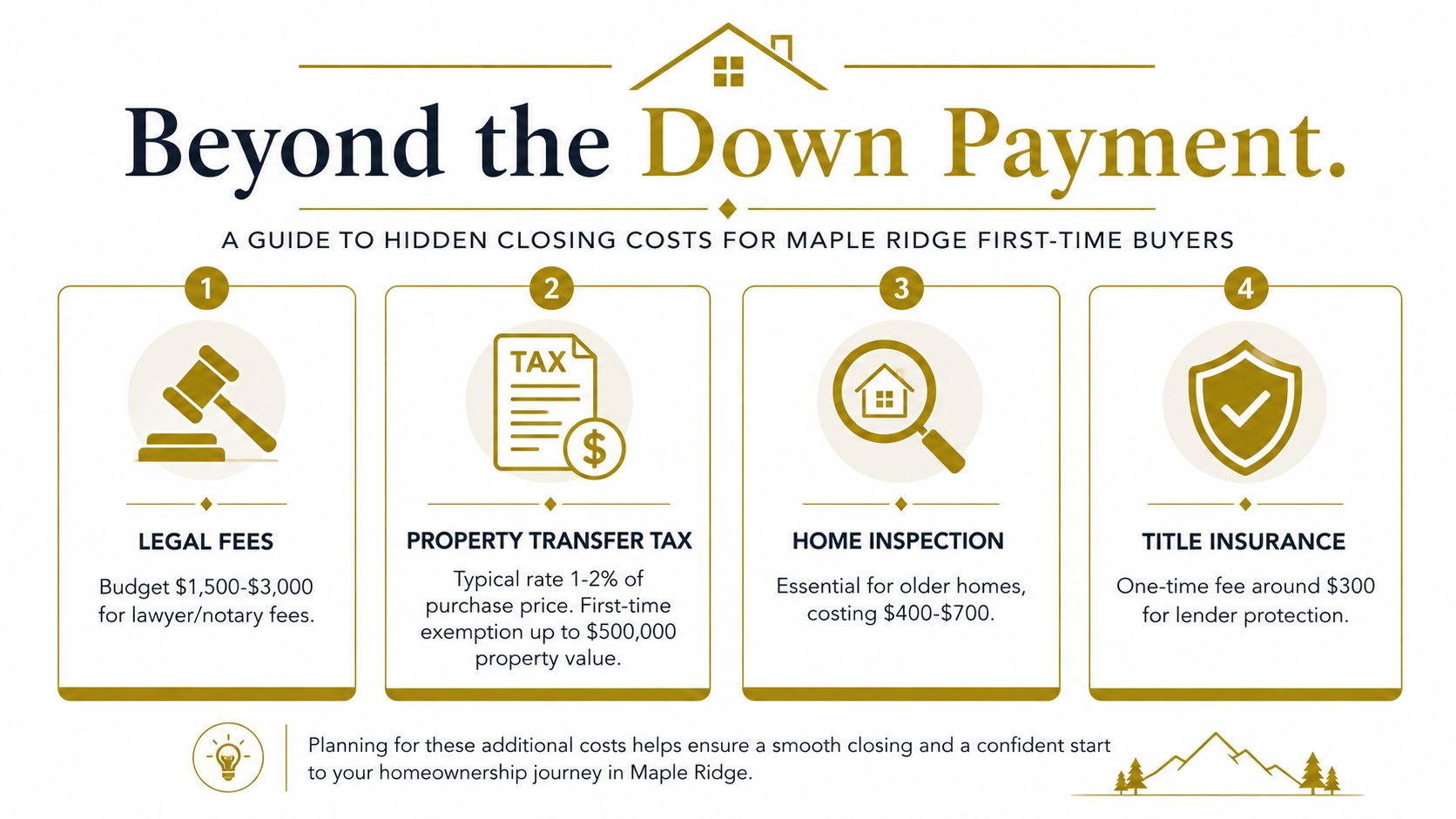
The biggest first-time mistake is assuming the down payment is the only serious cash item. It isn't. Buyers still need to budget for legal fees, title insurance, home inspection, appraisal if required, property insurance, and moving costs, and that's before the first repair or utility hookup bill arrives. CMHC's consumer guidance is clear that ownership costs keep going after possession, which is why cash planning has to extend beyond the offer date (CMHC closing cost guidance).
For resale homes, especially older ones in established Maple Ridge pockets, an inspection is money well spent. A buyer who skips due diligence on an older property can end up paying for problems the seller already lived with. If the home is a strata unit, there's a second layer of review as well, because the building's documents can say more than the paint colour ever will.
Budget rule: if the buyer only has the down payment and nothing left for closing, the purchase is too tight.
The practical way to think about this is simple. Start with the mortgage, then add the legal work, then add the inspection and insurance, then keep a reserve for the first month of ownership. For a clear overview of the cash-to-close side of the process, lower your cash-to-close bill is a useful reference point.
A simple closing-cost framework
- Legal and title work: Lawyer or notary fees, plus title insurance
- Inspection and appraisal: Especially important on resale homes
- Transfer-tax paperwork: Exemption claims or payment at completion
- Insurance and moving: The first real-life expenses after possession
The sensible move is not to guess. A buyer should ask for a full cash-to-close picture before writing an offer, especially if the home is new, older, strata-titled, or sitting on a larger lot.
Common First-Time Buyer Mistakes and Local Tips That Actually Help
The most common mistake is chasing the top of the Property Transfer Tax exemption band just because it feels efficient. That's a bad reason to stretch, because the tax break is small comfort if the monthly payment or maintenance cost is too heavy. Buyers should choose the right home first, then treat the exemption as a bonus, not a licence to overreach.

Waiving the inspection on an older home is another rookie error. The right move is to inspect, review the age and condition of the big systems, and only waive conditions if the buyer understands the trade-off. The same caution applies to townhomes, where strata documents deserve real attention and not a five-minute skim.
Four mistakes worth avoiding
- Stretching for the exemption ceiling: Buy within the monthly budget, not just the tax band
- Skipping the inspection: Older Maple Ridge homes deserve full due diligence
- Ignoring strata documents: Townhomes can carry hidden repair or governance issues
- Treating pre-approval like a guarantee: It's a snapshot, not a promise
The urban-rural edge brings another hidden cost, commuting and insurance can both change the monthly picture. A home that looks affordable on paper may not stay that way once the buyer adds gas, time, and the practical realities of a more rural lot or a property that asks for more upkeep. That's why local advice matters more here than generic internet advice.
The right move this week is straightforward. Get the pre-approval refreshed, narrow the neighbourhood list, and ask for a full closing-cost breakdown before writing any offer. Buyers who do those three things stop reacting to listings and start shopping like they mean it.
Royal LePage Brookside Realty Property Management helps buyers and owners in Maple Ridge and Pitt Meadows handle the practical side of local real estate, from purchase planning to property management and day-to-day ownership. If the next step is buying, selling, or managing a home in this market, visit Royal LePage Brookside Realty Property Management to connect with a local team that understands how Fraser Valley decisions play out at the kitchen table and at completion.