
A Maple Ridge listing can look excellent on paper and still miss the people most likely to buy it. The photos may be polished, the price may be defensible, and the home may be close to parks, schools, or commuter routes, yet the first weekend can pass without fanfare because the marketing speaks to “Vancouver buyers” instead of people weighing Albion against Silver Valley, Cottonwood against West Maple Ridge, or a townhouse against a detached home.
That's where social media marketing for real estate earns its place. It isn't a contest for the largest follower count. A well-organised campaign helps a listing reach the right local audience, gives sellers evidence of active promotion, and keeps an agent visible to homeowners who may not be ready to move today but are already watching the market.
Why Social Media Marketing Matters for Maple Ridge Listings Right Now
Maple Ridge listings lose attention on social media when the message targets “Vancouver buyers” instead of neighbours deciding between Albion and Silver Valley. A polished photo and defensible price cannot fix content that ignores how local buyers compare space, commute time, schools, trails, and neighbourhood routines.
Social media marketing for real estate works as a measurable listing tool when it connects a property with the people most likely to act. A young family moving from Burnaby or Langley may focus on room to grow. A first-time buyer may compare an entry-level townhome with continued renting. A downsizer may want to stay close to established routines in Cottonwood or West Central. Each audience needs different evidence and may respond on different platforms.
Maple Ridge also has distinct neighbourhood economics. In March 2026, average prices ranged from $1,007,530 in East Central to $1,433,712 in Cottonwood, with Albion at $1,289,955 and Thornhill at $4,990,750, according to independent Maple Ridge neighbourhood market reporting. Those figures are unsuitable for ad copy without local context. They do show why a single citywide message can miss the reasons a seller or buyer cares about a particular area.
Practical rule: Before publishing, name the buyer persona the post targets: young family in Albion, downsizer in Cottonwood, or investor in Thornhill. Then choose the property detail, neighbourhood proof, and call to action that fit that person.
Track business outcomes rather than follower counts. Useful measures include listing inquiries, viewing requests, open-house attendance, seller conversations, listing appointments, referrals, and the quality of the follow-up audience created by each campaign. These measures reveal whether a post generated genuine interest or only passive attention.
Facebook and Instagram can support targeted online promotion through Maple Ridge and Pitt Meadows real estate services, but content still has to connect with accurate pricing, strong negotiation, and responsive service.
For a working Fraser Valley agent, social is a listing-performance lever. It cannot rescue an overpriced home or replace preparation. It can put the property in front of a relevant local audience and show sellers how the agent works before they decide who to call.
Picking the Right Platforms for the Fraser Valley Buyer
Canadian audiences already spend substantial time on social platforms. 91.9% of Canadian internet users aged 16 to 64 use social media, spending an average of 1 hour and 53 minutes per day across about 6.4 platforms each month, according to the Canada-specific data cited by Real Estate Magazine's discussion of Facebook and Instagram marketing. Statistics Canada also found that, in 2018, about 78% of Canadians who had used the internet in the previous three months were regular social media users, as reported in the same source.
British Columbia's platform habits make the local priority clearer. 67% of British Columbians use Facebook at least once per week and 50% use it daily, while daily use is much lower on Twitter at 13%, Instagram at 5%, Pinterest at 4%, and LinkedIn at 3%, according to BC social media audience data. Instagram remains valuable for visual property discovery, but Facebook has the stronger broad-reach role for community awareness, listing exposure, open-house promotion, and local remarketing.
A Calgary and Alberta realtor benchmark also illustrates the direction of travel. Facebook usage among surveyed realtors fell from 94% in 2017 to 78% in 2021, while Instagram rose from 30% to 50%, and video usage climbed from 21% to over 30%, according to Royal LePage's benchmark discussion. The figures aren't a Maple Ridge buyer survey, but they support a sensible local conclusion: Facebook should anchor reach, while visual and video formats should receive deliberate testing.
| Platform | Primary Audience in Fraser Valley | Best Listing Funnel Role | Recommended Priority |
|---|---|---|---|
| Local groups, established homeowners, move-up buyers, downsizers | Broad listing exposure, community discussion, open-house promotion, remarketing | High | |
| Instagram and Reels | Visual-first buyers, younger households, first-time buyers | Property discovery, lifestyle storytelling, saves, direct messages | High |
| TikTok | Younger renters, townhouse buyers, informal local discovery audiences | Awareness, quick tours, neighbourhood personality, myth-busting | Selective |
| Relocating professionals, business owners, referral contacts, some investors | Professional authority, relocation conversations, referral development | Moderate | |
| YouTube Shorts | Search-minded viewers and people researching neighbourhoods | Evergreen tours, area explainers, buyer education | Selective but useful |
The weighting should follow the property. A detached family home in Silver Valley or Albion needs strong Facebook distribution, supported by Instagram video and local lifestyle content. A townhouse in West Central or Cottonwood can lean more heavily into Reels and short-form video, while still using Facebook groups and Marketplace-style local visibility. An acreage near Kanaka Creek or Webster's Corners needs longer explanations, practical access information, and YouTube or Facebook content that allows the lifestyle and maintenance realities to be understood.
Agents building a repeatable workflow can also review how Smarcomms helps realtors sell, particularly when content planning, publishing, and follow-up start competing with showings. The aim isn't to appear everywhere. It's to place each property where the audience is most likely to notice, understand, and act on it. Buyers can then move from discovery to Maple Ridge homes for sale with a clearer sense of the local options.
Content Ideas That Speak to Maple Ridge Neighbourhoods
Generic listing captions fail because they flatten Maple Ridge into one lifestyle. The city's official planning framework includes an Official Community Plan along with area and neighbourhood plans, and the municipality describes the OCP as a general guide for land use within the city, as outlined in Maple Ridge's area and neighbourhood planning information. Content should reflect that local structure.
1. Neighbourhood spotlights
A neighbourhood post should answer the question behind the search. For Albion, the concern may be whether a townhouse works for a growing family. For Kanaka Creek, it may be whether an acreage lifestyle is realistic. For Thornhill, the audience may need a more careful conversation about land, access, and property type.
Reels hook for an Albion townhouse:
“Could this Albion townhouse solve the space problem without pushing a young family out of Maple Ridge? Walk through the layout, storage, outdoor space, and the daily routes buyers should test before making an offer.”
A Silver Valley carousel can follow this sequence:
- “What does this detached home offer beyond the bedroom count?”
- Main living area and natural flow.
- Yard, storage, and family practicality.
- Nearby trails, parks, and routine considerations.
- Commute questions for buyers relocating from Burnaby or Langley.
- “Save this post before booking a Silver Valley viewing.”
2. Schools, parks, and amenity walkthroughs
School catchments require careful, current verification, so posts should direct readers to confirm details rather than making broad promises. A useful walkthrough can show the route to a nearby park, explain the difference between a short drive and a daily walk, and discuss how buyers should evaluate drop-offs, recreation, transit, and commuting.
The pain point is often commute uncertainty. A Burnaby migrant doesn't need a glossy “family-friendly” caption. That buyer needs a realistic discussion of morning travel, home office space, parking, and whether Albion or Silver Valley fits the household's routine.
3. Listing journey storytelling
Show the work behind a sale without exposing confidential client information. A sequence might cover preparation, photography, launch, showing feedback, pricing conversations, and the final negotiation. Sellers see a process rather than a promise, and buyers gain a better understanding of why presentation and accurate positioning matter.
4. Market myth-busting
Entry-level buyers often struggle to separate online commentary from advice that applies to their circumstances. A short video can address affordability confusion without inventing a payment example or making a prediction.
Script: “A lower-priced home isn't automatically the right value. Buyers should compare condition, strata obligations where relevant, location, future resale considerations, and the cost of making the home workable. A Maple Ridge search needs a complete comparison, not one headline number.”
For a broader guide to local lifestyle questions, agents can point readers to whether Maple Ridge is a good place to live while keeping the post focused on the particular neighbourhood being discussed.
5. Human, useful behind-the-scenes content
A cloudy day that forces a photography reshoot in Silver Valley is more credible than another polished quote card. So is a quick clip from an open house on 224th, a staging decision in Cottonwood, or a conversation about why an empty nester hesitates to downsize.
For visually difficult rooms or vacant properties, an agent may explain virtual staging for social posts as one presentation option. It should be labelled clearly and never presented as the home's actual condition. The strongest content remains honest, local, and tied to a decision a buyer or seller is already trying to make.
A Realistic Posting Cadence for a Busy Agent
A schedule has to survive showings in Albion, open houses near 224th, and last-minute photography changes in Silver Valley. A useful baseline is four to five posts per week across Facebook and Instagram, one LinkedIn update mid-week, and one weekend Reel or TikTok. That cadence creates repetition without requiring the agent to film every day.
The content should rotate through four dependable themes:
- Local market pulse: Explain what buyers and sellers should pay attention to in Maple Ridge.
- Listing features: Show one useful property detail instead of repeating the full MLS description.
- Neighbourhood lifestyle: Cover parks, trails, routes, and local routines accurately.
- Behind-the-scenes work: Show preparation, feedback, reshoots, negotiations, and client service.
A half-day batch session inside Meta Business Suite can handle much of the week. Later or Buffer can support scheduling across channels, while the agent keeps enough flexibility for a genuine market update or a timely listing change.
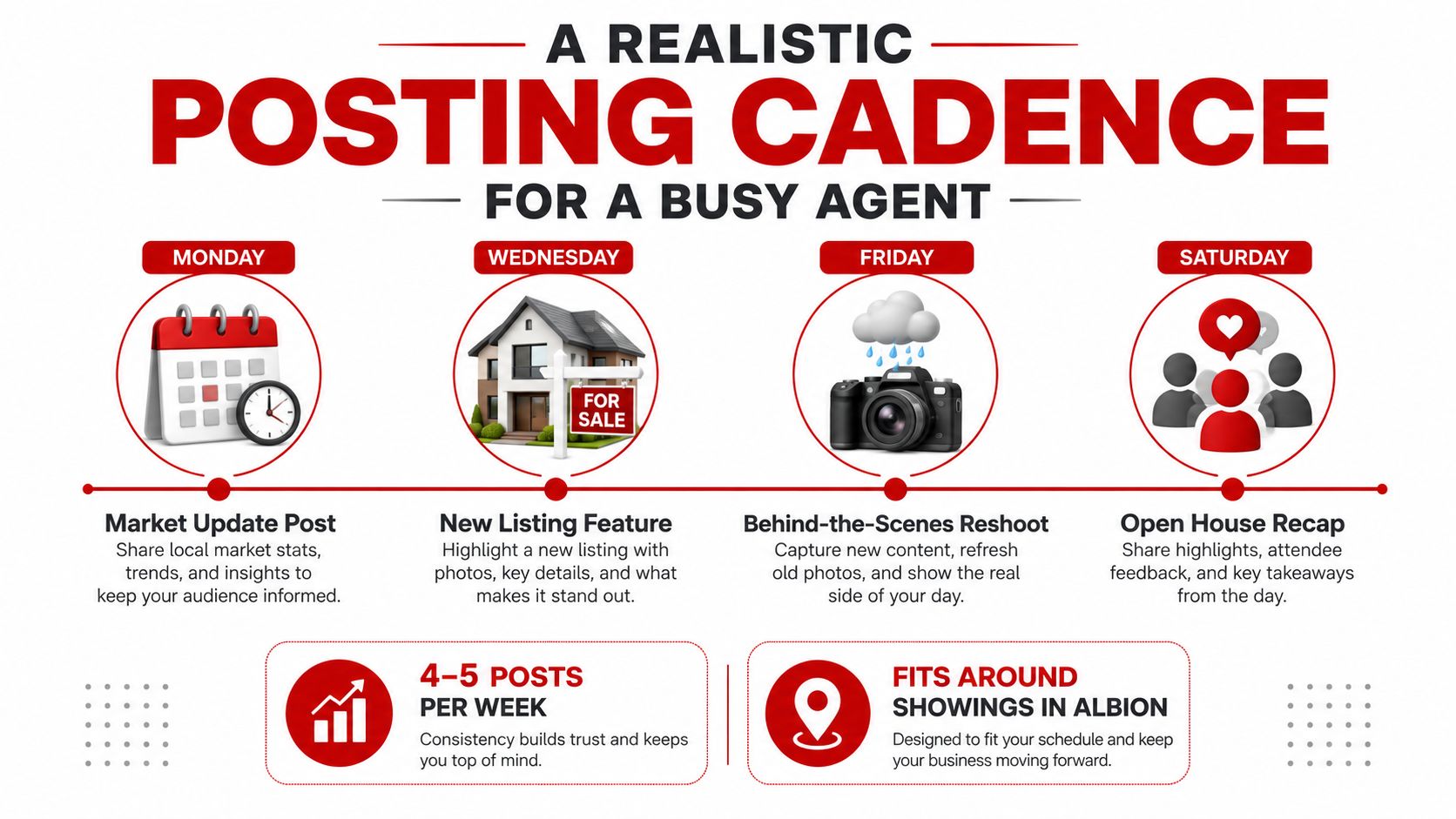
A worked weekly pattern could look like this:
| Day | Content | Purpose |
|---|---|---|
| Monday | Market update for Maple Ridge or Pitt Meadows | Start conversations with buyers and homeowners |
| Wednesday | New listing teaser with one clear feature | Build anticipation and direct attention to the property |
| Friday | Just-sold post or behind-the-scenes reshoot | Demonstrate active service and process |
| Sunday | Reel or TikTok featuring a park, trail, or neighbourhood detail | Reach lifestyle-led discovery audiences |
The full Brookside Realty blog can also provide ideas for educational posts, but the agent should adapt every topic to a real Maple Ridge question. A schedule that gets published consistently will outperform a complex calendar that collapses during listing preparation.
The accompanying video adds another practical format for agents who want to demonstrate process and presentation:
Running Paid Ads That Reach Local Buyers and Sellers
Paid social works best when the campaign has one local job. That job might be generating inquiries for a listing in Albion, attracting seller conversations in Silver Valley or Webster's Corners, or retargeting people who watched an open-house video.
A Canada-specific Meta benchmark puts average real-estate CPM at about CAD 14.06 in 2025, compared with CAD 20.15 globally, according to Canadian real estate Facebook advertising cost data. The same benchmark records a low of CAD 8.61 in August and a Q4 spike to CAD 28.44 in November. Those figures are benchmarks, not guarantees for a Maple Ridge campaign, so weekly monitoring matters.
That volatility supports a split between evergreen brand content and listing-specific bursts. A listing launch deserves the strongest creative while the property is fresh. A brand campaign can run steadily, but the creative should be refreshed before expensive periods rather than allowing a tired ad to absorb the budget.
The suggested operating range for an active listing is roughly CAD 400 to CAD 800 per month, with more weight during launch week and less after the first open house. A five to fifteen kilometre radius around the property can keep the audience local, while age, homeownership status, and available life-event signals may help refine the audience. Past purchasers should be excluded where the platform and campaign structure allow it.
| Campaign | Monthly Budget (CAD) | Geo-Target | Primary Audience | Main KPI |
|---|---|---|---|---|
| New listing | 400 to 800 | Five to fifteen kilometres around the property | Active local buyers and likely movers | Qualified inquiries and viewing requests |
| Seller lead magnet | Flexible portion of the active budget | Silver Valley, Webster's Corners, or another chosen area | Homeowners considering a move | Qualified seller leads |
| Retargeting | Flexible portion of the active budget | Recent local video viewers and site visitors | People who already engaged | Cost per follow-up conversation |
A listing-launch video usually has a stronger reason to exist than a generic “local expert” ad. It can show the kitchen flow, backyard, storage, views, or the way a townhouse handles everyday life. An agent looking for campaign structure can consult this guide to Facebook ads by AdStellar AI, then adapt the setup to local geography, compliant copy, and the property's actual audience.
Market context can support seller content, but it shouldn't replace a conversation about the individual home. A current Maple Ridge market report is more useful when paired with condition, location, competition, and timing rather than presented as a universal valuation.
Measuring What Actually Moves Your Business
Likes are easy to collect and difficult to deposit. A working real estate dashboard should show whether social activity created conversations that progressed into appointments, listings, and completed transactions.
The weekly review can happen every Monday morning and stay short. The agent should pull reach, video views, saves, shares, profile visits, link clicks, direct messages, and lead-form results from Meta Ads Manager and Instagram Insights. TikTok analytics can show video views, audience retention, profile activity, and inbound responses. LinkedIn Campaign Manager can show impressions, clicks, and lead activity for professional audiences.
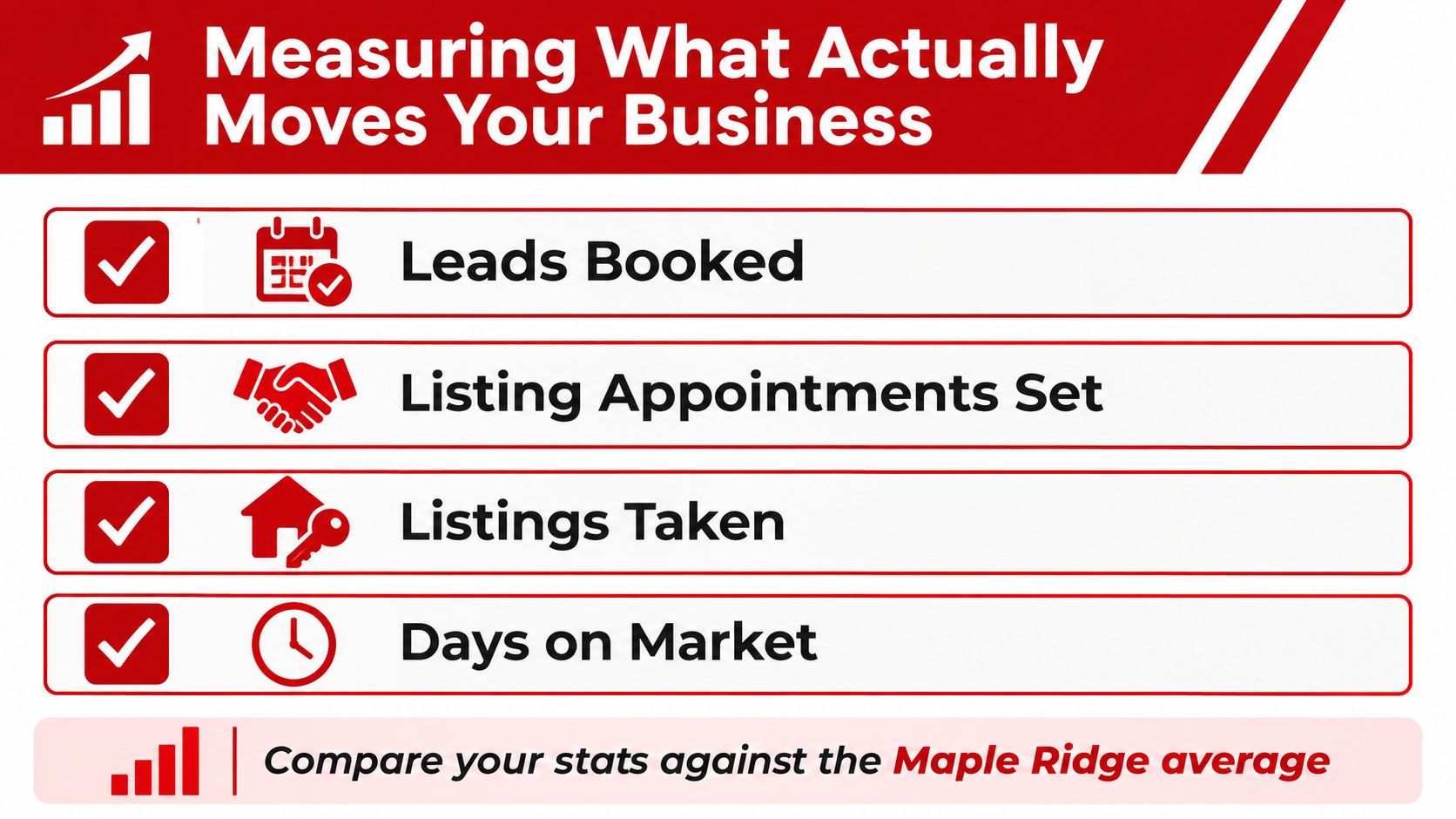
Those platform figures are diagnostic, not the final score. The business record should track:
- Leads booked: People who agreed to a meaningful follow-up conversation.
- Listing appointments set: Seller meetings placed on the calendar.
- Listings taken: Signed listing opportunities.
- Days on market: Compared with the relevant Maple Ridge average, property type, and market context.
Three ratios deserve attention:
- Cost per qualified seller lead, calculated from the campaign spend and leads that meet the agent's qualification standard.
- Cost per booked listing presentation, which removes low-intent form fills from the evaluation.
- Follower-to-listing conversion over 90 days, which shows whether audience growth becomes actual business.
The brief doesn't provide verified Fraser Valley benchmark ranges for these ratios, so agents shouldn't label a $45 cost per lead healthy or unhealthy without their own qualification rules, conversion history, and property focus. A low-cost lead that never answers can be less valuable than a higher-cost homeowner who books a presentation.
At the end of each 90-day review, compare platform, content type, neighbourhood, audience, spend, qualified conversations, appointments, listings taken, and days on market. Before changing the mix, ask only two questions: Did the campaign reach the people most likely to act? And did those people move into a measurable business conversation?
Staying Compliant With BC Real Estate Advertising Rules
A polished post can still create a regulatory problem. B.C. agents need to treat social content as advertising whenever it promotes a service, property, price, result, or professional identity, and they should confirm current requirements with the BC Financial Services Authority and the managing broker before publishing uncertain material.
The most common mistake is assuming that a casual caption is exempt because it appears beside an informal photo. A promoted listing post that omits the licensee's name or brokerage in the caption can create a disclosure issue. A Reel showing a renovation before and after can also imply an increase in value that the evidence doesn't support.
Price and property claims
An advertised price must not create false expectations. Copy should accurately describe the property and avoid language that suggests a guaranteed future value, inevitable appreciation, or a result the agent can't substantiate. If a price is likely to confuse the audience or requires important context, the safer choice may be to omit it and direct the reader to a properly maintained listing source.
Unverified market statistics create another avoidable risk. An agent shouldn't copy a dramatic number from a social post, use a citywide figure to describe one neighbourhood, or present an old result as current. The March 2026 neighbourhood figures cited earlier demonstrate why local context matters, but even verified data needs a date, source, and explanation.
Promotions, contests, and short-term rentals
Giveaways need careful handling. Rules can apply to eligibility, wording, administration, prize disclosure, and how the promotion is presented, so a contest should receive review before it goes live.
Short-term rental advertising also requires attention. If an agent posts a Maple Ridge Airbnb or other short-term rental opportunity, the post must not suggest that the use is automatically permitted. The property owner and agent need to verify applicable municipal, provincial, strata, licensing, and other requirements before describing a short-term rental as available or viable.
Compliance is part of marketing quality. A post that attracts attention but misstates the property creates work, distrust, and potential exposure.
A pre-post checklist belongs beside the desk:
- Licensee identity: Include the agent's name where required.
- Brokerage disclosure: Show the brokerage clearly on the post or in the required accompanying material.
- Price wording: Use accurate wording, or leave the price out when it could create a misleading impression.
- Property details: Verify every material feature, measurement, status, and claim.
- Audience language: Remove discriminatory or exclusionary wording.
- Statistics: Use only verified, current information with appropriate context.
- Visual accuracy: Label virtual staging and avoid implying that renovations guarantee value.
- Promotions: Obtain a review before launching contests or giveaways.
- Record keeping: Save a screenshot of the final post, caption, creative, and targeting details for the compliance file.
If a complaint is filed, the agent shouldn't delete evidence or respond impulsively. The complaint process can require a response within a 30-day window, so the licensee should preserve the relevant material, notify the managing broker, and obtain direction promptly. The managing broker should be involved before publishing any post involving uncertain price language, a contest, a short-term rental claim, a comparative performance statement, or a potentially sensitive property representation.

Royal LePage Brookside Realty Property Management offers buying, selling, property marketing, negotiation, and property management services for clients in Maple Ridge and Pitt Meadows. For local guidance on presenting a home accurately, reaching the right audience, and planning a move, visit Royal LePage Brookside Realty Property Management.