

A landlord in Cottonwood lays two management proposals on the kitchen table. Both promise rent collection, tenant communication and maintenance coordination, but one quotes a lower monthly percentage while the other lists separate leasing, inspection and renewal charges. The practical question isn't which headline number looks smaller. It's what each proposal will cost across a tenancy, including vacancy periods and work required to meet British Columbia rules.
Property management fees in Maple Ridge, BC are best compared as a share of the rent collected, with one-time costs and additional services counted separately. Local rental conditions matter, but so do the property's rent, turnover risk and the precise services in the agreement. The goal is to work out what the owner keeps after management costs, not to treat a quoted percentage as the whole bill.
Landlords can start by comparing the responsibilities they'd keep under self-management versus hiring a property manager in Maple Ridge. The right choice depends on the work an owner wants handled and the clarity of the written proposal, not on a universal fee formula.
Table of Contents
- Why Maple Ridge Landlords Are Comparing Fee Quotes Right Now
- The Main Fee Types You Will See in a Management Proposal
- What Percentage and Flat-Fee Ranges Look Like Locally
- Full-Service Versus À La Carte Pricing
- BC Tenancy and Licensing Rules That Shape the Fee
- Sample Cost Scenarios for Maple Ridge Rental Properties
- Questions to Ask a Maple Ridge Property Manager Before Signing
- Choosing a Management Partner in Maple Ridge and Pitt Meadows
Why Maple Ridge Landlords Are Comparing Fee Quotes Right Now
Rents across Maple Ridge and Pitt Meadows have climbed over the past several years, and every dollar of that increase flows into a percentage-based management invoice. An owner who signed an agreement when a Haney two-bedroom rented for less is now paying a larger monthly fee for the same scope of work. That widening gap is sending landlords back to their proposals.
Rent collected on a specific asset sets the dollar fee. Historical CMHC figures cited in the City's Housing Action Plan show that purpose-built rentals and secondary-market homes have long carried different price points in Maple Ridge, so two identical percentage quotes can cost two owners different amounts. The pricing section below covers what current ranges look like on local rents.
A proposal worth signing reflects the rules that drive the work. Managers collecting rent and handling trust money in British Columbia operate under provincial licensing requirements, and every tenancy follows Residential Tenancy Act timelines for deposits, notices and rent increases. Ask whether the fee applies to rent collected or rent due, whether billing continues through a vacancy, and who authorizes repairs at what dollar threshold.
Some owners request quotes purely as a benchmark while they keep managing the property themselves. In that case, the comparison of self-managing versus hiring a property manager in Maple Ridge helps price the hours and liability a monthly fee would replace.
Practical rule: Compare written scopes and estimated annual totals, not just the percentage printed in large type.
The Main Fee Types You Will See in a Management Proposal
Read enough Maple Ridge proposals and a pattern shows up: the same work appears under different names from one agreement to the next. Before comparing prices, match each line to a task, then check whether that task sits inside the recurring fee or gets billed separately. A plain-language description of what a property manager does helps separate ongoing administration from occasional services.
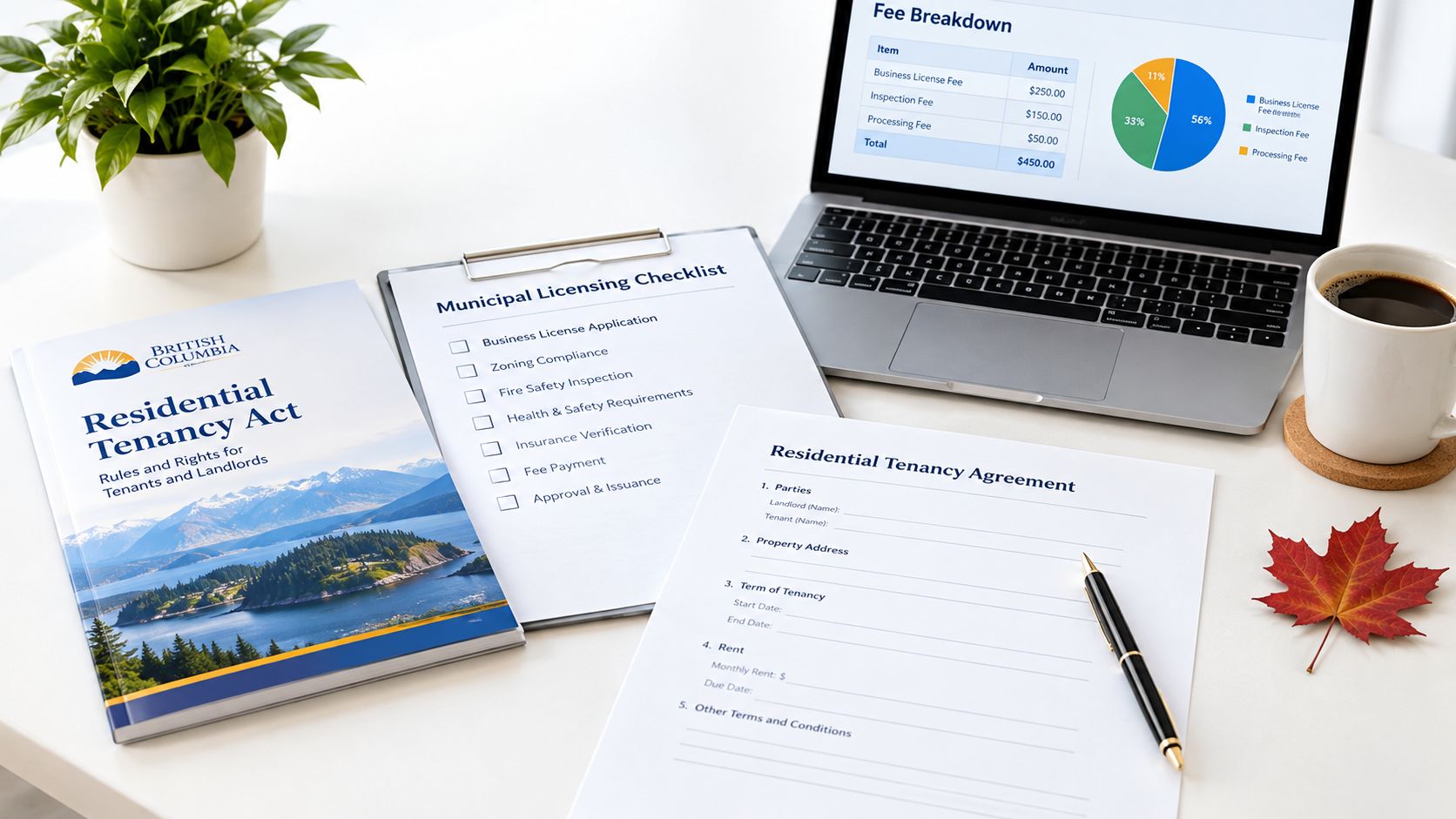
Recurring and leasing charges
The recurring management fee pays for regular work on an occupied rental: collecting rent, routine tenant communication, owner statements and basic maintenance coordination. That work involves handling rent money, so the firm doing it operates under provincial licensing requirements for trust funds. On a Maple Ridge or Pitt Meadows asset, the fee only becomes a dollar figure once the rate is applied to the rent that property collects. Two identical rates can still mean different monthly costs.
A tenant placement or leasing fee covers finding and securing a new tenant. It is an event-based charge rather than ongoing administration, and it usually bundles advertising, showings, application handling and screening. Ask which of those tasks sit inside the charge, since a thin scope can turn one placement into several smaller invoices.
Add-ons and occasional work
Renewal and inspection fees attach to specific tasks. A renewal charge may cover the paperwork and communication when a tenancy continues, while an inspection fee pays for a visit and written condition notes. Both carry weight because deposits and notices in BC follow Residential Tenancy Act timelines, and weak documentation at those points is what turns routine charges into expensive problems.
Maintenance markups and after-hours charges can raise the annual total even when the base percentage stays fixed. Ask whether the manager adds a coordination charge to contractor invoices, what counts as after-hours work, and the dollar level at which non-emergency repairs need owner approval.
Vacancy administration and dispute-resolution coordination need precise definitions. A vacant unit still requires advertising, showings and preparation, and a dispute under the provincial tenancy process can involve work beyond routine management. Neither should be assumed into the monthly fee.
One last check: these are owner-side contract costs. A manager cannot label an expense "tenant recoverable" and pass it down. British Columbia's Residential Tenancy Regulation limits tenant-facing charges to permitted categories, including certain key costs, financial-institution charges, qualifying strata fees and tenant-requested services, and it caps the returned-cheque administration fee at $25 subject to regulatory conditions (Residential Tenancy Regulation).
What Percentage and Flat-Fee Ranges Look Like Locally
Local market examples describe recurring property-management fees of 6% to 9% of monthly rent, with tenant placement often charged separately at roughly 40% to 75% of one month's rent. These are examples, not a regulated tariff. A written proposal may use a different structure, so the owner should compare the scope and total charges rather than assume one range applies to every property.
Consider a hypothetical rental at $2,500 per month. At a recurring rate of 6% to 9%, management would cost $150 to $225 per month, or $1,800 to $2,700 over a year, before placement and other add-ons. These estimates use market examples described for Maple Ridge rentals and aren't a quote for a specific property.
That percentage is only meaningful alongside the amount of rent collected. The same rate generates a larger fee on a higher-rent property, while an unoccupied unit may produce no collected rent but still need advertising, showings or other services. A proposal should explain whether the recurring charge pauses during vacancy and how vacancy work is billed.
CMHC identifies Maple Ridge/Pitt Meadows as Zone 25 and reports a 2025 vacancy rate of 3.5% for the zone. That figure describes the zone, not a guarantee about how quickly an individual rental will lease. A vacancy still means lost rent and can bring turnover costs, so the owner should assess the fee against the property's income and leasing needs (CMHC Vancouver Rental Market Report data tables).
| Fee line | Typical range | What it covers |
|---|---|---|
| Recurring management | 6%–9% of monthly rent in local market examples | Ongoing management, as defined in the agreement |
| Tenant placement | Roughly 40%–75% of one month's rent in local market examples | Leasing work, depending on the agreed scope |
| Renewals, inspections and maintenance coordination | Set by proposal | Specific tasks, if charged separately |
Those ranges are market examples, not fixed local prices. Flat fees can make monthly budgeting more predictable, but only if the agreement identifies which services sit outside the base charge. Percentage fees move with rent, while separate task charges can make either model more expensive over a full tenancy cycle.
Full-Service Versus À La Carte Pricing
Two proposals can quote the same monthly percentage and still produce very different annual bills. The gap usually sits in where the work appears on the invoice. A full-service package bundles rent collection, tenant placement, inspections, maintenance coordination, accounting and tenancy support into one recurring charge. À la carte pricing separates those tasks, so the owner pays as each service is requested or triggered.
| Work area | Full-service structure | À la carte structure |
|---|---|---|
| Rent collection and routine communication | Often part of the recurring fee | May be charged as a separate service |
| Tenant placement | May be included or billed separately | Commonly priced as its own task |
| Inspections and reporting | May be included at a stated frequency | Can be ordered separately |
| Maintenance coordination | May be included, with possible markups | Often billed per task or through a coordination charge |
| Disputes and unusual work | May remain outside the package | Usually priced separately |
A full-service arrangement tends to suit owners who don't have time for tenant calls, live away from Maple Ridge or Pitt Meadows, or want one point of contact for routine administration. An à la carte model can work for an experienced local owner with a stable, long-term tenancy who mainly needs occasional leasing or compliance support. A low base fee stops being low the moment the owner is billed separately for the tasks that prompted the search for a manager.
Rent level matters as much as the rate. As the historical CMHC figures cited earlier show, rent and unit mix change the dollar amount a percentage fee produces, so a quoted 7% on a higher-rent detached home can cost more over a year than 8% on a smaller unit. Comparing proposals on the projected annual dollar cost, rather than the headline rate, gives a clearer picture of what each model charges.
Some charges stay separate under either model. The agreement should state how eviction or dispute-resolution coordination, hearing attendance and major maintenance work are billed. Owners should also check cancellation terms and file-transfer responsibilities before assuming a bundled fee covers every unusual task.
BC Tenancy and Licensing Rules That Shape the Fee
A management fee pays for regulated work, not just administration. In British Columbia, managing rental property for remuneration is a licensed activity unless an exemption applies, and one specified exemption covers an employee who manages property only for the owner employing that person. The regulation behind that licensing line was cited in the fee-types section, and the practical question for an owner is simpler: confirm who in the proposal performs the compensated management functions.
Tenant-facing charges get their own check. The Residential Tenancy Regulation permits only specified charges, so operating expenses can't be pushed onto a tenant. A solid agreement separates owner expenses from legally permitted tenant charges and discloses any contractor-coordination markup. Owners wanting the wider statutory picture can review an overview of British Columbia's Residential Tenancy Act.
Deposit handling and municipal licensing
Deposit work runs on hard deadlines. A security deposit can't exceed one-half of the monthly rent, and a pet-damage deposit sits under the same cap. Within 15 days of tenancy end, the landlord must return deposits plus applicable interest, unless the tenant gives written permission for a deduction or the landlord applies for dispute resolution inside that window (British Columbia residential tenancy legislation). Ask who in the proposal tracks those dates. A missed deadline is a cheap thing to outsource and an expensive one to get wrong.
Maple Ridge adds a municipal layer on top. An owner renting two dwellings on one property, such as an upper-floor home plus a secondary suite, must hold a City business licence, and the City lists a business-licence fee plus a one-time $500 application-review fee, separate from anything a private manager bills (City of Maple Ridge secondary-suite licensing information). On a suite renting near the local range, that application charge alone can equal several months of management fees, so it belongs in the same comparison as the quoted percentage.
Short-term rentals carry a second set of filings. Maple Ridge operators need a City business licence before listing, advertising or renting the property, plus registration with the provincial Short-Term Rental Registry (City of Maple Ridge short-term-rental operator guide). The agreement should say who handles applications, registrations and renewals, and whether that work sits inside the fee or gets billed per task. Requirements shift, so confirm current rules with the City and the province before signing.
Sample Cost Scenarios for Maple Ridge Rental Properties
Percentages on a proposal mean little until they are converted to dollars against the rent a specific property collects. The scenarios below apply the local range described earlier to three common Maple Ridge holdings. Placement charges and add-ons sit outside these figures unless the agreement folds them in, and none of these are estimates for a particular home.
Basement suite at $1,800 per month
At $1,800 monthly rent, a recurring fee of 6% to 9% works out to $108 to $162 per occupied month. On a suite at this price point, a separately charged placement fee can exceed a full year of percentage fees at the low end, so the owner should confirm whether advertising, showings and screening all sit inside that charge or get itemized. One vacant month changes the math twice: lost rent plus whatever the manager bills while the unit sits empty.
Townhouse at $2,500 per month
At $2,500 monthly rent, the same percentage range produces $150 to $225 per occupied month, or $1,800 to $2,700 over a year before leasing and other charges. The dollar fee rises with rent even though the percentage holds steady, which is why a higher-priced proposal only makes sense if the extra services replace costs that would otherwise surface as separate line items.
Two-unit holding at $4,000 combined monthly rent
At $4,000 in combined monthly rent, the same illustrative percentage gives $240 to $360 per occupied month, before placement and other fees. Two dwellings on one Maple Ridge lot trigger the City's secondary-suite licensing requirements described in the BC rules section above, and those municipal charges belong in the budget alongside the management quote. On a file like this, I also ask whether the quoted fee covers both units or gets billed per door, since proposals differ on that point.
One month's vacancy on any of these means a month without rent from the affected unit while leasing and turnover work may still generate invoices. Running the fee proposal against projected income and operating expenses in a rental property ROI calculator gives the comparison that matters: an annual figure capturing recurring management, placement, renewals, inspections, maintenance markups and vacancy costs on one page.
Questions to Ask a Maple Ridge Property Manager Before Signing
A proposal should answer practical questions before the owner signs. The following checklist helps expose gaps that a headline fee won't show.
- Licensing and accountability: Is the person or firm performing compensated management work properly licensed, and who holds that licence? What insurance applies, and who is responsible for authorising urgent work?
- Fee structure: Is the recurring charge based on rent collected or rent due? What are the placement, renewal and inspection charges? Are maintenance markups, vacancy billing, after-hours work and cancellation terms stated in writing?
- Tenancy administration: Who tracks deposits and return deadlines? How does the manager handle dispute-resolution coordination and rent-increase notices?
- Local operations: What experience does the manager have with Maple Ridge and Pitt Meadows rentals? How are contractors selected, and what leasing guidance is available for a specific property?
Owners assessing how tenant enquiries and routine requests are handled may also find this overview of an AI front desk for property management useful as background on communication workflows. It doesn't replace questions about the manager's own staffing, response process or contract obligations.
For a broader look at choosing a property-management company in Maple Ridge, owners should compare the written service scope as well as the fee schedule. Confirm time-sensitive figures and responsibilities in the signed agreement, not just in a conversation.
Choosing a Management Partner in Maple Ridge and Pitt Meadows
Two proposals can quote the same monthly percentage and still produce very different annual totals once placement, renewal, inspection and maintenance-coordination charges are added in. The sound comparison is total management cost divided by annual gross scheduled rent, with vacancy and ancillary charges made visible in the written agreement. That agreement, not the headline rate, shows which proposal costs less on a given Maple Ridge or Pitt Meadows property.
A lower headline percentage can still cost more.
Short-term rentals sit in a separate category entirely. The compliance workload described earlier, a City business licence plus provincial registry registration, changes what the manager must handle and what the fee must cover. Owners weighing proposals for a long-term rental, duplex or townhouse can ask Royal LePage Brookside Realty to review the service scope and explain the trade-offs in practical, BC-aware terms.
Royal LePage Brookside Realty provides licensed residential property management and landlord guidance in Maple Ridge and Pitt Meadows. To discuss a management proposal or the services a rental may need, visit Royal LePage Brookside Realty.