A couple renting a one-bedroom near Port Haney can spend a Tuesday night scrolling listings, then notice that a townhome in Albion may be within reach. The excitement arrives quickly, followed by harder questions. Can the mortgage handle strata fees, taxes, insurance, and repairs? Will the commute work? Does a lower purchase price still make sense if property transfer tax, an older roof, or a special assessment appears after the offer?
Maple Ridge and Pitt Meadows give first-time buyers more property choices than many nearby Lower Mainland markets, but the decision still requires discipline. A home that fits the pre-approval can fail the actual budget once every ownership cost is added. This first time home buyer guide focuses on the number that matters most, the total cost of acquiring and keeping the home.
What Buying Your First Home in Maple Ridge Really Looks Like
Maple Ridge first-time buyers often start with a compromise, not a dream detached house. A buyer may choose an Albion townhome for newer construction and practical floor space, or a condo near central Maple Ridge to keep the purchase within reach. That pattern reflects the broader British Columbia market. Statistics Canada reported 25,315 first-time homebuyers in B.C. in 2020, a 28.0% increase from 2019, while earlier data showed first-time buyers made up 15.2% of B.C. buyers in 2018. The same provincial data found that 62.5% bought condominium apartments or row houses, rather than detached homes. Statistics Canada's housing data supports a practical conclusion, property-type flexibility is central to buying in B.C.
Maple Ridge and Pitt Meadows still offer a different lifestyle from Vancouver West, but buyers pay for that space with time and trade-offs. A detached home can mean a longer West Coast Express or highway commute, while a townhome may provide less privacy but a newer roof and fewer immediate repair decisions. An older strata can offer a lower entry point, yet its minutes, depreciation report, and contingency fund deserve close attention. River views near Kanaka Creek or the Fraser can be attractive, but floodplain considerations need to be reviewed before an offer becomes firm.
Neighbourhood choice affects daily life as much as the property itself. Albion offers newer communities and access to Westgate shopping, Silver Valley brings newer builds and natural surroundings, and West Maple Ridge can appeal to commuters seeking closer access to the West Coast Express. Buyers comparing schools, parks, transit, and shopping can also review this local guide on whether Maple Ridge is a good place to live.
Practical rule: The purchase price is only the opening number. The correct target is the all-in monthly cost plus the cash required to close.
Before possession, buyers should also plan for the condition of the home on move-in day. A careful checklist covering cleaning, ventilation, moisture, and unwanted pests can help, especially for buyers moving into older housing stock. The Green Advantage offers useful pest-free move in tips that can be added to the buyer's possession preparation.
Setting a Realistic Budget and Down Payment Plan
A pre-approval doesn't establish a safe budget. It establishes a borrowing limit under lender rules. A Maple Ridge buyer should build a personal ceiling below that limit, then test it against mortgage payments, strata fees, property taxes, utilities, insurance, maintenance, and the possibility of a temporary income change.
A representative townhome purchase at $750,000 with 10% down may carry an estimated monthly ownership cost of roughly $3,800 to $4,100, including strata, based on the planning assumptions in this guide. Property taxes around $3,400 per year and heating plus insurance of approximately $150 to $220 per month must be treated as part of the housing payment, not optional extras. These figures are planning examples, not a quote, and a lender or broker should confirm the mortgage portion.
A price band is not a budget
The local entry bands help buyers search, but they don't replace a full calculation. Condos may suit a buyer who prioritises a lower purchase price and less exterior maintenance. Townhomes can offer a stronger balance of space and affordability, while detached homes bring greater control over the land but usually a larger mortgage, higher maintenance exposure, and more sensitivity to interest-rate changes.
| Property Type | Price Range | Est. Mortgage, 10% down | Strata | Property Tax | Heat + Insurance | Total Monthly |
|---|---|---|---|---|---|---|
| Condo | $500,000 to $620,000 | Confirm with lender | Confirm by building | Confirm by assessment | Confirm by quote | Build from verified costs |
| Townhome | $700,000 to $850,000 | Confirm with lender | Confirm by complex | Confirm by assessment | Confirm by quote | Build from verified costs |
| Detached home | $900,000 to $1.1M | Confirm with lender | Usually none | Confirm by assessment | Confirm by quote | Build from verified costs |
The table uses local planning bands rather than a claimed market average. Buyers reviewing current Maple Ridge homes for sale should calculate each listing separately because taxes, strata charges, insurance needs, and utility arrangements vary by property.
Down payment choices
A 5% down payment preserves more savings but generally creates a larger mortgage and mortgage-insurance cost. With less than 20% down on a qualifying purchase below $1 million, mortgage insurance applies, so the buyer needs to understand both the premium and the cash required at closing. A 10% down payment reduces the loan balance and may improve the monthly picture, but it still requires a substantial reserve. A 20% down payment avoids mortgage insurance, although draining every available dollar to reach that threshold is poor planning.
Permitted sources can include the RRSP Home Buyers' Plan, up to $35,000 per person, TFSA savings, and gifted funds from family. The lender needs documentation showing where the money came from and whether any gift has repayment conditions. Buyers should also keep a closing reserve of 2% to 3% of the purchase price, plus three to six months of mortgage payments, rather than treating the down payment as the entire cash requirement.
The federal mortgage cap of $1.5 million provides context, but most entry-level Maple Ridge buyers remain well below it. The relevant question is whether the chosen home leaves room for real life, not whether the lender approves the maximum.
Getting Mortgage Pre-Approval the Right Way
A proper pre-approval begins before the first serious viewing. Buyers should compare a major bank, a local credit union such as First West or Vancity, and a monoline mortgage broker. A bank may offer familiar products and branch access. A credit union can provide local service and different underwriting policies. A monoline broker may compare products across lenders and can be useful for self-employed applicants whose income requires more explanation.
Documents that prevent delays
The lender will want a complete file, not a rough estimate. Buyers should gather:
- Income records: Two years of T4s or Notices of Assessment.
- Current earnings: Recent pay stubs.
- Down-payment history: Three months of bank statements, with explanations for large deposits.
- Existing obligations: Confirmation of other debts, including student lines.
Unexplained deposits can slow approval because the lender must verify the source of funds. A gifted down payment should be documented before the buyer writes an offer, not after acceptance.
The stress test changes the result
Canadian borrowers generally qualify at the higher of the contract rate plus 2% or 5.25%. This is why the pre-approval amount often feels lower than the buyer's preferred shopping range. The lender is testing whether the borrower could manage a higher payment, not just calculating today's payment.
A rate hold commonly runs for 90 to 120 days, depending on the lender and product. Buyers shouldn't treat the hold as a guarantee that every property will qualify. The lender still needs to approve the specific home, strata documents, borrower file, and final terms.
Credit inquiries also matter before shopping. A buyer who applies with several lenders independently can create unnecessary complications, so the financing strategy should be coordinated through one broker or a carefully selected lender. A local lender familiar with Maple Ridge strata documents can also reduce review friction when a buyer targets an older condo or townhome.
For buyers who want help comparing lending paths, Hand Vetted Co. lender matching can provide another starting point. The buyer should still ask every lender about qualification rules, penalties, portability, prepayment privileges, and the treatment of strata properties.
A mortgage pre-approval isn't the same as investment financing. Buyers considering a future rental or a property with suite potential should separate that analysis from the owner-occupied purchase, using guidance such as this resource on how to buy an investment property.
Choosing the Right Maple Ridge or Pitt Meadows Neighbourhood
Neighbourhood selection should come before emotional attachment to a particular listing. A buyer who starts with a house and then tries to make the location work often ends up compromising on commute, schools, parks, or resale appeal. In Maple Ridge and Pitt Meadows, small geographic differences can change the daily routine and the ownership cost.
Matching location to the first purchase
Albion appeals to buyers who prefer newer townhomes, modern layouts, and access to Westgate shopping. The trade-off is that many communities depend on shared amenities and strata rules, and the commute can feel long for anyone travelling toward Vancouver. A buyer who wants turn-key construction and doesn't need a large yard may find Albion practical.
Silver Valley is a strong fit for buyers who prioritise newer detached construction, small-lot yards, and access to trails and natural spaces. Newer homes can reduce immediate renovation pressure, but buyers should still examine development patterns, parking, slope considerations, and the distance to daily services.
Cottonwood offers family-oriented streets and established schools, with a mix of older and newer housing. Buyers may find more mature landscaping and established services, but the condition of an individual home matters more than the neighbourhood label. A lower-priced property that needs major work may cost more than a better-maintained home with a higher initial price.
Kanaka Creek suits buyers drawn to riverfront walks, green space, and older detached inventory. The local appeal can be substantial, but a buyer should investigate drainage, floodplain considerations, renovation history, and insurance before relying on a view or a large lot to justify the price.
West Maple Ridge works well for commuters who value access toward the West Coast Express and central services. Older homes may offer more land than newer developments, yet age brings potential maintenance work and less predictable energy performance.
Pitt Meadows' central corridors deserve a separate look. Newer condos and townhomes can offer comparatively lower price-per-square-foot, while the flatter setting and commuter connections appeal to buyers who want a quieter community without giving up access to regional routes. A buyer comparing current Pitt Meadows homes for sale should inspect each building's rules, parking, storage, and fee history.
| Neighbourhood | Typical Entry Price, 2-bed | Home Type Common | Commute to Vancouver | Best-Fit Buyer |
|---|---|---|---|---|
| Albion | Confirm current listings | Newer townhomes | Longer regional commute | Turn-key buyer who values newer construction |
| Silver Valley | Confirm current listings | Small-lot detached homes and townhomes | Longer commute | Buyer prioritising newer homes and outdoor access |
| Cottonwood | Confirm current listings | Townhomes and detached homes | Regional commute | Family-oriented buyer seeking established surroundings |
| Kanaka Creek | Confirm current listings | Older detached homes | Regional commute | Buyer who values trails, river walks, and larger settings |
| West Maple Ridge | Confirm current listings | Condos, townhomes, and detached homes | More convenient for West Coast Express access | Commuter balancing space and transit |
| Pitt Meadows central corridors | Confirm current listings | Condos and townhomes | Regional commute | Buyer seeking central access and comparatively lower price-per-square-foot |
Specific entry prices change with condition, size, and market activity, so they should be confirmed against current listings rather than treated as fixed thresholds. The durable rule is simple, pick the neighbourhood before the home. Resale patterns in Maple Ridge are closely tied to micro-location.
Working With a Local Realtor on Your First Purchase
A Maple Ridge buyer's agent should do much more than forward listing alerts. The agent should configure searches around the buyer's actual constraints, including strata age, rental restrictions, parking, pets, school priorities, and acceptable commute. Entry-level listings can attract attention quickly, so an agent who can arrange a same-day viewing gives the buyer a better chance to inspect the property before making a rushed decision.
The agent also interprets the paperwork. That includes reviewing listing history, identifying unusual strata language, checking whether the property's layout matches the buyer's financing plan, and coordinating inspectors, lenders, notaries, and insurance providers. An offer should include appropriate subjects for financing, inspection, and strata documents unless the buyer has deliberately accepted the risks of removing them.
What the buyer should ask
A first-time buyer should interview at least two local agents before signing a buyer-representation agreement. The conversation should cover:
- Recent transactions: Ask for experience with closed sales in the buyer's actual price band.
- Offer judgment: Ask how the agent handles subject-to-financing and subject-to-inspection offers.
- Response habits: Notice whether the agent answers clearly and promptly during the first contact.
- Local activity: Confirm the agent works in Maple Ridge and Pitt Meadows weekly, not occasionally.
- Strata knowledge: Ask how the agent reviews minutes, depreciation reports, bylaws, insurance, and special-assessment risk.
Buyer-agent compensation is commonly handled through the co-operating commission arrangement, so there may be no direct fee paid by the buyer. That arrangement doesn't make the service unlimited or eliminate the need to understand the representation agreement. The buyer should confirm what the agreement covers, how conflicts are handled, and what happens if the buyer changes direction.
Royal LePage Brookside Realty Property Management offers real estate services for buyers and sellers in Maple Ridge and Pitt Meadows, while other brokerages and independent agents may offer different representation models. The right choice is the agent who demonstrates local competence, disciplined communication, and clear advice when the attractive property is not the right purchase.
More information about local brokerage services is available through Royal LePage Maple Ridge real estate services.
Searching, Viewing, and Making an Offer That Wins
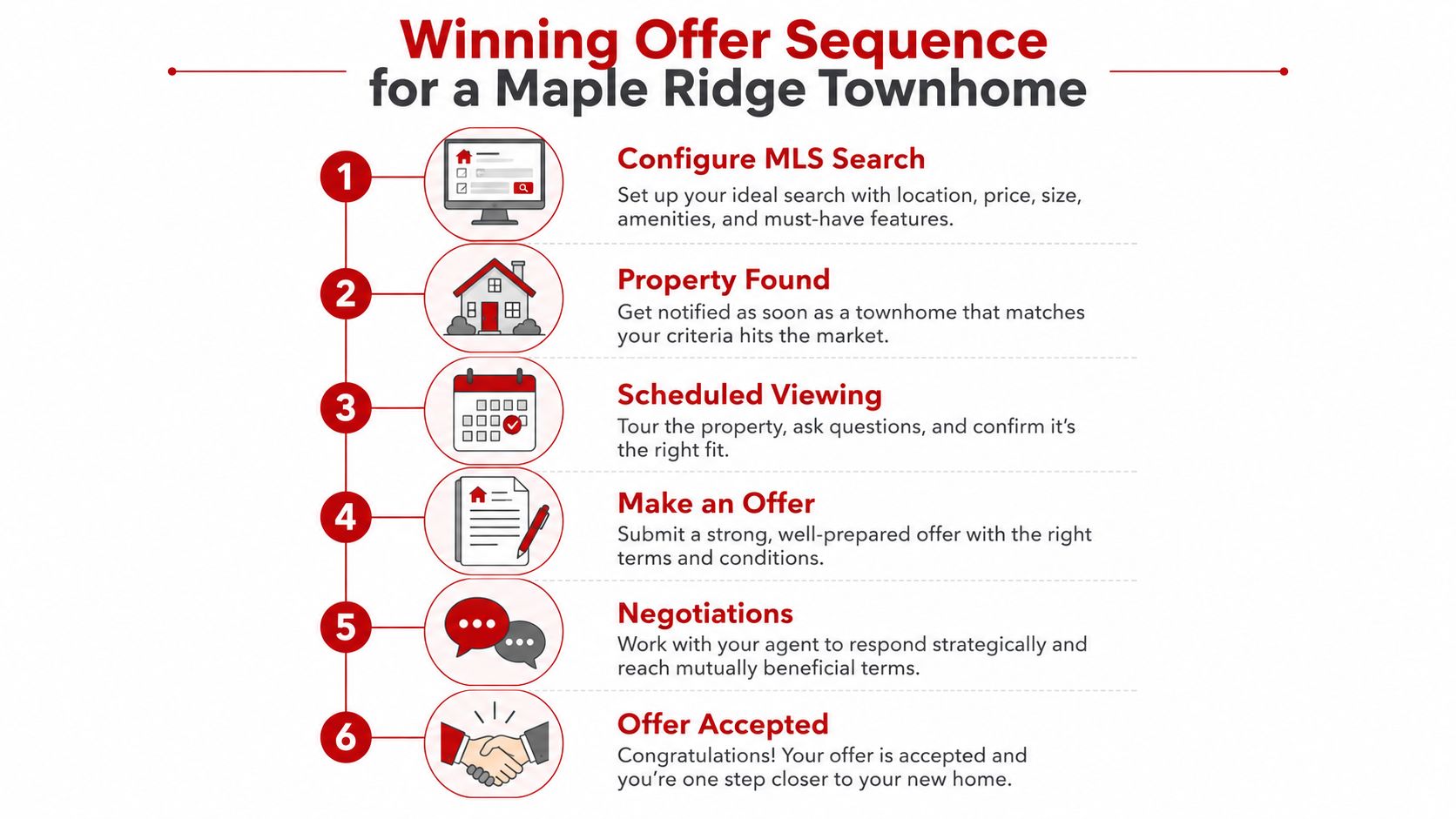
A representative Maple Ridge townhome search starts with filters, not wishful scrolling. The buyer's agent should set the search for the right property type, strata age, rental restrictions, parking count, and acceptable neighbourhoods. Off-market conversations, agent networks, upcoming listings, and cancelled listings can also reveal opportunities that a standard alert misses.
The buyer then visits a promising townhome at more than one time of day when possible. Morning traffic, evening parking, noise, visitor stalls, sunlight, and pedestrian activity can change the impression completely. The buyer should request available strata council minutes and review the depreciation report for a condo or townhome complex that is more than 15 years old.
A representative offer sequence
A townhome in Albion looks suitable on paper. It has the required bedrooms, parking, and access to shopping, but the buyer still compares the strata fee, insurance arrangements, maintenance history, and total monthly cost against two alternatives.
The first viewing confirms the layout. A second look focuses on windows, plumbing, flooring, attic or crawl-space access where applicable, drainage, appliances, and signs of moisture. The buyer's agent then prepares an offer with a deposit, financing subject, inspection subject, and strata-document review subject. The dates should give the buyer enough time to complete real due diligence, not just enough time to appear aggressive.
The seller counters on price and asks for an earlier subject-removal date. The buyer can improve the offer without blindly increasing the price by shortening the removal period, presenting a clean and organised subject list, or accommodating the seller's preferred possession date. A second counter may follow. If the seller demands waived financing or inspection conditions that expose the buyer to unacceptable risk, walking away is the correct move.
Subject removal requires discipline
Financing should be confirmed against the specific property, not just the buyer's income. The inspection should identify defects and likely near-term repairs, while the strata package should be checked for bylaws, meeting minutes, insurance, maintenance plans, litigation, and special assessments. If financing approval slips, the buyer should contact the lender and agent immediately, before a deadline passes.
A competitive offer isn't the highest offer. It is a credible offer with a price the buyer can carry, conditions that protect the buyer, and dates the seller can trust.
Inspections, Closing Costs, and First-Time Buyer Incentives
The closing budget begins with the offer price and then adds every cost required to take possession. A buyer who only models the mortgage can be caught by property transfer tax, legal work, inspection, appraisal, title insurance, tax adjustments, strata adjustments, insurance, moving costs, and immediate repairs.
British Columbia's first-time home buyer property transfer tax exemption is threshold-based. The province provides a full exemption when fair market value is $500,000 or less, a flat $8,000 exemption between $500,000 and $835,000, and a partial phase-out from $835,000 to $860,000. The official B.C. first-time home buyer property transfer tax exemption guidance should be checked before writing an offer because eligibility depends on the specific purchase and buyer circumstances.
The threshold matters in Maple Ridge. A townhome near an exemption cutoff can have a very different cash-to-close requirement from one priced just above it. The offer strategy should therefore consider total acquisition cost, not just the monthly mortgage payment.
A representative $750,000 purchase
A $750,000 Maple Ridge townhome falls within the range where the stated flat exemption may apply if the buyer qualifies. The table below separates known planning categories from costs that must be confirmed by the buyer's professionals.
| Line Item | Estimated Cost |
|---|---|
| Down payment | Based on buyer's selected percentage |
| Property transfer tax | Subject to eligibility and applicable B.C. exemption |
| Legal or notary fees | Confirm quote |
| Home inspection | Confirm quote |
| Appraisal | Confirm lender requirement and fee |
| Title insurance | Confirm legal quote |
| Property tax adjustment | Confirm statement of adjustments |
| Strata fee adjustment | Confirm statement of adjustments |
| Insurance setup | Confirm insurer quote |
| Moving and immediate repairs | Set a separate reserve |
Legal fees and inspection costs vary by provider and property complexity, so buyers should request written quotes rather than rely on a generic figure. The lender may require an appraisal, and the notary or lawyer will calculate title, tax, strata, and other adjustments for completion.
Review the property, not just the paperwork
An inspection can identify moisture, drainage, structural concerns, electrical issues, appliance condition, and signs of deferred maintenance. Older Maple Ridge homes may also require closer attention to radon risk, poly-B plumbing in some 1970s and 1980s inventory, and repairs that become apparent in estate sales. For strata properties, meeting minutes and the depreciation report can reveal maintenance plans or special assessments that aren't visible during a showing.
New construction requires a separate GST review. Buyers should confirm whether GST applies, whether the advertised price includes it, and whether any rebate or eligibility issue changes the cash required. Resale homes are treated differently, so the buyer's lawyer, notary, and lender should confirm the exact calculation.
The federal First-Time Home Buyer Incentive was announced in Budget 2019, launched on September 2, 2019, and discontinued on March 31, 2024 after uptake fell short of expectations. It operated as a CMHC shared-equity mortgage, contributing 5% to 10% of a purchase, with a $1.25 billion cap over three years. Eligibility included a maximum qualifying income of $120,000 and a borrowing limit of four times income. Statistics Canada's program background also reported that B.C. first-time buyers had a median purchase price of $530,000 in 2020, about $100,000 below repeat buyers, while 2023 data showed B.C. was the only jurisdiction where first-time and repeat buyers had similar median family incomes. The incentive is historical, not an available current funding option.
CMHC's 2026 Mortgage Consumer Survey reported that 72% of first-time buyers were renting before buying, with an average rental period of 7.6 years. CMHC's 2026 survey highlights why saving plans must account for rent, insurance, and changing closing costs over time.
A printable purchase checklist
Before shopping
- Confirm the funds: Document the down-payment source, including RRSP, TFSA, and family gifts.
- Prepare the file: Pull credit information and gather T4s, Notices of Assessment, pay stubs, bank statements, and debt records.
- Secure financing: Obtain written pre-approval from a lender who understands Maple Ridge and Pitt Meadows strata properties.
During the search
- Narrow the map: Shortlist two or three neighbourhoods based on commute, schools, parks, and total ownership cost.
- Inspect the fit: Attend open homes in Albion and Silver Valley, compare strata fees, and save only listings that fit the full budget.
- Compare buildings: Review age, parking, storage, insurance, maintenance, bylaws, and likely repair exposure.
At the offer stage
- Protect financing: Confirm the financing subject against the specific property.
- Schedule inspection: Set an inspection subject with a 7 to 10 day window where the transaction allows it.
- Review strata records: Obtain the strata package, minutes, depreciation report, bylaws, budget, insurance information, and notices of special assessments.
- Price the close: Confirm property transfer tax treatment, legal fees, appraisal, title insurance, tax adjustments, strata adjustments, and the insurance quote.
Before completion
- Plan possession: Book movers for possession day and arrange the key handoff.
- Transfer services: Set up utilities and insurance before possession.
- Update records: Notify B.C. Assessment and change the mailing address.
- Finish the file: Sign completion documents and confirm the funds transfer with the notary or lawyer.
The gap between subject removal and possession is typically 2 to 4 weeks, so buyers should organise insurance, movers, utilities, and banking well before the keys are released. A practical next step is a 20-minute introduction call with a buyer's agent who tracks Maple Ridge and Pitt Meadows inventory weekly, so the search begins with current listings and neighbourhood data rather than stale alerts.
Royal LePage Brookside Realty Property Management offers buyer guidance, seller services, market valuations, negotiations, and property management support in Maple Ridge and Pitt Meadows. Buyers ready to compare neighbourhoods, calculate total acquisition cost, or plan a first purchase can visit Royal LePage Brookside Realty Property Management to arrange a local conversation.