You're standing in a Maple Ridge driveway, looking at a two-bedroom townhouse on one side of the street and a tired detached starter home on the other, and the question isn't “which is bigger?” It's which one fits your life without forcing you to carry the wrong kind of risk.
For a young couple in Cottonwood, a townhouse can be the difference between entering the market now or waiting and hoping. For a retiree in Kanaka Creek, a ground-level rowhome can mean less yard work, less maintenance, and fewer weekend chores. For a family trying to move up, a detached home still has appeal, but only if the extra space is worth the much bigger jump in ownership cost and responsibility.
Maple Ridge isn't a one-size-fits-all market. Detached homes still anchor the local family-home market, but townhouses have become the practical alternative for buyers who want ground-oriented living without taking on the full burden of a house. That's the conversation here, not a generic “house versus townhouse” debate.
| Property Type | What You're Really Buying | Best For |
|---|---|---|
| Townhouse | Shared walls, shared maintenance, lower entry cost | First-time buyers, downsizers, mobility-focused households |
| Single Family Home | Land, privacy, full control, full responsibility | Upsizers, multi-generational households, renovation-minded owners |
What This Choice Actually Looks Like in Maple Ridge
A townhouse versus single family home decision in Maple Ridge usually starts with a life-stage question, not a style preference. A couple in Cottonwood might be trying to get into a newer complex without giving up too much space, while a retiree in Kanaka Creek may be trying to trade chores and upkeep for convenience. Those are not the same buyers, and they should not be shopping the same way.
Two very different ownership experiences
A strata townhouse gives a buyer shared walls, common-area upkeep, and a monthly fee that covers parts of the property the owner doesn't manage alone. A single-family home is the opposite, the owner carries the roof, the yard, the repairs, the insurance decisions, and all the surprise bills that show up when something ages out.
That difference matters in Maple Ridge because the city's housing stock still leans heavily toward detached homes. In the 2021 Census, Maple Ridge recorded 33,105 occupied private dwellings, and 52.6% were single-detached houses Maple Ridge real estate report. That tells buyers exactly why detached homes still set the tone for local pricing, even though townhouses remain a major part of the market.
The right choice also depends on how long the buyer plans to hold the home. A buyer staying three to seven years should think about liquidity, carrying costs, and how quickly the property can be resold. A household planning to stay for the long haul can afford to prioritise control and privacy more heavily.
Practical rule: if the extra space in a detached house doesn't materially improve daily life, the premium is usually too high to justify.
For Maple Ridge buyers, that's the basic filter. First-time buyers usually want the lower barrier to entry. Upsizers want room to grow. Downsizers want less upkeep and a cleaner exit later.
Brookside Realty's Maple Ridge market overview is a useful starting point for buyers who want to see how local neighbourhood patterns affect that decision.
Price, Benchmarks, and the Affordability Gap
Maple Ridge pricing makes the townhouse versus single family home decision easy to see. At benchmark level, a townhouse sat at $718,100, while a single-family detached home reached $1,184,800 Maple Ridge market report. The gap was $466,700, and that difference changes the mortgage, the down payment, the stress test, and the monthly carrying cost.
Detached homes were about 65% more expensive than townhouses at benchmark level Maple Ridge market report. Townhouses were priced at about 60.6% of detached homes in Maple Ridge BCNREB stats. That is why a townhouse is the starting point for so many buyers here, even for people who would rather own a house.
A buyer putting 20% down faces a very different cash commitment depending on the property type. On the townhouse side, the down payment stays much more manageable, and the mortgage amount is easier to qualify for. On the detached side, the bigger price tag raises the bar fast, and plenty of buyers feel that before they ever reach a showing.
The local numbers also show that both segments softened year over year. Townhouses were down 7.9%, detached homes were down 6.4% Maple Ridge market report. That does not close the gap. It keeps the detached premium front and centre.
| Maple Ridge Price and Affordability Snapshot | Townhouse | Single Family Home |
|---|---|---|
| Benchmark price | $718,100 | $1,184,800 |
| Premium over townhouse | N/A | $466,700 higher |
| Relative price level | 60.6% of detached | 100% |
| Year-over-year change | Down 7.9% | Down 6.4% |
| Typical entry point | Lower | Higher |
Sales volume shows the same split. In the Maple Ridge snapshot, there were 32 attached-home sales and 80 detached sales in the month, with attached sales down 25.6% from a year earlier and detached sales up 25% from June Maple Ridge market report. Buyers should read that as two separate markets, not one market with two styles.
If you want a clean local price check before touring homes, Brookside Realty's Maple Ridge home pricing page is a solid place to start.
Monthly Costs, Strata Fees, and Maintenance Reality
The monthly bill for a townhouse and a detached house goes beyond the mortgage. Maple Ridge buyers need to look at mortgage, taxes, insurance, utilities, strata fees, and the money set aside for repairs. In a lot of cases, the lower townhouse price still leaves more breathing room each month.
| Monthly Cost Breakdown by Property Type | Townhouse (monthly) | Single Family Home (monthly) |
|---|---|---|
| Mortgage | Lower because purchase price is lower | Higher because purchase price is higher |
| Property taxes | Usually lower | Usually higher |
| Strata fees | Yes, ongoing | Usually no strata fee |
| Insurance | Often lower personal exposure | Full owner responsibility |
| Utilities | Shared in some cases, more predictable | Full owner responsibility |
| Maintenance reserve | Smaller, but still needed | Larger, because every system is yours |
When something ages out in a detached home, that owner covers the full cost alone. In a townhouse, strata fees spread that burden across the project. A roof repair, fence replacement, or exterior envelope issue still gets paid for, but the hit is not dumped on one owner in one brutal month.
A $250 monthly strata fee does not stay small. Over a 15-year hold, it adds up to $45,000, before special levies or fee increases tied to reserves, roof work, depreciation reports, or insurance pressure.
That is the trade-off buyers need to face. Detached owners avoid strata fees, but they also carry the full shock of a furnace failure, gutter replacement, or deck membrane issue. In a Maple Ridge house, those bills land directly on the owner's side of the ledger.
If you want to understand how shared ownership works, what a strata property means in BC gives the basics in plain language. For anyone thinking about renting later, condo rental legal advice is worth reading, because bylaws, lease rules, and permission limits can change how flexible the property really is.
The right choice depends on what kind of owner you are. Detached homes give you more privacy and more control, but they also demand more cash and attention when systems fail. Townhouses give you more predictability and less solo maintenance risk. A young family often wants the yard and the freedom to live a little louder. An empty-nester usually prefers fewer exterior jobs and less pressure to manage every repair alone.
Neighbourhood Fit Across Maple Ridge and Pitt Meadows
Property type and neighbourhood should be judged together, not separately. A townhouse in one pocket can make a lot more sense than a detached home in another if the commute, schools, and day-to-day errands line up better.
Where each product fits best
Albion is the cleanest mixed example. It has newer townhouse complexes, family-oriented streets, and easier access to schools and transit than many older parts of town. Silver Valley and Cottonwood lean harder toward detached buyers who want bigger homes, trail access, and a quieter suburban feel, even if walkability is limited.
West Maple Ridge gives buyers older detached stock, mature trees, and a more established neighbourhood feel, but the trade-off is aging infrastructure and homes that can need more work sooner. Kanaka Creek usually appeals to buyers chasing a more upscale detached setting on the ridge, where privacy and house size matter more than convenience.
Pitt Meadows deserves a mention because it gives detached buyers a different value profile, plus a smaller townhouse pocket near the West Coast Express for commuters who want direct access to downtown travel. That station access matters to buyers who work in the city and don't want to build their life around highway traffic.
| Neighbourhood Fit by Property Type | Best Fit | Schools Nearby | Transit Access | Amenity Strength |
|---|---|---|---|---|
| Albion | Townhouse or detached | Maple Ridge Secondary, nearby family catchments | Bus routes and car-friendly access | Strong for schools and new development |
| Silver Valley | Detached | Local family schools nearby | More car-dependent | Strong nature and trail access |
| Cottonwood | Detached or townhouse | Garibaldi Secondary area | Lougheed corridor bus access | Strong for shopping and family routines |
| West Maple Ridge | Detached | Maple Ridge Secondary area | Some bus connectivity, but car helps | Mature streets and established neighbourhood feel |
| Kanaka Creek | Detached | School access via nearby catchments | Less transit-centric | Quiet, upscale, and residential |
| Pitt Meadows townhome pocket | Townhouse | Pitt Meadows Secondary catchment | West Coast Express access | Strong for commuters and compact living |
Brookside Realty's Maple Ridge and Pitt Meadows family guide helps buyers compare the two communities without guessing.
The simple call here is this. Detached homes suit upsizers who care most about space, privacy, and the freedom to spread out. Townhouses suit first-time buyers and downsizers who want convenience, shorter maintenance lists, and a location that keeps daily life moving.
Why a Townhouse Can Be the Smarter Buy
Detached homes carry prestige, but carrying costs decide the better move for a Maple Ridge buyer planning a 3 to 7 year hold. A well-located townhouse usually makes more sense because the risk is lower and the resale pool is broader. That matters even more when the detached premium is sitting at nearly half a million dollars.
Why the shorter hold matters
Townhouse demand stays more practical during rate shifts because buyers are balancing entry price and livability at the same time. In Greater Vancouver, townhome sales rose 11.4% year over year to 527 in June 2026 even as the benchmark price fell 5% GVR stats package. Broader BC townhome pricing was also down 7.1% year over year to $757,300 in July 2026 GVR stats package. That is the attached-housing market doing what it usually does, attracting buyers even when conditions get choppy.
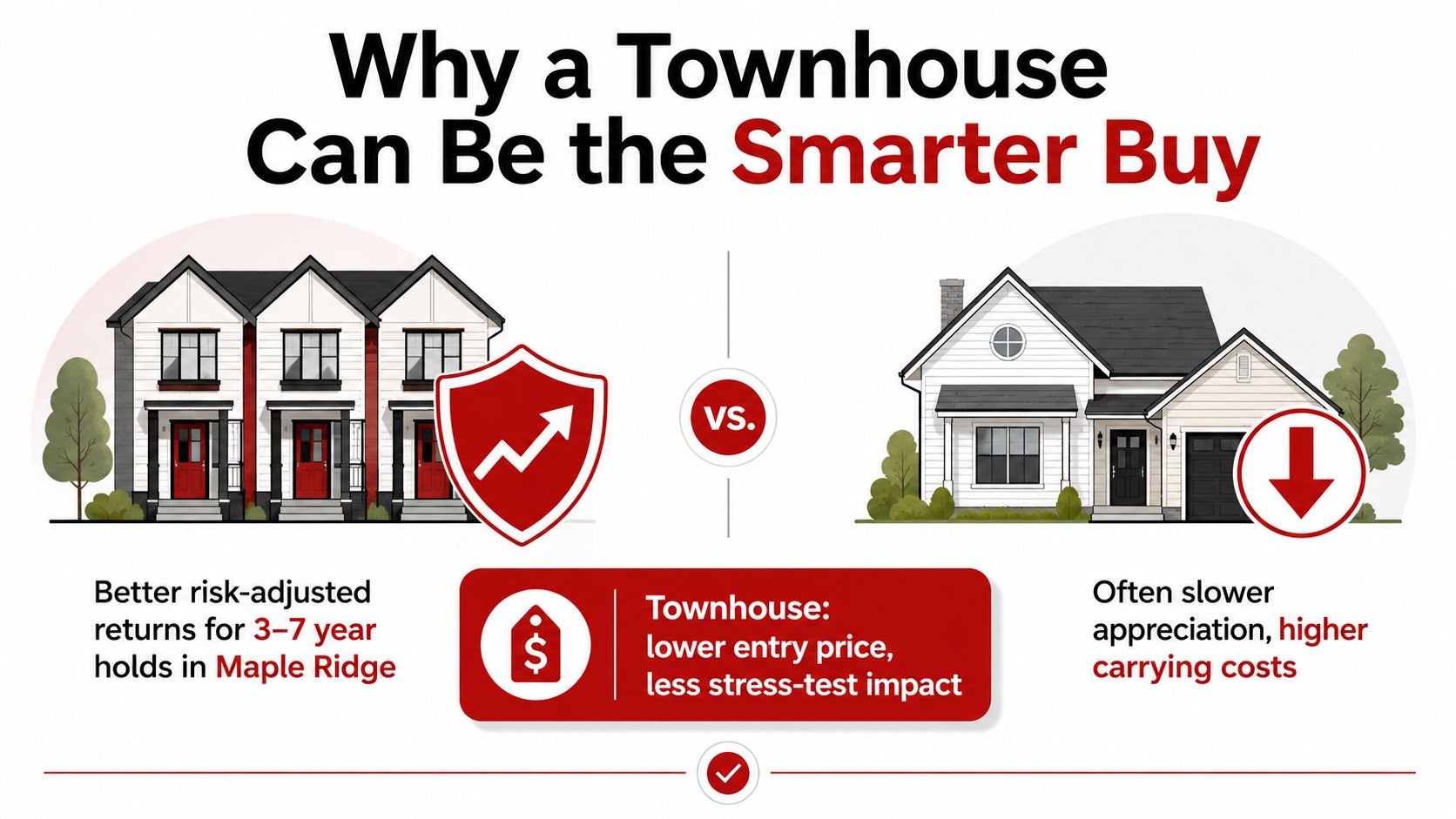
A townhouse also fits daily life better if the owner travels, works odd hours, or wants less to manage at home. That lock-and-leave advantage matters more than people admit. Downsizers want it too, because lower maintenance and less stress when leaving town make ownership easier to live with.
Liquidity beats romantic thinking
A lower entry price leaves room for renovations, emergency reserves, or a future move-up plan. That flexibility lowers risk instead of forcing every dollar into a larger mortgage.
The resale side matters just as much. If a townhouse is well run and the fees are reasonable, it usually sells into a deeper buyer pool than a detached home with heavy carrying costs. That is the point buyers miss when they assume the bigger house is automatically the smarter asset.
For readers who want a broader ownership lens, Fresno townhouse ROI analysis is a useful reminder that attached housing tends to hold attention where buyers care about entry cost, convenience, and resale depth. Maple Ridge works the same way. A townhouse with sensible strata fees and a practical layout is easier to sell, easier to carry, and easier to live with than a detached home that stretches the budget.
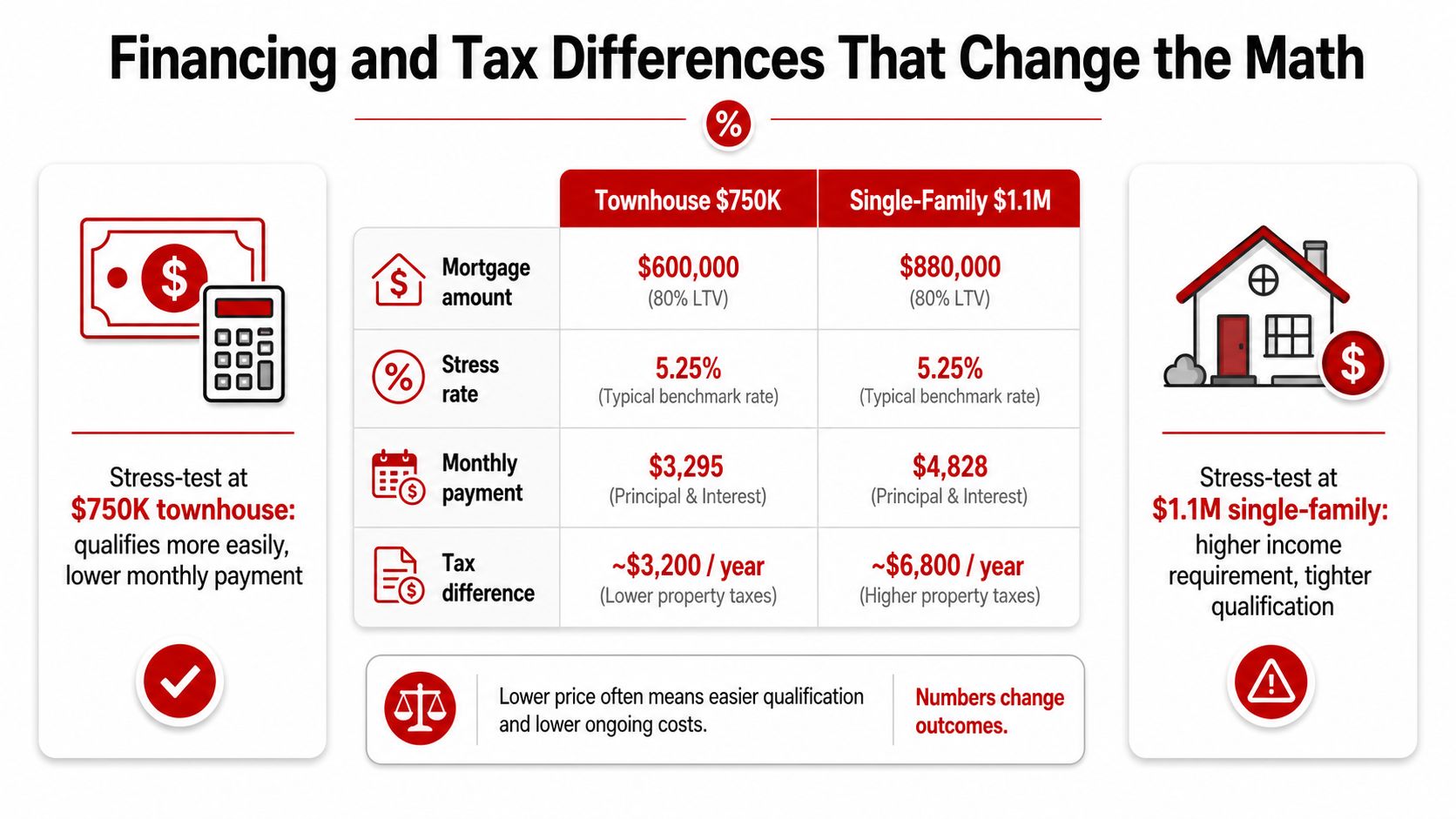
Financing and Tax Differences That Change the Math
A buyer in Maple Ridge feels the financing gap fast. A $750,000 townhouse usually leaves more room to qualify than a $1.1 million detached home because the mortgage is smaller and the monthly payment is easier to carry. Same income, different approval picture.
The tax rules people keep mixing up
The BC principal residence exemption applies to both property types if the home meets the rules. In British Columbia, the property has to be designed for and used to accommodate three or fewer families, only one principal residence can be claimed at a time, the land must be 0.5 hectares or smaller, and the property must be classified as residential by BC Assessment BC principal residence exemption principal residence guide.
That is the part buyers miss. A detached house does not get a special break just because it is detached. The structure and land size decide the tax treatment, not the label on the listing.
The First Time Home Buyers' Program often tilts toward townhouses. In BC, the home must be used only as the buyer's principal residence, be $835,000 or less effective April 1, 2024, be 0.5 hectares or smaller, and contain only residential improvements first-time home buyer exemption. That threshold catches more townhouses than detached homes in Maple Ridge and Pitt Meadows. If you are buying your first place, a good BC first-time buyer guide should be part of your offer prep, not an afterthought.
Where detached starts costing more
BC's property transfer tax already uses a tiered structure, and residential property over $3,000,000 gets an additional 2% tax on the portion above that amount BC property transfer tax. That is not a common Maple Ridge issue, but it matters once buyers push into higher-end detached markets and start stretching their cash.
Strata fees deserve a straight answer too. Only the contingency reserve fund portion is deductible where the work is performed. Buyers who compare a townhouse to a detached home need to factor that in, because the fee line on a monthly budget is not pure waste, and it is not fully interchangeable with mortgage principal.
The practical rule is simple. Townhouses fit first-time buyers, buyers using exemptions, and households that want steadier monthly costs. Detached homes fit buyers with stronger income, larger down payments, and a real appetite for land ownership, higher carrying costs, and longer hold periods.
Your Local Decision Checklist and Negotiation Tips
A Maple Ridge buyer should stop asking only, “Can this home fit the budget?” The better questions are more practical. How long is the hold period? Does the monthly fee still work if it goes up? Is the property easy to live in on a wet Tuesday after school pickup or after a late shift?
What to check before the second showing
- Hold period first: If the plan is three to seven years, a townhouse often fits better because it reduces entry cost and keeps resale options open.
- Strata fee tolerance: A monthly fee in the $350 to $550 range can be perfectly manageable for the right buyer, but only if it sits comfortably inside the whole housing budget.
- Document health: Ask for the strata's contingency reserve information and the latest depreciation report, because weak documents can turn a “good deal” into a future assessment problem.
- Lot and orientation: Check whether the outdoor space works for pets, kids, a home office, or simple privacy. A poor layout is annoying every day, not just on showing day.
- Noise and access: Return after work hours if possible. Shared walls, visitor parking, and street traffic all feel different once the neighbourhood is busy.
- Resale path: Study who is likely to buy the home later. A wide buyer pool usually means less risk when it is time to sell.
Negotiation rule: don't waive the strata review just because the unit looks tidy. Clean paint hides more problems than people think.
Buyers should also ask for recent capital work invoices when a townhouse or older detached home has obvious maintenance history. Roof work, envelope repairs, fencing, drainage, and parking lot upgrades all affect value, and sellers who have already paid for them often need reminding that those improvements support the ask.
Detached homes with older systems can also be used in negotiations. If the property is carrying outdated features or visible maintenance needs, the townhouse-versus-detached price gap gives the buyer room to ask for credits or a sharper number. That's especially true when a townhouse complex has healthy documents and the detached property clearly needs attention.
Timing matters too. West Coast Express commuters create a different rhythm in the market, so listings near station access can show better at certain times of day when buyers are thinking about real travel patterns instead of just square footage.
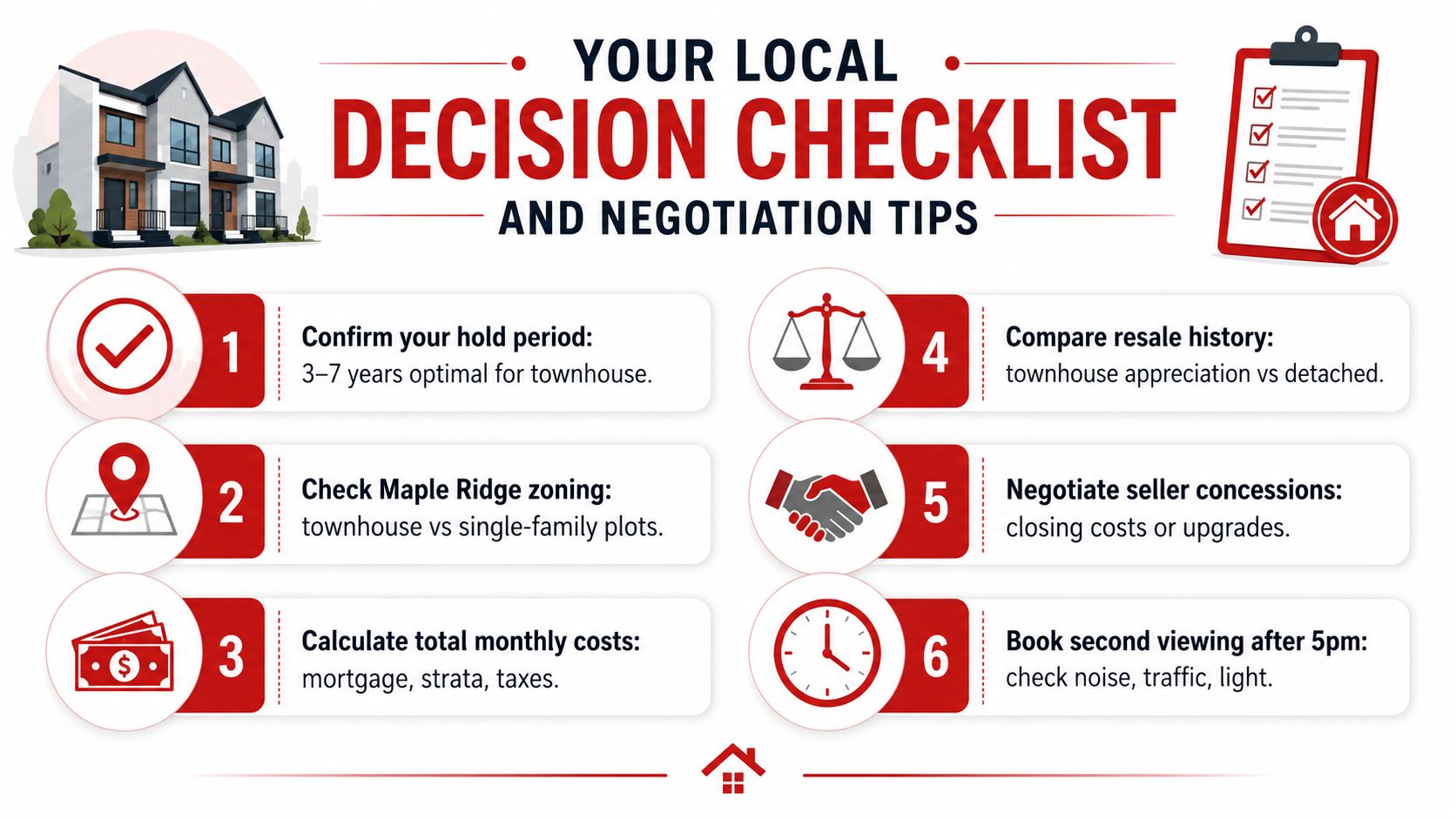
The recommendation is straightforward. Choose a townhouse if the hold period is under seven years or if mobility matters. Choose a detached home if multi-generational living, renovation freedom, or a full private lot is the priority.
Royal LePage Brookside Realty Property Management can help buyers and owners compare Maple Ridge townhouse and detached-home options with local pricing, rental, and ownership context in mind. Visit Royal LePage Brookside Realty Property Management if you want a neighbourly, straight-shooting conversation about what fits your budget, your hold period, and your next move in Maple Ridge or Pitt Meadows.