A tenant can look perfect at the showing in Albion, show up on time, speak politely, and still carry rental history that changes the whole decision. That's the part many Maple Ridge landlords learn after the fact, especially when a bright, friendly application for a Silver Valley suite turns out to hide old evictions, incomplete income details, or a reference that sounds convincing until the numbers don't line up. Tenant screening services sit between that first handshake and a lease you have to live with.
For a landlord or property manager in Maple Ridge or Pitt Meadows, screening is less about suspicion and more about evidence. A solid report helps separate the applicant who's stable from the one who looks polished but leaves a trail of unresolved issues. It also matters because the modern screening market has become more concentrated and data-driven, with the CFPB's 2022 market report citing an industry estimate of about US$1.3 billion in annual revenue for tenant screening services, alongside a fragmented history that has since narrowed into a smaller group of major providers (CFPB market report).
What Tenant Screening Services Do
A detached suite in Silver Valley can seem like an easy lease until a landlord skips proper screening and later learns the applicant had two prior evictions in Coquitlam. That is the kind of problem a screening service is meant to catch before the keys change hands. The report does not replace judgement, but it gives a landlord a structured way to verify who is applying, what is in the file, and whether the story matches the paperwork.
A packaged decision tool, not just a credit pull
A tenant screening service is a bundled process that gathers rental-risk information and presents it in one report. The Consumer Financial Protection Bureau says a tenant screening report can include credit reports, rental-history information such as eviction actions and lawsuits, and even a national terrorist watchlist, which is a useful reminder that screening is broader than a simple credit check (CFPB tenant screening report overview). In practice, that package often includes identity, credit, eviction, criminal, income, and reference data.
For a Maple Ridge landlord, the benefit is practical. Instead of phoning a prior landlord, Googling the applicant's name, and trying to interpret a credit file from a free consumer site, the service organises the information into one workflow. That matters in busy rental pockets like Cottonwood, where good units do not sit empty for long and weak applications need to be sorted quickly.
Practical rule: screening is a safety net, not a replacement for common sense. A polished application still needs source data behind it.
The industry grew into standardized reporting after years of consolidation, which is why most landlords buy screening rather than building their own process from scratch. The CFPB's market report describes an informal 2006 estimate of as many as 650 tenant-screening companies, followed by a move toward fewer major providers (CFPB market report).
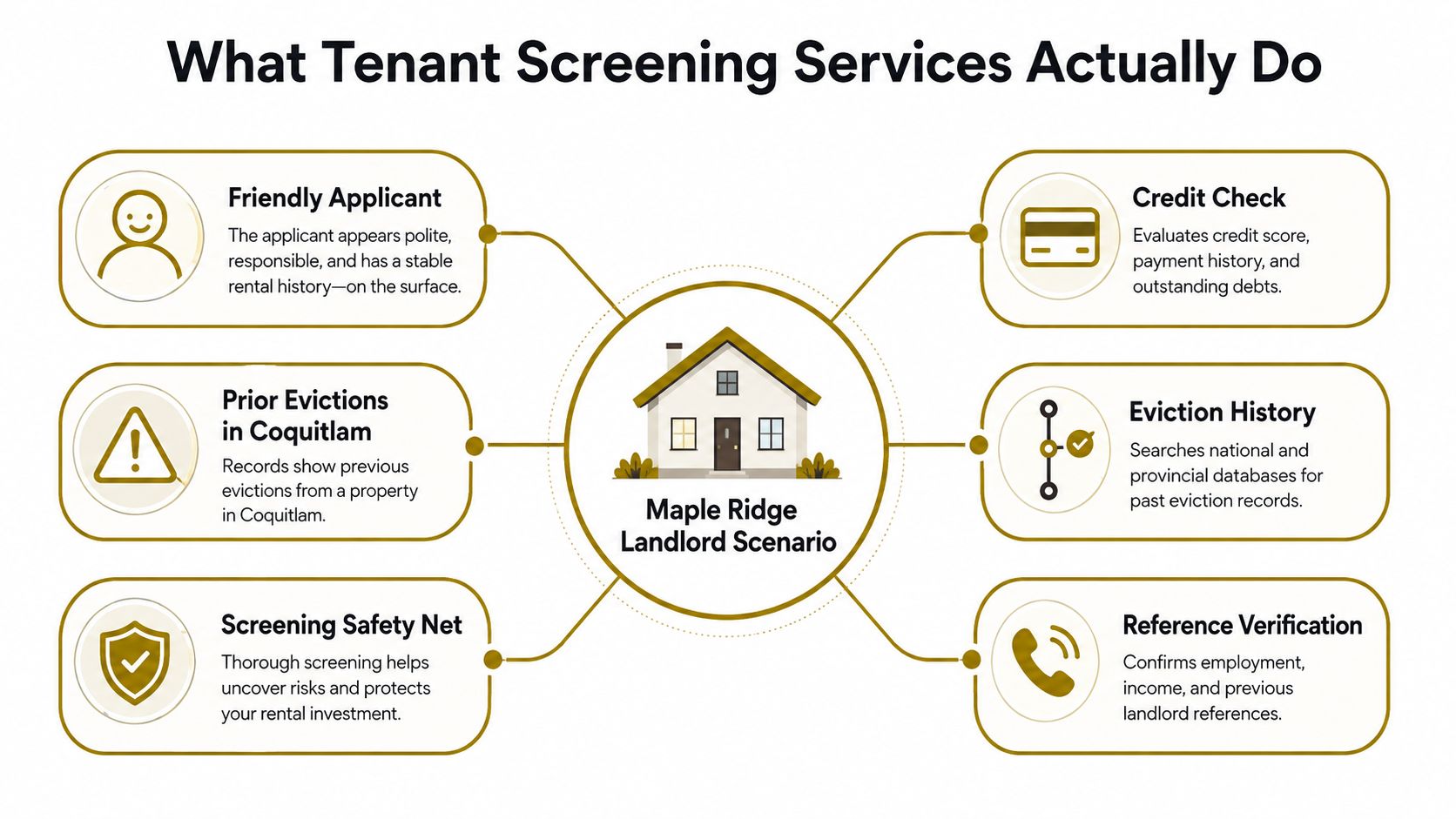
A modern report should give a Maple Ridge landlord a turn-key view of the applicant's background, plus enough detail to review any oddities manually. For a simple checklist before the deeper checks, use this tenant screening checklist. A good service does not just hand over raw data. It helps a landlord compare the application against the records, spot gaps in income or rental history, and decide where a follow-up question is needed.
A report also changes how fast you can work through real local scenarios. In Pitt Meadows, where a family may present strong references but limited credit history, the report can keep the conversation focused on verified facts instead of guesses. In a basement suite application near Albion, it can separate a clean file from one that looks tidy on the surface but hides missing addresses, inconsistent employment details, or references that do not line up once you call back.
The Core Checks Every Screening Report Covers
An Albion basement-suite application can look tidy on the surface. The applicant may have steady work, a current landlord who answers the phone, and a credit file that seems fine at first glance. A proper screening service checks that story against more than one source, because each part catches a different kind of problem.
Identity, credit, and rental history
Identity verification confirms the applicant is the same person attached to the records being pulled. That sounds basic, but it prevents file mix-ups before they turn into the wrong decision. Credit history then shows payment habits, outstanding debt, and patterns that point to stability or stress.
In a Maple Ridge file, a credit report might show a discharged consumer proposal. That is not the same as active non-payment, but it still needs context. The report should not make the decision on its own, the landlord should. A fair review asks whether the issue is old, resolved, and consistent with the rest of the applicant's file.
Eviction and court records are the next layer, and they need careful reading. A dismissed filing and an actual judgment are not the same thing, and automated screening can overstate risk if it treats them as equal. A landlord should check how the record was entered and whether the outcome is clear before relying on it.
Income, employment, and references
Income and employment confirmation helps verify that the applicant can handle the rent they are applying for. That does not require a forensic audit, but it should mean more than accepting a screenshot or PDF at face value. In a tight rental market, that extra check can prevent a rushed decision based on the first applicant who sounds convincing.
Landlord references still matter, but only when they are checked properly. A reference who says they manage a unit in Cottonwood but cannot recall the monthly rent, the move-in date, or whether the applicant ever paid late is a weak signal dressed up as reassurance. References work best as a confirmation tool, not the main decision point.
Social behaviour can also create false confidence. A landlord who wants to look at what an applicant presents publicly should read the cautions in this article on private social media posts and screening traps before drawing conclusions from casual online content.
Professional Service vs DIY Landlord Screening
A DIY landlord in Pitt Meadows can certainly run a few checks, but that doesn't make the process equal to a managed screening service. Free credit sites, ad hoc phone calls, and a quick Google search create the feeling of diligence without the structure of a defensible process. The weak point is usually not effort, it's completeness and consistency.
What the complaint data says about risk
The strongest recent complaint data available from a North American regulator shows why screening needs to be handled carefully. The CFPB received about 26,700 complaints related to tenant screening from January 2019 through September 2022, with monthly complaints rising from roughly 300 in January 2019 to nearly 700 by September 2022. More than 17,200 of those complaints involved incorrect information on a prospective renter's report, and another 5,000 concerned problems with investigations into existing issues (CFPB consumer snapshot).
That matters in real terms. If a record is wrong, the applicant may lose a Maple Ridge unit before the landlord even realises the report was flawed. In a market where demand is strong and turnover is costly, a bad match or a bad denial can be equally expensive.
The hidden cost of doing it yourself
DIY screening also shifts legal exposure onto the landlord. If a reference call is sloppy, if an eviction file is misread, or if an applicant is judged on an incomplete report, the landlord owns the result. That's where a managed service helps, not because it removes responsibility, but because it creates a repeatable workflow with cleaner documentation.
A screening process is only as good as the records it preserves. If the landlord can't explain why a decision was made, the process was too loose.
For a self-managing owner in West Maple Ridge, the question isn't whether free tools exist. The question is whether those tools produce a report that can stand up to a dispute, a correction request, or a Human Rights complaint. A process that saves a few dollars upfront can cost far more once the wrong applicant is approved or the right applicant is unfairly rejected.
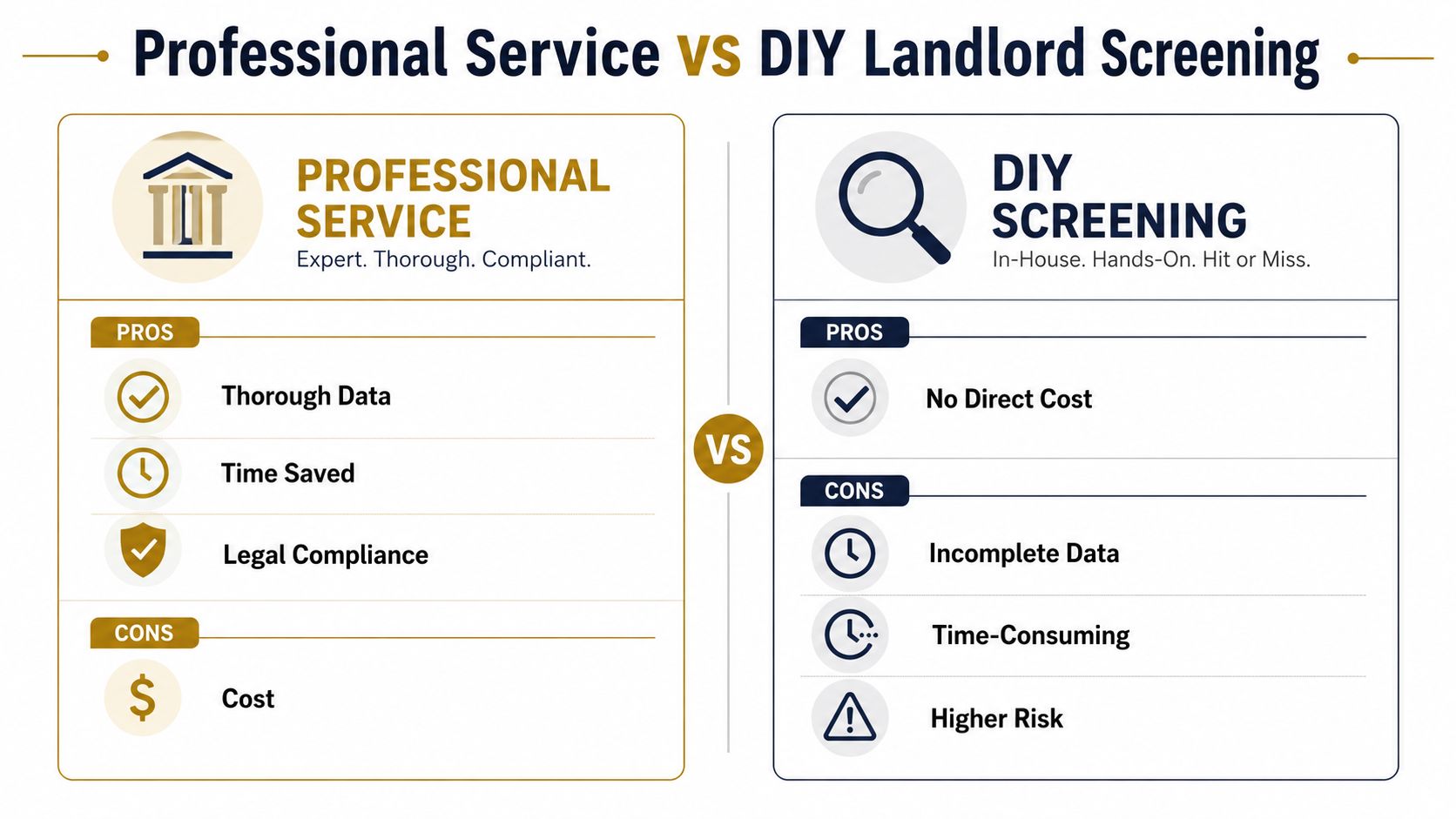
For property owners juggling listings, showings, and bookkeeping, a professional workflow usually earns its keep. A local guide to self-managing versus hiring property management in Maple Ridge is worth reading before assuming the DIY route is the cheaper one.
BC Legal and Privacy Considerations for Landlords
British Columbia landlords need to think differently from US-focused screening guides, because the legal environment is different. Privacy rules, consent, and fair treatment aren't optional extras here. A landlord in Maple Ridge who copies a generic American screening form without adjusting it is taking on unnecessary risk.
Privacy, consent, and written clarity
British Columbia privacy obligations run through PIPA, and information that crosses outside the province can also touch PIPEDA. That means a landlord should collect only what's relevant, explain why it's needed, and store it carefully. A screening process should not feel like a fishing expedition.
Washington law requires written notice before obtaining screening information, including the types of information, the denial criteria, and the consumer reporting agency's name and address when a consumer report is used (Washington RCW 59.18.257). BC does not automatically follow that rule, but the safest practice in Maple Ridge is still to be transparent. Applicants should know what will be checked, who will check it, and how they can correct an error.
Human Rights and fair use
The BC Human Rights Code is where screening mistakes often become avoidable disputes. Credit and criminal information can't be used in a discriminatory way, and a landlord should be careful not to let a screening report become a proxy for protected characteristics. That's especially important when an automated system presents a simplified yes-or-no answer without the details behind it.
The FTC's guidance for FCRA-covered screeners is a useful comparison point, because it reminds landlords that screening companies must use reasonable procedures, certify clients, provide required information, and honour applicant rights (FTC screening tenants guidance). British Columbia landlords should take the same disciplined approach even when the legal label differs.
A sensible consent form for a Maple Ridge rental should include:
- Applicant identity, with every adult occupant named
- Purpose of collection, tied to tenancy assessment
- Types of checks, such as credit, rental history, income, and references
- Consent language, signed and dated
- Correction path, so the applicant knows how to dispute an error
- Retention note, explaining how long the file is kept and how it's disposed of
For landlords who want a reference point on provincial tenancy rules, the local explainer on the BC Residential Tenancy Act is a useful companion. A practical consent form is the beginning of a fair file, not the end of one.

For landlords who also need help outside tenancy law, a similar consent mindset shows up in other screening contexts too, including a volunteer background check. The principle is the same, collect only what's relevant and make the process easy to understand.
Cost, Turnaround, and What Drives the Price
A cheap report often looks attractive until it fails to show the fields that matter. That's especially true for landlords comparing a bare-bones screening bundle against a more complete one in Maple Ridge. Price should track decision quality, not just how fast a dashboard loads.
Why field quality changes the value
Academic research on tenant-background-check assessment found that for eviction records, the two most critical fields are case type and judgment, and for criminal records, the key fields include disposition, offense degree, charge type, case type, and dates (tenant-background-check assessment study). That matters because a cheaper report that leaves those fields fuzzy is really handing over a flag, not a defensible decision.
A report in the lower-price range may still be useful for a quick first pass, but the landlord should know what's missing before relying on it. If the data can't show whether a filing was dismissed or how a record was resolved, the landlord is left to guess. Guessing is exactly where screening goes sideways.
Practical rule: pay for the fields that support a decision, not just the label at the top of the report.
What affects turnaround
Turnaround is usually tied to how much human review sits behind the report. Automated packages can return quickly, while manual verifications take longer when an employer, court clerk, or prior landlord has to be contacted. Same-day results are common for some automated checks, while more manual workflows can stretch to two days or more depending on the record.
For Maple Ridge landlords screening applicants in high-demand pockets like Silver Valley, speed still matters. A qualified renter won't wait forever while a landlord chases incomplete paperwork. The right balance is a report that is fast enough to keep good applicants engaged, but detailed enough to survive a closer look.
| Check | What It Measures | Typical Turnaround |
|---|---|---|
| Identity verification | Confirms the applicant matches the records | Same day |
| Credit history | Payment behaviour and debt profile | Same day |
| Eviction and court records | Rental dispute history and judgments | Same day to two days |
| Income and employment | Ability to support the rent | Same day to two days |
| Landlord references | Prior tenancy behaviour and communication | Same day to two days |
Red Flags, Decision Criteria, and Fairness
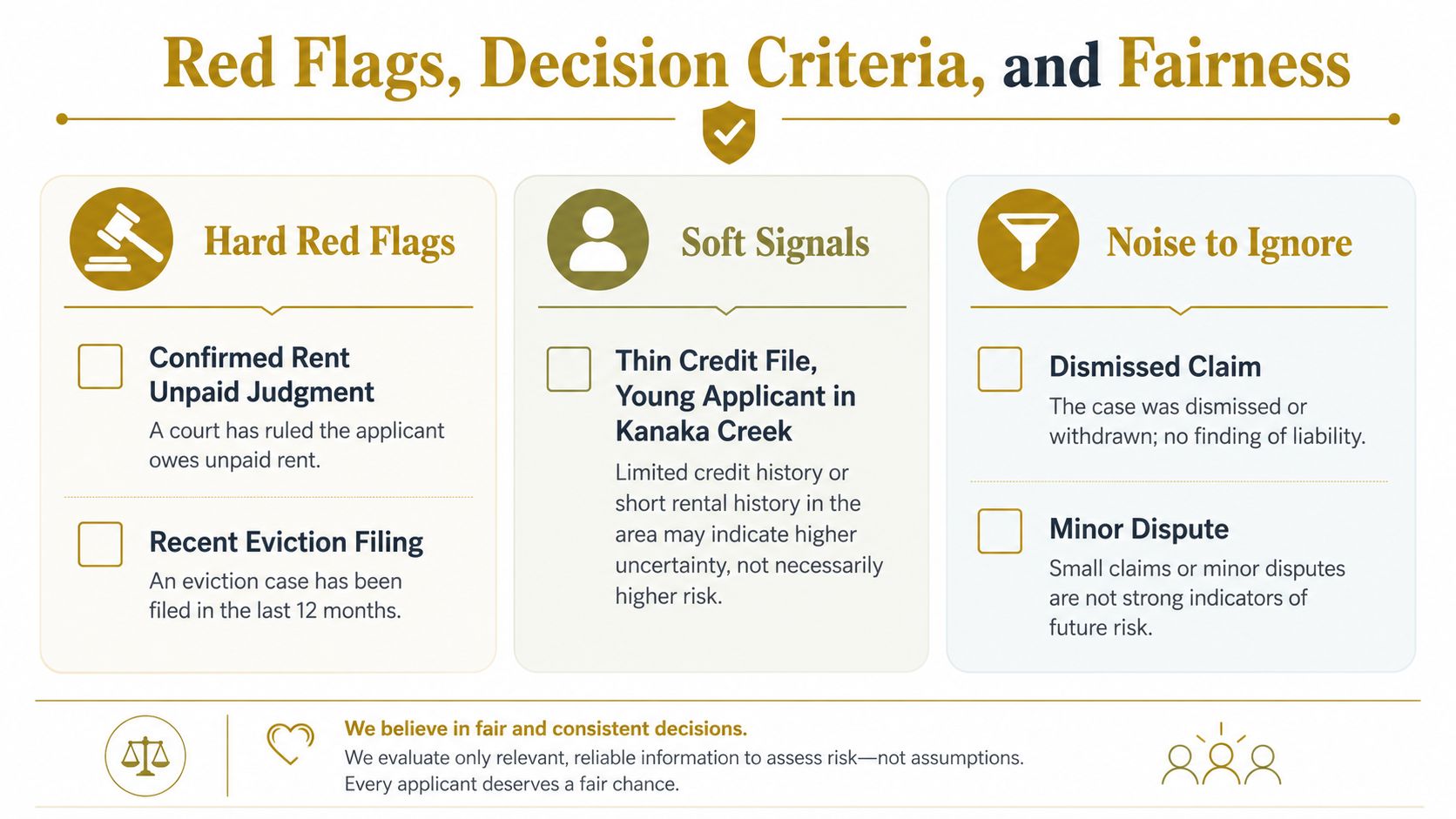
A thin credit file in Kanaka Creek doesn't mean the applicant is risky. A recent confirmed judgment for unpaid rent does. The problem for landlords is that automated systems often blur those categories, then leave the human decision-maker to sort out the mess after the fact.
Hard red flags, soft signals, and noise
Urban Institute research says tenant screening reports often rely on court records without unique identifiers, which can create erroneous matches and misleading reports. It also notes that eviction filings, not just judgments, are frequently used in screening even though many filings are dismissed or never result in a judgment (Urban Institute on tenant screening black box). That's a real risk in tight rental markets, where a bad match can keep a qualified applicant from getting a fair shot.
A workable matrix keeps the landlord consistent:
- Confirm the record. Make sure the name, dates, and outcome match the applicant.
- Check the age of the issue. Older problems may mean less than recent ones.
- Weigh the context. A dismissed filing is not the same as a judgment.
- Document the reason. Write down the business reason for the final decision.
Fairness is part of defensibility
BC landlords don't need to turn screening into a legal dissertation, but they do need a process that can be explained. Fairness under the BC Human Rights Code isn't a soft extra. It's what keeps the landlord from treating a noisy report as final truth.
If the file is unclear, the decision should be careful, not automatic.
For a young applicant with limited credit history, the fair answer may be to request stronger income verification or a co-signer rather than slam the door. For a record that looks questionable because of a dismissed filing, the landlord should verify before acting. That kind of discipline protects both the rental and the applicant.
Putting It Together and Working With a Local Property Manager
A screening file in Maple Ridge or Pitt Meadows should move in a fixed order. Consent comes first, then the application, then the checks, then a manual review of anything that looks odd, then a written decision. If that order changes from applicant to applicant, the process gets harder to defend and the file stops telling a clear story.

That order matters even more in local cases. An applicant for a basement suite in Albion who has strong income but a thin credit file needs a different review than someone applying for a family home in Cottonwood with a recent eviction note that turns out to be a dismissed filing. Automated reports often over-weight the loudest item on the page, while a local property manager looks at the rental history, the neighbourhood fit, and whether the story holds together.
A local manager also has to keep BC privacy and Human Rights rules in view while making the call. Personal information should be collected only for the rental decision, stored carefully, and shared only with the people who need to see it. If the screening result is unclear, the decision needs to be careful and explainable, especially when a protected ground may be in play. A guide to finding the right property management company in Maple Ridge can help owners compare how different teams handle that balance before they sign on.
For owners who want screening tied to the rest of the file, tenant billing and rent tracking matters too. The applicant who passes screening becomes the tenant whose payments, notices, and records need to be handled cleanly later. In practice, that means the initial decision and the ongoing file management should follow the same standard, not two separate habits.
Keeping the process boring is usually the safest route. Use the same consent form, the same criteria, the same review notes, and the same notice process every time. That turns tenant screening services into a repeatable part of the rental business instead of a hurried judgment call.
If the choice is between self-managing a suite in West Maple Ridge or handing the screening and tenancy work to a local team, Brookside Realty can walk through how the process works and what it costs before any commitment is made.
Royal LePage Brookside Realty Property Management helps Maple Ridge and Pitt Meadows owners with tenant screening, placement, and day-to-day rental administration in a way that keeps the process documented and BC-aware. If a landlord wants a clearer handle on how screening fits with local leasing, visit Royal LePage Brookside Realty Property Management and take a look at the services before deciding whether to self-manage or hand off the work.