

The right renovation financing option usually comes down to four buckets: cash, a HELOC capped by the usual 80% home-equity formula, a government-backed energy loan of $5,000 to $40,000 over 10 years, or a secondary-suite financing route that can reach $80,000 at 2% over 15 years and allow insured refinancing up to 90% of post-renovation value, capped at $2 million. No single option is universally best. The right choice depends on how much equity a homeowner has, how long the project will take, and whether BC or federal rebates apply.
That's the part most generic renovation guides miss. A Maple Ridge homeowner replacing windows, adding a heat pump, or building out a basement suite isn't just choosing between “loan A” and “loan B.” The decision is whether the renovation changes the home's value enough to justify secured borrowing, and whether rebates reduce the amount that needs to be financed at all.
A common local example looks like this. A family in Websters Corners wants to refresh an older kitchen and bathroom. Another owner in Albion has a townhouse with drafty windows and is thinking about a heat pump. A Pitt Meadows owner wants to make room for a parent or create a legal suite. Those are very different projects, and they should not be financed the same way.
Table of Contents
- Start with project cost
- Then look at project length
- The third lens is the one that matters most locally
- A practical checklist before applying
- First, calculate the borrowing room correctly
- Equity Borrowing Options at a Glance
- When a refinance deserves a hard look
- Energy-efficiency financing changed the benchmark
- Accessibility and suite-related renovations need their own strategy
- What to gather before talking to a lender
- Where local owners usually get delayed
- A clear next-step checklist
Renovation Financing Options for Maple Ridge Homeowners
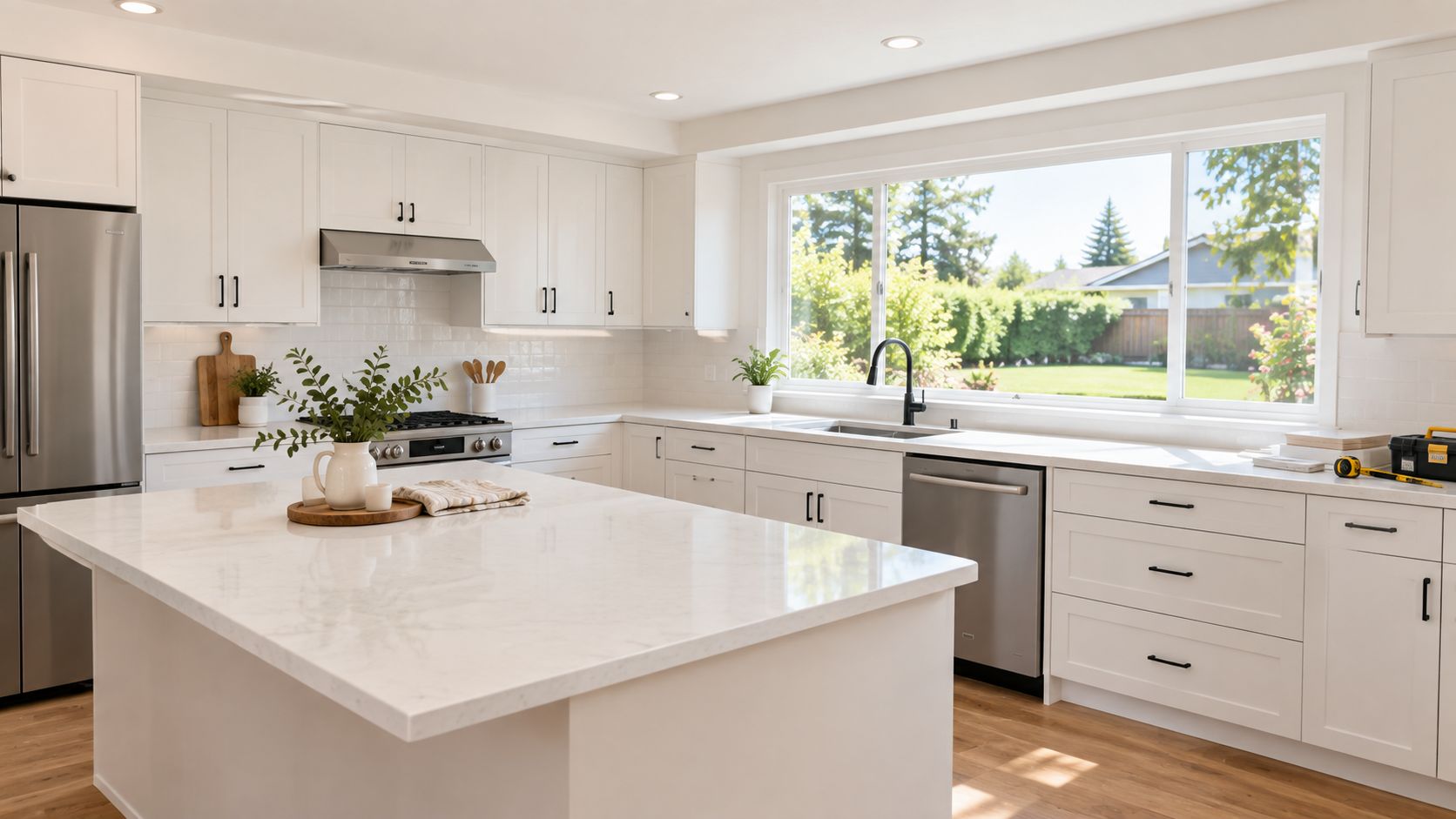
In Maple Ridge and Pitt Meadows, most homeowners asking about renovation financing options are trying to solve one simple problem. They want to improve the house without wiping out savings or paying too much interest for the wrong kind of borrowing.
That usually starts with a realistic look at the house itself. A cosmetic kitchen refresh in a rancher is one thing. New windows, electrical work, accessibility changes, or a suite conversion are another. The bigger and slower the project gets, the more the financing decision starts to depend on post-renovation value, not just current cash flow.
The main choices on the table
Most local renovation financing options fall into these groups:
- Cash and savings: Best for smaller work when the owner wants no debt, but it can leave too little reserve for surprises.
- Personal loans and unsecured lines of credit: Useful when there isn't enough equity available, or the owner doesn't want the house tied to the borrowing.
- Contractor financing and credit cards: Fine for short-term convenience. Dangerous if the promotional terms expire before the balance is gone.
- HELOCs and home equity loans: Better suited to larger projects once there's enough equity to work with.
- Cash-out refinance: Worth considering when the existing mortgage is already due for a reset.
- Program-based financing: The federal Greener Homes loan and suite-related borrowing have changed the market because they tie financing to specific renovation goals.
- BC rebates and tax credits: These can reduce the borrowing need before a lender is even part of the plan.
CMHC's consumer guidance also makes an important point that fits BC especially well. Renovation financing here often sits beside grants and rebates rather than replacing them, and governments and utilities may offer support for eligible energy-saving work. Nationally, CMHC's funding pages say the Affordable Housing Fund has repaired more than 174,500 units and supported construction of 60,000+ affordable homes across Canada. That doesn't mean every homeowner gets access to that funding, but it shows how renovation and housing finance are tied to public programs in Canada (CMHC funding programs)
For local owners, rebate stacking matters. BC says the BC Rebate for Accessible Home Adaptations can provide up to $20,000 per household, and the Seniors' Home Renovation Tax Credit offers 10% of qualifying expenses up to $1,000. That can materially change the net cost of a project before the borrowing decision is made.
Neighbourhood reality: The financing should match the scope. A quick kitchen facelift doesn't need the same structure as a suite conversion or a deep energy retrofit.
Before anyone borrows against a property, it helps to know what the home is worth in today's market. A current Maple Ridge home evaluation gives a better starting point for the equity math than an old purchase price or guess from a neighbour.
For owners trying to keep a renovation site organised, temporary off-site storage can also make staged work easier. A practical read on that side of the process is this piece on solutions for home renovation.
How to Decide Which Renovation Financing Option Fits

The cleanest way to sort through renovation financing options is to run every choice through three lenses. Not five. Not ten. Three.
Start with project cost
Small projects and large projects don't belong in the same financing bucket. If the work is limited and the scope is stable, unsecured borrowing or savings often makes more sense. If the project is broad, structural, or tied to a suite, owners usually need an equity-based plan.
The mistake is borrowing long-term for short-term work just because the monthly payment looks smaller. That can turn a manageable renovation into expensive debt that drags on.
Then look at project length
Timeline matters almost as much as price. A quick flooring, paint, vanity, and fixture job can usually be funded with cash, a personal loan, or a short revolving credit option. A phased renovation that unfolds around permits, inspections, and contractor availability needs more flexibility.
CMHC says line-of-credit structures are better suited to ongoing or long-term projects because funds can be re-borrowed without reapplying, and FCAC data show 40% of home-equity credit balances are associated with consumption and home renovation uses (CMHC home renovation financing options).
The third lens is the one that matters most locally
Post-renovation value is where Maple Ridge and Pitt Meadows owners either make a smart borrowing decision or overbuild the house for the block.
A renovation that improves energy performance, adds accessibility, or creates a legal secondary unit can change the financing math because it may qualify for rebates, improve appraisal support, or create income potential. A purely cosmetic project may still be worth doing, but it shouldn't be financed the same way as a value-creating one.
Borrow against the value the renovation is likely to support, not against the excitement of the idea.
A practical checklist before applying
A homeowner should be able to answer these before signing anything:
- Mortgage balance: What's still owed today?
- Available equity: How much borrowing room exists at current value?
- Debt service: Can the payment still work if rates or costs move the wrong way?
- Credit profile: Will the owner qualify for unsecured credit, secured credit, or both?
- Permit trigger: Will the City require permits, inspections, or phased approvals?
- Rebate eligibility: Is the work accessibility-related, energy-related, or suite-related?
The same three lenses can rank the options differently for different households. A downsizer with strong savings may avoid debt entirely. A young family with equity but tight monthly cash flow may prefer staged access through secured borrowing. A buyer considering a fixer-upper should also understand renovation scope before closing, which is why this guide on what to know when buying or renovating a home is worth reading early.
Cash, Personal Loans and Credit for Smaller Projects
The first tier of renovation financing options is usually the least complicated and the most misused. These are the tools for smaller jobs, fast repairs, or projects that don't justify putting the house up as collateral.
Savings belongs at the top of the list. It's simple, clean, and interest-free. It also becomes a bad idea if it leaves no cushion for the next furnace, roof leak, or plumbing surprise. Older homes in Maple Ridge and Pitt Meadows have a habit of revealing one more issue after the drywall opens up.
When cash is smart and when it isn't
CMHC's 2026 consumer findings showed 59% of future renovators planned to use savings, and 66% of consumers were aware that renovation costs can be financed (CMHC consumer survey PDF). That says two things. First, many owners still prefer cash. Second, a meaningful group still doesn't have a clear picture of the available borrowing routes.
Cash is strongest when the work is straightforward and the owner can pay without draining reserves. It's weak when the renovation is only the first phase of a bigger plan.
Entry-Tier Renovation Financing Compared
| Option | Typical Rate | Term | Best For | Key Trade-Off |
|---|---|---|---|---|
| Savings | No borrowing cost | No term | Small projects and urgent repairs | Uses liquidity and can empty reserves |
| Personal loan | Qualitatively higher than secured borrowing | Usually fixed repayment period | Defined budget with fixed payments | Less flexibility if costs change |
| Personal line of credit | Qualitatively variable | Revolving | Smaller phased work | Rate can move and discipline matters |
| Contractor financing | Promotional structure varies | Short promotional or instalment periods | Convenience at point of sale | Terms can become expensive after promo period |
| Credit card | Usually highest-cost option | Revolving | Very short-term purchases only | Costly if balance isn't cleared quickly |
Personal loans work best when the homeowner wants predictable payments and doesn't want to touch home equity. They suit projects with a clear budget and a short completion window. Personal lines of credit are looser. That flexibility helps if invoices come in phases, but it also invites overspending.
Contractor financing needs more scrutiny than most borrowers give it. The sales pitch often sounds easier than the contract reads. If the deal depends on paying the full balance inside a promotional window, the owner should plan as if that window will be missed unless the cash is already set aside.
Practical rule: If the renovation can't be fully paid off inside the promotional period without strain, contractor financing is usually the wrong tool.
Credit cards are last-resort financing for renovations. They're useful for deposits, small fixtures, or a short bridge between invoice and reimbursement. They're poor financing for cabinetry, windows, or a bathroom job that drifts beyond the original budget.
For homeowners trying to estimate whether a lower-cost finishing project is worth funding at all, a local example like basement completion cost can help frame the likely scope before credit is used.
Some borrowers also need a broader view of unsecured borrowing when their credit file isn't clean. A general primer on personal loans for bad credit can help clarify what to watch for before signing an unsecured loan agreement.
HELOC, Home Equity Loans and Cash-Out Refinance
Once the renovation gets bigger, unsecured debt usually stops making sense. Most Maple Ridge homeowners compare a HELOC, a home equity loan, and a cash-out refinance.
First, calculate the borrowing room correctly
Canada's standard home-equity borrowing mechanics commonly cap a HELOC at 80% of a home's appraised value minus the outstanding mortgage balance (FCAC home equity borrowing guide). That formula is the starting point. Not the contractor quote. Not a rough estimate from an online calculator.
If a home appraises well and the mortgage balance is manageable, that creates room. If the mortgage is already high relative to value, the options narrow quickly.
Equity Borrowing Options at a Glance
| Feature | HELOC | Home Equity Loan | Cash-Out Refinance |
|---|---|---|---|
| Structure | Revolving credit line | Lump-sum loan | Replaces existing mortgage with a larger one |
| Best use | Phased or unpredictable projects | One large defined invoice | Major renovation when mortgage terms already need review |
| Payment style | Usually interest on drawn balance | Fixed repayment | Mortgage-style blended payment |
| Flexibility | Highest | Moderate | Lowest after funding |
| Main caution | Variable borrowing cost and easy overspending | Less adaptable if scope changes | Can replace favourable existing mortgage debt |
A HELOC is usually the most practical tool for staged work. Kitchen renovations rarely run in a straight line. Neither do additions, major exterior jobs, or anything tied to permit stages. A HELOC lets the owner draw only what's needed when it's needed. That's its biggest strength.
A home equity loan fits a different profile. When the budget is known, the contractor schedule is set, and one large payment needs to be funded, a fixed lump sum can be cleaner. The payment is predictable, and some borrowers prefer that discipline.
When a refinance deserves a hard look
Cash-out refinance isn't automatically cheaper. It only works well when the owner was likely going to revisit the mortgage anyway, or when rolling renovation costs into longer amortized debt materially improves monthly affordability.
The risk is obvious. A homeowner can end up converting older mortgage debt into newer debt on less favourable terms. That's why the financing should be tested against both payment and purpose, not just approval.
One other factor deserves attention for owners planning to be mortgage-free sooner rather than later. A broader household-finance perspective, including how renovation borrowing can slow that path, is discussed in this pay off mortgage 2026 guide.
For local owners, the strongest reason to use equity borrowing is not that it feels bigger or more official. It's that it can align better with renovations that support value. That matters much more in Maple Ridge and Pitt Meadows than generic borrowing advice from outside the region tends to admit.
Renovation Mortgages and BC Rebate Programs

This is the part of the market that has changed the most. Renovation financing options in BC no longer sit neatly in a bank-only box. The homeowner now has to think in layers. Rebates first, program rules second, borrowing third.
Energy-efficiency financing changed the benchmark
The federal Canada Greener Homes Loan offered interest-free financing from $5,000 to $40,000, repayable over 10 years, for eligible energy-efficiency retrofits, and it was structured as an unsecured personal loan on approved credit (Natural Resources Canada Greener Homes Loan). That became a benchmark because it showed how large zero-interest renovation borrowing could be in Canada.
CMHC later noted that the program was designed for major energy-efficiency retrofits and that loan applications closed, with October 1, 2025 noted as the last day to apply (CMHC Greener Homes update). That matters because some homeowners still plan around programs that are no longer open.
Accessibility and suite-related renovations need their own strategy
In BC, accessibility work deserves its own financing review. The province says the BC Rebate for Accessible Home Adaptations can provide up to $20,000, and CMHC's 2025 survey found 21% of future renovators planned to use government incentives or rebates (BC housing financial incentives). That's a strong sign that many households still leave targeted money on the table.
For secondary suites, the post-renovation value angle is even stronger. The federal government's secondary-suite policy allows insured-mortgage refinancing up to 90% of post-renovation value, capped at $2 million, with amortization up to 30 years, and the Canada Secondary Suite Loan Program offers up to $80,000 at 2% over 15 years for adding a secondary unit (Department of Finance secondary-suite announcement).
That can completely reshape the viability of a basement suite or multi-generational conversion in Maple Ridge. It can also reduce the need for expensive unsecured borrowing if the project qualifies.
There's also a timing catch. Public and bank guidance in 2025 to 2026 continued to cite the $40,000 Greener Homes benchmark, but BC's pilot under the Canada Secondary Suite Loan Program stopped accepting applications after March 30, 2025. Program windows matter. Missing one can push a borrower from subsidized financing into regular private credit.
The right order is simple. Use rebates and tax credits to shrink the net project cost first. Then finance what's left with the structure that matches the renovation.
For owners looking at retrofit-related housing improvements and policy shifts, Brookside also has a useful local read on the BC retrofit accelerator response.
Budgeting, ROI and Resale Value in Maple Ridge
Borrowing for renovations only makes sense when the project supports the property's actual ceiling. That's where a lot of good intentions go sideways.
A home in Maple Ridge or Pitt Meadows does not become infinitely more valuable because the owner spends heavily on finishes. Buyers still compare it to the street, the subdivision, the lot, and the alternatives available at the time of resale.
Typical Renovation ROI in Maple Ridge & Pitt Meadows
| Renovation Type | Typical Spend Range | Resale Cost Recovery | Added Value Notes |
|---|---|---|---|
| Kitchen refresh | Qualitatively moderate | Qualitatively strong | Often improves buyer appeal quickly if the layout already works |
| Bathroom update | Qualitatively moderate | Qualitatively solid | Best when the existing bath is clearly dated or poorly functioning |
| Legal secondary suite | Qualitatively higher | Qualitatively strongest | Can add income potential and improve financing logic if zoning and permits align |
| Energy-efficiency upgrades | Varies widely | Qualitatively mixed to strong | Value depends on buyer demand, utility savings, and available rebate support |
| Finished basement | Qualitatively moderate to high | Qualitatively moderate | Better when it adds useful living area without over-improving the home |
Since verified local ROI percentages aren't available here, the safer approach is to treat resale as project-specific, not automatic. A tasteful kitchen refresh in an older home may be easier to defend than a high-end overhaul that pushes the property past what nearby buyers usually pay for that housing type.
The budget should include a contingency
Every serious renovation budget needs room for change orders, permit conditions, hidden repairs, or product substitutions. If there's no contingency, the financing plan is incomplete.
A common mistake is financing the quote and ignoring everything around it. Appliances, permit revisions, flooring transitions, temporary storage, disposal, and code-driven fixes all count. So does the possibility that the owner will want to upgrade one more item once the job starts.
A renovation should be tested against resale reality before the contract is signed, not after the invoices arrive.
For suite-focused projects, the value equation changes again. A legal secondary unit can support the home in two ways. It may improve the property's marketability, and it may help the owner's carrying costs if rental income is part of the long-term plan. That doesn't remove risk, and it isn't legal advice, but it does make suite renovations different from vanity upgrades.
Applying for Renovation Financing in BC and Next Steps

The application process goes better when the homeowner treats it like a file to be built, not a quick form to be filled out.
What to gather before talking to a lender
Start with the practical documents:
- Contractor pricing: Three detailed quotes are better than one vague estimate.
- Property records: Current title, recent mortgage statement, and a reliable sense of present value.
- Income paperwork: Pay stubs, T4s, and recent CRA notices of assessment.
- Project details: Scope of work, timing, and whether the renovations will be staged.
- Permit status: Confirmation of whether the work requires municipal approvals.
Underwriters usually want to see whether the borrower can handle the debt, whether the property supports the request, and whether the renovation scope is credible. A half-formed plan weakens the application even when the borrower is financially strong.
Where local owners usually get delayed
Permits can slow things down. So can appraisals. So can a contractor quote that doesn't match the actual intended work.
That matters more in a suite conversion or a value-based equity application, because the lender may care about both current condition and completed condition. When post-renovation value is part of the logic, the paperwork has to be tighter.
A homeowner financing a renovation should also sort out mortgage readiness early. This guide on what mortgage pre-approval means is helpful because many of the same underwriting habits carry over into refinance and renovation lending.
One more practical note. Royal LePage Brookside Realty can be one useful local option for owners who need a grounded view of current property value, likely buyer response to upgrades, and whether a renovation supports a later sale, hold, or suite strategy. That part should be settled before the financing product is chosen, not after.
A clear next-step checklist
- Get the scope in writing. No vague wish list.
- Confirm whether permits apply. Especially for structural, electrical, accessibility, or suite work.
- Check rebate eligibility early. Program windows and categories matter.
- Run the equity math. Don't assume the house can support the borrowing.
- Keep a reserve. Financing the full visible budget is rarely enough.
Homeowners in Maple Ridge and Pitt Meadows often need two answers before renovating. What will the work do to the property's value, and what financing structure fits that plan. Royal LePage Brookside Realty helps owners sort through that local value question before they overborrow, underspend, or renovate past what the home can realistically support.