
Scrolling Panorama Ridge listings on a Tuesday night usually starts the same way. A buyer sees two homes that look close on paper, then notices one asking several hundred thousand dollars more, and the question becomes simple, what's different here?
In Panorama Ridge homes for sale, the answer is rarely just square footage. It's the mix of hillside terrain, lot quality, view potential, property type, permit history, and how much work the next owner is willing to take on before living comfortably in the home.
That's why this neighbourhood needs a sharper lens than a broad Fraser Valley search. A generic market overview won't tell a buyer why one detached house feels fairly priced while another, with a similar footprint, sits in a different bracket entirely. It also won't show why the right listing photos matter so much here, or why a clean presentation can change perception fast, especially when a buyer is trying to understand how virtual staging works on a home that already has strong bones.
What Buyers Are Really Looking At in Panorama Ridge
A serious Panorama Ridge buyer is usually not hunting for the cheapest listing. They're trying to decide whether the premium makes sense for the lot, the setting, and the long-term resale story. That's a very different decision from shopping a flat, cookie-cutter suburb where the homes feel interchangeable.
The search usually starts with price, then shifts to context
A listing portal can make two houses seem similar until the details start to separate them. One may be a detached home with a stronger site position, another a townhome with simpler upkeep, and another a condo that trades land and privacy for a lower entry point. The question is what the buyer values more, land, convenience, or simplicity.
That's why a local guide matters. A broader buyers' guide such as types of homes in Maple Ridge helps frame property categories in a general sense, but Panorama Ridge asks a different set of questions because the neighbourhood is built around hillside conditions and premium detached inventory.
Practical rule: in Panorama Ridge, the price tag only becomes useful after the lot, the slope, and the site history are understood.
Who tends to be drawn here
Panorama Ridge tends to appeal to move-up buyers, families wanting more space, and purchasers who care about privacy and outlooks. Some are comfortable stretching for a home with a better view corridor. Others want a property that feels set apart from denser suburban stock, even if that means accepting a little more due diligence before they remove conditions.
There's also a presentation issue that buyers sometimes underestimate. A well-photographed listing can look polished, but the structure still has to withstand a real inspection and a real site review. For sellers, that means the best-looking marketing still needs to be backed by documentation and a property story that makes sense on the ground.
Reading the Current Panorama Ridge Market
A buyer touring Panorama Ridge feels the split right away. One listing may sit on a stronger hillside site with a cleaner outlook, while another asks you to weigh slope, access, and possible maintenance costs before you ever think about finishes. That matters here because the neighbourhood is a Surrey hillside pocket, and premium pricing only makes sense once the site is understood.
The current inventory picture shows a tight and segmented market at the upper end of Surrey. That combination points to a neighbourhood where asking prices and absorbed-sale behaviour are not the same thing.
Why different dashboards tell different stories
Both sources are measuring different market slices, which explains the pace gap.
The same kind of spread shows up in broader live-area snapshots. That range is a warning sign for buyers. In Panorama Ridge, the mix of higher-end homes, larger lots, and different site conditions can move averages around fast, so a headline number rarely tells the full story. A current Metro Vancouver housing market trends update helps put that kind of variation in context.
The estate segment behaves differently
A separate MLS summary cites 102 listings, an average list price of $4,199,400, an average property tax of $6,855, an average square footage of 3,758, and an average days-on-market figure of 84. That is a different pool than a family detached home or a townhouse search. It is an estate-style segment with its own buyer pool, its own patience level, and a much narrower comparison set.
The smartest buyers stop asking, “What's the average price in Panorama Ridge?” and start asking, “What's the right comp set for this specific home?”
| Snapshot | Listings | Avg Price | Days on Market | Price per Sq Ft |
|---|---|---|---|---|
| MLS trend snapshot | 157 homes | $1,653,333 sale price | 6 | Not stated |
| Listing-based snapshot | 119 active listings | $1,549,999 | 69 | $489.42 |
| Live-area snapshot | Not stated | $1,599,000 | 66 | $489.42 |
| Live-area snapshot | Not stated | $1,548,800 | 62 | $503.11 |
| Estate-style MLS summary | 102 listings | $4,199,400 | 84 | Not stated |
Detached Homes, Townhomes, and Condos in Panorama Ridge
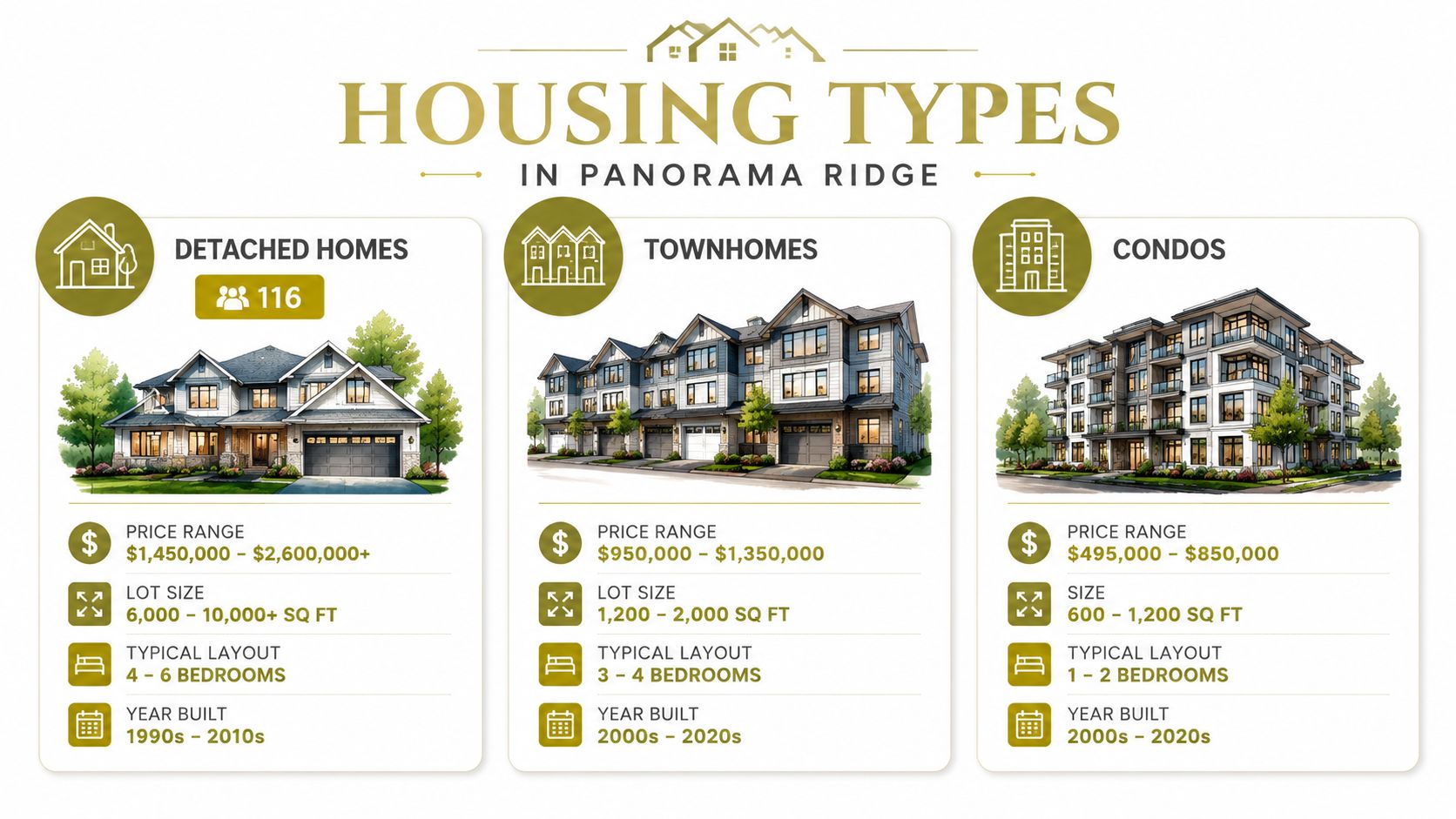
Detached homes dominate Panorama Ridge, and that matters because the neighbourhood's identity is built around land, slope, and outlook. The inventory mix is not balanced evenly across housing types, and buyers feel that imbalance quickly once they start comparing options. A home on a substantial lot behaves differently in the market than a townhome or condo.
Detached homes set the tone
There are 116 detached houses in the current snapshot, and the estate-tier part of the market shows an average square footage of 3,758 with an average list price of $4,199,400 from Strawhomes. Detached homes are where buyers will see the biggest spread in lot quality, view orientation, and upkeep. Some are straightforward family properties. Others sit much higher on the value curve because the site itself does more of the heavy lifting.
That's why detached buyers need to read the land as carefully as the floor plan. A well-kept house on a better site can outperform a larger house with awkward access or weaker exposure. The market in this pocket rewards judgement, not just size.
Townhomes and condos fill a different role
Townhomes count 32 listings in the cited snapshot, with an average value around $986,000 in the supplied data, while the 2 condos average about $660,000. A useful comparison for townhome shoppers is this Maple Ridge townhome guide, which shows how strata living changes the ownership experience even before local land values come into play.
Townhomes usually suit buyers who want less maintenance and fewer site-specific concerns than a detached home brings. Condos, though rare here, appeal to buyers who want the simplest entry into the neighbourhood and are prepared to trade away land and independence. In Panorama Ridge, both options are limited enough that many buyers eventually pivot back to detached properties because that's where the neighbourhood's character really lives.
Due Diligence on a Hillside Lot
Panorama Ridge is explicitly described as a hillside residential area, and local listings show a meaningful mix of detached homes on substantial lots. That makes site-specific diligence more important here than in flatter suburban markets, as noted in Frive's neighbourhood profile. The obvious features, the view, the deck, the size of the lot, can hide the most expensive questions.
The checks that need to happen before conditions come off
A buyer looking at a sloped or view lot should confirm zoning and overlays, ask for a geotechnical review before any addition or new build, and verify whether the property uses sewer or septic. Permit history also matters. Decks, retaining walls, and other exterior alterations can leave a paper trail that tells a buyer whether the work was properly approved.
Oil-tank clearance is another practical step. So is asking the insurer directly about slope-related exclusions before assuming the property will be covered on normal terms. These steps separate a clean closing from a costly surprise later.
If the lot is doing the job of creating value, the buyer has to know exactly what that lot demands in return.
A useful design-oriented reference for how layered outdoor structures can be handled in a sloped setting is Guelph Deck Builders ideas for 2026. The point is not to copy styles from another market. It is to recognise that multi-level outdoor living can look elegant while still requiring serious structural thought, especially on terrain that is not flat.
For a cautionary local perspective on why documentation matters, the internal guide on real estate agent penalized 66k for undisclosed archaeological site is worth a look. The lesson is simple, disclosures and site history are not optional reading when land carries hidden constraints.
What a buyer should ask for
- Zoning confirmation: Check whether the intended use matches the property's current designation and any overlays.
- Engineering records: Ask for geotechnical reports if there is any slope sensitivity or future building interest.
- Utility proof: Confirm sewer or septic status before assuming the service setup is standard.
- Permit file review: Look closely at decks, retaining walls, additions, and any prior work done without obvious paperwork.
- Insurance clarity: Ask the insurer how slope, drainage, and access affect coverage.
- Tank and site history: Verify that older environmental concerns have been cleared properly.
Schools, Parks, and the Daily Commute
Panorama Ridge feels quieter than many buyers expect from a Surrey neighbourhood this close to major routes. That's part of the appeal. It tends to attract people who want a calmer residential rhythm, bigger lots, and a stronger sense of separation from busier pockets of the city.
How the weekdays usually feel
Mornings here are often built around driving rather than walking. School drop-offs, errands, and commuting usually shape the day more than neighbourhood foot traffic does, and buyers who work toward Langley, Burnaby, or Vancouver usually look closely at access through Highway 10 and the South Fraser Perimeter Road. The trade-off is easy to understand. Quieter streets and more space often come with longer drive times and fewer walkable amenities than denser Surrey neighbourhoods.
Parks and green space help balance that out, especially for families who want outdoor time without giving up residential calm. Panorama Ridge's setting gives residents a more open feel than tightly packed urban areas, and that influences both lifestyle and resale appeal.
What Saturdays tend to look like
Weekends in Panorama Ridge are usually less about stepping out the front door into a retail strip and more about planning the day around a drive. Buyers who want a café-heavy, walk-to-everything lifestyle often feel the difference immediately. Buyers who want privacy, yard space, and a more relaxed pace usually see the same pattern as a benefit.
The neighbourhood suits people who can live with a little more coordination in exchange for a better sense of room. That's not a compromise for everyone, but for the right household it's exactly the point.
The daily-life question is not whether the area is convenient in a generic sense. It's whether the commute, the errands, and the school routine match the way the household already lives.
Pricing Strategy and How to Make a Competitive Offer
A solid offer in Panorama Ridge starts with the right comp set, not the broad neighbourhood average. The same hillside pocket can contain detached homes, strata product, and estate-style properties that behave very differently on price and timing. A buyer who ignores that reality can overpay without realising it.
Benchmark the home, not the headline number
The cleanest way to price a specific home is to compare it with nearby sold and active listings that match on lot size, age, and condition. That principle is the same one used in a proper comparative market analysis, and a practical overview of that process appears in AgentPulse's guide to pricing a home for sale. In Panorama Ridge, this matters even more because the listing mix can distort averages quickly.
The key is to avoid forcing a detached hillside house into the same pricing box as a townhome or a smaller-lot property. That mistake is common, and it leads to weak offers or missed opportunities.
Timing matters more in a fast-moving segment
When one market snapshot shows 6 days on market and another shows 69 days on market, buyers need to think carefully about timing, financing, and conditions. A well-prepared buyer doesn't wait until the last minute to sort out pre-approval. The internal guide on what mortgage pre-approval means is a useful reminder that the financing conversation should happen before a favourite listing creates urgency.
A strong offer in this neighbourhood usually balances three things:
- Pricing discipline based on real comp evidence, not the headline average.
- Inspection strategy that respects the hillside due-diligence workload.
- Condition timing that matches the pace of the specific property type.
Subject-to-sale offers can still be relevant on the right property, especially at the upper end, but they need to be judged carefully against the seller's options. Escalation clauses can also play a role, though they work best when the buyer already knows the ceiling they're comfortable with. The disciplined approach wins more often than the aggressive one.
Your Next Step in Panorama Ridge
A buyer or seller in Panorama Ridge gets better results by moving in order. First, narrow the property type, detached, townhome, or condo. Second, run the hillside due-diligence checklist against the actual lot. Third, have a valuation conversation that uses the right local comparables instead of a loose neighbourhood average.
That sequence keeps emotions from outrunning the facts. It also makes the next showing more productive, because the buyer already knows what to inspect and the seller already knows what will need to be disclosed or documented.
For people working across the Fraser Valley, including Maple Ridge and Pitt Meadows, a conversation with a Royal LePage Brookside Realty advisor can turn this market data into a short, practical shortlist and an offer plan that fits the home in front of them.
Royal LePage Brookside Realty Property Management helps owners handle the day-to-day side of ownership, which can matter when a Panorama Ridge purchase is being evaluated as a residence or as an investment. For buyers and sellers who want a grounded local conversation about pricing, site-specific concerns, or property management options, visit Royal LePage Brookside Realty Property Management and connect with a team that works through the details with care.