A Maple Ridge landlord can buy a well-located house, choose a reliable tenant, and still lose money through ordinary operational mistakes. A delayed repair in Silver Valley, an underpriced renewal in Albion, an empty suite during a slow leasing period, or incomplete documentation at the Residential Tenancy Branch can erode the return. Residential property management services exist to protect that return, not merely to collect rent.
The calculation has become more demanding across Maple Ridge and Pitt Meadows. British Columbia now limits annual in-place rent increases, vacancy has loosened across the region, and local rules affect property taxes, short-term rentals, inspections, and turnover procedures. Owners weighing self-management against professional help need to assess the whole operating burden, not just the monthly management fee.
The Maple Ridge Landlord Moment Most People Underestimate
A single detached rental in Cottonwood Park changes hands in March. The new owner pays $1.05 million and inherits a tenant paying $2,400 per month under a fixed-term lease signed in 2022. The owner expected the rent to reflect the purchase price, but the existing agreement controls the immediate income.
The first weekend brings three more surprises. A property tax notice arrives, the hot water tank starts failing, and a quiet provincial rent-freeze advisory follows a November update. The owner is suddenly balancing lease terms, emergency maintenance, tax obligations, and provincial tenancy rules without a clear operating system.
The decision looks simple until the details arrive:
- Maintenance: Should the owner answer the tenant, find a plumber, approve the repair, and monitor the work?
- Entry: Can the owner inspect the tank or coordinate access without making a mistake on notice requirements?
- Rent: Is the owner allowed to adjust the rent immediately, or does the fixed-term agreement restrict that choice?
- Documentation: Are the move-in condition report, invoices, notices, and communications organised well enough to withstand an RTB dispute?
A landlord who gives the wrong entry notice can create a dispute that costs far more than the repair itself. A landlord who waits too long to address a failing hot water tank can turn a manageable service call into damage, tenant frustration, and a longer vacancy later.
Practical rule: A rental property should be managed as an operating business, not as a spare house that produces rent.
The BC damage deposit rules are one example of the detail that matters. Deposit handling, inspection records, notice periods, and communication all need to line up. None of those tasks feels difficult in isolation. The risk appears when several arrive during the same weekend and the owner is away from Maple Ridge, working in Vancouver, or managing another property.
That's the point where residential property management services stop looking like a luxury. A capable manager protects response time, documentation, tenant relationships, and the owner's ability to make sound decisions before a small issue becomes a margin bleed.
What Residential Property Management Services Include
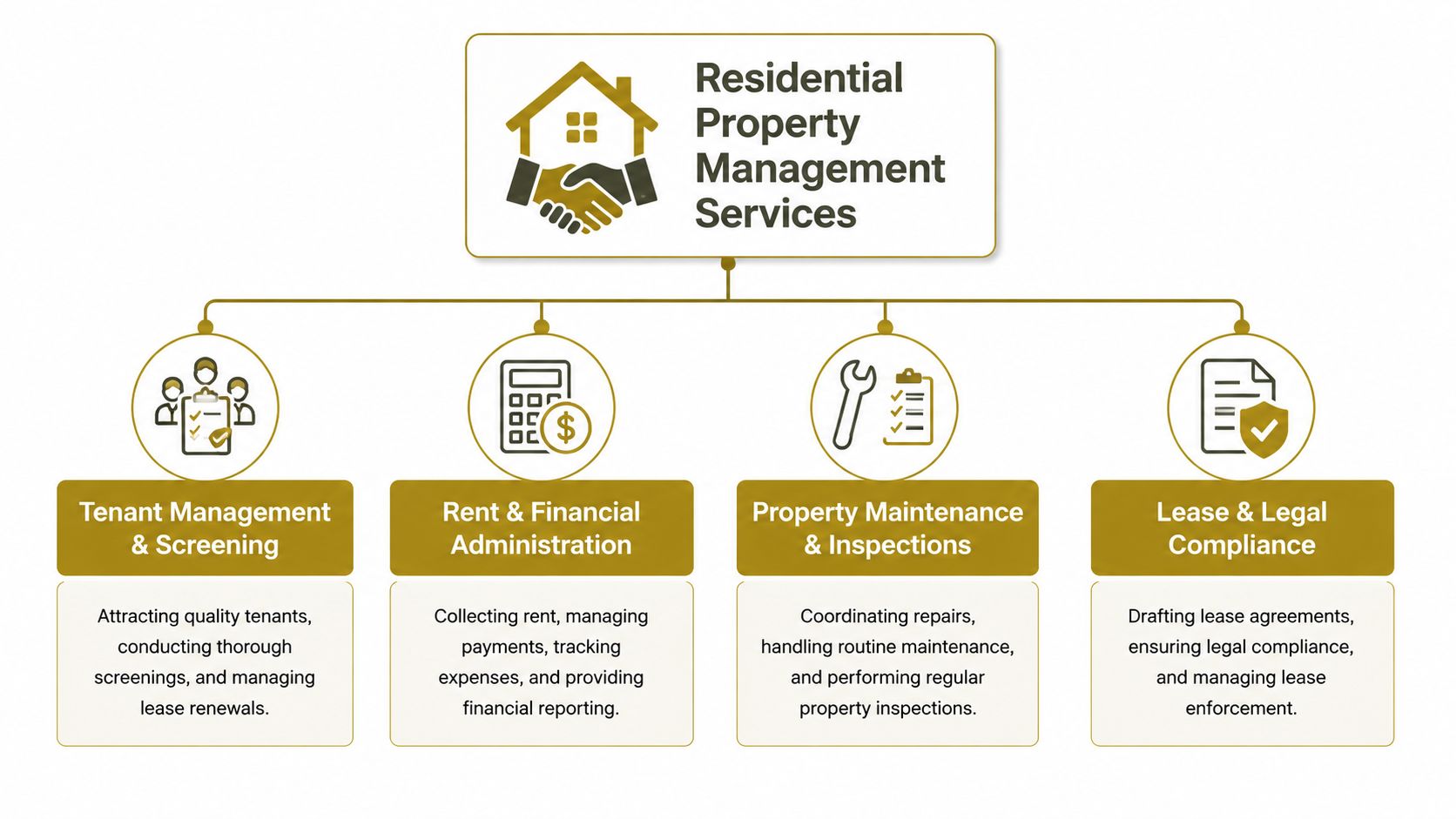
Residential property management services provide ongoing operational ownership on behalf of the landlord. A manager handles the recurring work that keeps a Maple Ridge rental occupied, maintained, compliant, and financially visible. That function protects revenue when tenant demand softens and small delays begin affecting vacancy, repairs, or cash flow.
Stronger tenant placement begins before the showing
A manager markets the property to the Lower Mainland renter pool, arranges viewings, screens applicants, checks credit and references, and prepares a tenancy agreement that follows the BC Residential Tenancy Act. The work continues through move-in. Condition details, keys, access arrangements, and communication expectations all need clear records from the start.
For a house near Kanaka Creek or a basement suite in West Maple Ridge, local positioning affects the applicant pool. The listing should explain parking, transit access, school catchments, parks, storage, and the practical differences between neighbourhoods. A generic listing may create activity while attracting tenants who are a poor fit for the property.
Maintenance coordination protects future revenue
Maintenance covers emergency response, vendor scheduling, access coordination, invoice review, and follow-up. A manager should maintain dependable contacts for plumbing, electrical, heating, appliances, landscaping, and general repairs.
Seasonal planning prevents avoidable interruptions. Gutter clearing in Thornhill, heat-pump servicing in Silver Valley, and moisture checks around older homes can reduce emergency calls and protect the asset. Owners planning larger updates can also review guidance on tenant improvements and maintenance before authorising work.
Financial records give the owner control
A professional service collects rent, tracks arrears, maintains appropriate trust-account processes, issues monthly owner statements, and organises year-end tax information. The owner should see income, expenses, outstanding work, and upcoming obligations without rebuilding records from email threads and bank transactions.
That visibility supports better decisions on repairs, pricing, and capital work, particularly as the BC rental market loosens.
Daily compliance work owners often miss
Legal compliance includes condition-report documentation, RTB dispute preparation, lawful notices, privacy-conscious recordkeeping, and local bylaw coordination. Maple Ridge owners also need to determine whether proposed short-term rental use is permitted, alongside understanding the tax and tenancy implications of that operating choice.
The Maple Ridge property manager responsibilities guide helps separate routine administration from duties requiring careful legal and operational handling. Good management builds the records and procedures before a dispute arises, giving the landlord evidence, response time, and clearer control over the property's income.
How Property Management Fees Work in the Fraser Valley
The cheapest management arrangement isn't automatically the best value. Fraser Valley landlords commonly encounter three fee structures, and each transfers a different portion of the work and risk back to the owner.
| Fee Model | Typical Rate | Landlord Still Pays For |
|---|---|---|
| Percentage of collected rent | 7% to 10% for single-family rentals | Repairs, leasing costs, major work, and sometimes inspections |
| Flat monthly fee | $150 to $300 for standalone houses | Leasing, maintenance, legal work, and other add-ons |
| À la carte or leasing-only | $300 to $700 for tenant placement | Ongoing rent collection, inspections, repairs, and compliance |
The figures above describe commonly encountered structures, not a universal tariff. A written agreement should define whether the fee applies to collected rent or scheduled rent, whether vacancy periods are charged, and whether lease renewals, inspections, advertising, and administrative work cost extra.
Self-management has a price even when no invoice arrives. An owner travelling from Port Haney to a downtown showing gives up time, fuel, and flexibility. A missed rent collection creates follow-up work. Conservative pricing can extend a vacancy, while a rushed listing can produce a poor tenant fit. A furnace failure on a long weekend may also lead to an after-hours vendor charge and a stressed tenant relationship.
Maple Ridge owners need to account for fixed costs that don't wait for rent growth. The City calculates municipal property tax by multiplying assessed taxable value by the applicable property-class rate, and the residential mill rate expresses tax payable per $1,000 of assessed value, as explained in the City's property tax overview. British Columbia's rent-increase ceiling further limits how quickly an owner can recover a poor operating decision.
The meaningful comparison isn't “What percentage does the manager charge?” It's “What does the owner keep after vacancy, repairs, errors, and lost time?”
Owners should request a complete fee schedule before comparing proposals. The Maple Ridge property management fee guide can help frame that conversation, but the management agreement remains the controlling document. A transparent provider will explain every pass-through cost and identify which decisions still require owner approval.
Maple Ridge Rules That Shape Day-to-Day Management
A Maple Ridge rental can look profitable until municipal taxes, short-term rental limits, and tenancy deadlines affect the monthly result. Local rules shape how owners forecast expenses, respond to tenant requests, assess alternative income, and maintain records.
For 2025, Maple Ridge's residential Class 1 municipal tax rate was $2.6648 per $1,000 of taxable value, with a recorded -0.13% residential tax-rate change, according to the City's 2025 property tax bylaw. The mill rate alone doesn't determine the annual tax bill. Owners should budget using the full assessed taxable value and the complete tax structure.
| Rule Area | Current 2025 Threshold | Day-to-Day Impact |
|---|---|---|
| Maple Ridge residential municipal tax | $2.6648 per $1,000 of taxable value | Budget from assessed value, not rent alone |
| Short-term rentals | Eligible residential forms, minimum lot of 371 m2, maximum 6 guests, one off-street parking space per listing | Confirm property and parking eligibility before advertising |
| Residential rent increases | 3.0% in 2025 | Serve compliant notices and follow in-tenancy limits |
| Provincial tenancy compliance | Requirements under the BC Residential Tenancy Act | Organise notices, reports, communications, and deadlines |
Short-term rentals require a local bylaw check
Maple Ridge's 2025 short-term rental rules cover specified property types, including a single-detached house, secondary suite, detached garden suite, duplex, triplex, or fourplex. The lot must measure at least 371 m2, each listing allows a maximum of 6 guests, and the listing requires one off-street parking space, under the City's short-term rental bylaw.
Owners should verify the property, zoning, parking, strata rules where applicable, insurance position, and registration requirements before treating short-term rental use as an income plan. A manager who checks those details first can prevent an owner from marketing a use the property cannot support.
Rent notices need a compliance calendar
British Columbia's residential rent-increase cap is 2.3% for 2026, down from 3.0% in 2025 and 3.5% in 2024, under the provincial rent-increase rules. The cap limits in-place increases, so managers must track dates and serve notices correctly. Revenue planning depends on lawful turnover pricing, tenant retention, and disciplined operating costs.
The BC Residential Tenancy Act overview gives owners a useful framework. Daily operations still need a calendar, consistent forms, organised records, and one person accountable for each deadline. Landlords should measure value not by management fee percentage but by what they retain after vacancy, repairs, errors, and lost time.
Why a Looser Rental Market Changes the Case for Hiring a Manager
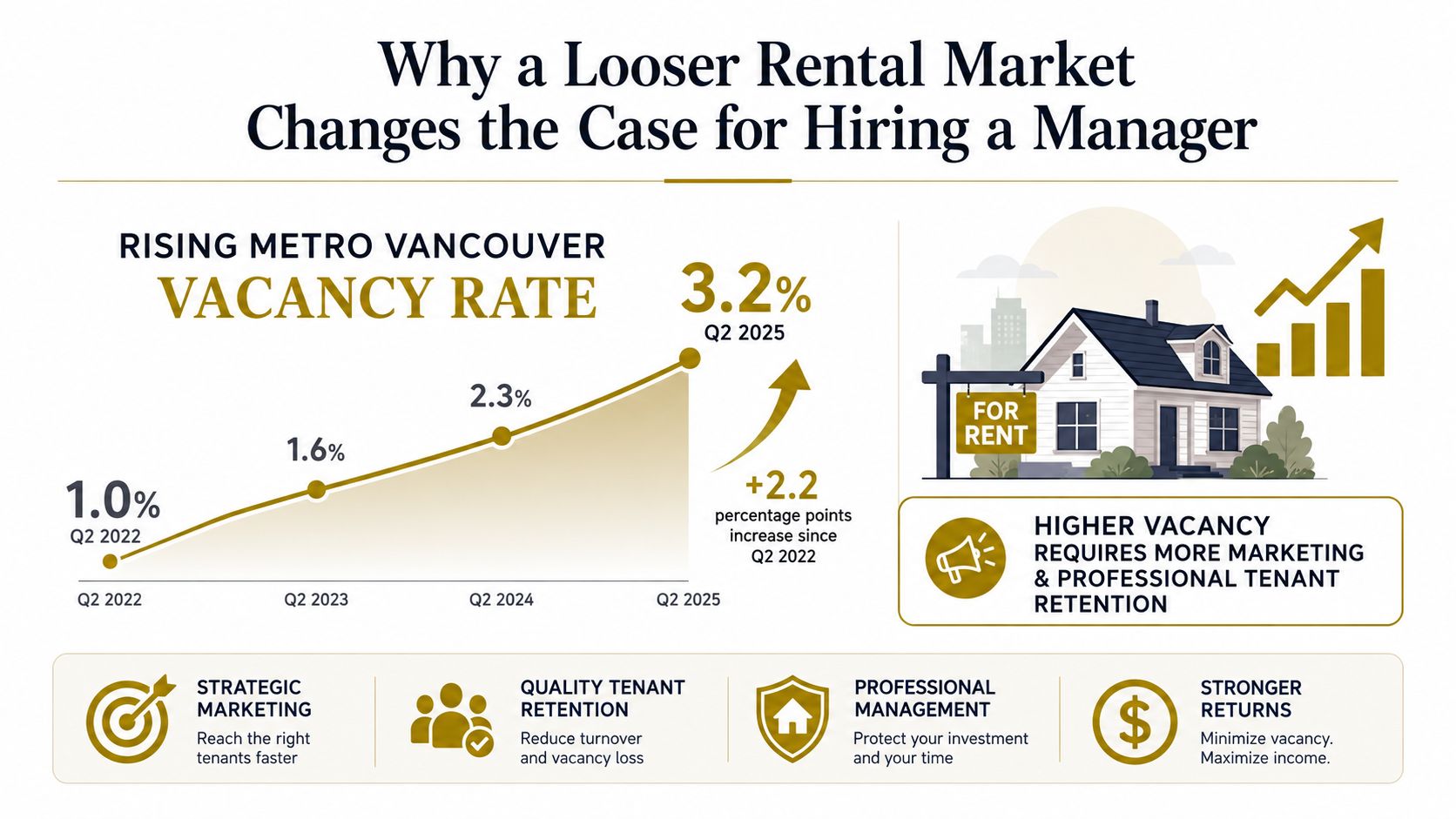
A Maple Ridge rental can sit longer when competing homes offer better photos, faster replies, or a more realistic asking rent. In a softer market, each vacant day reduces income while the owner still carries mortgage, utilities, and property costs.
CMHC reported that Canada's purpose-built rental vacancy rate rose to 3.1% in 2025 from 2.2% in 2024, while Metro Vancouver reached 3.7%, the highest level in over 30 years, according to CMHC's vacancy announcement. Industry reporting also placed Metro Vancouver purpose-built vacancy at 3.7% in late 2025, compared with 1.6% the year before, as cited in the verified market context from Statistics Canada.
The listing has to compete on more than price
A Maple Ridge rental near Alouette Lake, a family home in Albion, and a condo near Dewdney Trunk Road attract different renters. Position the property around its real advantages, including schools, parks, commuting routes, storage, parking, pet policies, and maintenance history.
Leasing speed can also vary by neighbourhood. A home in Hammond may attract a different pool, and move at a different pace, than a newer family property in Silver Valley. A manager who tracks local responses can adjust presentation, showing availability, and pricing before vacancy stretches.
Tenant screening matters more when lease-up takes longer. Apply consistent criteria, verify information, and choose a tenant who can sustain the tenancy and treat the property responsibly.
The video below adds another perspective on the operating demands managers face:
Retention becomes a revenue strategy
A good tenant who renews reduces advertising, showing, cleaning, and turnover coordination. Proactive maintenance helps preserve that relationship, especially when the owner cannot respond quickly to a heating problem, water leak, or appliance failure.
Professional oversight becomes more valuable when the property must compete for attention, the rent ceiling limits in-place growth, and small delays can lengthen vacancy. Lease-up execution and resident retention protect income more reliably than aggressive pricing. That is the revenue-protection case for hiring residential property management services in Maple Ridge.
Questions Worth Asking Before You Sign a Management Agreement
A management agreement should answer practical questions before the first tenant calls. Owners should interview the person who will manage the home, not just the salesperson who explains the package.
Test local operating knowledge
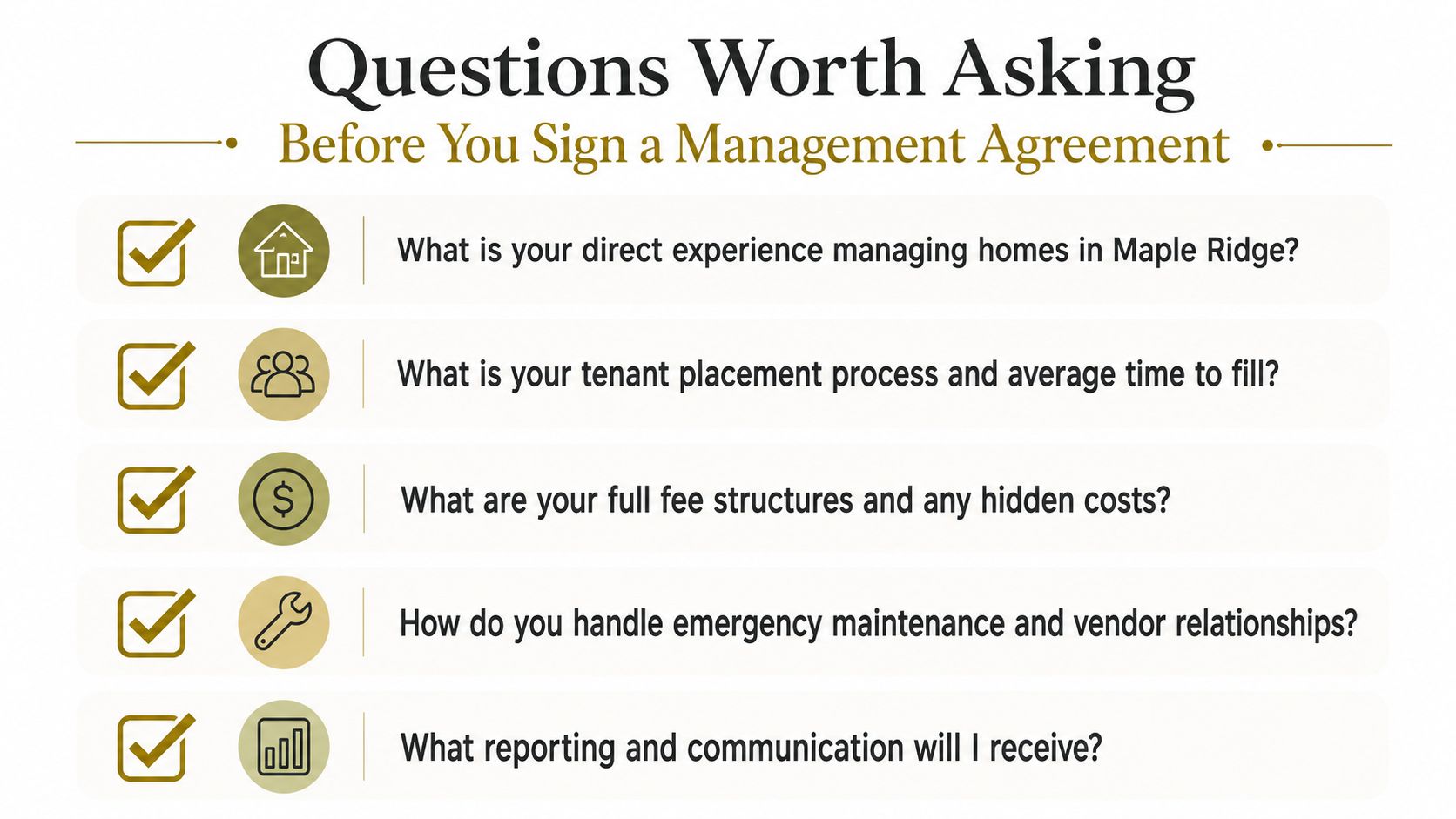
Ask whether the manager directly handles homes in Silver Valley, Albion, Cottonwood, Hammond, and other Maple Ridge neighbourhoods. Local knowledge should show up in practical answers, such as how the firm positions a family home near schools, manages a suite with separate access, or responds to winter maintenance concerns in a more rural pocket.
The manager should also explain vacancy marketing, showing procedures, applicant screening, and the information provided to owners. If the answer is only “the listing goes online,” the process is too thin.
Get the fee schedule in writing
Ask for every charge, including leasing, renewal, inspection, advertising, emergency coordination, project supervision, and owner-requested work. The agreement should state when fees are billed, how maintenance approvals work, and whether the owner can set a spending limit for routine repairs.
Owners should ask these questions directly:
- Tenant placement: Who conducts showings, screening, reference checks, and lease signing?
- Maintenance: Does the firm use in-house staff, contracted vendors, or both?
- Emergencies: Who answers a burst-pipe call in Hammond after regular business hours?
- Reporting: What appears on the monthly owner statement, and how are invoices stored?
- Disputes: Who prepares evidence and attends or supports an RTB hearing?
- Inspections: How are move-in, routine, and move-out conditions documented?
A manager who can't explain the dispute process before signing probably won't make the process feel simple after a notice is challenged.
Verify responsibility and licensing
Owners should confirm the firm's licensing position under the BC Real Estate Services Act, ask for references from current Maple Ridge clients, and identify the individual responsible for the portfolio. A manager should also explain how privacy, keys, tenant communications, contractor access, and records are controlled.
The best agreement is specific about authority. It says what the manager can approve, what requires owner consent, how urgent repairs are handled, and what happens when the owner is unreachable.
Choosing the Right Local Partner for Your Rental
Self-management can work for a nearby owner with one rental, stable tenants, low turnover, and enough time to answer calls during business hours. It becomes a poor fit when the owner lives outside Maple Ridge, owns several units, travels frequently, or dislikes dealing with contractors and tenancy documentation.
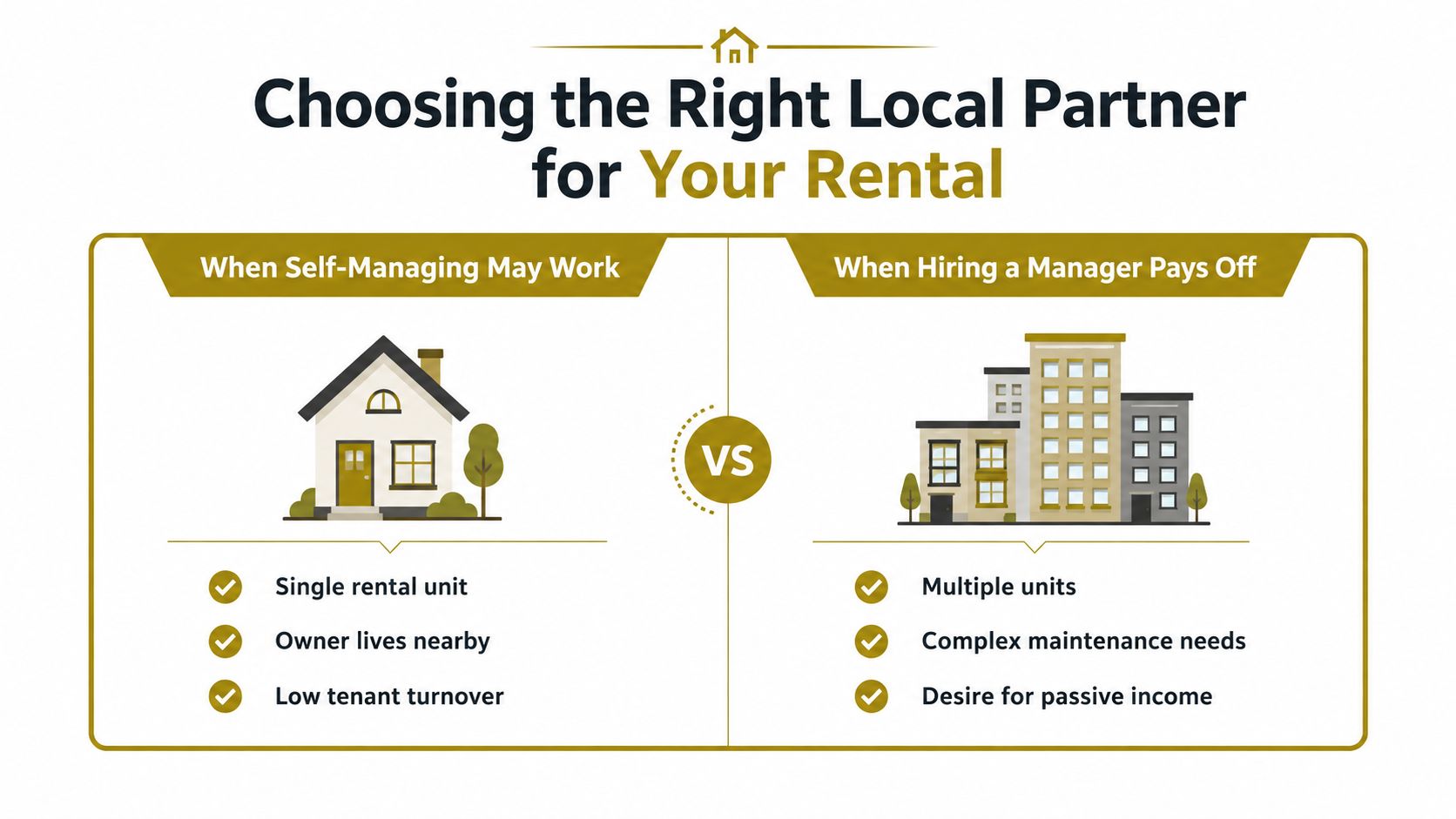
A practical decision can be made by scoring three areas:
- Availability: Can the owner respond promptly to tenant calls, showings, inspections, and emergencies?
- Compliance: Can the owner track notices, rent limits, condition reports, local bylaws, and RTB deadlines?
- Financial control: Can the owner price vacancies, review invoices, monitor arrears, and keep organised records?
If the answer is weak in two areas, hiring usually deserves serious consideration. A manager's value comes from consistent execution across leasing, maintenance, finance, and compliance, not from one impressive listing or a low headline fee.
The service should also match the property. A detached home in Cottonwood, a townhouse in Albion, a condo near central Maple Ridge, and a strata rental in Pitt Meadows each carry different access, maintenance, parking, and bylaw considerations. Owners should choose a partner with a clear process for the actual asset, not a generic package designed for every property type.
The Maple Ridge property management company guide can help owners prepare for those conversations. Royal LePage Brookside Realty Property Management provides tenant placement and screening, rent collection, inspections, maintenance coordination, owner reporting, and BC tenancy compliance for rental owners in Maple Ridge and nearby Fraser Valley communities.
Landlords weighing self-management can visit Royal LePage Brookside Realty Property Management for a local conversation about protecting rental income, handling compliance, and managing houses, suites, townhomes, condos, or strata properties in Maple Ridge and Pitt Meadows. The team can also help owners connect the rental decision with a future purchase, sale, or broader real estate plan.